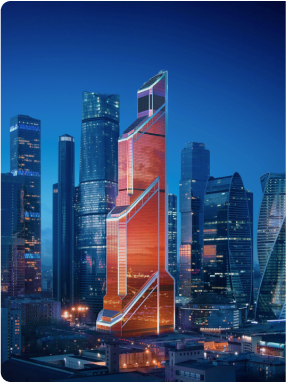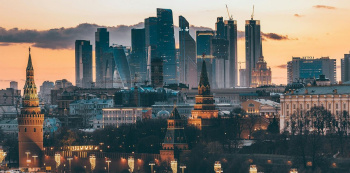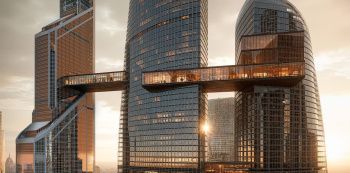




Moscow City has long ceased to be an experiment. Over two decades, it has evolved into a fully formed business cluster with its own logic, density, and growth limitations. However, its very success has raised a new question for the city: where and how will Moscow’s business core develop next?
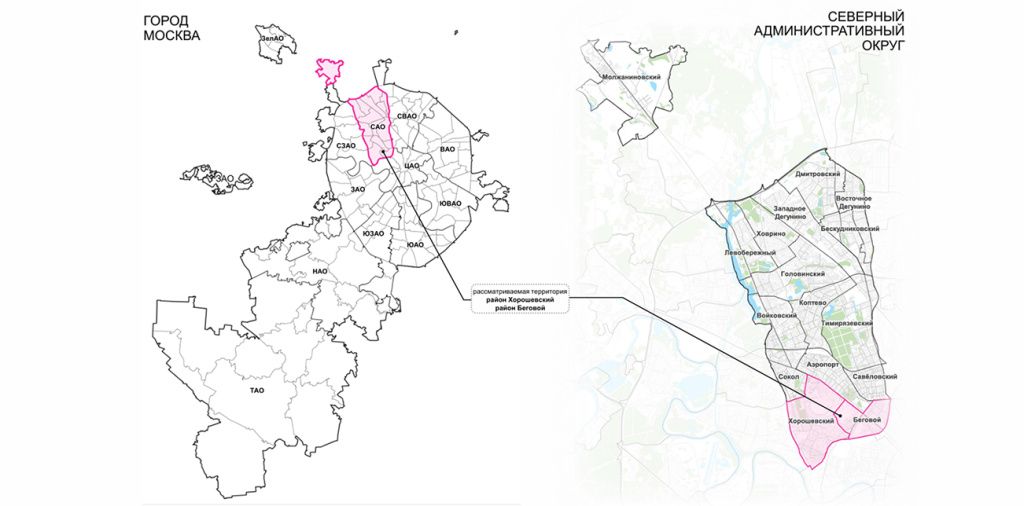
The answer to this question is increasingly described as “Greater City” — not a single district and not a brand, but a system of interconnected business and public territories distributed along key urban axes. One of the largest and most illustrative fragments of this system is now taking shape in north-west Moscow — in the area of Leningradsky Avenue, the Botkinsky Proezds, and the Dynamo sports and business hub.
The comprehensive territory development project (KRT), whose documentation has been thoroughly analysed (27 pages of urban planning, economic, and engineering materials), makes it possible to see how Greater City ceases to be a concept and becomes a real urban process.
From Moscow City to Greater City: the logic of business center expansion
Moscow City was originally designed as a compact business enclave. The high concentration of offices, housing, services, and transport hubs produced a strong effect, but at the same time created natural limitations:
-
overload of the road and street network;
-
rising prices and shortage of space;
-
difficulty of further densification without loss of environmental quality.
Under these conditions, the city shifted from the idea of a “single center” to a model of a distributed business belt. Greater City is not an alternative to Moscow City, but its continuation and reinforcement. Moscow City remains the core, while new territories take on part of the functions: office, public, educational, medical, and institutional.
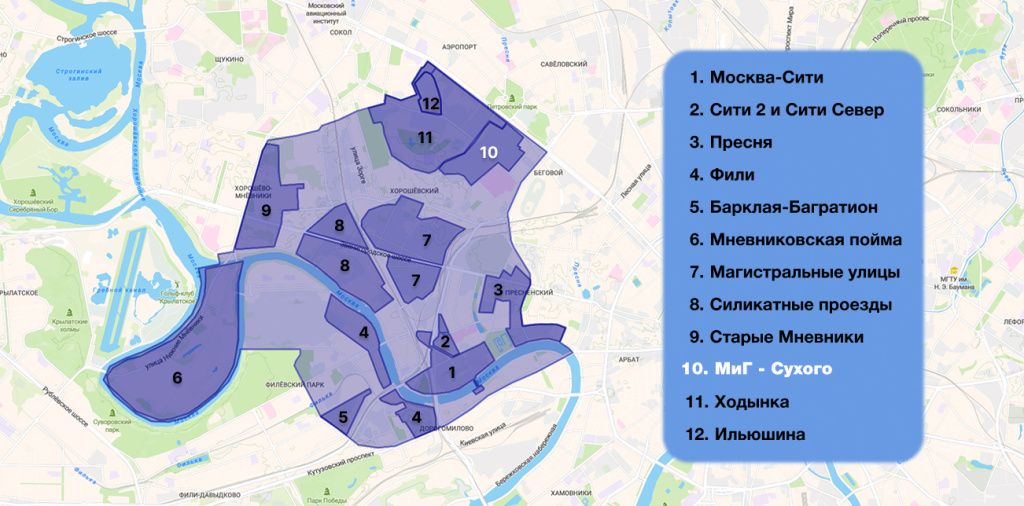
The north-western direction — Leningradsky Avenue, Dynamo, and Petrovsky Park — logically became one of the key vectors of this expansion.
Why this territory
The area under consideration is not an established residential district, but a large industrial and administrative cluster that had been isolated from urban life for decades:
-
aviation and defense enterprises (RSC MiG, Sukhoi Design Bureau);
-
warehouse and engineering infrastructure;
-
fragmented administrative buildings;
-
minimal residential function.
From an urban planning perspective, this is a classic “closed zone” in the center of a мегаполиса — precisely such territories became the main target of the KRT mechanism.
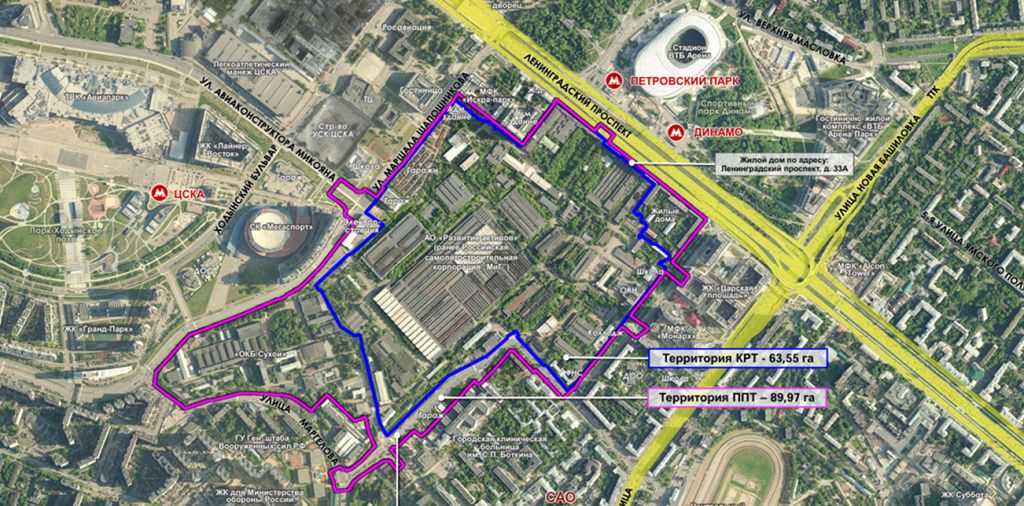
It is important that this is not about spot development, but about a full transformation of 63.55 hectares within the KRT framework and nearly 90 hectares within the planning project boundaries.
Project scale: arguments in numbers
The project clearly goes beyond local development:
-
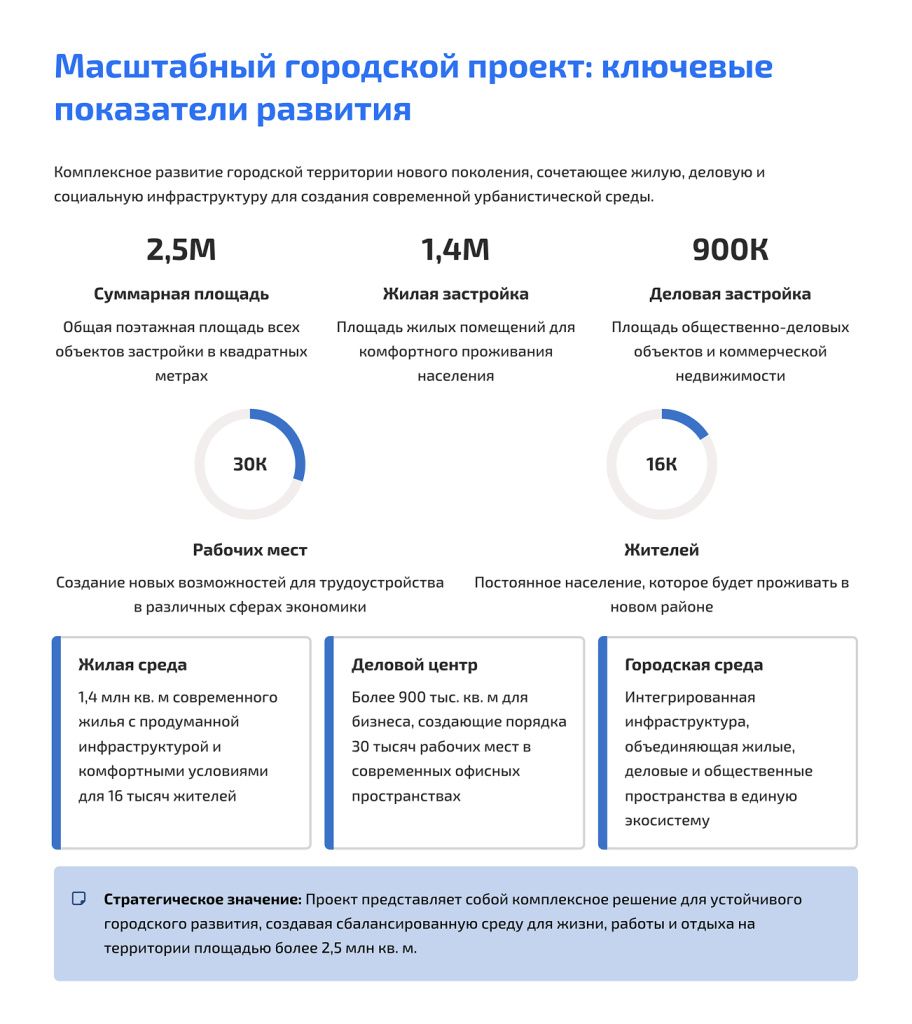
Total gross floor area — over 2.5 million sq. m.
-
Residential development — about 1.4 million sq. m.
-
Public and business development — more than 900 thousand sq. m.
-
Jobs — approximately 30,000.
-
Permanent population — about 16,000 residents.
In terms of the “jobs / housing” balance, the area becomes a donor of employment rather than a dormitory district — one of the key features of a Greater City business cluster.
Phasing as a tool for sustainable development
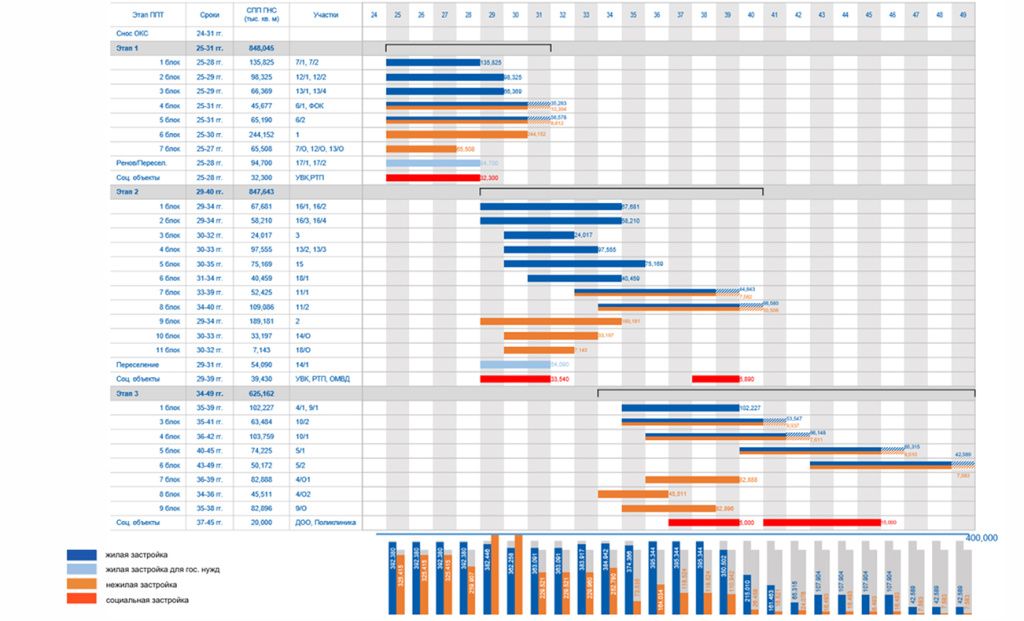
The project is designed for almost 25 years and is implemented in three stages, each with its own logic:
-
Stage one — launch of the territory: basic construction, start of social infrastructure, beginning of resettlement.
-
Stage two — peak activity: formation of the business core, office clusters, large-scale construction.
-
Stage three — completion: healthcare facilities, final quarters, integration of the Sukhoi Design Bureau territory.
This model fundamentally differs from “rapid development”: social facilities, schools, and kindergartens are introduced in parallel with housing, not afterwards.
The role of the city: not a developer, but an architect of rules
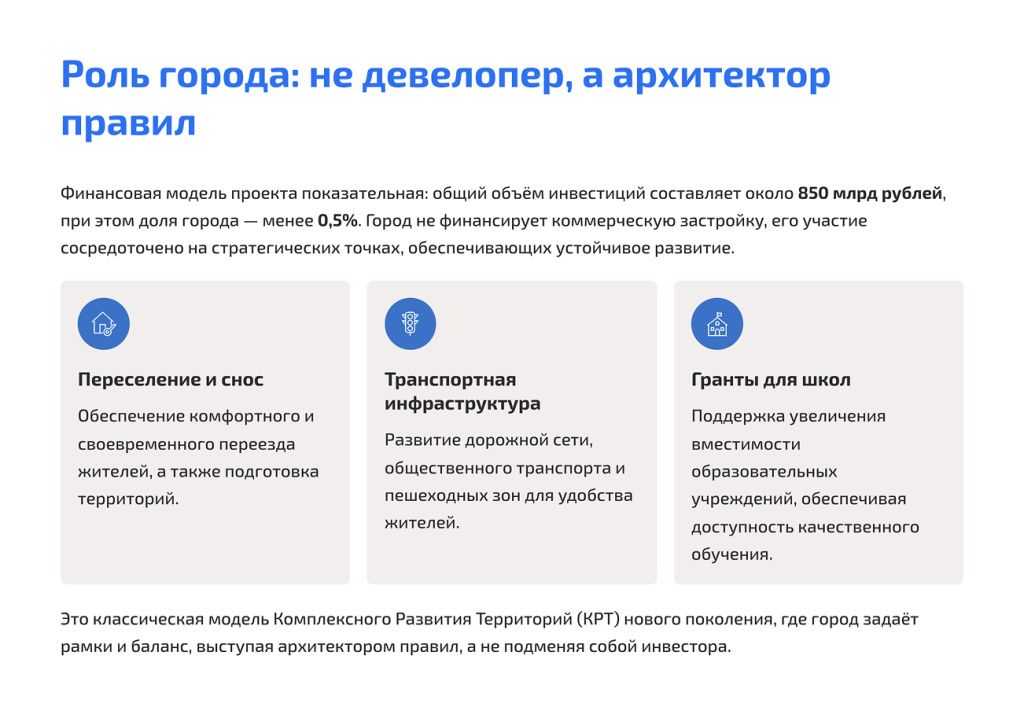
The financial model of the project is illustrative:
-
Total investment volume — about 850 billion rubles.
-
City’s share — less than 0.5%.
The city does not finance commercial development. Its participation is concentrated at critical points:
-
resettlement and demolition;
-
transport infrastructure;
-
grants to increase school capacity.
This is a classic next-generation KRT model, where the city sets the framework and balance rather than replacing the investor.
Architecture and the urban skyline
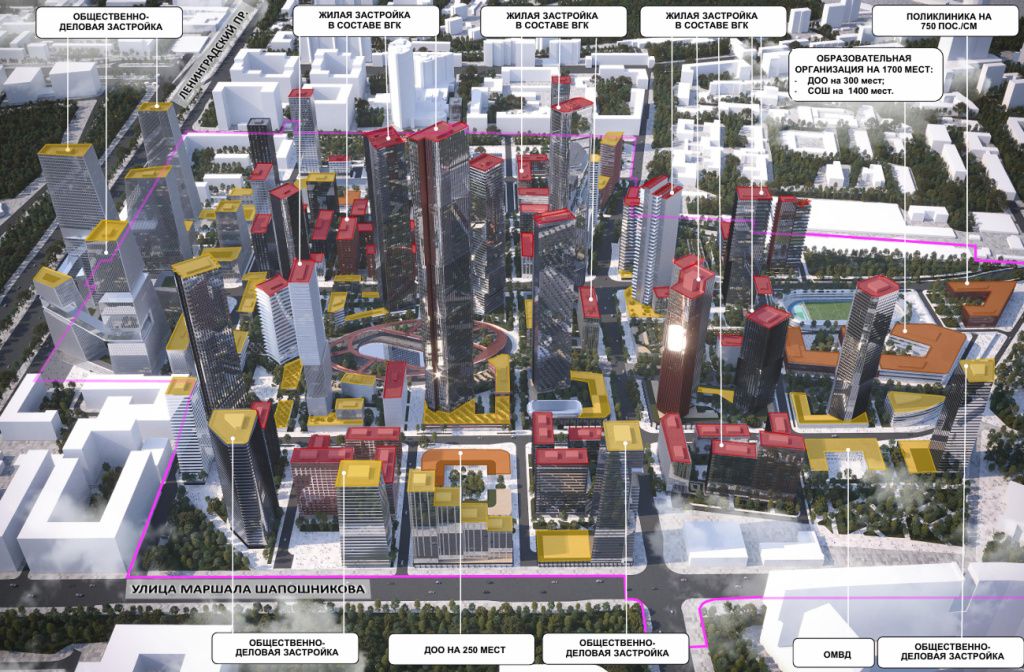
The project forms a new development frontage along Leningradsky Avenue — one of Moscow’s most prestigious and visually significant avenues.
High-rise dominants:
-
do not form a continuous wall;
-
create a readable skyline;
-
engage in dialogue with Prime Park, VTB Arena, and Alcon Tower.
Here, Leningradsky Avenue acts as an urban planning screen of Greater City, comparable in significance to the Presnya panorama.
Social infrastructure as a foundation
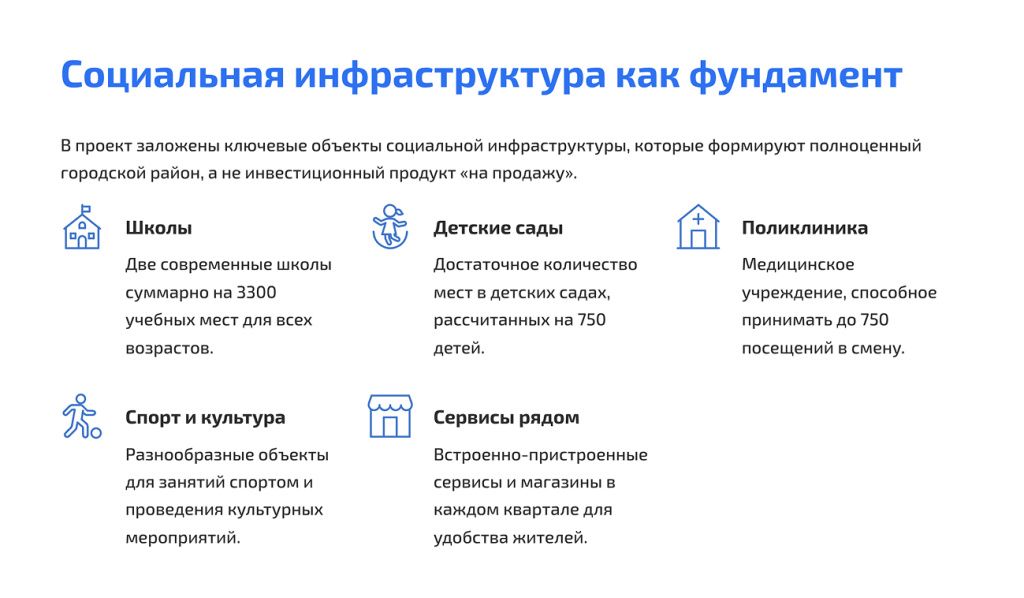
The project includes:
-
Two large schools (1,600 and 1,700 students);
-
Kindergartens for a total of 750 places;
-
A polyclinic with 750 visits per shift;
-
sports and cultural facilities;
-
integrated services within each quarter.
This creates a full-fledged urban district, not an investment product “for sale”.
Engineering and transport: the invisible foundation
The project has undergone detailed calculations for all engineering systems:
-
water, heat, electricity, sewage;
-
relocation of trunk networks;
-
modernization of boiler houses and substations.
The transport model is not car-oriented:
-
standard pedestrian accessibility to metro and surface public transport;
-
a developed street network;
-
parking provision of about 85–86% as a deliberate limitation of automobilization.
Greater City as a system, not a point
The KRT under consideration does not claim the status of a “second Moscow City”. Its role is different:
-
to distribute business activity;
-
to relieve pressure on Presnya;
-
to form the north-western contour of Greater City.
Moscow City remains the core, but it is projects like this that make Greater City a reality — not as a slogan, but as a connected urban structure.
Conclusion
Greater City is no longer an idea or a distant future. It is a process unfolding right now.
The comprehensive development project near Leningradsky Avenue is one of its largest and most illustrative fragments.
It demonstrates:
-
how Moscow moves away from monocentric development;
-
how industrial territories become urban;
-
how the city’s business center ceases to be a single point on the map.
Greater City is its logical continuation.
Related materials:
Greater City – the new business center of Moscow