


The National Center "Russia" is a grand multifunctional complex being built in Moscow's Moscow-City business district on the site of the former Expocentre exhibition complex on Krasnopresnenskaya Embankment. The project is intended to become a new symbol of the country and a premier venue for exhibitions, forums, concerts, and public events of national significance. The complex will encompass a variety of spaces under one roof: approximately 60,000 square meters of exhibition halls, a modern media center , a convention center for business events, a concert hall for 3,500 spectators, and educational and leisure areas for young people. The architectural concept for the center was developed by ATRIUM and features a futuristic bionic style inspired by images of Russia itself—from snowy expanses to flowing natural landscapes.
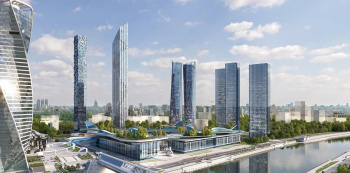
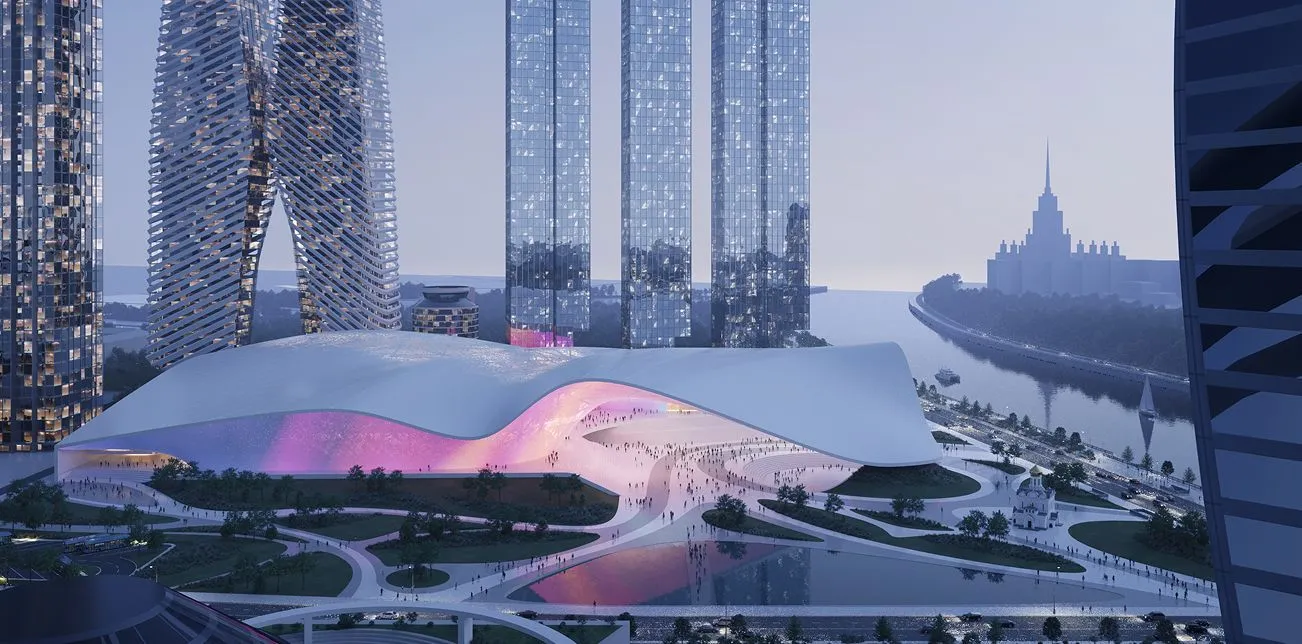
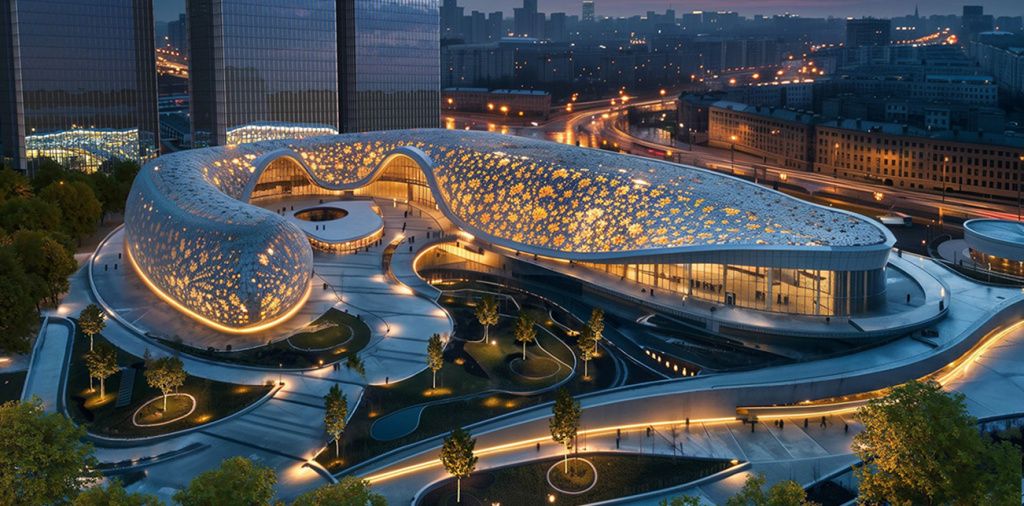
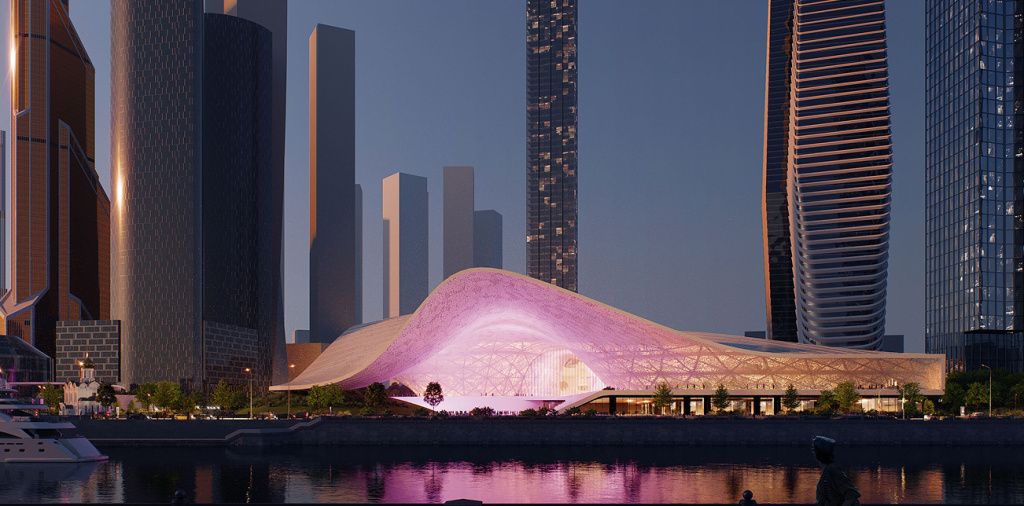
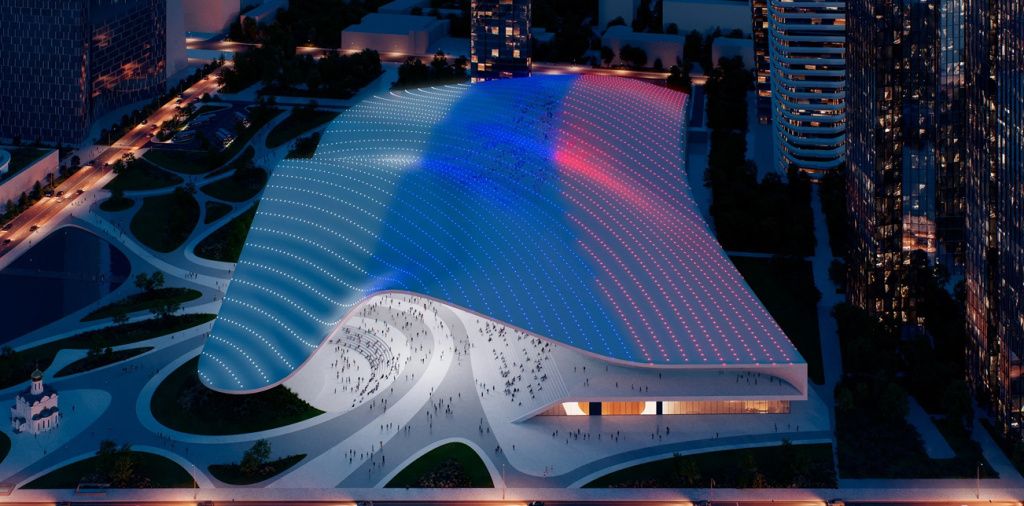
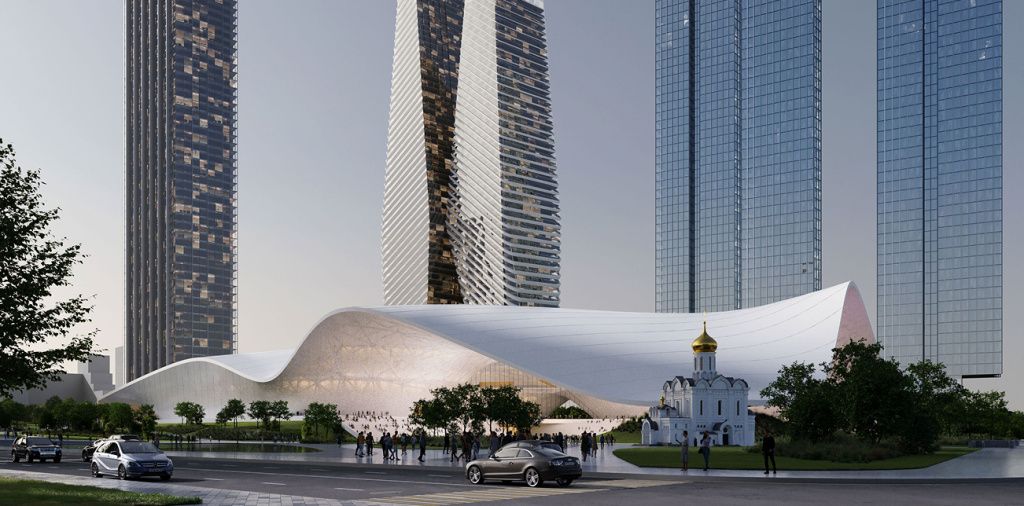
The architectural concept of the National Centre "Russia": the complex's undulating dome and the extensive public space around it harmoniously blend with the Moscow City skyscrapers in the background.
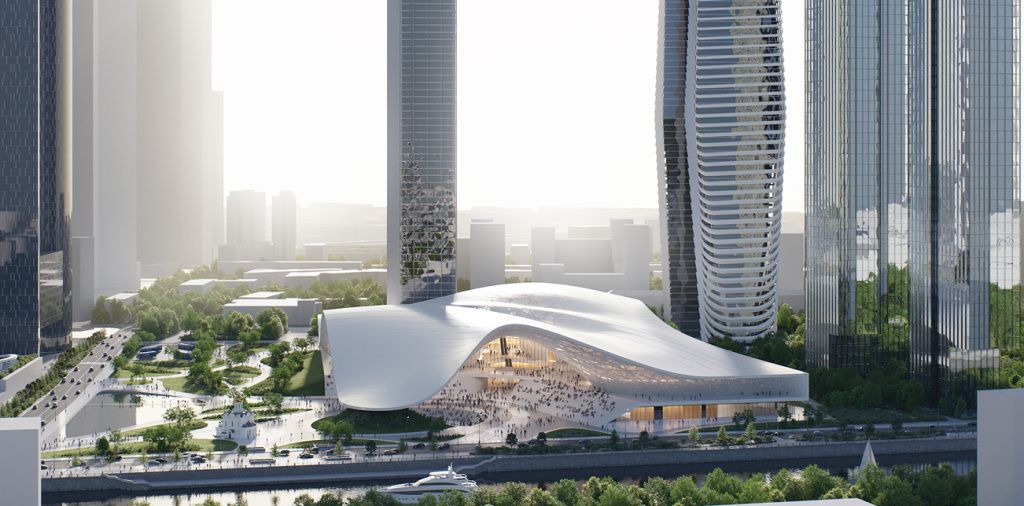
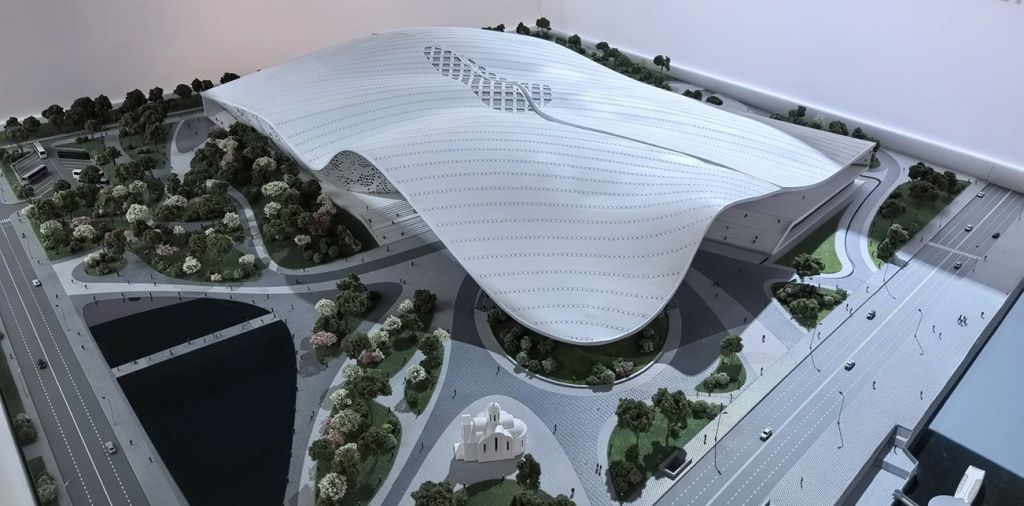
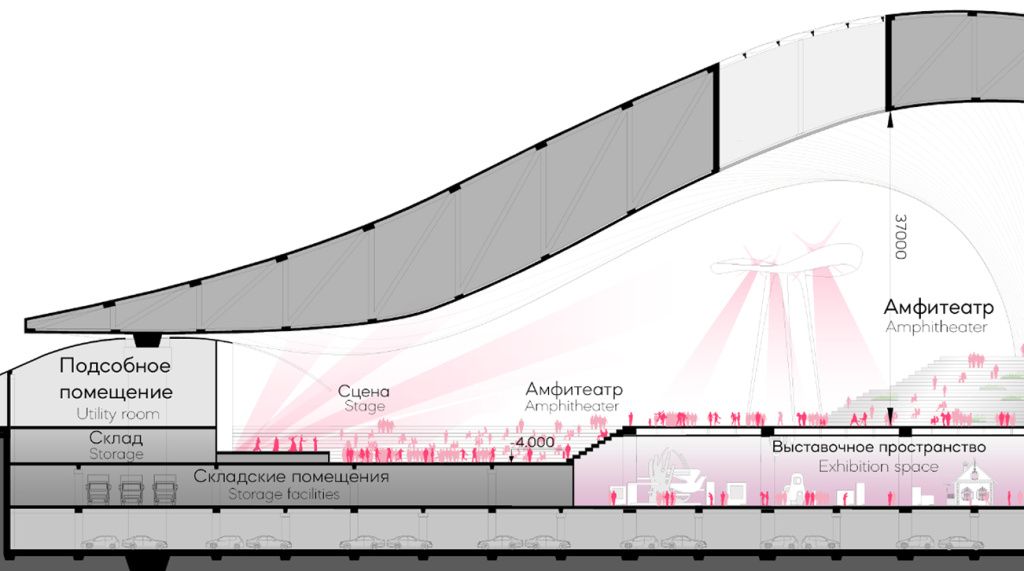
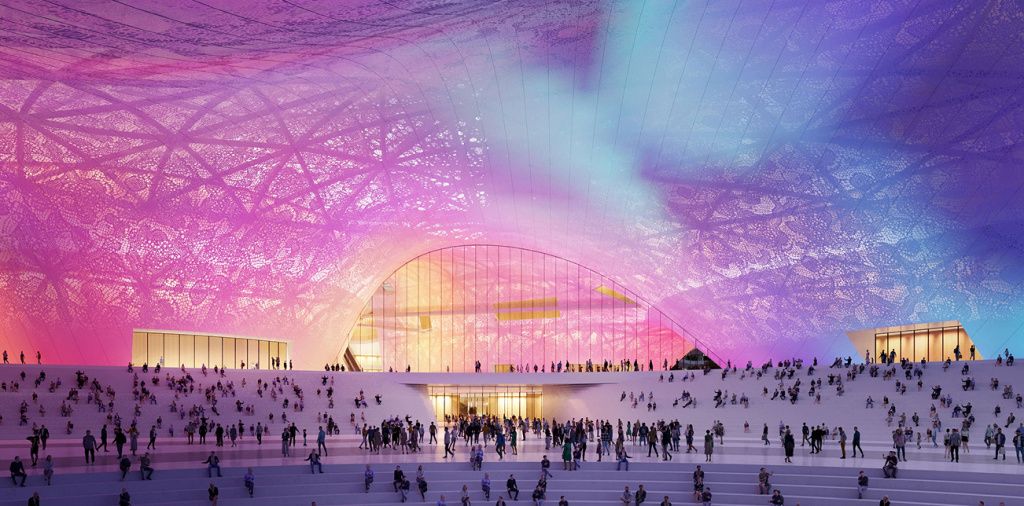
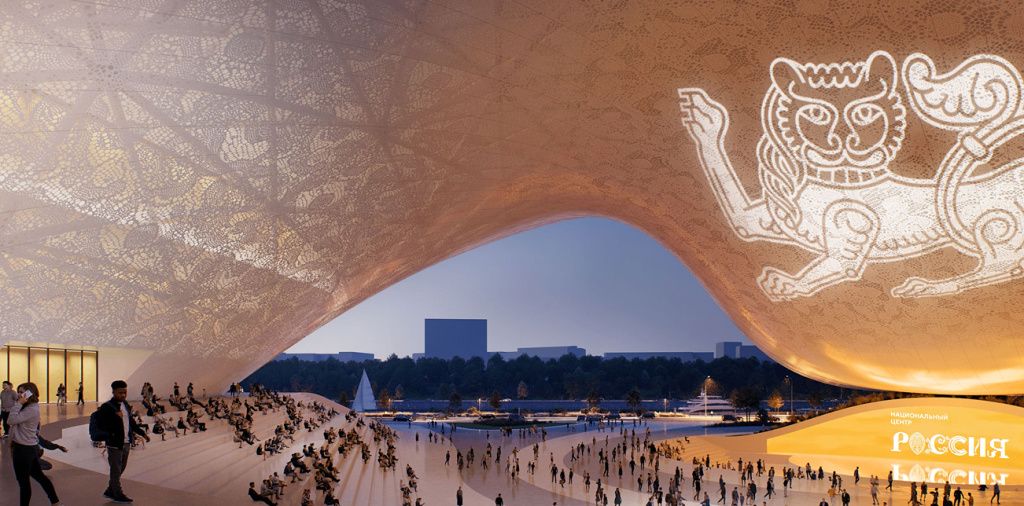
The complex's exterior is striking in its unusual form. A huge, undulating , covered dome encloses the event space and open-air amphitheater. The building's sleek horizontal lines contrast with the soaring verticals of the surrounding skyscrapers, lending the center a distinct identity. Thanks to transparent structures and panoramic openings, the interior is filled with natural light and air, creating a feeling of lightness, as if the building were floating above the ground. A covered event plaza with an amphitheater is located beneath the dome: in warm weather, it can host large-scale public events, festivals, and concerts, while in winter, the space will be transformed into a large skating rink for everyone. Thus, the National Center "Russia" will become one of the largest public spaces in the capital—a new "calling card" for Moscow and the entire country.
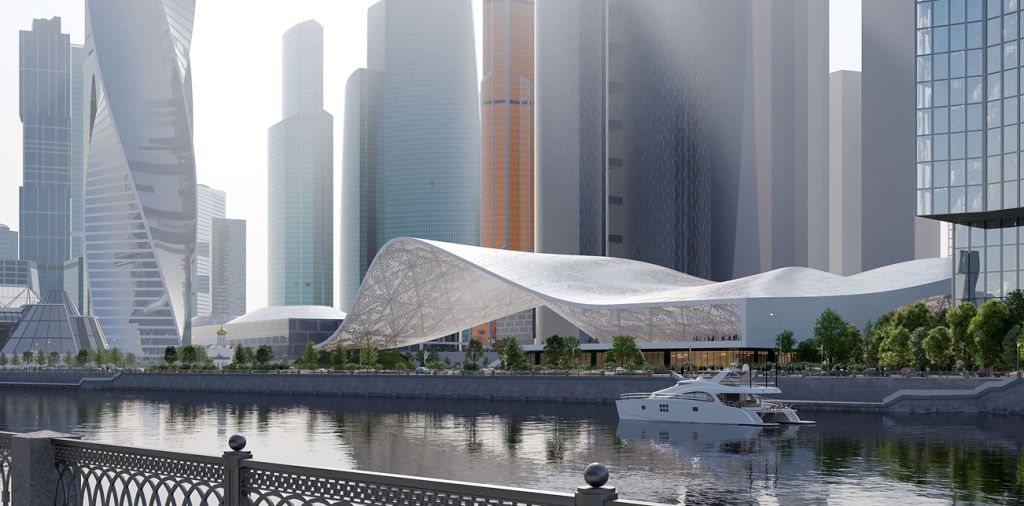
In addition to the interior spaces, the project includes the improvement of the extensive surrounding area. A landscaped park with green alleys, gardens, and artificial ponds will be created around the building. Walking paths, cozy squares, and fountains will be added—all the amenities previously lacking in the Moscow City business district for comfortable recreation for city residents. The new public space on the banks of the Moskva River will become a focal point for both Muscovites and visitors.
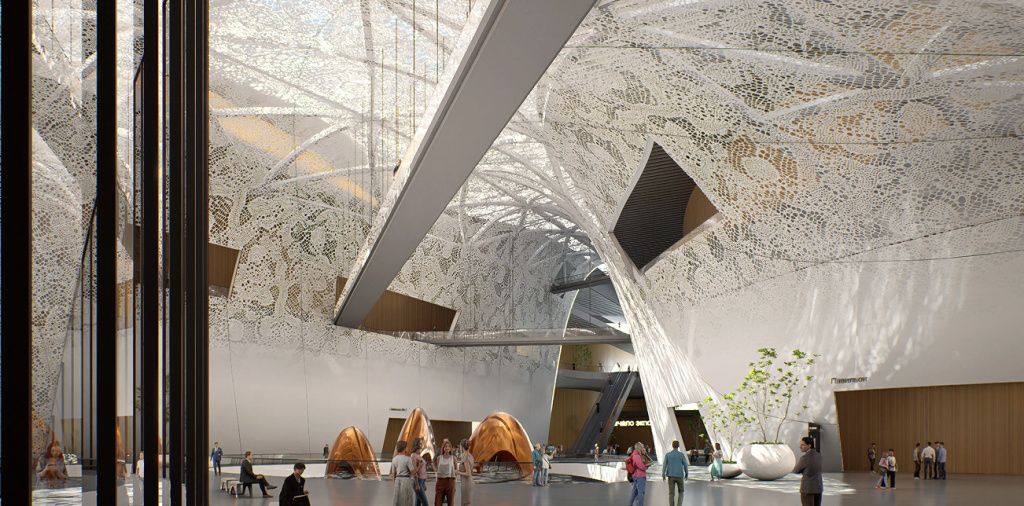
The architects also paid attention to the symbolic content of the center's appearance. The interior decor includes modern abstract patterns on the walls and ceilings, inspired by traditional Russian lace – a subtle nod to cultural heritage, evoking a feeling of warmth and comfort. In the evening, the building's façade will transform into a giant media screen : the innovative multimedia façade will be able to display dynamic light installations. On national holidays, the colors of the Russian flag and other national symbols will shine on it, and during festivals, themed art projections will be displayed. Thus, the center's appearance will change in sync with the events taking place, making it an integral part of city life.
History of creation
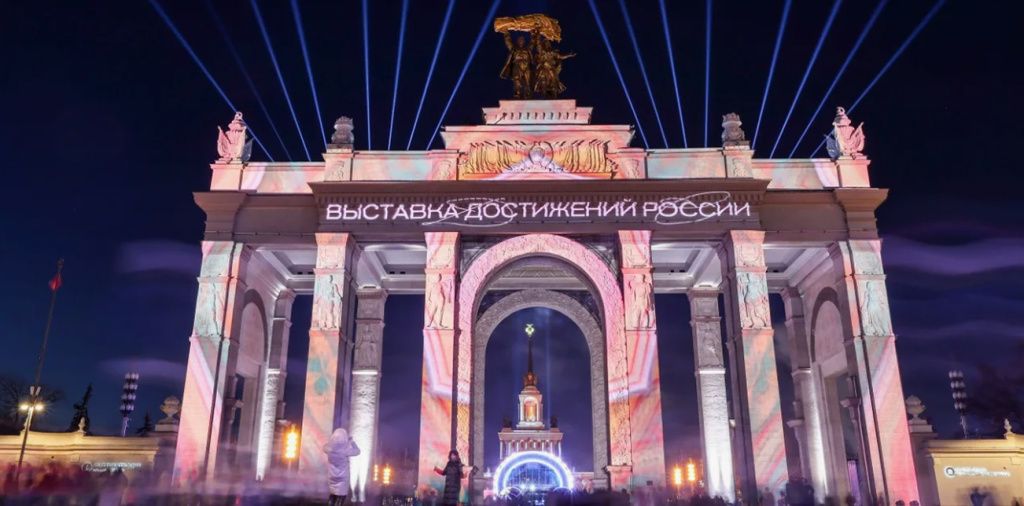
The idea for the National Center "Russia" arose as a follow-up to the triumphant success of the large-scale "Russia" exhibition and forum, previously held at VDNKh. This unique exhibition opened on November 4, 2023, and during its eight-month run (through July 2024), attracted a record number of visitors—over 18.5 million . In terms of visitor numbers, it ranked among the top ten most visited exhibition venues in the world. The "Russia" forum showcased the achievements of all regions of the country, as well as the latest projects of key state corporations, ministries, and public organizations. Official delegations from more than 120 countries, including heads of government, attended the exhibition. The success of this event demonstrated the enormous public interest in Russia's achievements, and the question of the permanent preservation and development of its legacy soon arose.
The President of Russia initiated the creation of a permanent national center. In early July 2024, Vladimir Putin signed a decree establishing the National Center "Russia" in Moscow as a successor to the forum at VDNKh. The document emphasized that the new center would showcase the country's key achievements , strengthen national identity and civic pride, inspire young people to pursue scientific and creative endeavors, and preserve the exhibits and developments presented at the temporary exhibition. A high-level Organizing Committee was formed to implement the project, headed by First Deputy Chief of Staff of the Presidential Executive Office Sergei Kiriyenko . The Organizing Committee included representatives of federal and Moscow authorities, including Moscow Mayor Sergei Sobyanin , as well as the exhibition-forum project curators, led by the center's General Director, Natalia Virtuozova.
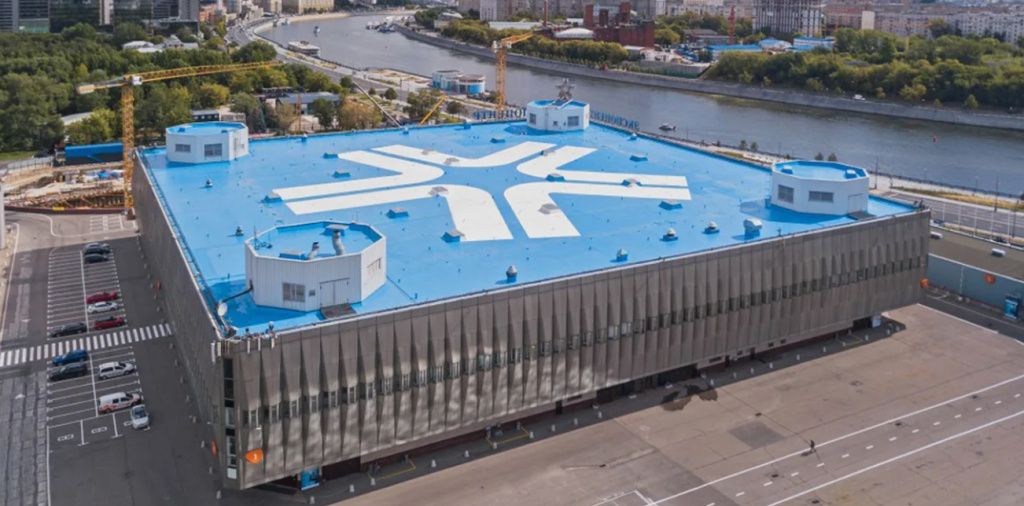
According to a presidential directive, the Moscow government was instructed to transfer the Expocentre building complex on Krasnopresnenskaya Embankment to accommodate the new center. This move is symbolic: the renowned Expocentre, which had served as the capital's main exhibition venue since Soviet times, is giving way to a modern space designed to become a "territory of dialogue and inspiration" for all Russians. By the fall of 2024, a detailed roadmap for the project's implementation had been prepared, and in September, a presidential decree established the directorate of the National Center "Russia."
On June 4, 2024, Global Exhibitions Day, a public presentation of the future center's concept took place under the slogan "Exhibition Russia. Creating the Future." The project's goals and objectives were outlined, and initial architectural concepts were showcased. Initially, a preliminary architectural design developed by the creative team DO buro in collaboration with young Russian architects was discussed. However, it was subsequently decided to revise the concept in favor of a bolder and more innovative solution. As a result, in early 2025, ATRIUM was selected as the final architectural concept designer, presenting a futuristic, bionic-inspired design.
The official opening of the National Center "Russia" at its new location took place on November 4, 2024—symbolically, on National Unity Day. On this day, a ceremony was held on the grounds of the former Expocentre, marking the start of the center's operations, even though its permanent building has yet to be built. The first event was the international science fiction symposium "Creating the Future," which brought together over 3,000 delegates from 101 countries from November 4–6—scientists, engineers, futurologists, writers, and government officials. The symposium focused on a shared vision of the future of technology, society, and global civilization. Since November 7, 2024, the center has opened its doors to all visitors: for now, exhibits and events are being held in temporary halls—pavilions of the former Expocentre adapted for new purposes. The first exhibitions and interactive spaces have opened here, including the "Heritage for the Future" exhibit and the "Creating the Future" educational route, which introduces visitors to how the bold ideas of science fiction writers have been embodied in real-world technologies.
A major milestone was the launch of the permanent exhibition "Journey Across Russia," which opened to the public in early 2025. This large-scale exhibition explores the diversity of Russia's regions—from natural beauty and cultural traditions to economic potential and scientific achievements. At the same time, the center's infrastructure continues to develop: lecture halls, conference spaces for business events, and an in-house library with books on history, science, and art have opened. Thus, even in its temporary location, the National Center "Russia" is beginning to fulfill its educational mission, and the construction of a unique building capable of taking these activities to a new level lies ahead.
Construction Features
The construction of the new complex on Krasnopresnenskaya Embankment is a complex and unique engineering and construction challenge. Builders will be transforming a vast 14.1-hectare site in the heart of the metropolis, integrating a completely new type of facility into the dense urban fabric. The first stage will be the gradual demolition of the old Expocentre pavilions and site preparation. The work must be carried out carefully, given the proximity of the existing Moscow City skyscrapers and key transportation arteries. The project includes the creation of a deep underground section for parking and technical facilities, which will require the excavation of a large pit and a reliable foundation. Particular attention is paid to safety: modern technologies are being used to monitor soil and protect adjacent buildings from potential deformation.
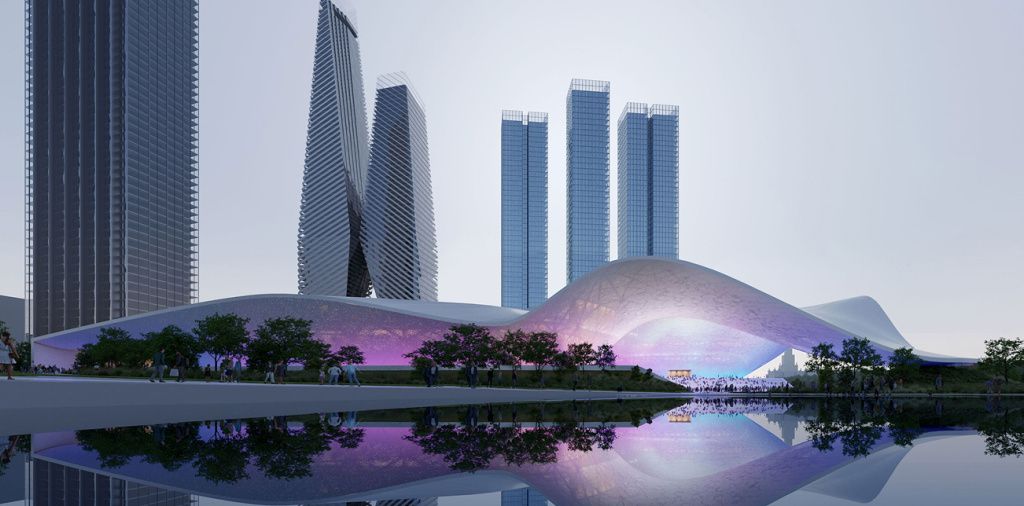
One of the key architectural and engineering features will be the construction of a gigantic, undulating roof over the main event space. This complex dome will span several hectares without internal supports, providing column-free space for exhibits and spectators. Implementing this design will require innovative design solutions: likely, ultra-strong, lightweight materials (special steel grades, spatial trusses, composite panels) and computational models used in stadium or airport construction will be used. The roof structure will be equipped with the integrated lighting and media screen system mentioned above—another challenging engineering challenge, requiring the installation of thousands of LEDs and cables within the building envelope. Furthermore, reliable acoustics must be ensured: the shapes of the amphitheater and dome will be designed to ensure uniform sound distribution during concerts and events, while preventing outside noise from penetrating.
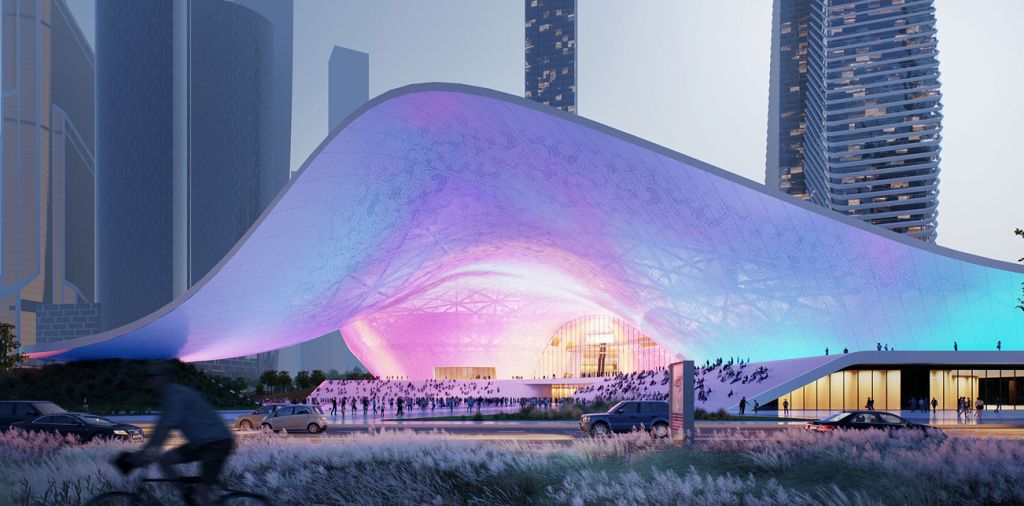
The center's architecture is designed in bionic forms , which technically means an almost complete absence of right angles and standard structural elements. All façade lines are curved and fluid, reminiscent of natural contours. The builders will have to embody this in the material with pinpoint precision. The façade shell will consist of numerous unique panels with complex curved shapes. A significant portion of these will likely be custom-made using digital modeling and 3D fabrication, then assembled in place using high-precision cranes. As a result, the building will have a streamlined appearance without visible joints—as if woven from a single fabric. Similar technologies have already been used on some iconic architectural landmarks worldwide, and the National Center "Russia" will be one of the first examples of their large-scale use in Russia.
Another distinctive feature of the project is the extensive use of digital technologies throughout all stages. The design is being conducted using BIM modeling, which allows for precise calculations of every structural component and optimizes costs. The building itself is planned to feature advanced "smart building" systems: automated climate control, lighting, multimedia screens, and security. The multimedia façade will require high-performance servers and software to synchronize the massive visual projections. Engineers are also addressing energy efficiency issues—despite the complex's impressive size, energy-saving technologies, renewable energy sources, and modern heating and ventilation systems are planned to reduce the building's environmental footprint.
The construction of the National Center "Russia" is planned to be carried out within a tight timeframe, leveraging cutting-edge global practices. According to the organizers, the site will employ leading general contractors and engineering companies experienced in constructing complex projects. Construction is expected to begin in full force after final design approval—tentatively beginning in 2025—and will last approximately four years. Some preparatory work (relocation of utilities, installation of temporary infrastructure) has already begun while the center is operating in temporary pavilions. Through precise planning and phased construction, disruptions to exhibition displays are planned to be minimized: some programs will continue to operate in the remaining buildings until the new complex is ready to take over.
Composition of the complex
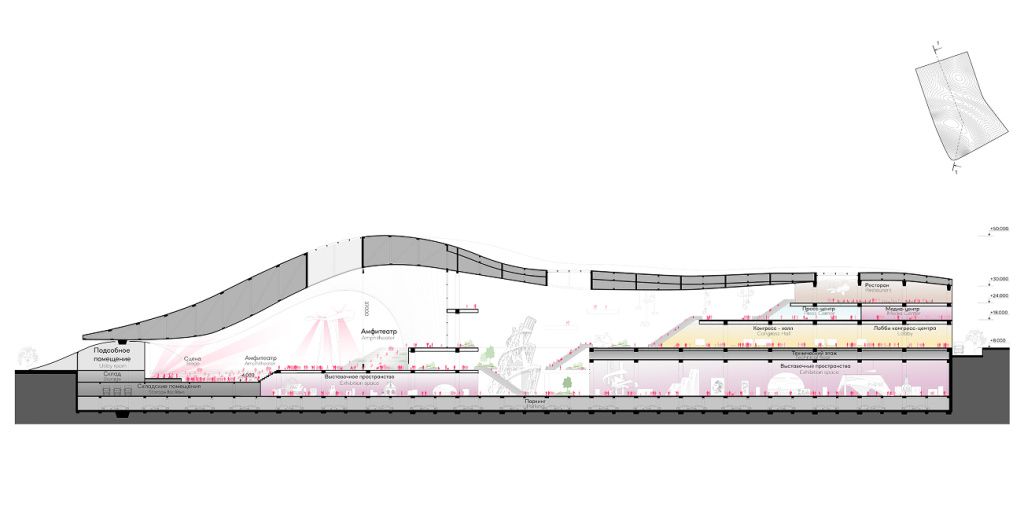
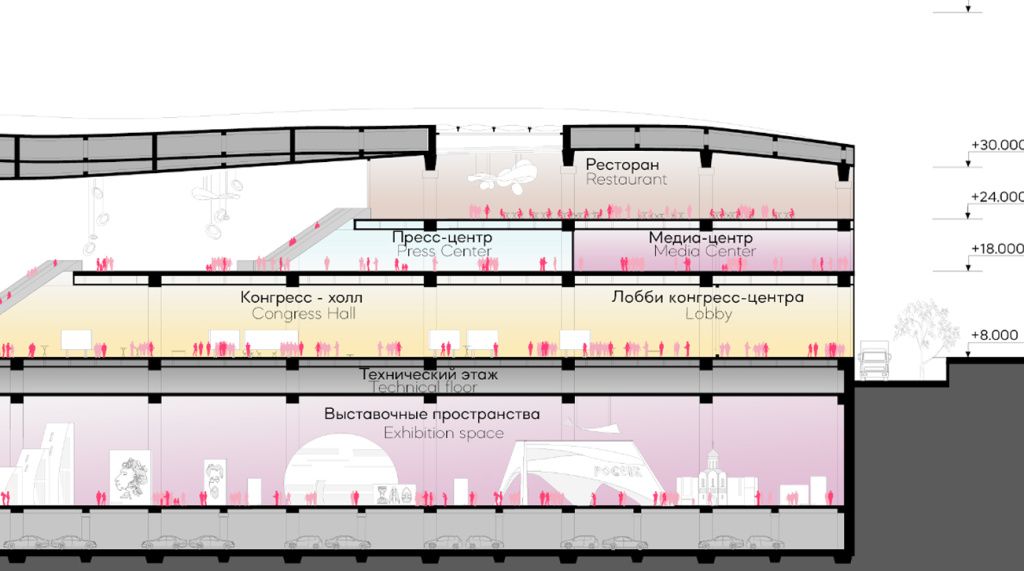
The new National Center "Russia" is conceived as a multifunctional cluster capable of hosting a wide range of events, from large-scale international exhibitions to intimate cultural events. Essentially, the complex will combine the functions of an exhibition center, convention center, concert arena, contemporary history museum, and public park. Its interior space will be divided into several main units:
-
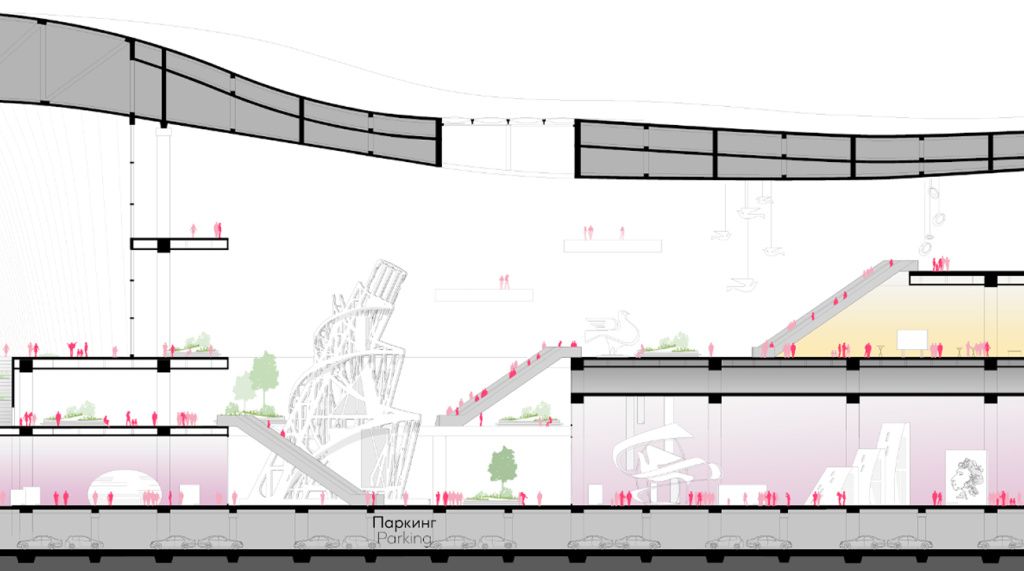
Exhibition Galleries and Pavilions: The center's core is comprised of expansive exhibition halls with a total area of approximately 60,000 square meters. These spaces can be transformed to accommodate various exhibition needs: they will house permanent exhibitions dedicated to Russia's achievements in science, technology, culture, and economics, as well as temporary thematic displays, fairs, and technology expos. The halls will be equipped with modern exhibits, interactive displays, and VR installations, allowing visitors to explore the country's past, present, and future in an engaging way.
-
Congress and Concert Block: The central section will house a 3,500-seat concert hall with a modern stage and professional sound and lighting equipment. It is designed to host official ceremonies and forums, as well as concerts by popular artists, opera productions, and film premieres. Directly adjacent is the congress center —a complex of conference halls of varying sizes, equipped with everything necessary for business events, symposiums, and international conferences. It will also include rooms for simultaneous interpretation, press centers, and VIP areas for delegations. This combination of concert and congress functions will allow events on the scale of global summits or major festivals to be held in a single location.
-
Media Center and Educational Spaces: A separate section of the center will house a media center , which will serve as a venue for presentations, media exhibitions, and journalistic work. It will likely house studios for television and radio broadcasts, interactive screens, and information desks. It will also house lecture halls and classrooms for educational programs, ranging from open lectures by prominent scientists to master classes for schoolchildren and students. The National Center "Russia" plans to collaborate closely with universities, research institutes, and creative associations, developing into a permanent educational platform .
-
Youth Creative Cluster: An important part of the concept is attracting young talent. In a specially organized creative space, young people will be able to present startups, work on creative projects, and hold hackathons and competitions. It could include studios for experiments, coworking areas , laboratories for young inventors—anything to stimulate the development of new ideas. The center's goal is to become an incubator for bold projects, a platform where young engineers, artists, and IT specialists can find support and like-minded people.
-
Public and recreational areas: The National Center will be open and attractive not only for official events but also for everyday city life. A covered plaza with an amphitheater will be located under the giant dome—a space for meetings, relaxation, and celebrations. Here, visitors can enjoy street theater performances, art installations, or simply find shelter from the weather while enjoying the river view. Along the center's galleries, there will be food stalls —cafes, food courts, and restaurants serving cuisine from various regions of Russia—where guests can sample national dishes. Retail spaces will also be organized: a dedicated "Department Store" will showcase products from across the country—from folk crafts and souvenirs to farm produce and designer goods. A pilot store is already operating in the center, bringing together 150 producers from 50 regions, offering visitors the best of Russia's renown. Museum exhibits and interactive attractions for children are also planned, making a visit to the center engaging for the whole family.
-
Infrastructure and amenities: Despite its status as a major public and cultural facility, the National Center "Russia" is designed with the comfort of every visitor in mind. The complex will be equipped with underground parking for guests and tour buses, with space for thousands of vehicles. Convenient entrances will be provided directly from the Vystavochnaya metro station and the Delovoy Tsentr Moscow Central Circle (MCC). Inside, there will be elevators, escalators, and navigation accessible to people of all ages. Particular attention is paid to barrier-free access: the center will be a model of accessibility for people with limited mobility, with tactile signs, ramps, and special services. Plans also include recreational areas and green spaces even inside the building—for example, an indoor winter garden with exotic plants and benches where visitors can rest while exploring the exhibits.
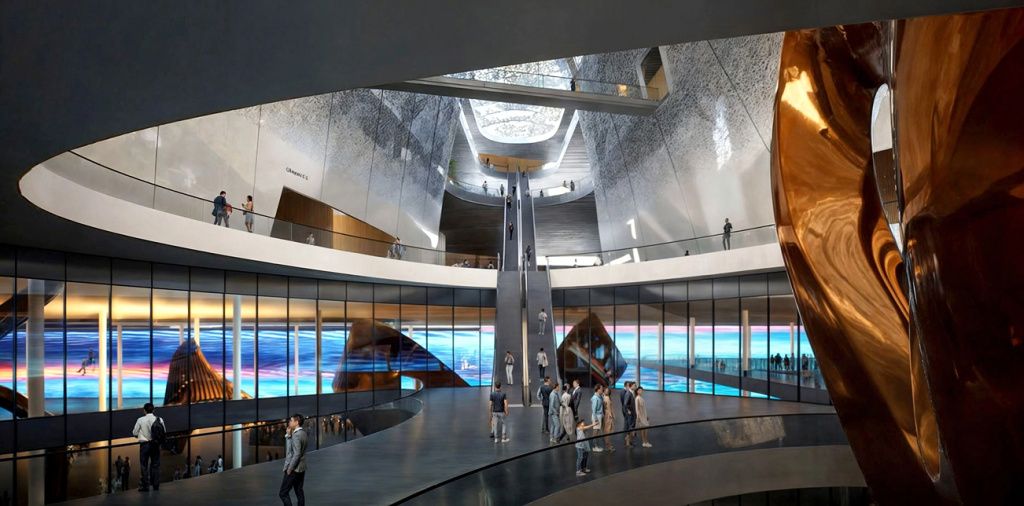
Thus, the complex's composition has been designed with maximum versatility: educational, business, cultural, and entertainment functions will coexist within a single space. The National Center "Russia" will be a place where you can come with your entire family or colleagues—someone can visit an exhibition of the latest technologies, someone can listen to a symphony concert, and still others can participate in an educational seminar. And all this will be under one roof, in the very center of the capital.
Project participants
A broad team, bringing together representatives from the government, business, and the creative community, is working on the creation of the National Center "Russia." The project's client and curator is the Government of the Russian Federation, with the support of the Moscow City Government. Overall coordination is provided by the Organizing Committee, headed by Sergei Kiriyenko. This committee makes key decisions regarding the concept, funding, and timeline. Moscow City Hall also plays a significant role: Mayor Sergei Sobyanin's team is responsible for land allocation, urban development approvals, and the development of transportation and urban infrastructure around the complex.
The project's direct operator is the autonomous non-profit organization "National Center 'Russia,'" created by presidential decree. Its CEO , Natalia Virtuozova, oversees the center's day-to-day operations, from hosting exhibitions during the transition period to preparing for the move to the new building. She has assembled a young and energetic team of managers, exhibition curators, marketers, and technical specialists, who have already proven their worth during the Russia Forum at VDNKh. This team will also determine the content of the future complex—the exhibition themes, the event program, and partnerships with regions and educational institutions.
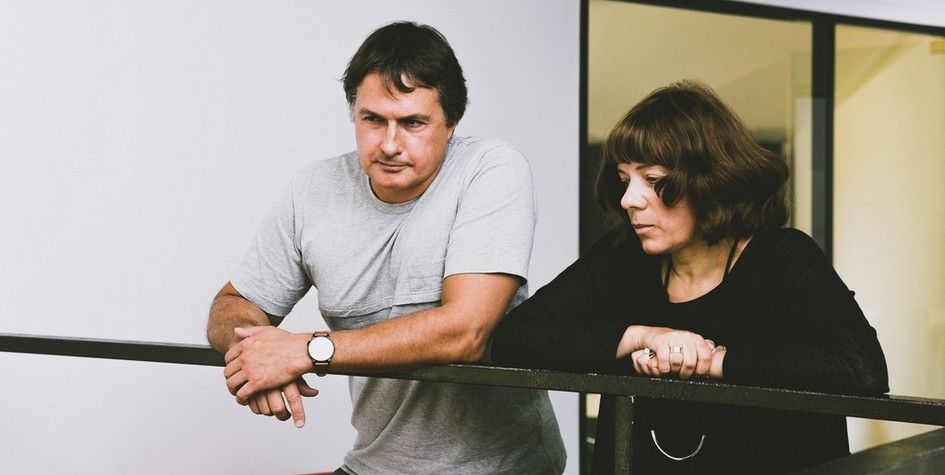
The architects and designers are the project's pride and joy. The architectural concept competition was won by the renowned Moscow firm ATRIUM , led by architects Anton Nadtochiy and Vera Butko. Their studio has extensive experience creating striking public spaces, and in this case, ATRIUM proposed a truly bold and original solution, which was supported by the expert council. Architects Petr Alimov, Polina Yavna, Alisa Silantyeva, Roman Khorev, and other young specialists from the firm also worked on the project—a total of more than ten authors on the team. Before the final concept was selected, a design by DO buro (led by Alexander Kazachenko and Alexey Agarkov) was considered. Although it was not implemented in its original form, their contribution was also recognized—many of their functional planning ideas formed the basis for the final design. Specialized design institutes will subsequently join the work to develop engineering systems, structures, and cost estimates. These will likely include some of the country's leading organizations specializing in the design of cultural and entertainment facilities.
The National Center "Russia" (ANO) itself is the de jure developer and investor of the project, but funding is provided primarily from the federal budget, as it is a particularly significant national project. Responsibility for implementation has been jointly assumed by the Russian Ministry of Construction and the Moscow Government. The general contractor will be selected through a competitive bidding process; its name has not yet been officially announced, but participation by major companies with experience in constructing iconic structures (such as PAO Mosinzhproekt, PIK Group, and others) is not ruled out. The project is also attracting sponsoring partners from among state corporations and businesses: VTB, Sberbank, and energy and high-tech corporations have already expressed interest in participating in the center's creation. Their role could include financial support, as well as the content of the exhibits and the technological equipment of the center.
The contribution of the expert and scientific community is worth noting. The center has a board of trustees and expert groups, including renowned scientists, cultural figures, and museum and exhibition center directors. They advise on the content concepts of exhibitions, advise on the implementation of new technologies, and share international experience. For example, experts from the State Hermitage Museum, the Tretyakov Gallery, and the Polytechnic Museum help develop collections and exhibition scenarios to make the center's exhibitions as engaging and educational as possible.
Thus, the National Center "Russia" project has brought together many participants: from top government officials to young architects, from bankers to artists. All are driven by a common idea: to create a unique space in the heart of Moscow that will honorably represent the greatness and diversity of our country.
Exact figures
Some key characteristics of the complex and project parameters are worth highlighting separately:
-
Location and area: Moscow, Presnensky district, plot No. 20 of the Moscow-City International Business Center. Total area: 14.1 hectares .
-
Total area of the building: approximately 240,500 m² (including exhibition halls – 60,000 m², other functional areas, foyers, technical rooms, etc.).
-
Height: The project has a predominantly low-rise, horizontally spread configuration . The main volumes are 3-5 above-ground levels. The maximum height of the undulating dome is approximately 40-50 meters (approximately 10-12 stories of a traditional building) at its highest point above the amphitheater.
-
Main facilities: concert hall with 3,500 seats ; congress center with several transformable halls (the largest has 1,500 seats); media center with an area of ~10,000 m²; youth creative cluster of ~5,000 m²; library and lecture halls of ~2,000 m²; gastronomic zone and retail spaces of ~8,000 m².
-
Parking: underground parking for at least 2,000 cars (the exact capacity will be specified during the design stage).
-
Investment: The project is being financed from the federal budget. The exact investment volume has not been officially announced, but experts estimate it to be in the tens of billions of rubles. For example, construction of similarly scaled complexes would require approximately 40–50 billion rubles or more , given the complexity of the architecture and equipment.
-
Implementation timeline: preparatory phase – 2024 (organizational structure creation, design, network relocation); main construction is planned for 2025. Construction duration – approximately 3–4 years . The opening of the new building is planned for 2028 , or, according to some sources, no later than 2029 (this timeframe may be adjusted during construction).
-
Operation: The center is designed to accommodate up to 50,000 people daily (during peak periods of major events). Annual visitor flow is projected to be between 5 and 7 million people per year .
These figures reflect the scale and ambition of the project. In many respects, the National Center "Russia" is unparalleled: it will be one of the largest exhibition and convention centers in Europe, comparable in size to Moscow's Soviet-era Expocentre, but equipped with the latest technology and architecture. The project's funding demonstrates the state's priority – the public investment of tens of billions of rubles is justified by the cultural and social impact expected from the center's operations.
Interesting facts
The National Center "Russia" project, even at the conceptual stage, was enriched with many interesting details and symbolic nuances:
-
Architectural symbolism: The building's undulating, snow-white dome, according to the designers, evokes a shroud spreading over the earth —an image inspired by legends of the heavenly protection of Russia. At the same time, its smooth lines suggest the contours of snowdrifts and snow dunes, evoking Russia's northern character and the boundless expanses of Siberia and the Arctic. Thus, the building visually embodies the idea of the security and vastness of our native land.
-
Bionic style: The Center will be one of the first examples of such pronounced bio-architecture in Moscow. Its form seems to be borrowed from living nature – not a single section is repeated. Interestingly, when viewed from different angles, the building evokes different images: from one angle, a hovering tent or a temple dome; from another, a wave or a dune ; from a third, a gigantic winged hill. This multifaceted appearance was specifically conceived so that each visitor can see something resonant with their imagination.
-
Multimedia Façade: A massive media façade integrated into the building's shell will allow for light shows comparable to those at Olympic opening ceremonies or major festivals. On important occasions, the façade can display, for example, video sequences from the country's history, footage of space launches, or scientific achievements—all of which can be displayed as part of the exhibition and even brought outside as media installations. This will transform the center itself into a giant screen of history , visible from afar. On ordinary days, the media façade can be configured neutrally—for example, to match the color scheme of the day or season, so that the building seamlessly complements the city skyline.
-
Park around the center: The landscaped park surrounding the complex will have not only aesthetic but also practical significance. Several artificial ponds are planned – in addition to being decorative, they will collect rainwater, which will then be used to irrigate the greenery (part of an eco-friendly system). Hundreds of trees and thousands of shrubs are planned for the park, including rare species characteristic of various regions of Russia – a kind of "botanical garden of achievements" reflecting the country's flora. Furthermore, the park may also feature a public art object – such as a sculpture or fountain, selected through a competition among artists, to continue VDNKh's tradition of creating iconic fountains.
-
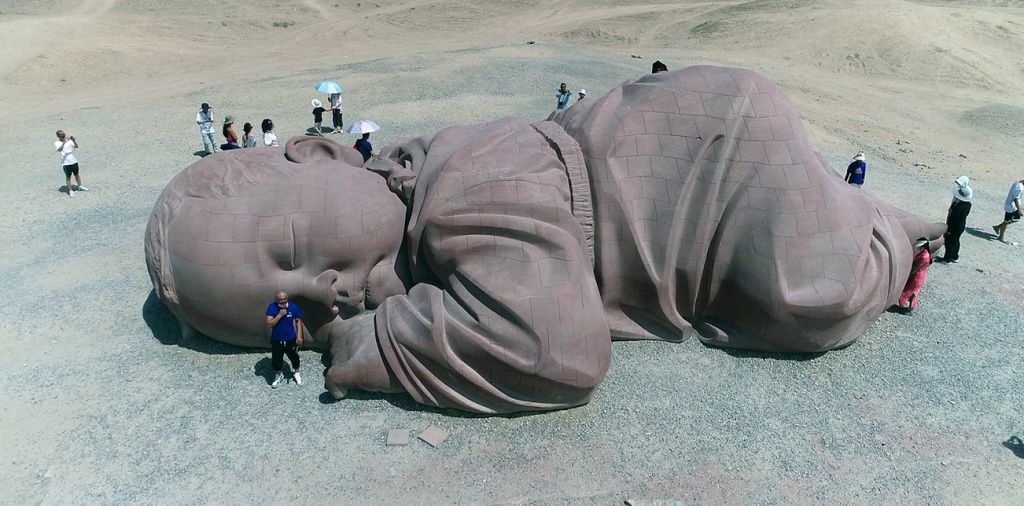
The legacy of the Russia Forum: Many exhibits presented at the 2023–2024 temporary exhibition have been given a second life at the national center. For example, the unique interactive exhibition "Time of Pioneers" with augmented reality elements will move to the new complex and become a permanent highlight for the younger generation. And the famous art piece "Child of the Earth" —a giant sculpture of a baby by artist Don Shubin, which was on display at the forum—is planned to be installed in one of the halls of the new center as a symbol of the future being born today. This piece is particularly interesting because the original version of the sculpture is located in the Gobi Desert, and a smaller replica will be brought to Moscow, making the Russian center the only place where one can see the "Gobi Baby" without traveling to Asia.
-
Regional branches: The National Center "Russia" will not be limited to its Moscow location. The President announced that branches will open in various regions of the country. Ideas are already being considered for creating mini-centers "Russia" in major cities such as St. Petersburg, Novosibirsk, Kazan, Vladivostok, and others. While these centers will be smaller in size, they will showcase the achievements of a given federal district. Muscovites and visitors to the capital will be able to learn about the entire country at the main center, while residents of the regions will have their own local spaces for pride and development. This interconnected network is intended to strengthen cultural and economic ties between the regions, creating an "exhibition ecosystem" across the country.
-
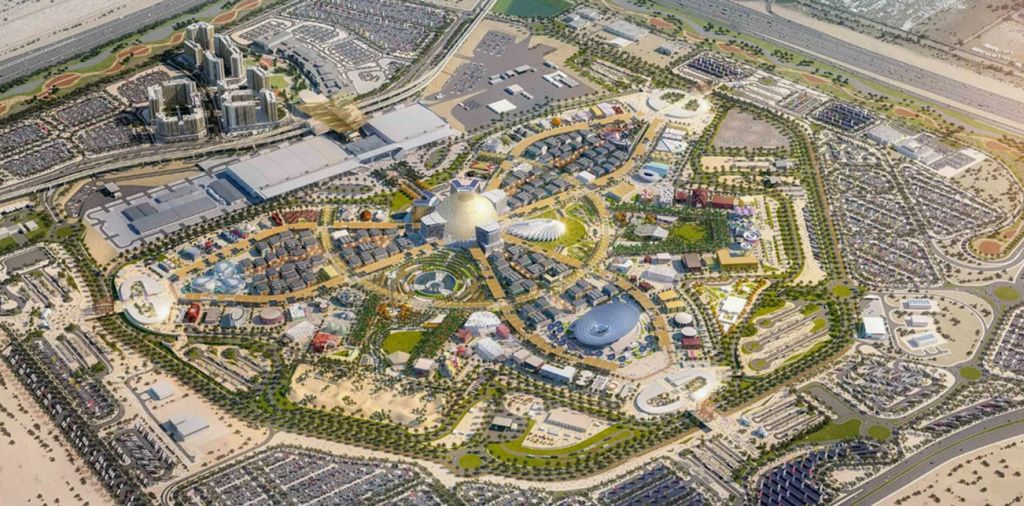
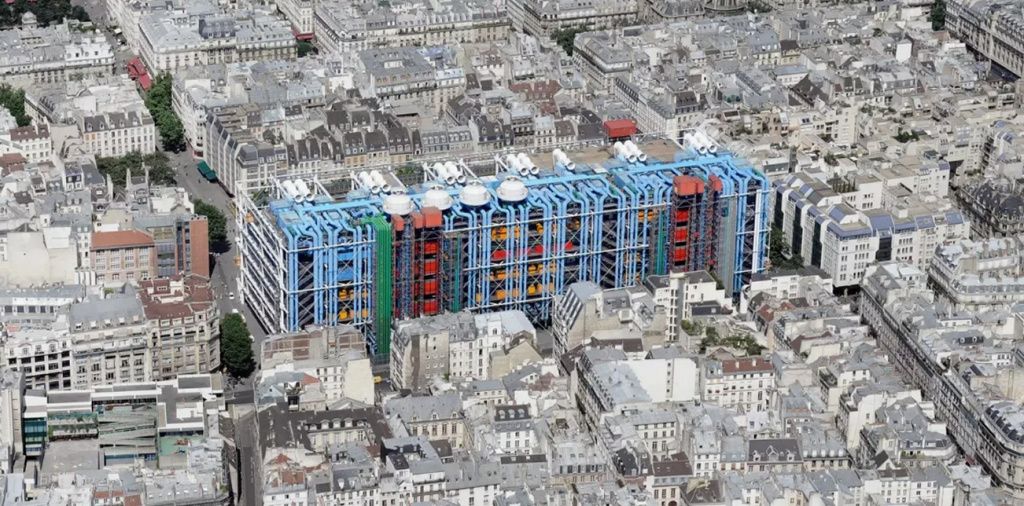
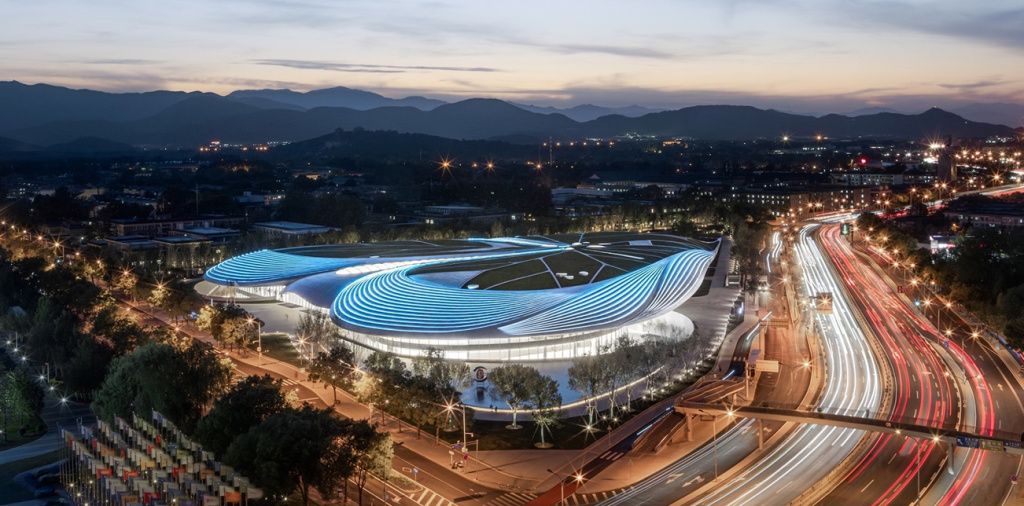
Global Analogues: According to the organizers, the Moscow National Center "Russia" is intended to rank among the world's largest expo complexes. In some respects, it is compared to Expo City Dubai , the legacy of Expo 2020, where a permanent museum and exhibition cluster was also created after the expo's conclusion. In other respects, the project resembles the Centre Pompidou in Paris (as a multifunctional cultural space) or the National Center for Technology and Innovation in Beijing . However, the Russian center will be unique in that it combines the functions of a classic museum of achievements, a cutting-edge venue for business events, and a public park. This complexity has led to it being called the future architectural symbol of 21st-century Moscow .
Economic and social significance
The launch of the National Center "Russia" will have a significant impact on the development of Moscow and the country as a whole – both economically and socio-culturally. Above all, the center will provide a powerful impetus for the capital's development as a tourist and business destination . Millions of tourists visiting Moscow are expected to make the center a must-see, alongside the Kremlin and the Tretyakov Gallery. This, in turn, will increase demand for hotels, restaurants, and city tours, boosting the hospitality industry. International exhibitions and congresses held at the site will attract thousands of foreign delegates, strengthening Moscow's position in the global exhibition and convention services market.
For the city, the project also means significant infrastructure improvements . The Moscow City district will receive a new park, pedestrian areas, and improved transport accessibility. During construction, utility networks will be modernized, new access roads will be built, and the nearby metro station or Moscow Central Diameters (MCD) may be expanded. All of this will be a benefit to the city and its residents for decades to come. Moreover, the implementation of such a large-scale construction project means jobs: at the peak of construction, thousands of specialists will be employed on site, and after the complex opens, its maintenance, operation, and hosting events will require a large staff (preliminary estimates put the permanent staff at at least 1,500). Thus, the center will create new jobs and opportunities for businesses (cafes, shops, and service providers).
The center's social significance is even broader. It is intended to become a unifying force for society, a space where residents across the country will feel a connection to their homeland. Exhibits on the achievements of Russia's regions, the history of great discoveries and heroic deeds, will instill pride in the country, especially among young people. It's no wonder that one of the goals is to strengthen national identity—through an introduction to Russia's culture and achievements, visitors to the center will develop a deeper sense of belonging to a single, multinational nation. The center will also become a platform for intercultural dialogue: international events, symposiums, and exhibitions of other countries' achievements (which can also be held in its halls) will foster openness and cooperation.
Much attention is paid to the development of children and youth . The center's programs—competitions, festivals, and educational initiatives—are aimed at identifying and supporting talented young people from across Russia. Here, schoolchildren from the provinces can showcase their inventive projects to the entire country, and students can find like-minded people and mentors. This environment of creativity and innovation will help shape a new generation of engineers, scientists, and entrepreneurs in the long term. The center could serve as a kind of "social elevator," providing equal opportunities to prove themselves regardless of birthplace or income.
The emergence of such a new venue is a colossal enrichment for Moscow's cultural life. The National Center "Russia" will complement existing museums and exhibition centers, but will occupy its own unique niche. It will showcase projects that previously lacked space or format. For example, large-scale immersive exhibitions about the future, demonstrations of scientific achievements, and presentations of regional cultures will now have a permanent "stage." The center will be able to host events on the level of global forums, from a technology forum to a cultural Olympiad. Its multifunctionality will ensure year-round occupancy: while one hall hosts an energy conference, another will host an art exhibition, a youth concert in the square, and a food festival in the park. The city will gain a new attraction , enlivening the business district even on weekends and evenings.
Finally, from an international perspective, the National Center "Russia" will become an important part of the country's image. It will be a destination for foreign guests, delegations, and tourists to see a cross-section of Russia's best assets in one place. Such a center will effectively serve as a permanent "calling card" for the state. Foreign partners will be able to hold their national days, technology exhibitions, and cultural exchanges there—especially relevant in a context where direct dialogue between countries is sometimes difficult. With such a center, Moscow will strengthen its status as a global city, open to cooperation and showcasing its achievements to the world.
In summary, it can be confidently stated: the National Center "Russia" is more than just a building or an exhibition. It is a living organism that will grow and develop along with the country. It will connect the past (preserving the legacy of the exhibition-forum), the present (showcasing current successes), and the future (inspiring new achievements). Its construction is an investment not so much in concrete and glass, but in the future of people , in knowledge, culture, and pride for the Motherland. When this center opens its doors in 2028–2029 in its new form, it will undoubtedly become the place where the pulse of modern Russia beats—great, forward-looking, and open to the world.
The article uses media materials from the architectural studio ATRIUM
Related materials:
The National Center "Russia": a new architectural symbol of the capital
The new National Center "Russia" in Moscow City, replacing the Expocentre (renderings)
The new national heritage preservation center for the "Russia" exhibition in Moscow City