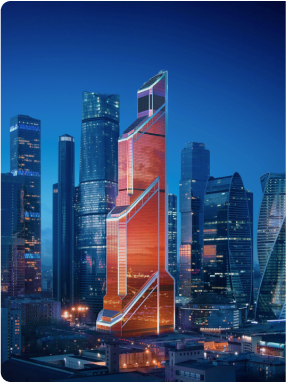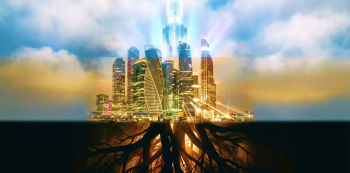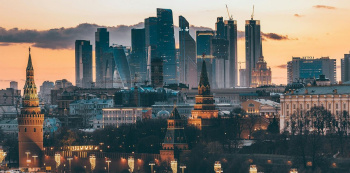



On the site of the legendary Expocentre Fairgrounds on Krasnopresnenskaya Embankment, in close proximity to Moscow City and Krasnaya Presnya Park, one of the largest cultural projects in modern Russia is being formed – the National Centre "Russia" (NCC) .
The decision to build it was made in 2024, and preparatory and engineering work on the site began in 2025.
From Expocentre to the National Centre
For decades, Expocentre remained the country's premier exhibition complex, a symbol of Soviet and Russian business activity. However, by the mid-2020s, the traditional exhibition format gradually gave way to new cultural and educational formats.
This is why the government decided to transform the Expocentre site into the National Cultural Centre "Russia"—a large-scale public space combining exhibition, concert, educational, and media functions.
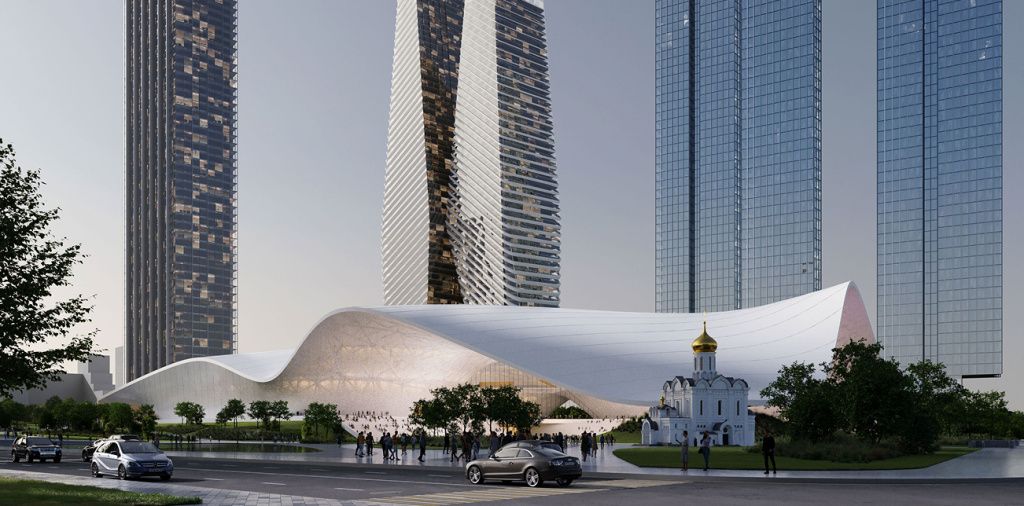
According to official information, the project is being implemented on a site of approximately 14 hectares, with the total area of the future facilities exceeding 205,000 square meters. The complex will include:
-
multifunctional exhibition spaces with an area of approximately 60,000 m²;
-
a concert hall with 3,500 seats;
-
amphitheater under a domed roof;
-
educational and creative clusters for youth;
-
new generation media center.
The official completion of construction is scheduled for 2029.
Two architectural lines: ATRIUM and TIC-PROJECT
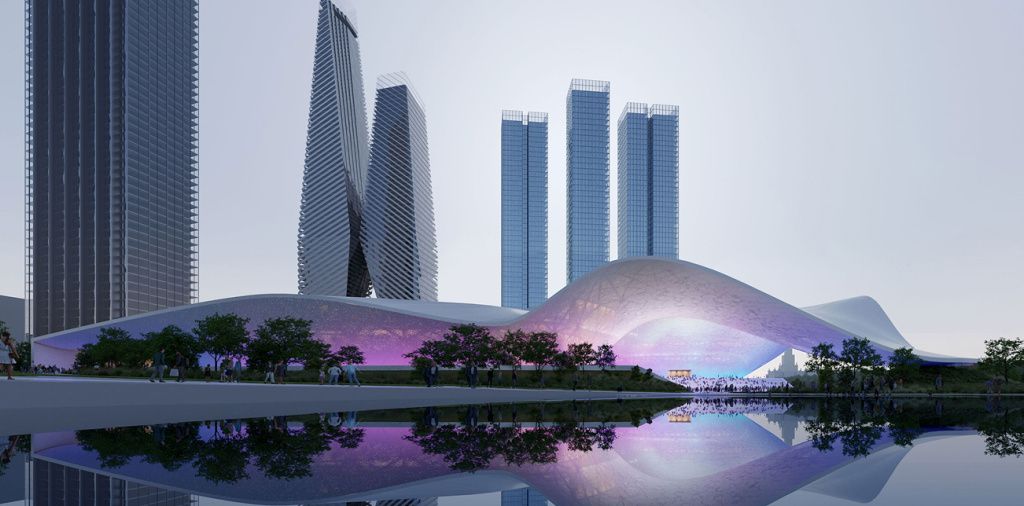
The accepted concept was developed by the architectural firm ATRIUM, whose design was recognized as the baseline. It includes a single, wave-like volume for the center, integrated into the embankment and park, as well as a system of public spaces that transition into pedestrian routes and green terraces.
The complex's image alludes to the idea of an "open Russia"—flexible, modern, and uniting different cultures and regions.
However, before the ATRIUM concept was approved, other options were also considered.
Specifically, in 2024, the TIK-PROJECT bureau, commissioned by Expocentre JSC, presented an alternative development concept for the area. This project, published on the bureau's official website, was not formally accepted for implementation, but it contains a number of solutions that could form the conceptual basis for the future NCC.
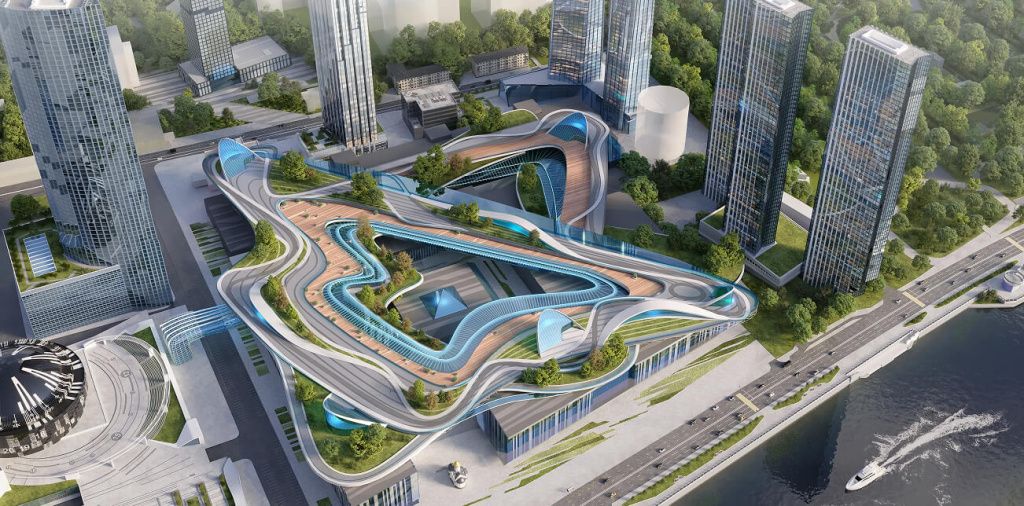
TIKE PROJECT's ideas: green roofs and bionic towers
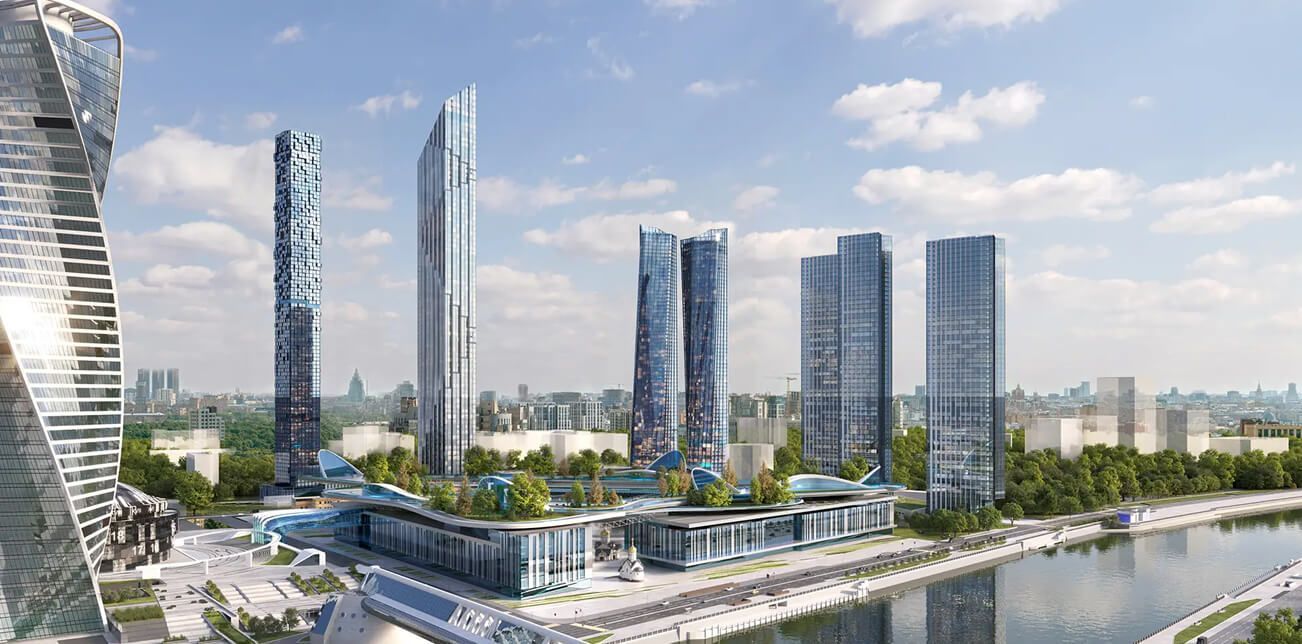
In their version, the architects at TIK-PROJECT proposed a redevelopment of the existing Expocentre buildings, with a thorough reconstruction and adaptation for modern public use.
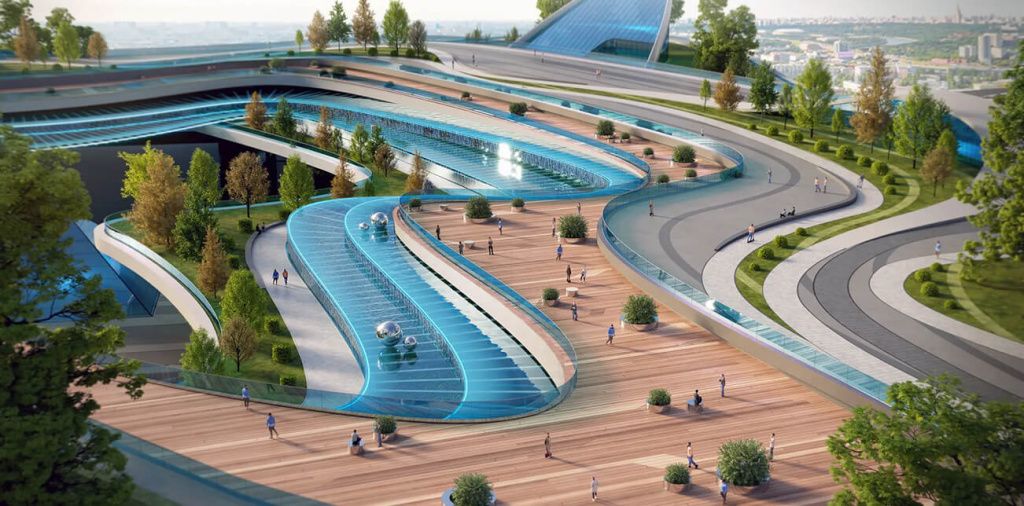
Key elements of the concept:
-
green roofs and walking paths along the roofs of the pavilions, creating a single “above-ground park”;
-
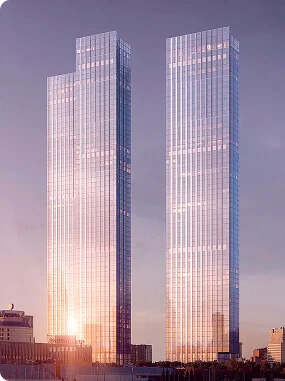
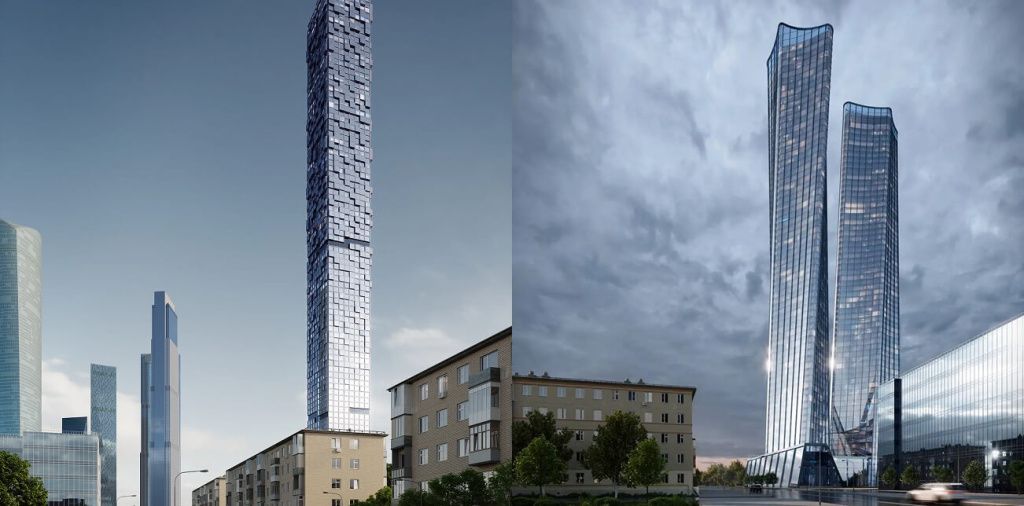
two bionic towers near Krasnopresnensky Park, combining residential and office functions;
-
A premium residential skyscraper on the site of a former energy center across the street from the main complex—a neat, laconic architecture that matches the scale of the neighboring Moscow City towers.
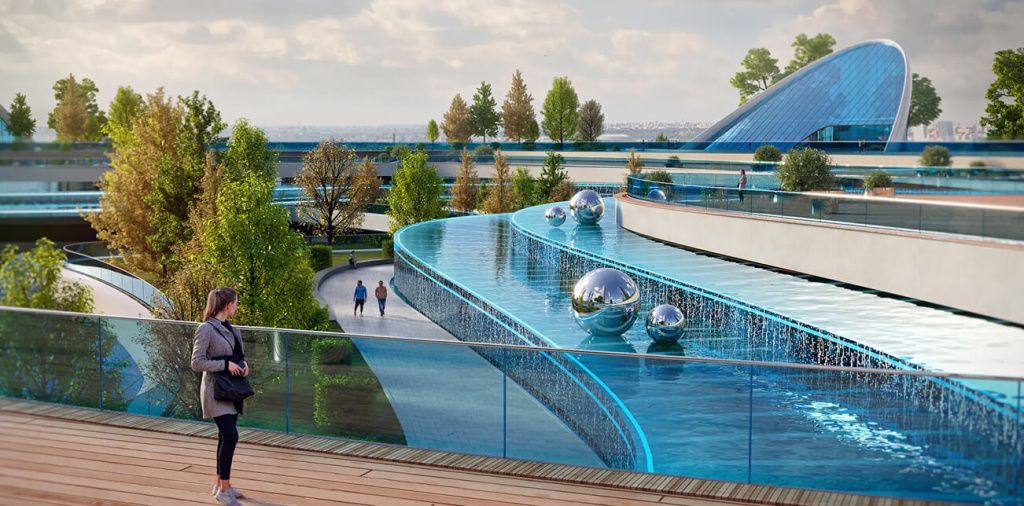
Although these ideas did not make it into the final version of the NCC "Russia," experts note that they set the direction for spatial thinking—the search for a dialogue between architecture, nature, and urban dynamics.
Some visual elements, including the silhouette of the so-called "clothespin" skyscraper, subsequently began to appear in other projects related to the Presnya area and the business cluster.
What will happen to the surrounding areas?
Expocentre's utility and public utility areas, located along the embankment and on the other side of Krasnopresnenskaya Road, have not yet been formally included in the approved ATRIUM concept.
However, their location—in the Moscow-City area and the future National Cultural Centre—makes development of these areas virtually inevitable.
According to urban development analysts, these areas may eventually acquire the following functions:
-
premium class apartments and offices;
-
representative premises for delegations and residences of creative institutes;
-
or cultural and hotel facilities that support the concept of the NCC.
While there are no official decisions yet, the logic of the development of central Moscow suggests that the new towers discussed within the TIK-PROJECT project may return as separate development initiatives after the completion of the first phase of construction.
The project's significance for the city
The creation of the National Center "Russia" is not only a new point of attraction, but also an architectural link between the historic Presnya and Moscow-City, between Soviet modernism and contemporary technological aesthetics.
Moscow authorities emphasize that the project will be an example of "smart redevelopment": preserving the urban framework while simultaneously infusing it with modern features.
"Russia" on Krasnaya Presnya will be more than just an exhibition pavilion, but a multi-level public space combining culture, education, media, business, and recreation.
On the site of the old Expocentre, a new symbol of the era is being born – a center where the past and future of Russian architecture come together at a single point.
Although the ATRIUM concept was approved for implementation, the ideas embodied in the TIK-PROJECT project undoubtedly influenced the formation of the new appearance of Presnenskaya Embankment – the “second core” of Moscow City.
Related materials:
The National Center "Russia" in Moscow City: Design, History, and Significance
The National Center "Russia": a new architectural symbol of the capital
The new National Center "Russia" in Moscow City, replacing the Expocentre (renderings)
The new national heritage preservation center for the "Russia" exhibition in Moscow City