



The question is complex and uncomfortable, yet it can be analyzed from an engineering perspective. A modern skyscraper is not merely a tall “box,” but a multi-level system with a redundant structural scheme designed to withstand local damage without an immediate transition to progressive collapse.
Real-world cases show that even severe local impact does not necessarily lead to a global catastrophe if alternative load paths remain intact and the central core is not destroyed.

How Skyscraper Stability Works
Before discussing damage scenarios, it is important to understand the fundamental principle: a skyscraper is not simply a stack of floors placed one upon another. It is a multi-level engineering system in which each column, floor slab, and core work together, redistributing loads and providing structural reserve capacity. The stability of a high-rise building is determined not only by material strength, but also by structural logic — how it responds to the loss of individual elements and whether it can localize damage without triggering a chain reaction.
Structural Redundancy
Most high-rise buildings have:
-
a rigid reinforced concrete core (elevators, stairwells, utilities);
-
a system of columns or perimeter walls;
-
outriggers (rigid core-to-perimeter connections);
-
diaphragm slabs that distribute loads.
If one element is lost, loads are redistributed. This is the key to preventing the “domino effect.”
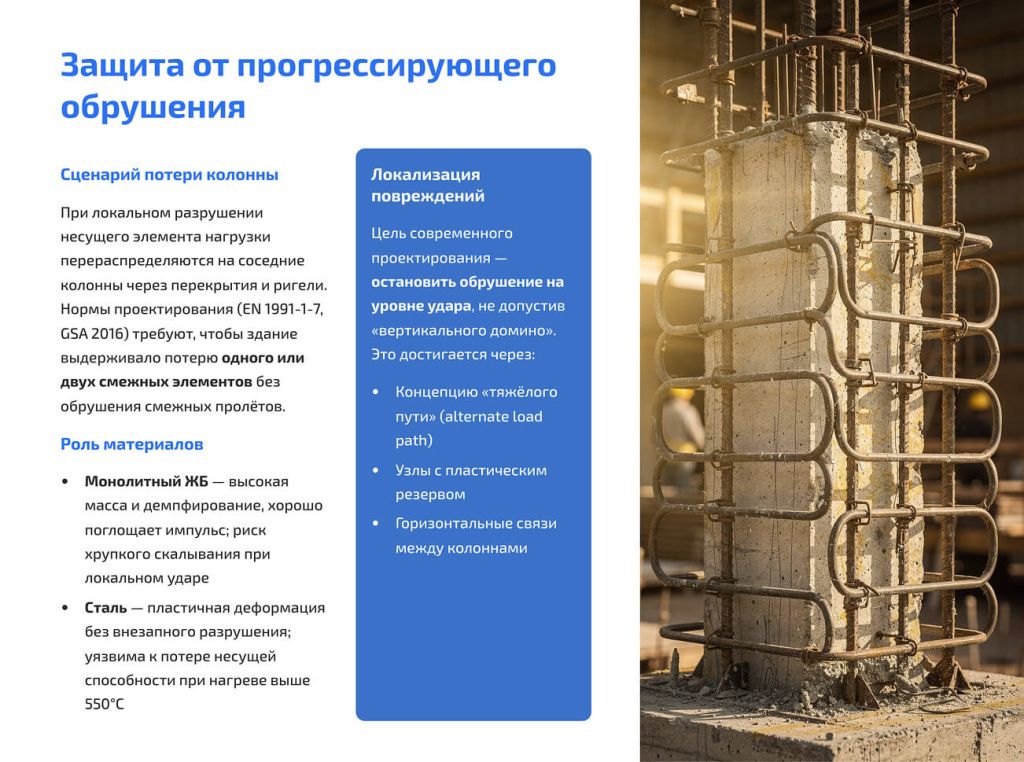
Protection Against Progressive Collapse
Modern design considers the scenario of sudden column loss.
If floor systems and joints are capable of sustaining the structure after such an event, collapse remains localized.
Material
Reinforced concrete skyscrapers provide:
-
high mass;
-
resistance to localized destruction;
-
reinforcement continuity that holds elements together even after cracking.
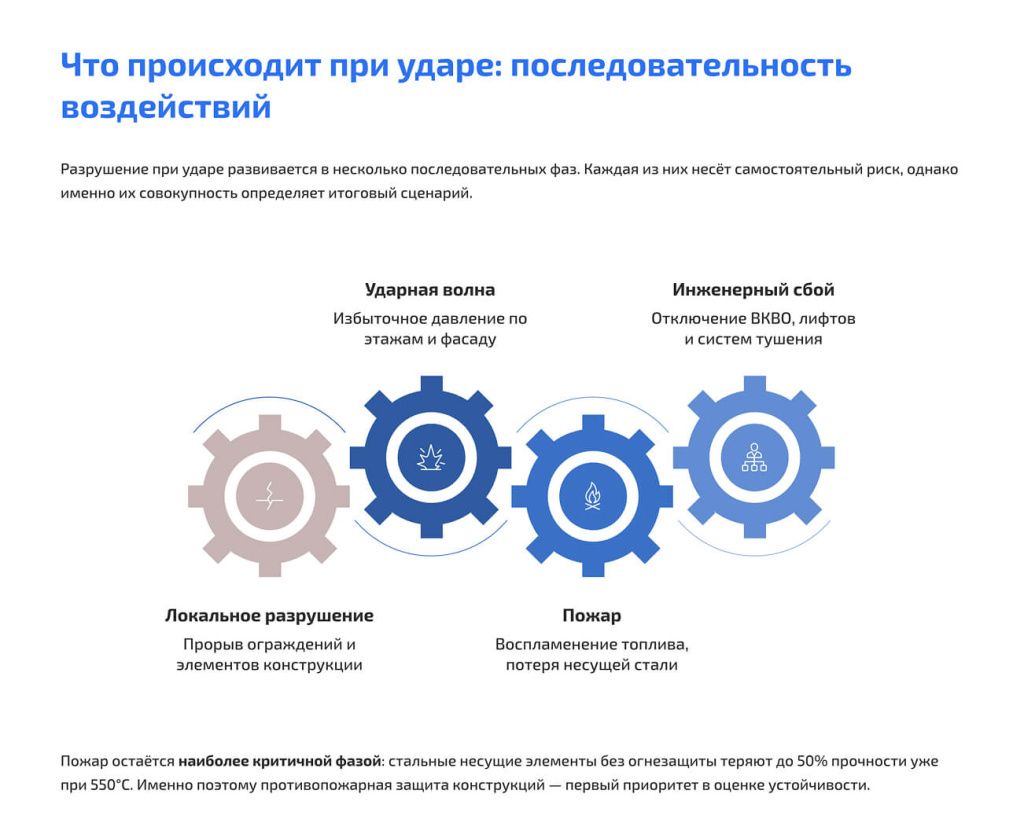
What Happens When a Missile Hits
-
Local destruction of load-bearing elements.
-
Shockwave and secondary façade damage.
-
Fire — the primary risk factor.
-
Disruption of engineering systems.
In many scenarios, it is fire and the loss of engineering systems that pose the greatest threat.
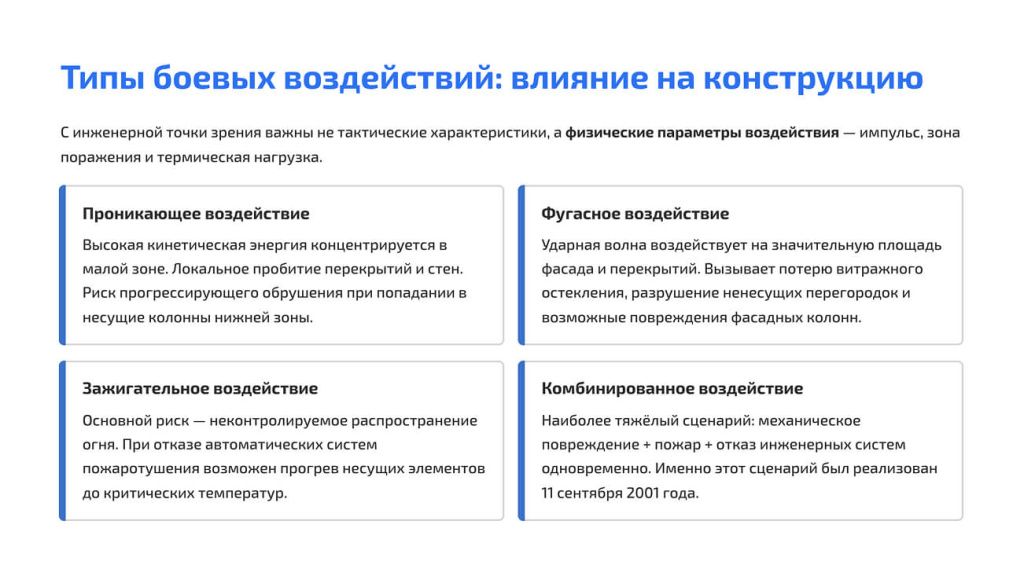
Ballistic Missiles: Types, Power, and Nature of Consequences
A ballistic missile is a delivery system that transports a warhead along a trajectory close to ballistic (with an active boost phase followed by inertial flight). They differ by range: tactical and operational-tactical (tens to hundreds of kilometers), medium-range, and intercontinental. For analyzing impact on buildings, what matters most is not range, but the type of warhead and the impact energy.
Warheads may be:
-
high-explosive fragmentation (most common in regional conflicts);
-
penetrating (designed to destroy fortified structures);
-
cluster;
-
special (including nuclear — a separate, qualitatively different scale of consequences).
With non-nuclear payloads, the warhead mass typically ranges from hundreds of kilograms to more than a ton. The destructive effect is compounded by the kinetic energy of high-speed entry as well as the blast shockwave. In urban environments, consequences include:
-
localized destruction of load-bearing elements;
-
extensive façade and internal partition damage;
-
secondary damaging factors (fragments, structural collapse);
-
fires;
-
failure of engineering systems.
For a high-rise building, the key question becomes whether the damage remains localized or leads to progressive destruction. In the case of a nuclear warhead, the scale of impact extends far beyond a single building and is determined not only by structural stability, but by blast radius, thermal radiation, and citywide consequences.
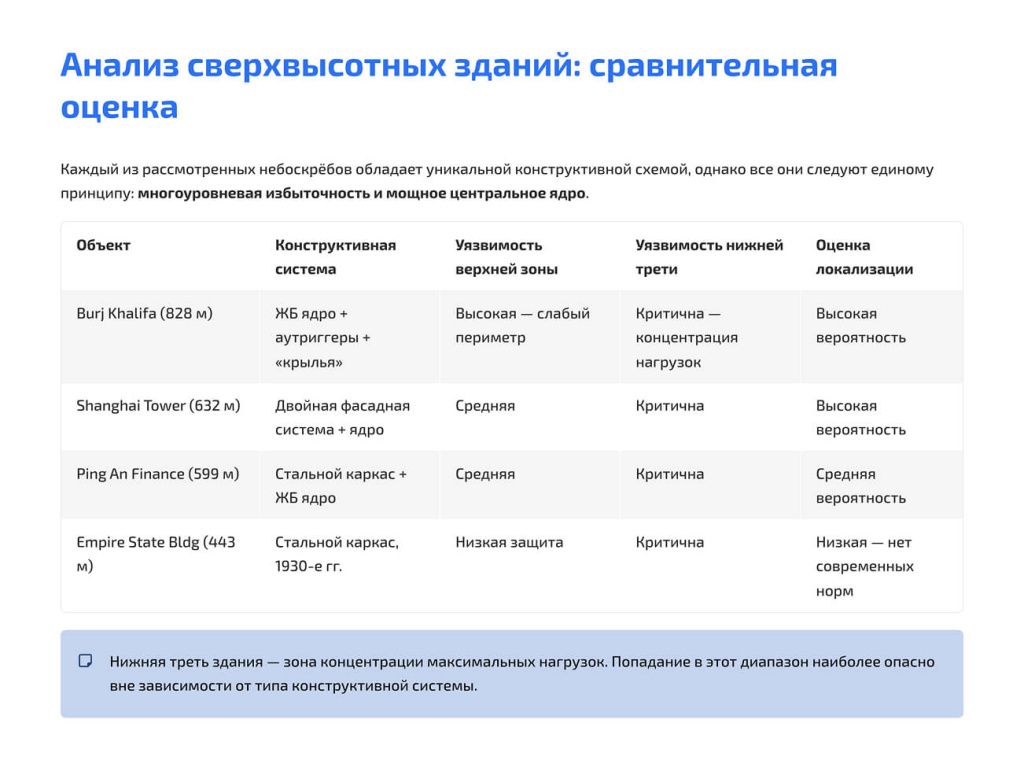
Potential Consequences for the World’s Tallest Skyscrapers
When discussing supertall buildings, scale changes everything. Different loads, different dynamics, different risks apply. The question is no longer only about the strength of individual elements, but about how a multi-hundred-meter structure behaves under extreme localized impact — whether it maintains integrity, whether damage remains confined to one zone, or whether it triggers a chain of secondary consequences.
Burj Khalifa (828 m)
Burj Khalifa is the tallest building in the world, reaching 828 meters. Its structure is based on a “buttressed core” system — a powerful reinforced concrete core with a three-lobed support scheme that provides exceptional stiffness and resistance to wind and dynamic loads. This structural logic makes the tower one of the most engineering-resilient supertall structures on the planet.
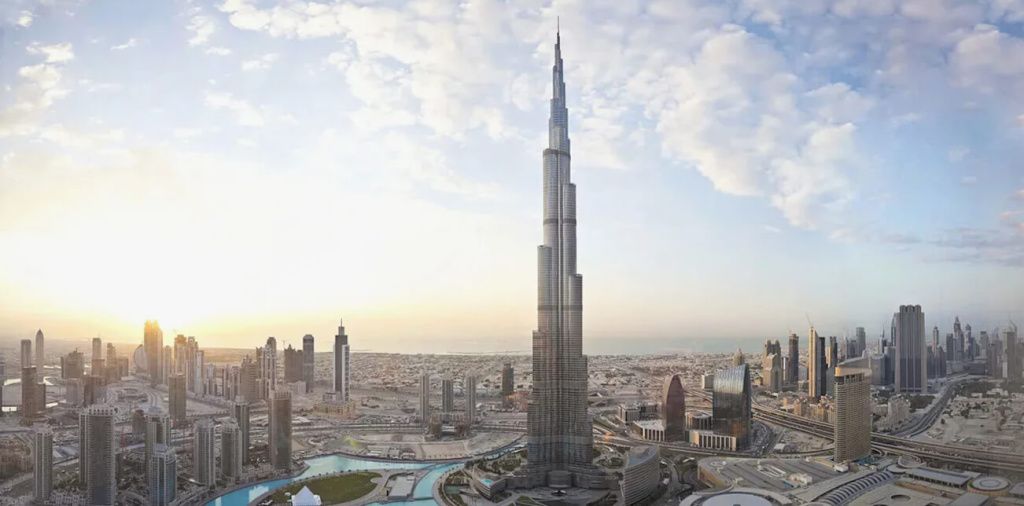
Scenario:
-
impact on upper floors — localized destruction of façade and slabs;
-
impact on lower zones — significantly more dangerous due to concentration of vertical loads;
-
global collapse without repeated strikes is highly unlikely.
Shanghai Tower (632 m)
Shanghai Tower is the second-tallest skyscraper in the world (632 m), distinguished by its complex composite structure. At its core lies a massive reinforced concrete core connected to the external frame through outrigger floors, while a double façade reduces wind loads and improves energy efficiency. Thanks to this multi-level system, the building combines flexibility and stiffness, ensuring stability under extreme dynamic effects.

Scenario:
-
severe façade damage;
-
possible dynamic consequences due to extreme height;
-
if the core remains intact — localization of destruction.
Ping An Finance Center (599 m, Shenzhen)
One of the tallest skyscrapers in the world, built using a composite scheme: a powerful reinforced concrete core combined with a steel frame and an outrigger system.
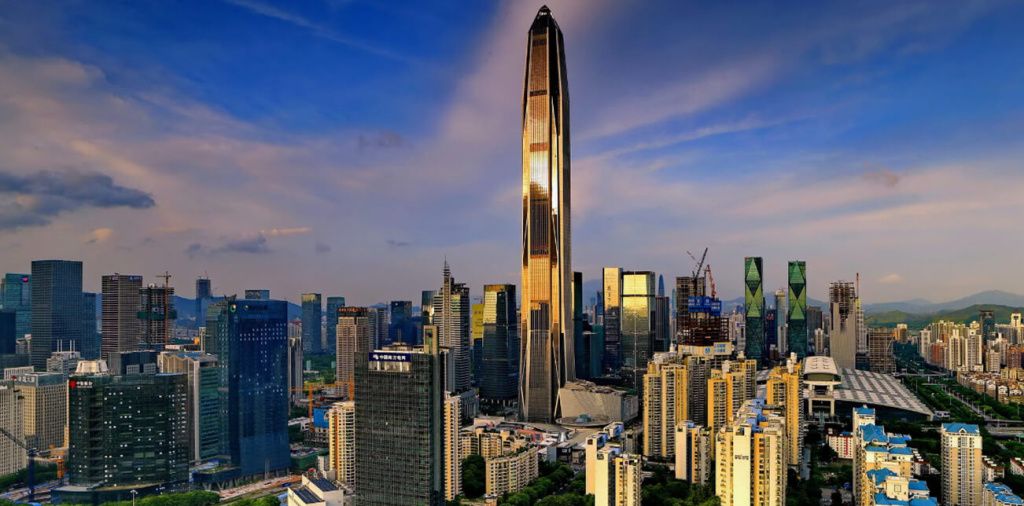
Scenario:
-
impact on the upper section — likely localized destruction of slabs and façade without loss of overall stability;
-
damage to outrigger floors may temporarily reduce stiffness but does not necessarily lead to progressive collapse;
-
the lower third of the building is most critical, where maximum vertical loads are concentrated.
Empire State Building (443 m)
Empire State Building is a legendary skyscraper 381 m tall (443 m including the spire), completed in 1931. Its structure consists of a massive steel frame with a dense grid of columns and beams typical of the early era of high-rise construction. Thanks to high structural redundancy and the strength of steel, the building has substantial load-bearing reserve capacity. Despite its age, the frame system with evenly distributed elements makes it resistant to localized damage, although modern safety and anti-collapse standards are significantly stricter today.

Scenario for the Empire State Building:
-
localized destruction of steel frame and floor slabs in the impact zone;
-
significant façade and internal partition damage;
-
possible fires with risk of loss of fire protection for steel structures;
-
if the primary frame grid and connections remain intact — high probability of damage localization without progressive collapse.
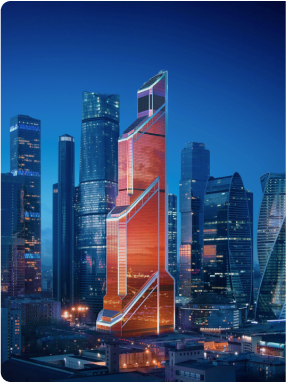
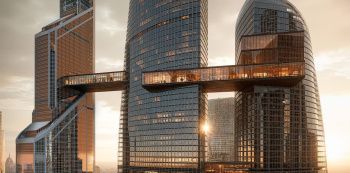
Some Towers of Moscow City
The business cluster Moscow City includes some of the tallest buildings in Europe:
-
Federation Tower
-
OKO
-
Neva Towers
-
Mercury City Tower
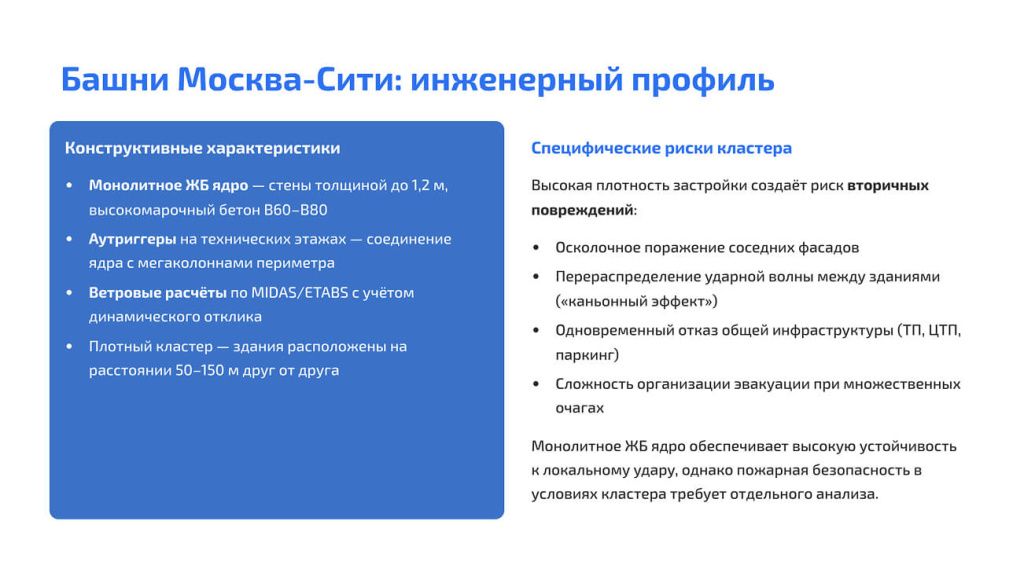
Structural Features of the Cluster
-
Most towers are monolithic reinforced concrete with a powerful central core.
-
Outrigger floors are used.
-
Enhanced wind design calculations (height 300–370 m).
-
Advanced fire-safety infrastructure.
Possible Impact Scenario
-
If the upper part is hit — localized destruction of the façade and part of the floor slabs.
-
If the core is hit — serious functional limitations (elevators, evacuation).
-
The lower third of the building is the most sensitive, where maximum loads are concentrated.
A Feature of Dense Development
Moscow City is a compact cluster.
Possible risks:
-
secondary damage to neighboring towers;
-
constrained evacuation routes;
-
difficulty for emergency services to operate.
However, from a structural-scheme standpoint, the towers are designed for significant wind and operational loads, which increases their overall structural resilience.
Real Confirmed Cases of Strikes on High-Rise Buildings
High-rise buildings have already faced extreme external impacts in real history — from accidental aircraft collisions to deliberate attacks and missile strikes. These events became not only tragic episodes but also important engineering precedents, making it possible to analyze how structures behave under local destruction, fires, and system failures. Practical experience from such cases provides a more objective understanding of the limits of skyscraper resilience than any theoretical scenarios.
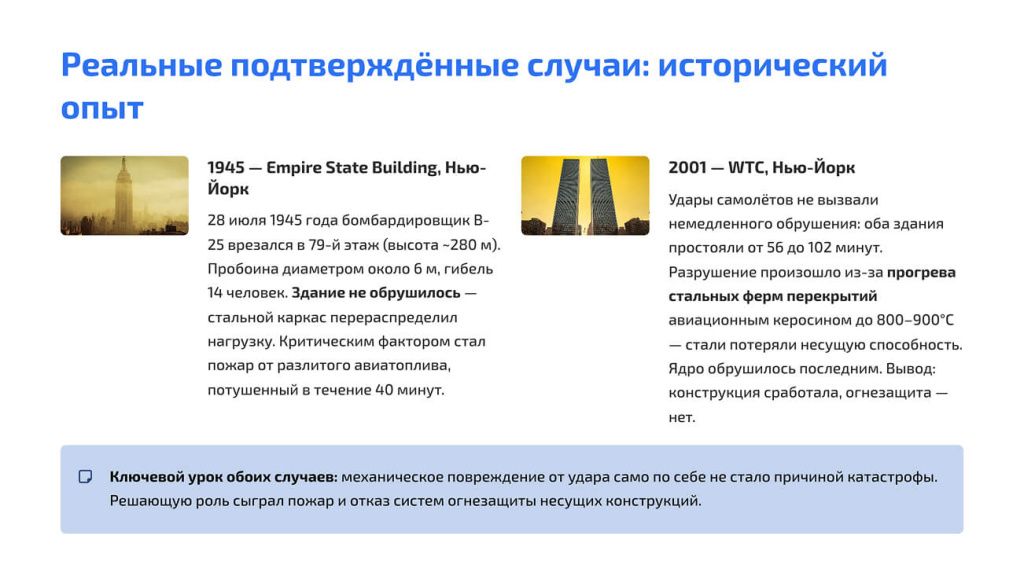
July 28, 1945 — Aircraft Strike on the Empire State Building
In dense fog, a U.S. Army Air Forces B-25 Mitchell bomber crashed into the northern side of the Empire State Building at approximately the 78th–80th floors. The impact breached the façade and caused a fire, killing 14 people. Despite severe localized damage, the load-bearing steel frame retained stability, and the building partially returned to operation within a few days. This case is still regarded as an example of the high structural redundancy of a frame system.
September 11, 2001 — Destruction of the World Trade Center
Passenger aircraft hit the World Trade Center towers (WTC 1 and WTC 2) in New York. The initial damage destroyed part of the columns and floor systems; however, prolonged fires played the critical role, weakening the steel structures. Within several hours, both towers fully collapsed. The WTC 7 building also later collapsed. Official investigations emphasized that the decisive factor was the combination of mechanical damage and thermal effects.
Modern Missile Strikes on Multi-Story Buildings
In armed conflicts of recent years, missile hits on residential and administrative high-rise buildings in the Middle East and Eastern Europe have been documented. In most confirmed cases, destruction was localized — façade damage, collapse of отдельных floor slabs, and the outbreak of large-scale fires — while total collapse occurred much more rarely.
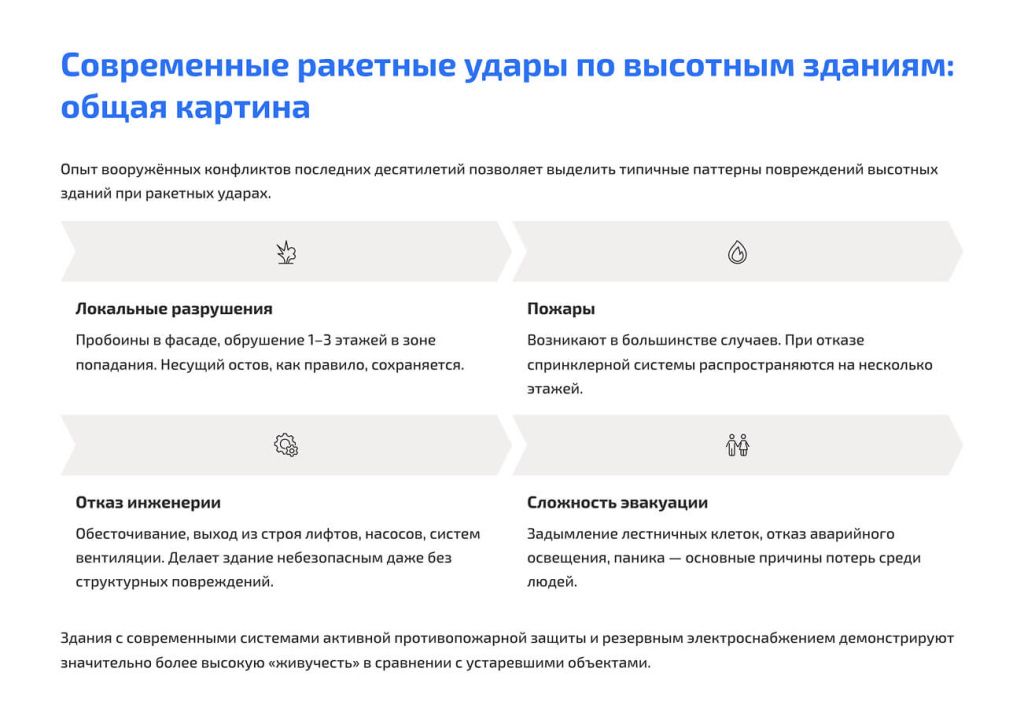
Common confirmed consequences of such strikes:
-
localized destruction of load-bearing and enclosure elements;
-
intense fires as the main factor escalating damage;
-
failure of engineering systems and elevator equipment;
-
difficulty of evacuation and emergency response operations.
These cases show that the outcome is determined not only by the power of the strike, but also by the building’s structural scheme, the behavior of materials under heating, and the structure’s ability to localize damage without allowing progressive collapse.
Comparison with an Earthquake
An earthquake and a missile strike are two fundamentally different types of extreme impact on a high-rise building. In the first case, the structure experiences prolonged dynamic oscillations along its entire height; in the second, it faces a sharp localized impulse and the risk of subsequent fires. Comparing these scenarios helps clarify which engineering solutions increase a skyscraper’s overall survivability regardless of the nature of the threat.
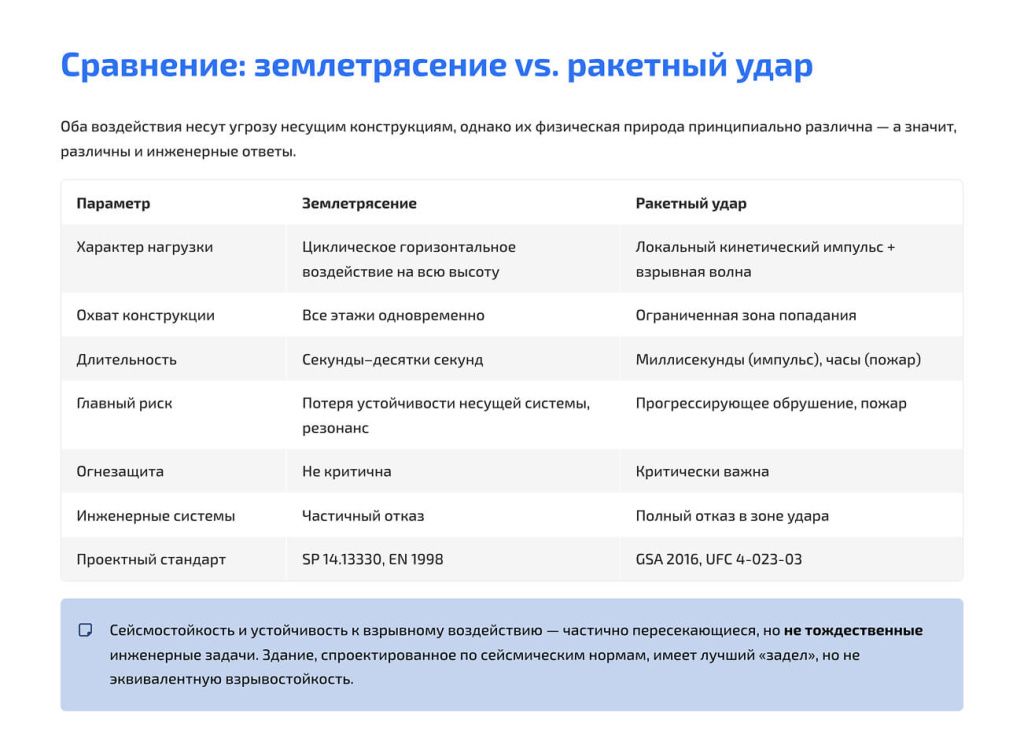
Earthquake:
-
affects the entire building;
-
cyclic loading;
-
requires ductility and energy dissipation.
Missile strike:
-
localized impulse;
-
risk of progressive collapse;
-
fire is critical.
Seismic solutions (stiff cores, ductile connections, dampers) indirectly increase resilience to extreme localized impacts as well.
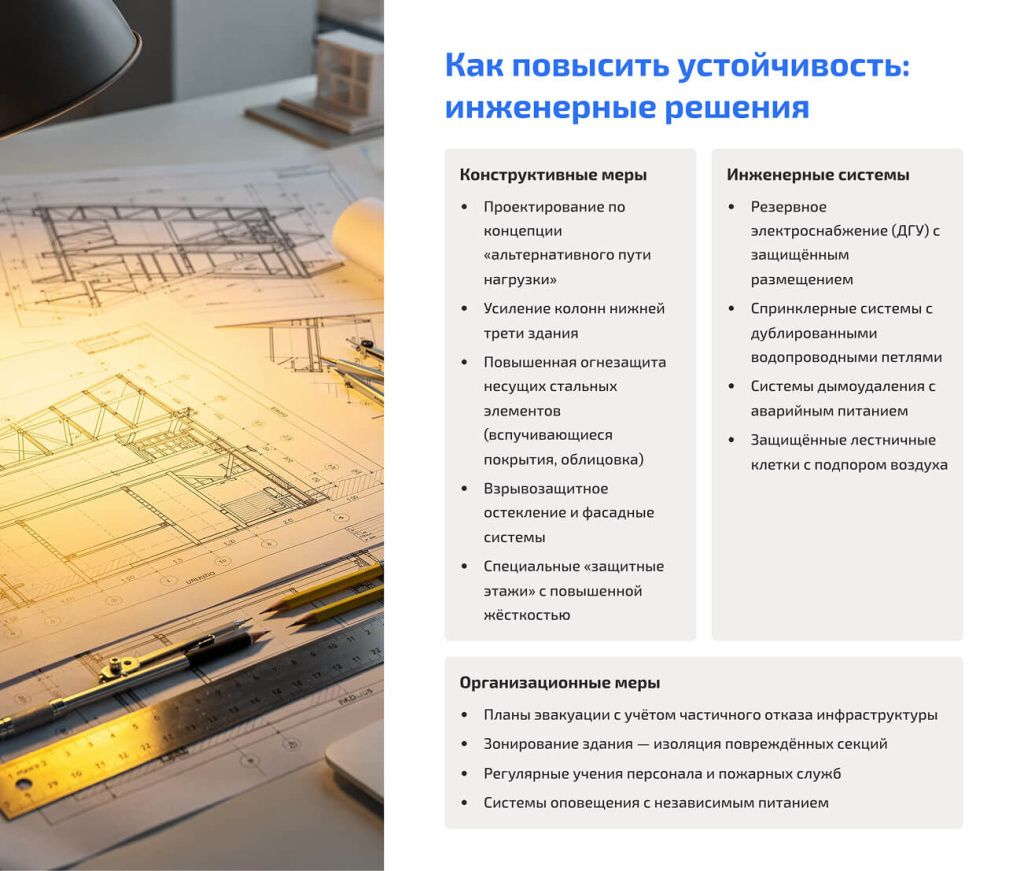
How to Increase Resilience
Structurally
-
designing alternative load paths;
-
reinforcing critical zones;
-
using high-strength concretes;
-
additional reinforcement continuity.
Engineering Systems
-
redundancy of power supply;
-
protected utility shafts;
-
automatic fire-suppression systems.
Organizationally
-
deformation monitoring;
-
readiness for rapid strengthening measures;
-
emergency response scenarios.
Conclusion
A modern skyscraper is a system with a high degree of redundancy.
A single severe strike does not mean inevitable global collapse.
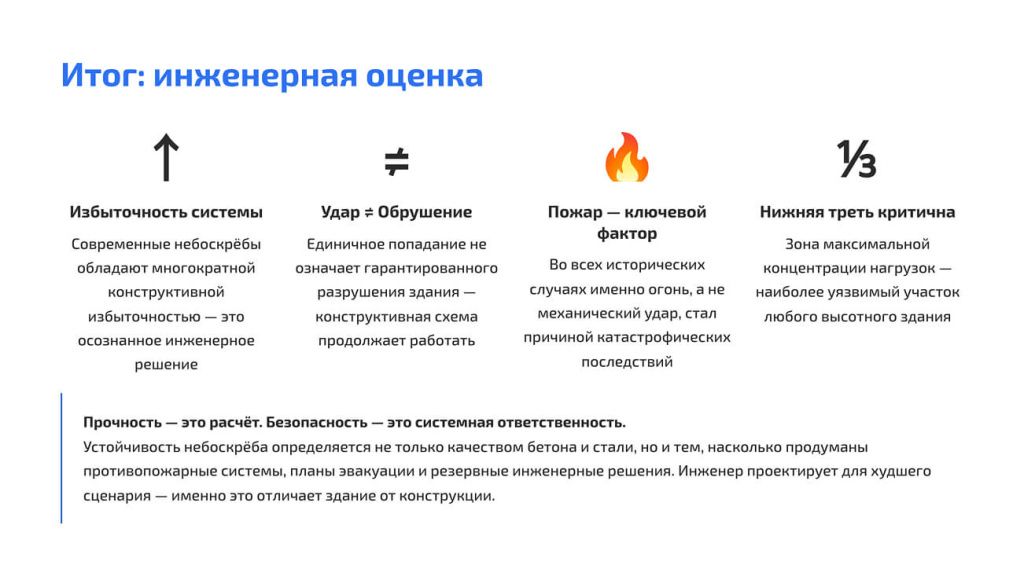
However:
-
the consequences may be functionally severe;
-
recovery may be prolonged;
-
fire remains the primary amplifier of destruction;
-
the lower floors are the most critical.
21st-century engineering has significantly increased the survivability of high-rise buildings, including the towers of Moscow City and the world’s supertall structures.
But the main conclusion remains unchanged: structural strength is a matter of calculation, and urban safety is a matter of responsibility.