



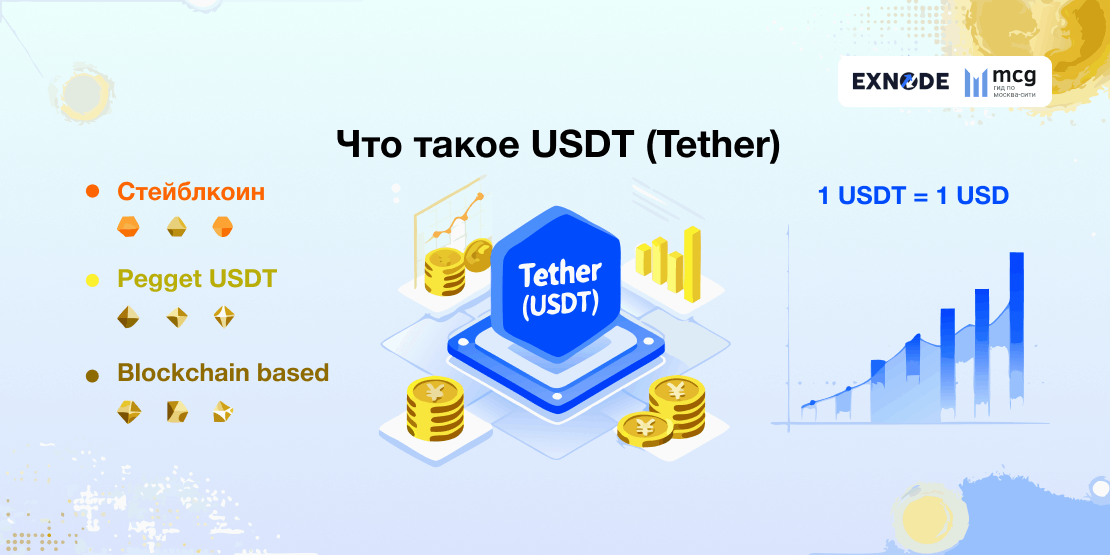
Stablecoins have become an important part of the cryptocurrency infrastructure. Their role is to reduce the impact of high volatility, which is typical for most digital assets. One of the most well-known projects in this category is Tether and its main token — USDT. In practice, it is often used as an intermediate asset between trades. Traders move funds into a stablecoin when they want to temporarily exit cryptocurrencies that frequently change in price, while still keeping their capital inside the crypto market. In addition, the token is actively used for transfers between exchanges and for settlements within the blockchain environment.
For this reason, Tether has become one of the key instruments of the modern crypto economy. For market participants, USDT plays the role of a digital analogue of the US dollar, allowing them to maintain liquidity and work with cryptocurrencies without moving funds into the traditional financial system.
What USDT Is in Simple Terms
USDT is a digital asset that belongs to the stablecoin category. The name comes from the Tether project, which issues this token and supports its circulation on blockchain networks. The abbreviation USDT stands for United States Dollar Tether and reflects the token’s core idea — a peg to the US dollar.
The main feature of USDT is that its price aims to remain at a 1:1 ratio with the dollar. This means that one digital dollar token should correspond to approximately one US dollar. This mechanism is typical for stablecoins — cryptocurrencies with relatively stable prices. Unlike most digital assets, whose value can change significantly over a short period, stablecoins are created specifically to maintain a relatively constant exchange rate. According to TradingView, USDT’s market capitalization exceeds $100 billion, which makes it the largest stablecoin on the market.
It is also important to understand how a digital dollar differs from regular cryptocurrencies. Assets such as Bitcoin or Ethereum form their price solely based on supply and demand in the market. The token, however, was created as a tool of stability within the crypto economy. Because of this, it is used for storing funds between trades, transferring value between platforms, and making settlements in the digital environment.
Thus, Tether can be described as a cryptocurrency equivalent of the dollar, created to ensure stable settlements within blockchain infrastructure. This is why Tether has remained one of the key elements of the modern cryptocurrency ecosystem for many years.
Which Networks USDT Runs On and Why It’s Important Not to Confuse Standards
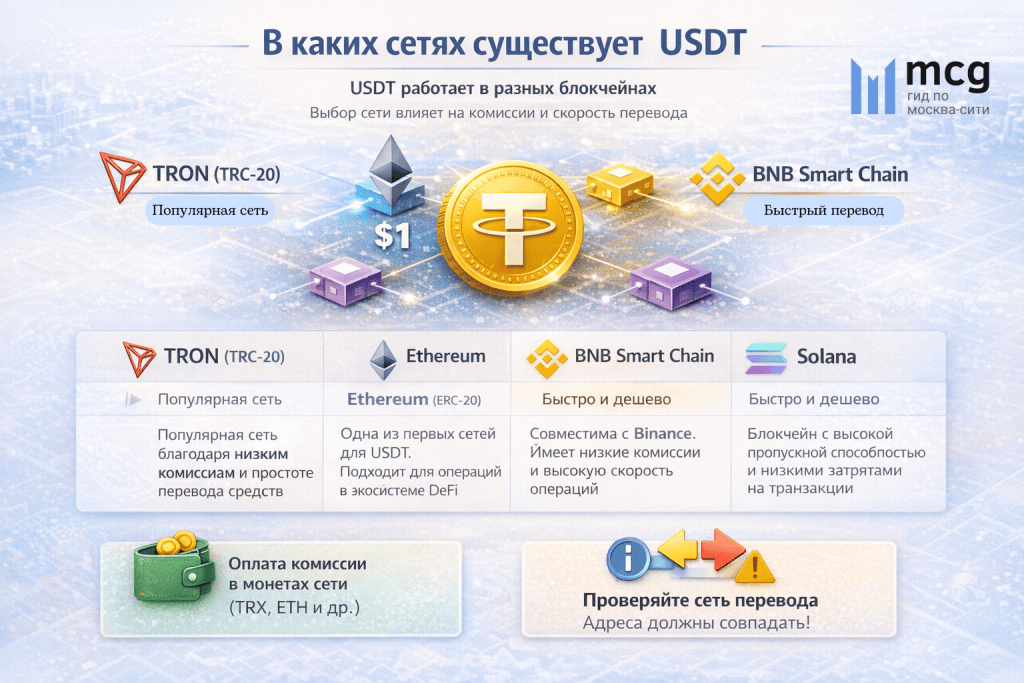
One of USDT’s features is that this token can operate on several blockchain networks at once. This is because Tether issues USDT not as a separate blockchain, but as a token within existing networks. In essence, the same digital asset can be created on different blockchains, using their infrastructure to process transactions.
This model allows users to choose a network depending on operating speed and the convenience of transferring funds. The token itself remains the same USDT — only the blockchain through which the transaction is processed changes.
Main Networks Where USDT Is Used
Today, USDT is available on several popular blockchain networks.
TRON (TRC-20)
The TRON network has become one of the most common for USDT transfers. The main reason is high transaction processing speed. For this reason, TRC-20 is often used for transfers between exchanges and crypto exchangers.
Ethereum (ERC-20)
This is one of the first blockchains where USDT appeared. The Ethereum network is widely used in the decentralized finance (DeFi) ecosystem. However, due to heavy network load, fees here can be significantly higher than in other networks.
BNB Smart Chain
A network created by the Binance ecosystem. It supports smart contracts and allows transactions to be carried out faster and cheaper than on Ethereum. The digital dollar in this network is often used in DeFi applications and cryptocurrency services.
Solana Blockchain
Solana is known for high throughput and very low fees. Thanks to this, the network is actively used for fast transfers and for working with decentralized applications.
Polygon
Polygon is a scalable solution for the Ethereum ecosystem. It allows operations to be carried out faster and cheaper, while maintaining compatibility with Ethereum’s infrastructure.
Avalanche
Another network focused on high transaction processing speed and smart contract support. In it, USDT is used across various DeFi services and applications.
Why It’s Important to Choose the Right Network
When sending cryptocurrency, you need to carefully check the transfer network. The same digital dollar token can exist on different blockchains, but the addresses and technical standards of these networks differ.
If you send funds to an unsupported network or specify the wrong standard (for example, mixing up TRC-20 and ERC-20), the transaction may become unrecoverable. Blockchain operations are irreversible, so correcting a mistake after the transfer is confirmed is practically impossible.
For this reason, before sending funds it is always important to make sure that the sender and the recipient use the same USDT network. This helps avoid loss of funds and ensures the transaction is processed correctly.
How USDT Differs from Other Cryptocurrencies
To understand the role of the Tether token in the crypto market, it is important to compare it with classic cryptocurrencies. Assets such as Bitcoin and Ethereum were created as independent digital systems with their own economies and price formation mechanisms. Tether works by a different logic — it serves as a stable unit of account within the cryptocurrency environment. Key differences:
1. Volatility
The price of Bitcoin and Ethereum is formed solely by supply and demand. Because of this, the value can change noticeably even within a single day. USDT belongs to the stablecoin category, so its price aims to remain at the level of one dollar. This stability makes the token a convenient tool for storing funds between trades and for transfers within cryptocurrency services.
2. Purpose
Bitcoin is often viewed as a digital analogue of gold — an asset for long-term value storage. Ethereum serves as an infrastructure platform: its blockchain powers smart contracts, decentralized applications, and various tokens. A stablecoin, in turn, is used primarily as a digital dollar that simplifies settlements in the cryptocurrency economy.
3. Issuance
Bitcoin and Ethereum are issued algorithmically: new coins appear as a result of network operation — mining or transaction validation mechanisms. USDT is created centrally by Tether. New tokens are issued as needed and are linked to Tether’s reserves, which, according to the issuer, back the token’s value.
For clarity, the differences can be shown in a comparison table.
| Criterion | Bitcoin | Ethereum | USDT (Tether) |
|---|---|---|---|
| Volatility | high | high | minimal |
| Purpose | investment asset | technological infrastructure | digital dollar |
| Issuance | algorithmic | algorithmic | centralized |
In practice, this means the digital dollar is typically not used for speculative price growth. Its main role is to serve as the unit of account for the crypto market. Traders move funds into USDT between trades, companies use it for international settlements, and users apply the token for fast transfers between cryptocurrency platforms.
Thus, USDT acts as a stable instrument within the cryptocurrency system, while Bitcoin and Ethereum remain full-fledged digital assets with their own price dynamics and network economies.
Fees and Transfers
When working with a stablecoin, it is important to understand that the transfer fee depends not on the token itself, but on the blockchain network in which it is used. The token exists on several networks — for example, TRON, Ethereum, or BNB Smart Chain. Each has its own infrastructure, transaction processing rules, and load level. These factors determine the cost of a transfer.
Why Fees Differ
In any blockchain network, transactions are processed by network participants — miners or validators. They add operations to blocks and receive rewards for their work. The fee is the payment for using the network’s infrastructure.
The fee size depends on several factors at once:
- the blockchain architecture;
- the network’s throughput;
- the current network load;
- the number of users sending transactions at the same time.
For example, the Ethereum network is used by a large number of applications and services. During periods of high activity, the cost of operations can increase significantly. Newer networks such as TRON or BNB Smart Chain were originally designed for cheaper and faster transactions.
Which Network Is Cheaper
Today, most USDT transfers are carried out via the TRON network. It became popular due to relatively low fees and fast confirmation times. Ethereum, by contrast, often turns out to be the more expensive option because of high network load.
For clarity, the differences can be shown in a table.
| Network | Average fee |
|---|---|
| TRON (TRC-20) | $0.5 – 1 |
| Ethereum (ERC-20) | $5 – 20 |
| BNB Smart Chain | $0.2 – 0.5 |
It is important to note that these values are indicative. The fee can change depending on the current network activity.
What the Fee Is Paid In
Another feature of blockchain transfers is that the fee is paid in the network’s base cryptocurrency, not in USDT itself.
For example:
- on TRON, the fee is paid in TRX coins;
- on Ethereum — in ETH cryptocurrency;
- on BNB Smart Chain — in BNB coins.
Therefore, even if your wallet holds Tether tokens, you will need a small balance of the network’s base coin to send funds.
Where to Store USDT
After buying a stablecoin, the next practical question is where exactly to store USDT. Technically, tokens are not stored inside an app or a device. They are recorded on the blockchain, and a wallet only provides access to managing the address and private keys.
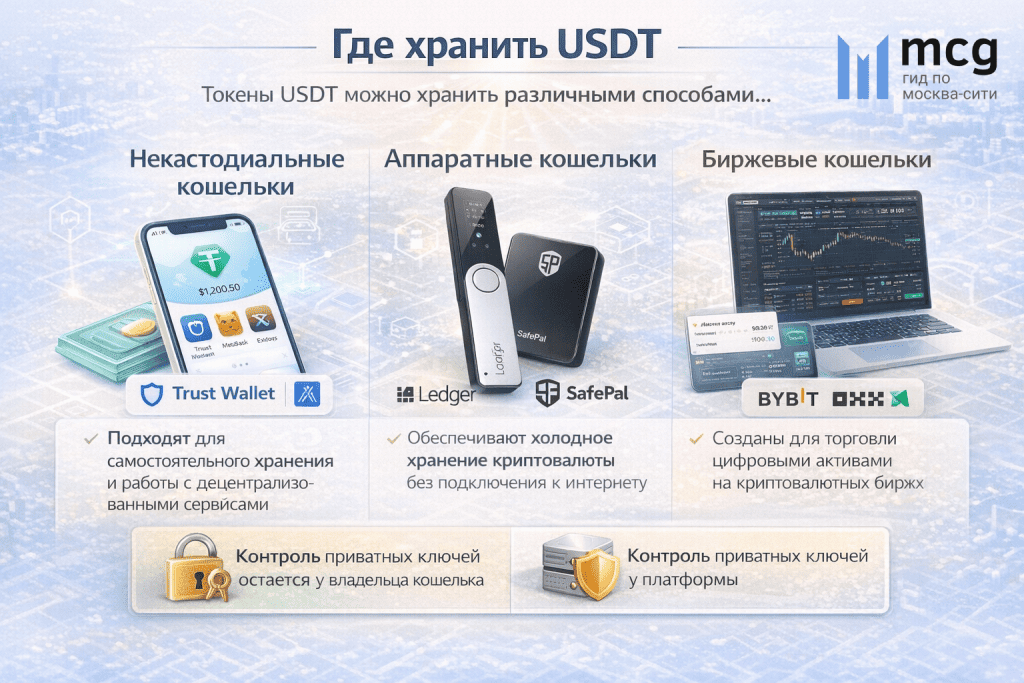
In practice, there are several main ways to store USDT. They differ in security level, ease of use, and who controls access to the funds.
Non-Custodial Wallets
Non-custodial wallets assume that the private keys are held by the user. The application generates a seed phrase, which serves as a backup way to access funds. The service developer has no ability to manage the assets or restore access.
This approach is considered more independent, since control over the cryptocurrency fully remains with the wallet owner. However, responsibility for security also lies with the user: losing the seed phrase means losing access to the funds.
Popular non-custodial wallets include: habr.com/ru/articles/507878/?ysclid=mmdrcmpuiu987401674
- Trust Wallet — a mobile wallet that supports a large number of networks and tokens;
- MetaMask — a browser and mobile wallet widely used in the Web3 and DeFi ecosystem;
- Exodus — a desktop and mobile wallet with a user-friendly interface and support for various cryptocurrencies.
Such solutions are suitable for storing funds on a personal device and for working with decentralized services.
Hardware Wallets
Hardware wallets belong to the cold storage category. These are separate devices where the private key is created and stored. It never leaves the device and is not transmitted to a computer or smartphone.
A transaction is created on the connected device, and the operation is confirmed directly on the hardware wallet itself. This mechanism reduces the risk of theft even if the computer is infected with malicious software.
Among the most well-known devices:
- Ledger — one of the most common hardware wallets with support for a large number of cryptocurrencies;
- SafePal — a device focused on secure asset storage and use with a mobile application.
Hardware wallets are more often used for long-term storage of cryptocurrency and large amounts.
Exchange Wallets
The third option is storing the digital dollar directly on a cryptocurrency exchange. In this case, the user creates an account on the platform and gains access to a balance within the system.
Technically, the cryptocurrency is stored in the exchange’s own wallets, while the user manages the funds through the account interface. This format is called custodial storage because the private keys are controlled by the platform.
Examples of exchange wallets:
- Bybit
- OKX
- MEXC
The main advantage of this option is convenience. Funds are immediately available for trading, exchanging, or withdrawing. However, the user effectively entrusts asset storage to the exchange’s infrastructure.
How Storing on an Exchange Differs from a Personal Wallet
The main difference lies in control over the private keys.
If USDT is stored on an exchange, access to funds depends on the platform’s operation and its internal rules. The user manages the balance through an account, but technical control over the assets remains with the service operator.
In non-custodial and hardware wallets, the situation is the opposite: the private key is held by the owner. This means only they can sign transactions and распоряжаться funds.
For this reason, in practice a combined approach is often used. Funds intended for active trading may remain on an exchange. Longer-term holdings, users prefer to store in personal wallets where control over access remains with the owner.
Conclusion
Tether (USDT) has become one of the key elements of the modern cryptocurrency infrastructure. Unlike most digital assets, which are subject to high volatility, USDT was created as a stablecoin pegged to the US dollar. Thanks to this, it serves as a stable unit of account within the crypto market and allows ecosystem participants to work with digital assets without constantly moving into the traditional financial system.
Today, the digital dollar is used in various scenarios: to store capital between trades, transfer funds between exchanges, make international settlements, and interact with decentralized services. The token’s infrastructure also plays an important role — it can exist on several blockchain networks at once, allowing users to choose the most convenient option in terms of fees and transaction speed.
Thus, USDT can be viewed as a digital analogue of the US dollar within the blockchain economy. It reduces the impact of market volatility and makes using cryptocurrencies more convenient for everyday settlements, trading, and international transfers. As the cryptocurrency industry develops, the role of stablecoins, including Tether, continues to grow, forming the foundation of liquidity and financial operations in the digital environment.