



The cryptocurrency market in recent years has evolved from a niche instrument into a full-fledged financial segment with its own infrastructure. Against this backdrop, demand has grown for universal platforms that combine trading, asset storage, and investment tools within a single interface. These are precisely the functions that centralized cryptocurrency exchanges perform today.
Centralized platforms remain a key element of liquidity: the main trading volume passes through them, market prices are formed on them, and access is provided to various classes of digital assets — from basic cryptocurrencies to derivatives and new tokens. For the user, this is an entry point into the market with a clear operating logic and ready-made tools.
OKX in this structure occupies the position not just of an exchange, but of a multifunctional ecosystem. The platform combines classic trading, investment products, and Web3 tools — including its own wallet, access to DeFi, and NFT services. This format reflects the general market trend: the transition from separate services to comprehensive solutions.
The geography of OKX’s operations covers more than 160 countries, which makes the platform a global player. At the same time, access to certain functions depends on local regulation: in a number of jurisdictions there are restrictions on derivatives, registration of new users, or full access to services. These factors become part of the user experience and directly affect which tools are available in a particular country.
In practice, this means that OKX operates as a single technological platform, but with a variable “overlay” depending on regulatory requirements — and this is exactly what determines how users interact with the exchange in different regions.
What is OKX and how the platform is structured
The OKX exchange is a centralized cryptocurrency platform that combines trading, investment, and infrastructure solutions within a single account. Unlike narrowly specialized services, it was originally built as a universal environment for working with digital assets — from basic buy-and-sell operations to more complex strategies and interaction with Web3.
Centralized exchange model
Like other centralized platforms, OKX acts as an intermediary between users and the market. The exchange ensures order execution, storage of funds in internal accounts, and control over operations through its own accounting system. This simplifies entry for users: there is no need to independently manage private keys or configure complex protocols — all operations take place within the platform interface.
At the same time, this model implies mandatory verification (KYC) and compliance with internal security rules. Access to account functions, limits, and tools directly depends on the level of identity verification and regional requirements.
Main platform components
The structure of OKX is divided into several key areas, each of which covers a separate scenario of working with cryptocurrency.
1. Trading: spot and derivatives
The basic level is the spot market, where users buy and sell cryptocurrency at current prices. For more advanced strategies, derivatives are available: futures, options, and margin trading. These instruments make it possible to work with leverage, hedge risks, or profit from price movements in either direction.
2. Investment products
A separate block consists of solutions for passive income. OKX offers Earn products, including staking and other asset allocation mechanisms. They make it possible to generate income without active trading, but with different levels of risk and return. The availability of some instruments may be limited depending on the region.
3. Web3 infrastructure
In addition to centralized services, the platform is developing its Web3 direction. This includes its own OKX Wallet, access to DeFi protocols, NFTs, and on-chain operations. This is a separate layer where the user already interacts not with the exchange as an intermediary, but directly with the blockchain environment.
Evolution: from trading to ecosystem
Initially, OKX developed as a trading platform focused on active traders. However, as the market grew, the emphasis shifted toward expanding functionality. Investment products, automated strategies, and Web3 services appeared.
As a result, the platform has turned into a multi-product ecosystem where the user can not only trade, but also store assets, diversify a portfolio, participate in new projects, and work with decentralized tools — without the need to switch between different services.
Geography and access restrictions
OKX is positioned as a global platform and is in fact available in most countries — its geographic presence exceeds 160 jurisdictions. However, access to specific functions and even the possibility of registration directly depend on local regulation. This is standard practice for centralized exchanges operating in different legal regimes.
Key restrictions are distributed by region:
- USA — exchange trading is unavailable due to regulatory requirements (in particular, the SEC and CFTC). Users may interact only with certain services through affiliated structures.
- Canada — registration of new users is restricted, while previously created accounts may function under a number of conditions.
- United Kingdom — restrictions apply to derivatives trading and some complex instruments.
- Asia (including Singapore, Japan, Malaysia, India) — partial or full restrictions apply depending on local requirements for crypto services.
- Sanctioned and prohibited jurisdictions — access to the platform is completely closed (including Iran, North Korea, Syria, and a number of territories with restrictions).
- European Union (partially) — in certain countries, such as France and the Netherlands, there are restrictions on the registration of new users or the use of certain services.
Separately, it is worth considering several basic conditions for working with the platform.
First, mandatory verification (KYC). Access to most functions requires identity confirmation — as a rule, this is a passport and additional data verification. The verification level affects transaction limits and available tools.
Second, the regulatory environment remains dynamic. Operating conditions may change: new requirements are introduced, access rules are revised, and lists of permitted and prohibited regions are updated. This means that it is important for the user to track current conditions rather than rely on outdated information.
Third, compliance with platform rules is directly related to account security. Attempts to bypass regional restrictions (for example, via VPN) violate the user agreement and may lead to restriction of functions or blocking of funds until additional checks are completed.
Availability of OKX for users from Russia
OKX maintains its presence in the Russian market: the platform remains available to users, including account creation and verification. Registration is possible through the standard procedure, and KYC using Russian documents is supported under general conditions.
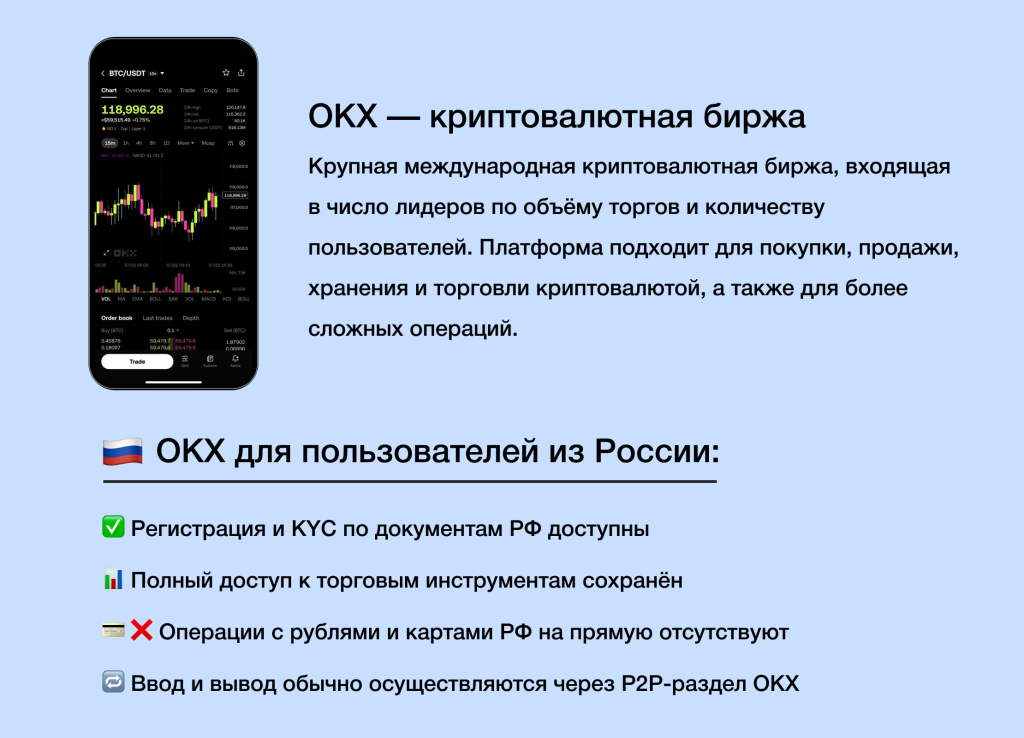
The basic functionality of the exchange has also not undergone significant changes. Users have access to spot trading, derivatives (futures and options), automation tools (including trading bots and copy trading), as well as Web3 infrastructure and a wallet. In this sense, the set of key services is comparable to what is offered in other jurisdictions.
At the same time, a number of features remain that affect the practical use of the platform:
- Absence of ruble operations in the P2P section. Settlements are carried out in other currencies, which limits the direct connection with the local banking system.
- Restrictions on investment products. Some Earn instruments are unavailable or operate in a reduced format, including products with increased yield.
- Dependence on external payment channels. Deposits and withdrawals, as a rule, require the use of third-party solutions — exchange services or cryptocurrency transfers.
Thus, the platform remains functionally accessible, but interaction with fiat infrastructure and certain investment instruments takes place taking into account the current restrictions.
How to start using OKX: registration, security, and first login
Account registration
The registration process looks as follows:
- Go to the official OKX exchange website
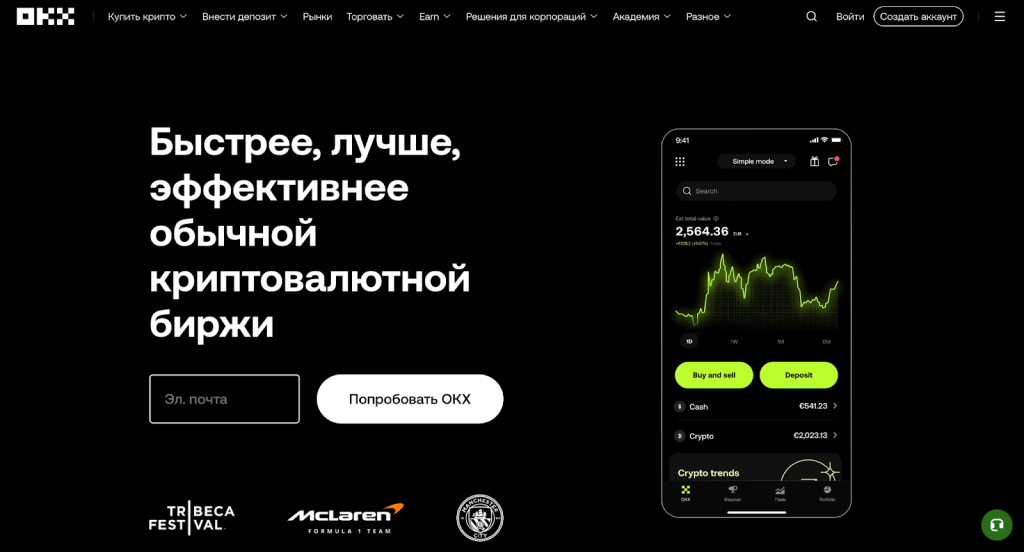
Official resource okx.com
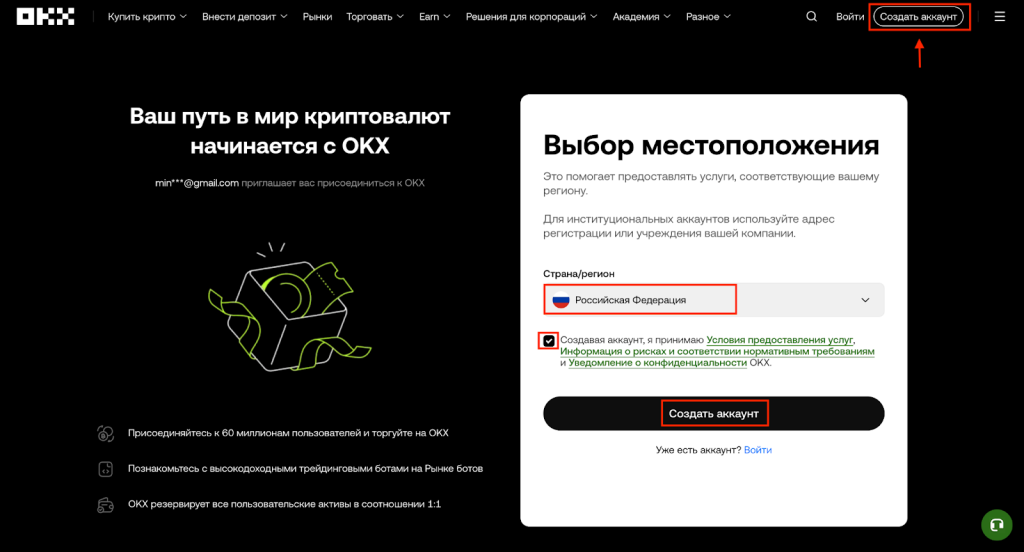
- The “Create account” button. The location is selected.
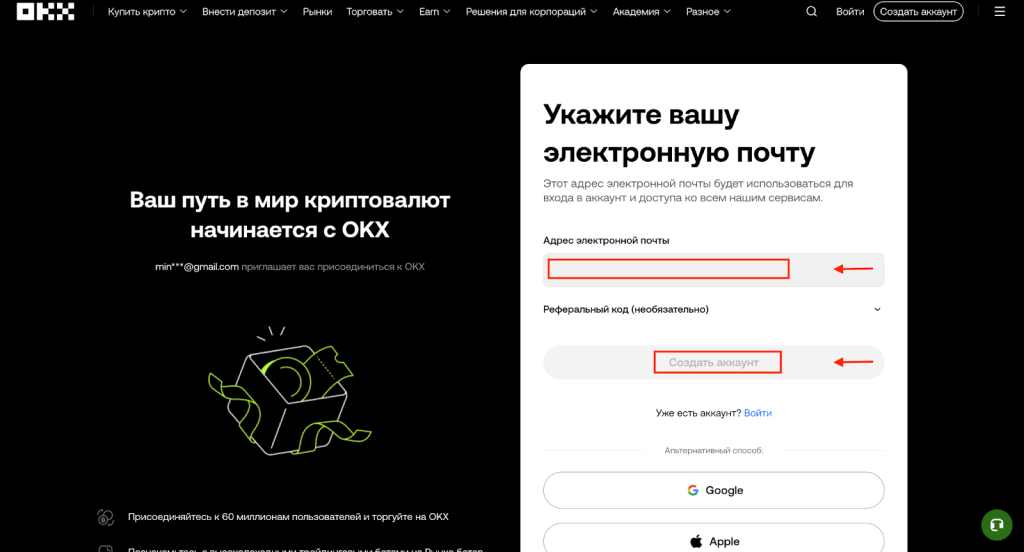
- A valid email address is entered in the registration form.
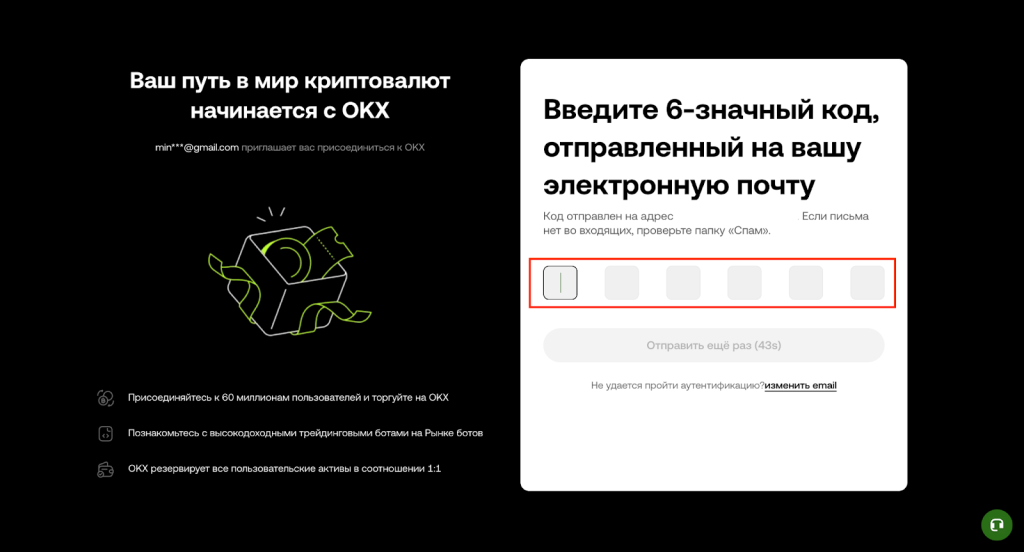
- After clicking the “Create account” button, a six-digit confirmation code is sent to the specified email address. The code is entered on the website.
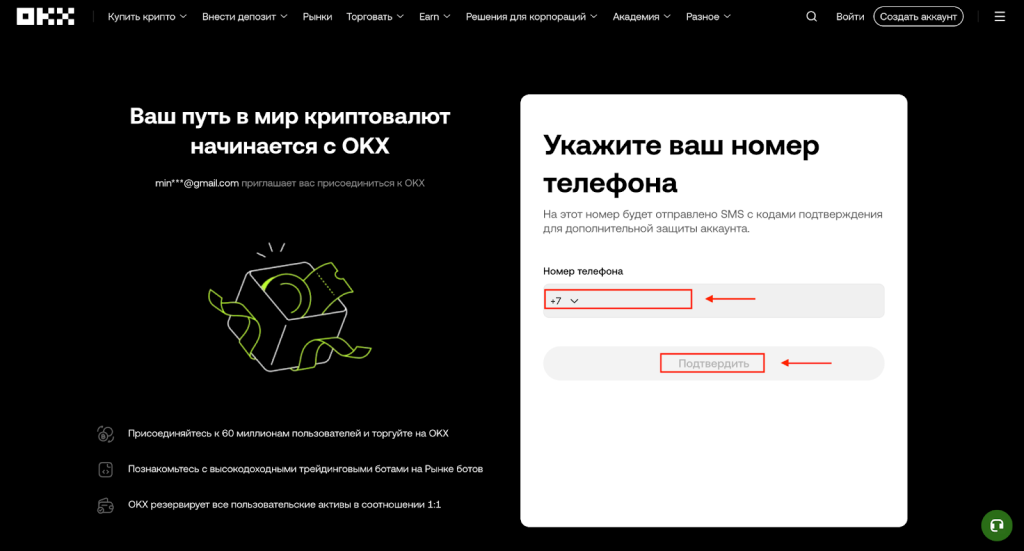
- Next, the system requests a mobile phone number. An SMS with a new code is sent to it, which must also be entered.
- At the final stage, a password for logging into the system is set.
Done. The account has been created. In the future, login is carried out using the “email — password” or “phone — password” combination.
Security settings
After registration, it is recommended to strengthen the protection of the account.
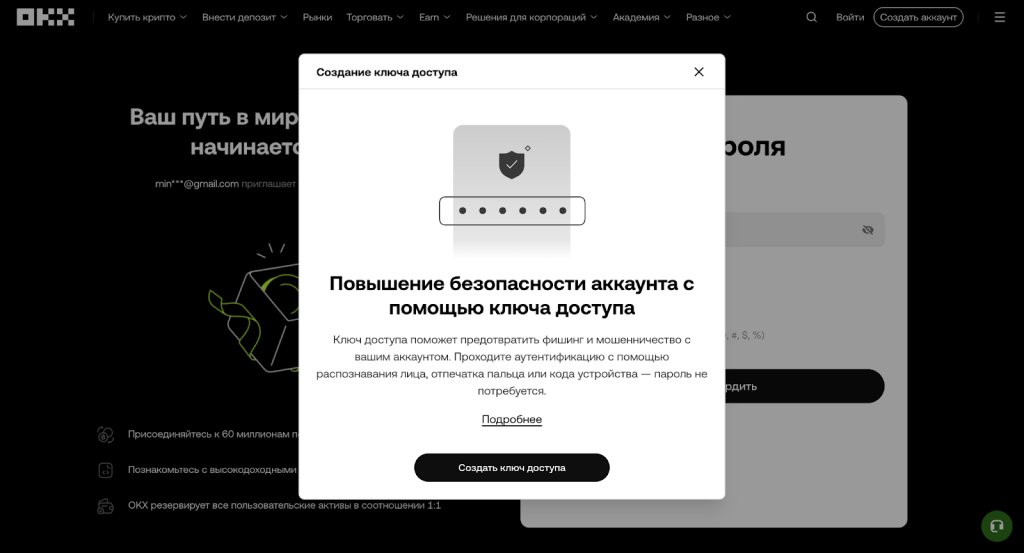
The exchange offers a standard set of security tools:
- Password. It must contain from 8 to 32 characters, including at least one uppercase and one lowercase letter, a number, and a special character.
- Phone number. Linking a number makes it possible to receive SMS notifications and confirmation codes when logging in.
- Email address. It is used to restore access and receive system notifications.
- Authenticator app. Generates one-time codes for logging into the account and confirming transactions. Recommended for use as the most reliable protection factor.
- Access keys. An alternative login method that uses the device’s biometric data (fingerprint or face) instead of entering a password.
- Anti-phishing code. The user sets a unique combination of characters. If this code is missing in an email from the exchange or is specified incorrectly, such a message is considered fraudulent.
Identity verification (KYC)
Without completing verification, the account functionality is seriously limited: deposits and withdrawals are unavailable. KYC on OKX consists of one stage — uploading documents.
To pass the check, you need to open the user menu and go to the “Verification” section.
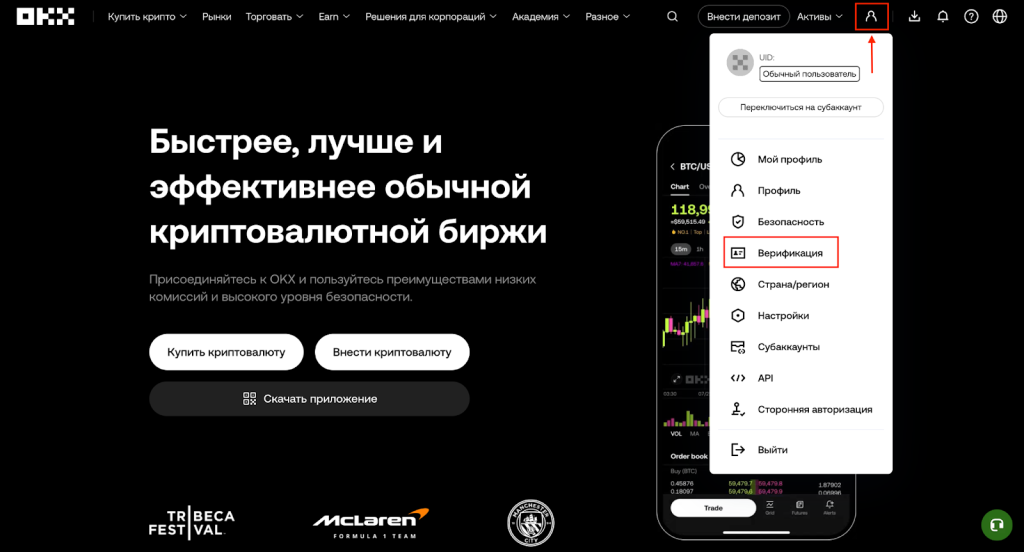
The system will request the upload of photos of an identity document (passport or driver’s license) and a selfie of the user.
Depositing and withdrawing funds
The following methods of adding funds to a trading account are available:
- Buying cryptocurrency with a bank card through the exchange’s built-in exchanger.
- Purchasing coins on the P2P market (direct deals between users).
- Depositing cryptocurrency by transfer from an external wallet or another exchange (deposit).
- Transferring assets from the OKX Web3 wallet.
- Purchase through third-party partner payment services (Banxa, Coinify, and others).
Withdrawal of funds is carried out through reverse operations: sale in the exchanger, sale on the P2P market, transfer to an external address, or to a Web3 wallet.
Available payment methods depend on the transaction currency, amount, verification status, and the user’s country of residence.
Main OKX tools (overview)
The functionality of OKX is built around several key areas that cover both basic and advanced scenarios of working with cryptocurrency.
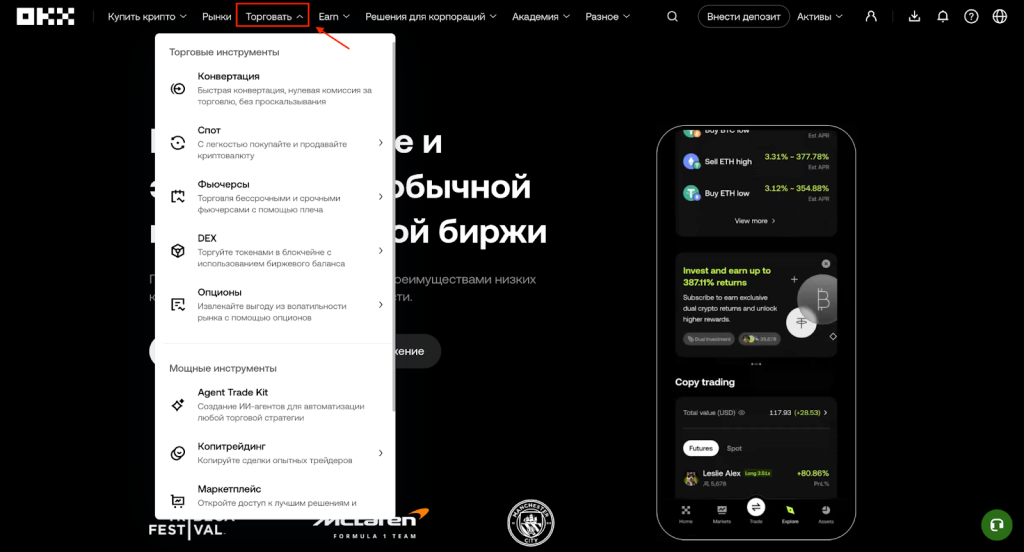 The platform combines trading, investments, and Web3 tools within a single ecosystem.
| Instrument | Brief description |
|---|---|
| Spot trading | Buying and selling cryptocurrencies at the current price or through limit orders |
| Margin trading | Trading using borrowed funds to increase a position |
| Futures and options | Instruments for hedging, leveraged trading, and working with volatility |
| Automated trading and copy trading | Algorithmic strategies and the ability to copy the trades of successful traders |
| P2P platform | Direct deals between users with a choice of payment methods (without rubles for the Russian Federation) |
| Earn and staking | Allocating assets for passive income through staking and investment products |
| Jumpstart (Launchpad) | Participation in initial token offerings and new blockchain projects |
| Web3 wallet | Access to DeFi, NFTs, and on-chain operations through OKX Wallet |
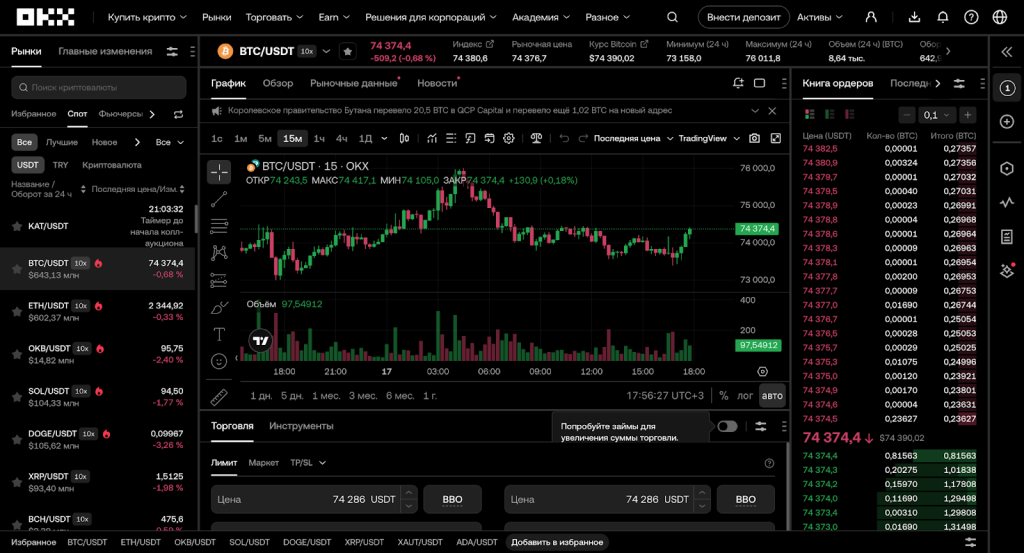
Deposit, fees, and withdrawal of funds on OKX for Russian users
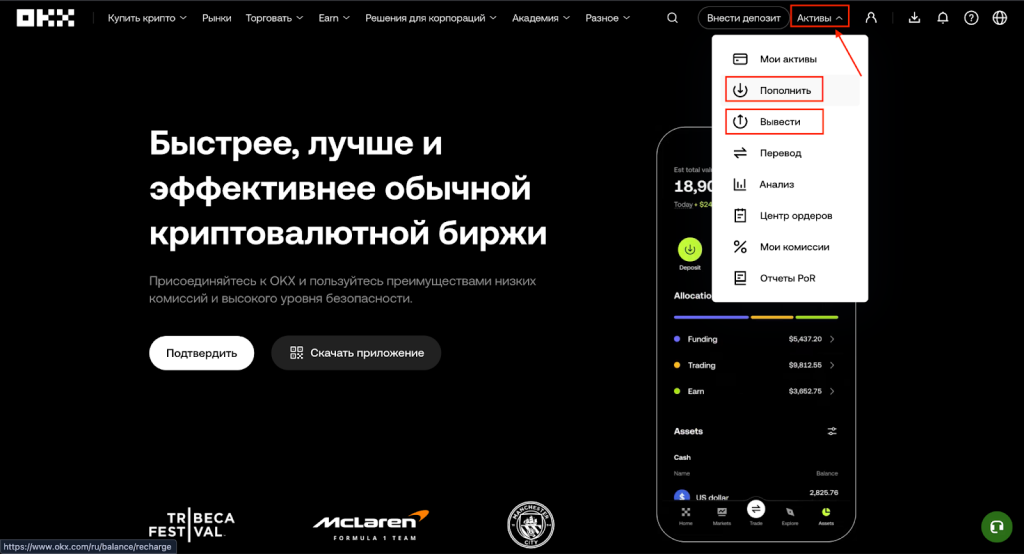
Deposit
- Log in to your account and open the “Assets” → “Deposit” section.
- Select the cryptocurrency for deposit (for example, USDT, BTC, ETH).
- Specify the transfer network (it is recommended to choose one with the minimum fee, for example TRC20 for USDT).
- Copy the wallet address or use the QR code.
- Send funds from an external wallet or another exchange.
- After the transaction is confirmed, the cryptocurrency will be credited to the spot balance (usually 5–10 minutes).
Withdrawal of funds
- Go to “Assets” → “Withdraw”.
- Select the currency and network for withdrawal.
- Specify the recipient address (another exchange, wallet, or service).
- Enter the amount and check the minimum limit and fee.
- Confirm the transaction via email and 2FA.
- The funds will arrive within a few minutes, depending on the network.
Features for Russian users
- Deposits and withdrawals most often take place through cryptocurrency, since direct ruble deposits/withdrawals on the exchange are unavailable.
- For converting fiat funds, it is more convenient to use trusted exchangers (for example, via BestChange).
- Choosing a network with a low fee helps save on transactions, especially for small amounts.
OKX fees
| Category | Maker | Taker | Notes |
|---|---|---|---|
| Spot trading (A/C class) | 0,08% | 0,10% | Standard fees without bonuses |
| Spot trading with OKB staking | up to 0,06% | up to 0,08% | Reduced fees for holding OKB |
| Futures | 0,02% | 0,05% | For perpetual contracts and standard futures |
| P2P trading | 0% | 0% | No fees, settlement through counterparties |
| Crypto deposits | 0% | – | The exchange does not charge a fee for depositing funds |
| Crypto withdrawals | – | Network fee | The amount depends on the selected network |
Storage of funds and security
The security of assets on OKX is a key aspect for users, especially under regional restrictions.
- Separation of funds – it is recommended to keep part of the assets on the exchange for trading, and the main part — in external wallets. This reduces the risk of loss in case of technical failures or temporary blocks.
- Cold wallets – for long-term storage, it is better to use hardware wallets (Ledger, Trezor). They store private keys offline, which minimizes the threat of hacking and theft of funds.
- 2FA and account protection – enabling two-factor authentication via Google Authenticator or SMS, an anti-phishing code, and login notifications increases account security and prevents unauthorized access.
- Diversification of assets – you should not keep all funds in one token or wallet. Distribution among USDT, BTC, ETH, and other assets reduces the risk of losses and allows flexible portfolio management.
This approach provides comprehensive protection of funds, combining technological tools and user discipline — this is exactly what leading financial media emphasize.
Conclusion
OKX today is not just a platform for cryptocurrency trading, but a comprehensive solution for working with digital assets. The user gets unified access to spot and margin trading, futures, options, passive income tools, P2P operations, and Web3 services — including a wallet, DeFi, and NFTs.
The platform demonstrates an evolution from narrowly focused trading to a multifunctional ecosystem where one can manage a portfolio, participate in early projects, and use both centralized and decentralized solutions. For Russian users, access to services remains available, while the specifics of local infrastructure are taken into account: there are no ruble operations on P2P, some Earn products are restricted, and deposits and withdrawals depend on external channels.
Asset security remains a priority: separation of funds between the exchange and external wallets, the use of cold storage, two-factor authentication, and diversification of the crypto portfolio make it possible to reduce risks and control access to funds.
Ultimately, OKX combines the versatility of tools, flexibility of operation in different jurisdictions, and opportunities for advanced strategies, which makes the platform relevant for both beginners and experienced participants in the crypto market.
Frequently asked questions (FAQ)
In which countries does the OKX exchange not operate?
Access to the platform is closed to users from Canada, the USA (including territories), Belgium, France (and its overseas territories), Japan, Malta, Iran, Syria, the Bahamas, Malaysia, as well as Cuba and North Korea.
Is registration from Russia allowed?
Yes, the creation of new accounts for residents of the Russian Federation is currently carried out without restrictions.
Can minors trade?
No. Full access to the exchange’s functions is granted only to persons who have reached the age of 18.
Is verification mandatory?
Yes, completing KYC is a mandatory condition for using the exchange’s main services, including depositing and withdrawing funds.
What documents are needed for KYC?
A scan of an international passport or driver’s license will be required, as well as a selfie with the document in hand.
Is it possible to have more than one account?
The OKX exchange allows opening additional subaccounts within one account.
How can I contact support?
The “Support” section is located in the upper right corner of the screen (on the website and in the application). There you can submit a request regarding the issue of interest.