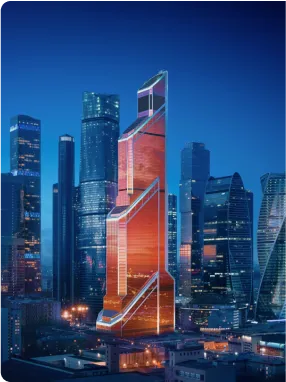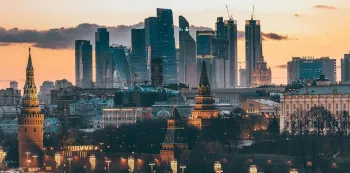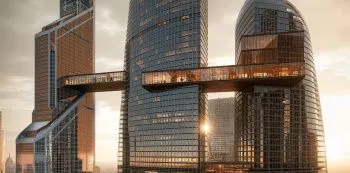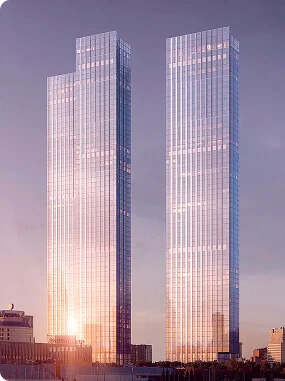




The Moscow City skyline features buildings that are taller, more austere, and perhaps more pragmatic. But if you ask which tower stands out at first glance, the answer will be obvious to many: “Evolution.” This is not just another glass skyscraper in the business district, but a rare example of a building that functions on multiple levels—as an engineering experiment, as a visual symbol, and as part of a broader international conversation about what a modern skyscraper can actually be.
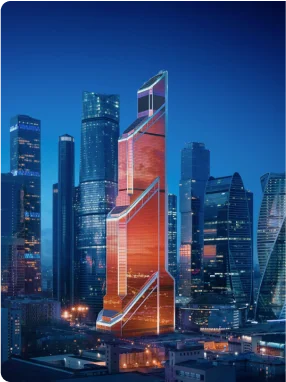
"Evolution" rises 246 meters and is one of Moscow’s most prominent skyscrapers. According to the Skyscraper Center, the building has 55 floors above ground, and in the CTBUH professional publication, the tower section is described as an 82,000-square-meter office space spread across 52 levels, where each successive level is rotated 3 degrees relative to the previous one. It is precisely this strict geometry that creates a total rotation of 156 degrees. Not a chaotic sculpture, but a precisely calculated spatial logic.

The most interesting thing about “Evolution” is that it gives the impression of an almost impossible form, yet is structured with extreme rationality. The inner core and eight columns remain vertical, while the twisting effect is created primarily by the corner zones and the facade geometry. In other words, what we see is not a “curved” skyscraper in the everyday sense, but a highly disciplined engineering scheme hidden within an expressive shell. This is precisely why the tower does not appear to be a whim of the architect: it is grounded in solid logic, not pure emotion.

From a Wedding Palace to a Symbol of “Moscow City”
The history of “Evolution” is no less important than its appearance. Initially, a completely different structure was planned for this site—the City Palace Tower, closely associated with the image of the Wedding Palace. A CTBUH technical paper describes in detail how the early concept reimagined the themes of the bride and groom, dance, two ribbons, and even yin-yang motifs. Over time, the project went through a series of revisions, the 2008 global crisis, a freeze, and a new phase of financing, but the very idea of the twisted form survived. And this is very characteristic: the objectives, investors, and economic conditions changed, but the tower’s image remained.
There is a consistency here that is rare for development projects. Many high-rises lose their character during the optimization process and become simpler, flatter, and visually cheaper. “Evolution,” on the contrary, has retained its key gesture—the spiral. Hence the power of its presence in the city: it does not look like a compromise.

Why “Evolution” is so easily recognizable from a distance
For most of the towers in Moscow City, their expressiveness is based on scale, height, sharp peaks, or a pure vertical rhythm. “Evolution” works differently. Its silhouette doesn’t just rise upward—it unfolds in motion. Because of this, the eye perceives it not as a static volume, but as a frozen gesture. It is precisely this kind of architecture that best remains in the memory: one does not need to know the architect’s name or the exact height of the building to recognize it within the overall skyline.
This quality is particularly important for a large business district. In a cluster where there is a lot of glass, metal, and buildings of similar typology, it is not always the tallest tower that stands out, but the one with its own distinctive character. “Evolution” achieved this through twisting—not a rough twist, but a smooth one—without jagged transitions or aggressive forms.

The facade as an optical machine
One of the tower’s key engineering strengths is its facade. The CTBUH publication and GORPROJECT materials highlight that cold-bent glazing technology was used here—that is, the cold bending of glass elements within the facade system. This made it possible to achieve a visually continuous, fluid shell with double curvature and avoid the “stepped” effect that often occurs with complex forms. At the time of construction, this facade was called the world’s largest cold-bent facade in terms of area within a single building.
It is the facade that transforms “Evolution” into an almost kinetic object. According to CTBUH, the glazing strip at the corners has a constant inclination of about 14 degrees to the vertical, causing the surrounding cityscape to be reflected with a rotation of approximately 90 degrees. Hence the famous visual effect: the sky and the city on the glass behave as if someone had gently tilted the familiar horizon to the side. This is not a literary exaggeration, but a real consequence of the shell’s geometry.
That is why “Evolution” is one of the few towers that is interesting to look at not only from a distance but also up close. From a distance, the overall silhouette stands out, while up close the surface comes to life: the facade does not simply reflect the city but reinterprets it.

How was it even possible to build floor by floor in such a shape?
The more complex a skyscraper’s geometry, the more costly every mistake on the construction site. For “Evolution,” this was critical because the form repeated as a system, yet each level still differed by a twist. The CTBUH specifically noted that the project required acceleration and optimization following a crisis-induced pause, and that special self-climbing formwork helped maintain the pace of construction—floor slabs achieved structural integrity in approximately six days per floor. For a high-rise building with twisted geometry, this is an impressive result.
It is telling that all this complexity did not translate into visual clutter. On the contrary, the deeper you delve into the engineering side, the clearer it becomes: the tower’s beauty does not rest on the “design” itself, but on the high degree of coordination among architects, structural engineers, facade specialists, and builders.

Space-saving elevators
Evolution has another important technological feature: vertical transportation. According to GORPROJECT and CTBUH, the project utilizes ThyssenKrupp’s TWIN system: two cabins move independently of each other within a single shaft. This allowed the number of shafts in the core to be reduced from 12 to 10, thereby reclaiming usable floor area for the building. Skyscraper Center also notes that the elevators reach a maximum speed of 7 m/s.
To a visitor, this may seem like a purely technical detail, but in reality, it is precisely such solutions that distinguish spectacular architecture from mature architecture. The tower not only looks unusual but also makes rational use of its interior space. In high-rise construction, this is fundamental.

International Recognition and Evolution’s Place in Global Architecture
“Evolution” did not remain a local Moscow sensation. The professional community took notice of the project immediately. The tower was among the finalists for the CTBUH’s specialized international awards, and in the 2015 Emporis Skyscraper Award competition, it took second place, losing only to the Shanghai Tower. For Russian high-rise architecture, this was a very notable achievement.
And this is particularly important in the context of international comparison. “Evolution” is valuable not because it is simply “beautiful” or “different from the rest,” but because it proved compelling against the backdrop of truly strong global examples of twisted architecture.

Who is “Evolution” logically comparable to?
Turning Torso, Malmö: the tower where it all began
If you’re looking for the progenitor of recognizable “twisted” skyscrapers, one of the first that inevitably comes to mind is the Turning Torso in Malmö. According to the Skyscraper Center, this is a 190-meter tower completed in 2005. The building is based on the idea of a twisted human torso and became one of the first world-famous examples of the “twisting skyscraper” as a distinct architectural genre.
It shares a kinship with “Evolution” not only in the twisting technique itself, but also in the fact that both towers create their image not through decoration, but through pure form. But there is also an important difference. Turning Torso is closer to sculpture, to the architect’s signature gesture. "Evolution," on the other hand, looks more "urbanistic": it is not detached from the business context but is integrated into the dense urban landscape of the metropolis and functions precisely as its focal point.

Cayan Tower, Dubai: the rational spiral of the luxury housing market
Cayan Tower in Dubai is another important landmark. According to the Skyscraper Center, it stands 306.4 meters tall and has 73 floors above ground. The tower twists 90 degrees, and its repeating floor plates rotate around a central core.
Compared to “Evolution,” the Dubai tower gives a more regular, almost mass-produced impression. The logic of standard repetition is more pronounced here—as if the same module were simply being neatly rotated along a spiral. In “Evolution,” the form is more delicate and emotive: the Moscow tower reveals two bands, a counter-movement, and a more complex facade drama. If Cayan Tower is the engineering purity of a gesture, then “Evolution” is already an architectural narrative.

Absolute World Towers, Canada: twisting as the living form of housing
Absolute World Towers in Mississauga are interesting in that they demonstrate: a twisted form can be not only a hallmark of a status-symbol skyscraper, but also a way to make residential towers almost organic. According to CTBUH, the taller tower in the complex has a total twist of 209 degrees, while the second has about 200 degrees. At the same time, the project demonstrates how a unique form can contribute to commercial success: the apartments sold out quickly, and the complex itself became a visual landmark of the neighborhood.
Compared to the Absolute Towers, Moscow’s “Evolution” appears more austere and composed. The Canadian project seems to emphasize physicality and fluidity, whereas “Evolution” is closer to the image of a ribbon, to rhythm and graphic design.

Shanghai Tower: When Twisting Works for Aerodynamics
The most significant contrast comes from the Shanghai Tower. Its twisted form is linked not only to aesthetics but also to aerodynamics. The CTBUH case study states that the asymmetrical twisted shell, the tapering volume, and the rounded corners helped reduce wind loads on the tower by 24 percent, and every 5 percent reduction resulted in significant savings in construction costs.
This is a very telling comparison. “Evolution” is closer to symbolic architecture: the city needs it as a strong visual sign. The Shanghai Tower takes a different approach—form as a tool for optimization. In this sense, the Moscow tower stands at the boundary of two worlds: on the one hand, it is highly fluid and artistic; on the other, its form does not undermine engineering logic but works in harmony with it.

Why “Evolution” is important specifically for Moscow
For a long time, Moscow perceived high-rise architecture either through the image of Stalinist monumentality or through the pragmatic language of a glass business center. “Evolution” occupies an intermediate—and therefore valuable—position. It is modern, international, and technologically advanced, yet not faceless. The tower demonstrates that the Russian capital is capable not only of great height but also of memorable, world-class design.
Furthermore, “Evolution” handles the theme of movement with great precision. For a business district, this is an almost ideal motif: speed, transformation, development, continuous ascent. Here, the name aligns with the image not merely in name but in essence.
What is the main secret of its appeal?
A truly powerful tower always has one defining feature: it can be explained both as a number and as a feeling. “Evolution” excels in both respects.
In terms of numbers, it is 246 meters tall, 55 stories, a 3-degree rotation per level, a total rotation of 156 degrees, the largest cold-formed facade of its kind at the time of construction, a TWIN system that saves on the core, and international professional awards.
In terms of sensation, it is a tower that alters the very nature of the gaze. It compels one not merely to note the structure on the horizon, but to question one’s own perception: has the facade truly turned the city, is the glass truly moving, can a vertical line truly resemble a dance? This is precisely why “Evolution” continues to make an impression even against the backdrop of new high-rise landmarks.

Conclusion
“Evolution” is not just a beautiful tower in “Moscow City” and not just a striking photo spot. It is one of the rare Russian skyscrapers that can confidently be placed in the international ranks alongside the Turning Torso, Cayan Tower, Absolute World Towers, and Shanghai Tower. Each of these towers has its own character: in some, the twist serves the sculpture; in others, residential comfort; and in others, wind resistance. In the case of “Evolution,” it became a way to give the business district its own emotional center.
And perhaps that is its greatest merit. It is not the tallest or the most radical in the world. But it is one of those towers that prove: high-rise architecture can be not only a matter of square footage and rent, but also a matter of character. And “Evolution” has character—a rare, recognizable, and very Moscow one.