




Over the past few years, Bitcoin has transformed from an experiment by a small circle of developers into a full-fledged financial instrument with global reach. It attracts the attention of both private users and companies, offering new opportunities for storing and transferring value.
Interest in Bitcoin is explained by its unique structure, which allows participation in a global network, making transfers and managing assets without intermediaries. The development of infrastructure and the emergence of various types of wallets make the use of cryptocurrency increasingly accessible and secure.
Bitcoin has become one of the first systems where users can store and transfer funds without banking intermediaries.
What is Bitcoin in simple terms
Bitcoin (BTC) is a digital form of money that works without banks and financial intermediaries. People can transfer funds to each other directly through a special network of computers. Each transfer is recorded in a common accounting system — the blockchain. This is an open database where a sequential record of all operations is stored, so it is impossible to change or delete transactions that have already been completed.
The operation of the network is subject to predefined rules that no one can change or influence, including government regulators. The number of bitcoins is limited by software code, so new coins appear gradually and in a strictly defined volume. Bitcoin is used for international transfers, storing funds and settlements in the digital environment, while the network operates constantly and does not depend on banks or government institutions.
History of Bitcoin (BTC)
Bitcoin was created in 2009 by an anonymous developer or group of developers under the pseudonym Satoshi Nakamoto. The date of its appearance is marked by the publication of the original paper describing the operating principle of the new digital money system. From the moment of launch, the first transaction between network users was carried out, which marked the beginning of the history of decentralized currency.
In the early stages, the network had a limited number of participants, and all transactions were reliably recorded in the blockchain and preserved in the archive. Each block contained information about transfers that could not be edited retroactively, which ensured the security of the system.
Over time, the Bitcoin network began to attract the attention of a wide audience. The value of the cryptocurrency gradually increased, reflecting demand for a new tool for storing and transferring digital value. Key events included halvings — the automatic reduction of miner rewards — as well as the recognition of Bitcoin by major companies and integration into financial services. At the same time, exchange crises showed the vulnerability of the market and the need for careful handling of the asset.
Today Bitcoin represents a full-fledged financial system where every transaction is recorded in a distributed database, and information about turnover and the annual volume of issuance can be archived for analysis and reporting.
The technology of how Bitcoin works
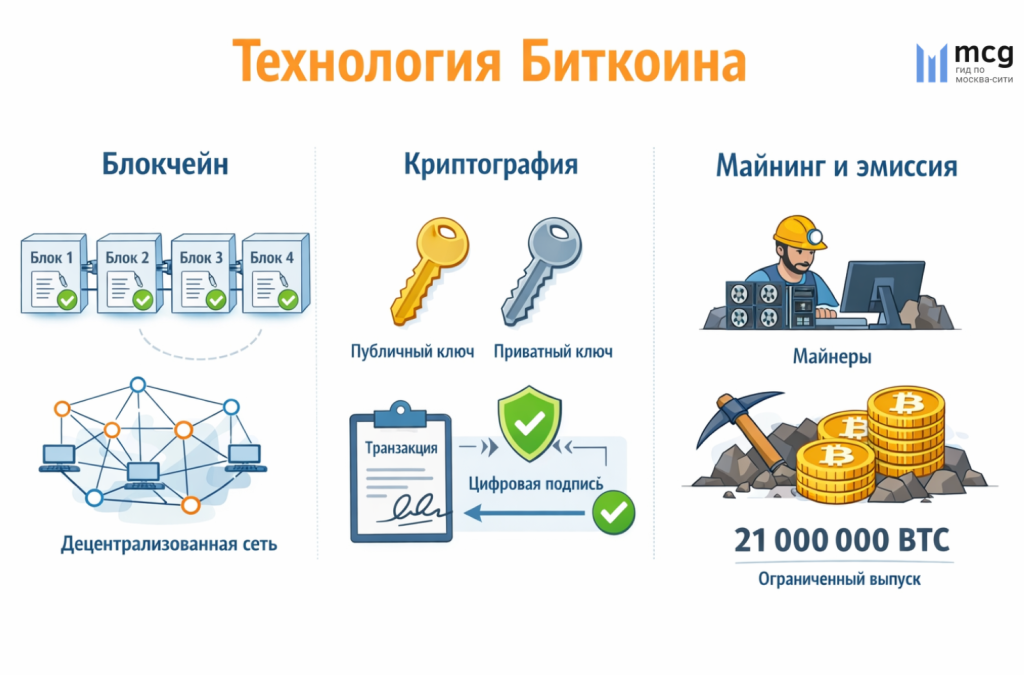
Bitcoin is not only a digital currency. Behind it stands a technological system: blockchain, cryptography, and the mechanism for issuing new coins.
1. Blockchain
Blockchain is a distributed database that records all Bitcoin transactions in sequential blocks, ensuring their immutability. Each operation is recorded in a block — a separate part of this ledger.
Blocks are connected to each other in a strict sequence: each new block contains a reference to the previous one. Such a chain makes it impossible to edit old records without the consent of the entire network.
Decentralization plays a key role. Information is stored simultaneously on many computers around the world. This means that no central authority controls the system: transaction data is verified and confirmed by all participants in the network, rather than by a single bank or government. Thanks to this, blockchain ensures the security of each transaction.
2. Cryptography
For the security of all operations, the Bitcoin network uses asymmetric cryptography. Each user receives two keys:
- Public key — a kind of address for receiving bitcoins. It can be freely shared with others.
- Private key — a secret combination of characters that gives full control over the funds.
When a user sends bitcoins, a digital signature is generated and verified by the network using the public key. This confirms that the transaction originated from the owner of the funds and was not altered. Thanks to this principle, it is impossible to forge a transfer or steal funds without the private key.
3. Mining and issuance
New Bitcoin appear through the mining process based on the Proof-of-Work algorithm. Computers in the network perform complex mathematical tasks, verifying transactions and creating new blocks. For this, miners receive a reward in the form of newly issued coins and transaction fees.
In total, 21 million bitcoins can exist in the system. This limitation is embedded in the network protocol and makes Bitcoin similar to a rare digital asset. Over time, the issuance of new coins is reduced through events called halvings, which affects the supply and value of the currency.
Thus, BTC technology combines the reliability of blockchain, cryptographic protection and a controlled issuance mechanism, providing users with independence and security when handling digital funds.
Using Bitcoin: wallets, transactions and security
To work with the Bitcoin network, a crypto wallet is needed — a software application or hardware device that manages keys and transactions. The speed of operations, convenience and level of security depend on the chosen type of wallet.
Cryptocurrency wallets
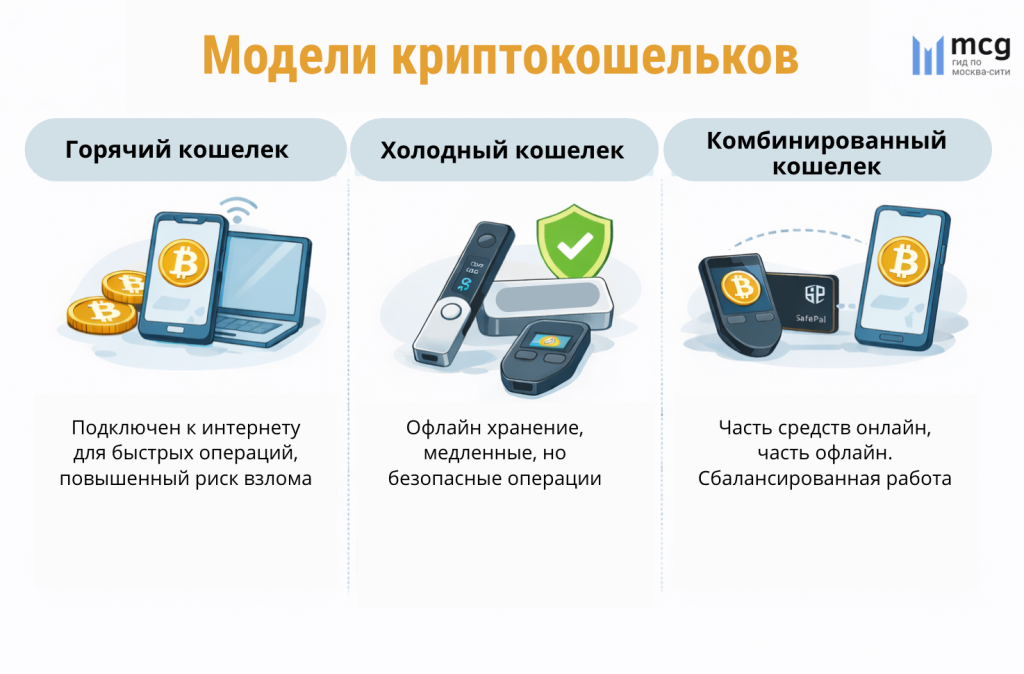
There are three main models for storing bitcoins:
- Hot wallet — a software solution that is constantly connected to the internet. Such wallets are suitable for everyday use: fast transfers, payment for goods and exchange into other cryptocurrencies. Examples: mobile applications, web interfaces, browser extensions. The main advantage is speed and convenience, while the disadvantage is the increased risk of hacking in the event of an attack on the device or network.
- Cold wallet — a device or program isolated from the internet. Private keys are stored offline, which makes their theft through the network practically impossible. Used for storing large amounts or long-term investments. Examples: hardware devices Ledger, Trezor.
- Combined wallet — combines the advantages of hot and cold storage. A small part of the funds remains available online for quick operations, while the main part is stored offline for security. Example: SafePal.
This division allows the user to independently choose the right balance between access convenience and asset protection.
Comparison of wallet models
| Wallet type / parameter | Hot | Cold | Combined |
|---|---|---|---|
| Where the key is stored | On an internet-connected device | Offline, in a device or on paper | Partly online, partly offline |
| Accessibility | Fast and convenient | Slow | متوسط |
| Security | Medium | High | High |
| Examples | Trust Wallet, MetaMask | Ledger, Trezor | SafePal |
The choice of wallet type is determined by personal preferences and goals: hot wallets are suitable for daily transfers, while cold or combined solutions are better for long-term storage and large amounts.
Public address and private key
Two types of keys are used to work with BTC:
- Public address — an analogue of an account number that can be shared with other users to receive BTC.
- Private key — a secret combination of characters that gives full control over the funds. It is never shared with third parties.
When sending a transaction, the private key creates a digital signature that is verified by the network through the public address. Thanks to this, it is impossible to forge a transaction or steal funds without access to the private key.
Sending and receiving Bitcoin
- Sending funds: the user specifies the recipient's public address and confirms the operation with the private key. The transaction is recorded in the blockchain and verified by the network.
- Receiving funds: funds are automatically credited to the public address, and information about the transaction becomes part of the chain of blocks.
Fees and transaction speed:
- The fee is paid to miners for including the transaction in a block.
- The size of the fee affects the confirmation speed: a high fee speeds it up, a low fee slows it down.
- The average processing time ranges from a few minutes to an hour, depending on network congestion.
Security
The main methods of protecting funds include:
- Seed phrase — a sequence of words that allows the wallet to be restored on any device. Losing the phrase makes it impossible to restore access.
- Hardware wallets — separate devices for offline storage of private keys, protected from viruses and network attacks.
- Two-factor authentication (2FA) — an additional check when logging into the wallet and confirming transactions, increasing the security of online operations.
Types of wallets and platforms
Different models of key storage are used to work with Bitcoin and other cryptocurrencies. The main division is into custodial and non-custodial wallets. Custodial solutions assume that private key management and fund storage are carried out by a third-party platform, such as an exchange or service. The user gains access to the funds through an account, but actual control remains with the operator. This approach is convenient for beginners because it simplifies management and reduces technical complexity, but it increases dependence on third parties.
Non-custodial wallets provide full control to the user: keys are generated and stored locally, and access to assets is provided through the private key or seed phrase. This increases the level of security and eliminates the risk of a platform-side block, but requires careful handling of backups and compliance with protection rules.
By platform type, wallets are divided into mobile, desktop and hardware wallets. Mobile applications are convenient for fast transactions and everyday use, desktop solutions provide more stable fund management on a computer, and hardware wallets are created for long-term storage and isolation of keys from the network.
Among popular wallets, Ledger and Trezor can be highlighted for cold storage, MetaMask for browser access to Web3 applications, and Trust Wallet as a convenient mobile solution. The choice depends on goals: custodial or mobile wallets with a simple interface are suitable for beginners, while advanced users and investors value hardware and non-custodial solutions with extended security features.
The main criterion when choosing a wallet is the balance between convenience, speed of access and level of asset protection. Understanding the differences between wallet and platform types allows you to safely manage cryptocurrency and minimize risks in daily and long-term operations.
What Bitcoin is needed for and how it is used
Today, Bitcoin is used as a full-fledged financial instrument in different areas. It is needed for storing and transferring digital money without the participation of banks and intermediaries. Its use can be divided into several areas, each of which demonstrates the capabilities of the network and its key advantages.
Investments and store of value
For many users, Bitcoin has become a means of saving and accumulation. The limited number of coins (21 million) makes it an analogue of digital “gold” — an asset that is not subject to inflation, but at the same time remains volatile and does not depend on centralized issuance. Investors use this asset for portfolio diversification, long-term storage of funds and hedging against the instability of national currencies. An important aspect is the possibility of secure coin storage using cold or combined wallets, which minimizes the risks of loss or theft.
Purchases and payment for services
Bitcoin is gradually being integrated into the commercial environment. Today, a number of online stores, services and private suppliers accept payments in cryptocurrency. With the help of hot wallets and mobile applications, users can quickly pay for goods and services by transferring funds directly to the seller without the participation of banks or payment systems.
International transfers
One of the key advantages is the possibility of fast and inexpensive cross-border transfers. Unlike banking systems, where transfers can take days and involve high fees, transactions on the Bitcoin network are processed within a few minutes or hours depending on network congestion and the size of the fee. Users can send funds directly, without intermediaries, which makes cryptocurrency convenient for freelancers, international contracts and private transfers between countries.
Business and corporate use
Companies and organizations also find uses for Bitcoin in the corporate environment. One of the effective tools is multisignature (multisig) — a scheme in which access to corporate funds is distributed among several participants. A transfer requires confirmation from several keys, which increases security and reduces the risks of internal fraud. BTC is used for settlements with foreign partners, payment for supplies, investment in digital assets and integration into blockchain services.
Thus, Bitcoin performs several roles at once: a means of saving, a tool for daily operations, an effective channel for international transfers, and a secure corporate infrastructure. Flexibility of use and independence from centralized authorities make it a universal solution for private users and businesses, while understanding the possibilities of cryptocurrency allows the network to be used as efficiently as possible and digital assets to be managed effectively.
Risks and limitations
The use of cryptocurrency is associated with a number of features that every user must take into account. Despite the advantages of a decentralized system, cryptocurrency carries certain risks and limitations that directly affect the security and efficiency of operations.
Price volatility
The price fluctuates significantly in the market. The value can rise or fall quickly depending on demand, global events, news and regulatory decisions. Such volatility makes cryptocurrency attractive to traders, but risky for storing funds as a stable asset. Users should take into account the possibility of sharp price changes when planning operations and investments.
Loss of a private key or seed phrase
The private key and seed phrase are the only ways to access funds in non-custodial wallets. Their loss means complete impossibility of restoring bitcoins, since in a decentralized system there are no support services or centralized recovery mechanisms. Therefore, reliable storage of this data is a critically important aspect of security.
Scammers, phishing and fake wallets
With the development of the market, cases of fraud have become more frequent, including fake wallets, phishing websites and social engineering. Users can lose funds if they accidentally install a fake application or share a private key or seed phrase with third parties. It is important to download programs only from the official websites of developers and to use two-factor authentication to protect accounts.
Regulatory restrictions
Legal regulation of cryptocurrency differs from country to country. In some states Bitcoin is fully allowed, in others it is restricted or prohibited. Regulatory measures may include a ban on exchange, taxation of transactions or requirements for user identification. These restrictions affect the availability of services, the speed of transfers and the choice of platforms for working with cryptocurrency.
Comparative table of risks
| Risk / parameter | Description | Impact on the user | Ways to reduce the risk |
|---|---|---|---|
| Price volatility | Rapid fluctuations in value | Losses are possible when storing and trading | Use reserves, diversify, monitor the market |
| Loss of a private key / seed phrase | Loss of access to funds | Complete loss of funds | Store backups in safe places, use offline media |
| Scammers and phishing | Fake wallets, counterfeit websites | Theft of funds | Download only from official sources, enable 2FA, verify links |
| Regulatory restrictions | Legislative restrictions and taxation | Restriction of operations and access to platforms | Study the laws of your country, choose regulated services |
Thus, working with Bitcoin requires a conscious approach. It is important for the user to understand all potential risks, choose the right type of wallet and platform, keep keys and seed phrases secure, and also monitor the regulatory environment and market situation. This allows losses to be minimized and cryptocurrency to be used as safely as possible as a tool for storing, transferring and investing funds.
Bitcoin and traditional money: advantages and disadvantages
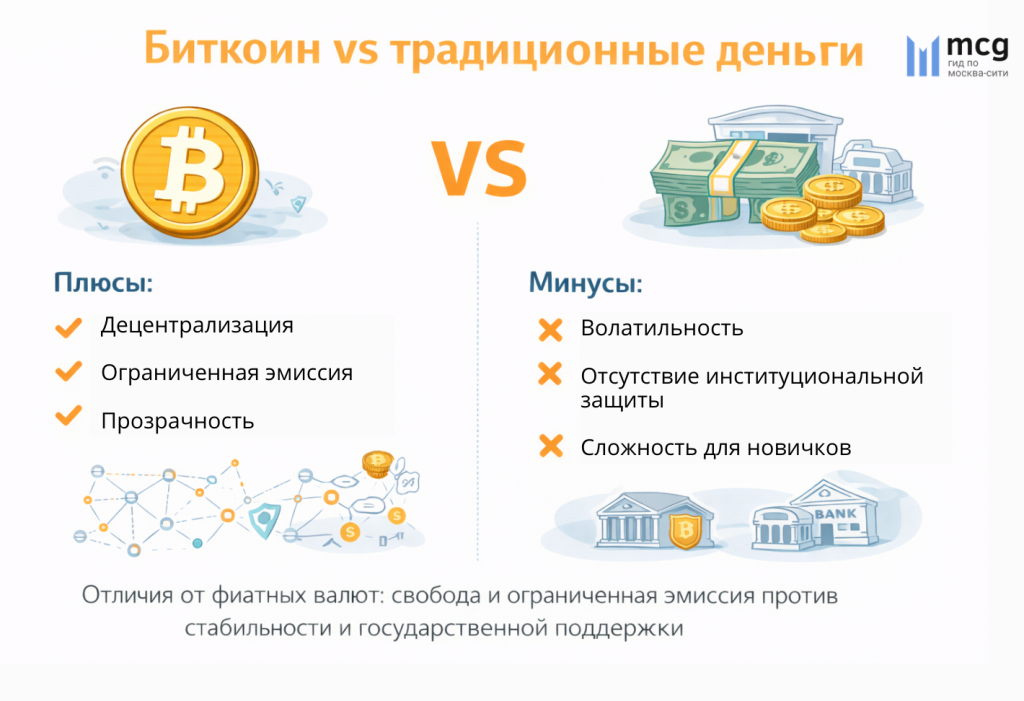
Bitcoin is fundamentally different from familiar fiat currencies such as the ruble, dollar or euro. The main difference is that fiat money is issued and controlled by state authorities, whereas Bitcoin operates in a decentralized network without the participation of banks and central regulators.
Advantages of Bitcoin
- Decentralization — there is no single center that controls the network or users’ funds. Each participant can independently verify and confirm transactions. Limited issuance — there are only 21 million coins in the system, which excludes uncontrolled “money printing” and makes Bitcoin a digital analogue of a scarce resource.
- Transparency — all transactions are recorded in the blockchain and available for verification. This excludes the possibility of hidden manipulations with balances and increases trust in the system.
Limitations and disadvantages
- Volatility — the price of Bitcoin can change sharply, which makes it a less stable store of value compared to traditional currencies.
- Lack of institutional protection — there is no central bank, deposit insurance or support service; loss of the key or compromise of the wallet leads to a complete loss of funds.
- Complexity for beginners — managing private keys, choosing a wallet and understanding blockchain require certain technical knowledge, which can be difficult for new users.
Thus, Bitcoin offers unique opportunities and freedom unavailable when using ordinary money, but at the same time requires greater responsibility and a conscious approach. It is important for the user to take into account both the advantages and limitations of digital currency in order to use it safely and effectively for storage, transfer or investment.
Conclusion
Bitcoin is not just a digital currency, but an entire financial system combining blockchain technology, cryptography and a controlled issuance mechanism. It allows users to make transfers directly, without intermediaries, store value in digital form and use coins as a tool for investment and international payments.
The decentralized structure of the network ensures transaction security, and the limited number of coins makes Bitcoin a scarce digital asset. The variety of wallets — hot, cold and combined — allows each user to choose a balance between ease of access and security of fund storage. Custodial solutions simplify work for beginners, while non-custodial and hardware wallets give experienced users full control over assets.
Bitcoin finds application in investments, everyday payments, international transfers and corporate activity, including multisignature schemes for distributed control. At the same time, users must take into account risks: price volatility, the threat of theft of private keys and seed phrases, fraud, as well as differences in the regulatory environment of different countries.
Compared with traditional money, Bitcoin offers decentralization, limited issuance and transparency of operations, but requires greater responsibility and understanding of the principles of how the network works. Mastering basic concepts — from blockchain and cryptography to choosing a wallet and assessing risks — allows Bitcoin to be used safely as a tool for storing, transferring and investing digital assets.
Understanding the principles of how Bitcoin works makes it possible to confidently use cryptocurrency both for personal and business purposes in the modern digital space.