


The government has submitted a bill titled “On Digital Currency and Digital Rights” to the State Duma, which, for the first time, outlines not just individual restrictions but a comprehensive model for the cryptocurrency market in Russia. The document effectively brings together disparate elements—exchanges, exchange platforms, banks, and users—into a unified infrastructure where cryptocurrency transactions must take place within a regulated framework.
Official source: Bill No. 1194918-8 “On Digital Currency and Digital Rights” has been posted on the State Duma’s Legislative Activity Support System. Bill details on the Legislative Activity Support System.
To put it simply, the market is not being banned, but rather brought into a system where control is focused on intermediaries, record-keeping, and the movement of funds.
Regulator’s position: The Bank of Russia has previously publicly described precisely this model—transactions with cryptoassets through a regulated infrastructure, with separate rules for investors and subsequent tightening of liability for the illegal segment. The Bank of Russia’s concept for regulating the cryptocurrency market.
Timeline: How the 2026–2027 Transition Is Structured
One of the key misconceptions in public discussions is to view July 1, 2026, as the moment when “everything will start working.”
In practice, the bill sets out a two-stage model.
Basic regulation will be launched in mid-2026. This means that a legal framework will be established, requirements for market participants will be defined, and a gradual transition to the new infrastructure will begin.
Starting July 1, 2027, the model is set to enter a strict phase. By this point, it is expected that:
- the infrastructure (exchanges, depositories, exchange platforms) will be fully operational
- operations outside the licensed framework will begin to be restricted
- liability for illegal activities will be strengthened
Essentially, 2026 is a period of restructuring, and 2027 marks the establishment of the new model.
And this is important: it is during this period that the market will undergo a redistribution.
New infrastructure: what the crypto market now consists of
The bill does not simply introduce rules—it establishes a structure.
Organized trading is the foundation of circulation. Cryptocurrency transactions must go through companies licensed as exchanges or trading systems. This means that the crypto market is being integrated into the existing model of organized trading, where access to liquidity is controlled.
Digital depositories—the point of asset accounting.
A new institution is being introduced to record rights to cryptocurrency. Essentially, this is the transfer of traditional depository logic to the digital environment:
- recording of asset ownership
- settlement
- storage of transaction data
- working with address identifiers (analogous to wallets)
This is a key shift—the asset ceases to exist solely at the blockchain level and gains a “second layer” of accounting.
What will happen to crypto exchanges
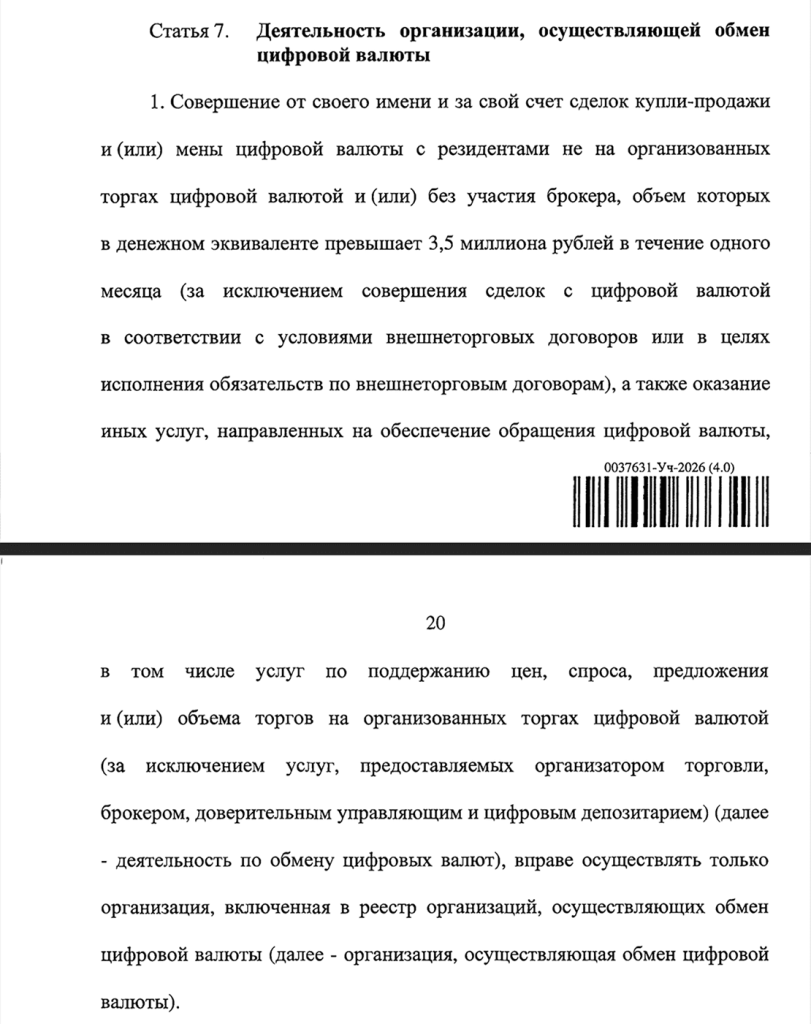
Crypto exchanges are a separate category with strict requirements. The bill introduces exchanges as a distinct type of market participant. Moreover, this is no longer a service but a regulated entity.
And here, it is not the wording that matters, but the consequences:
- the exchange must be registered in Russia and included in the Central Bank’s registry
- capital and internal control requirements apply to it
- it is required to monitor transactions and block suspicious ones
- it becomes part of the banking and payment infrastructure
In effect, the exchange becomes a fintech organization subject to the full regulatory burden.
Users: access remains, but the access model itself changes
For private investors, cryptocurrency is not formally banned or “shut down,” but the very logic of market access is changing. Whereas technical capability used to be the key factor (if you have a wallet, you can trade), an institutional filter is now being introduced.
Testing is the new entry point into the market. Before conducting transactions with crypto assets, an investor must confirm a basic understanding of the risks. This is not merely a formality, but an attempt to integrate cryptocurrency into a model already used in the stock market. Importantly, this isn’t just about unqualified participants—the testing affects everyone, just to varying degrees and with different consequences.
In effect, this means that access to the market ceases to be completely “open” and begins to be regulated through admission.
Limits are a tool for restricting participation, not for banning it. The bill itself does not specify concrete figures, but the Bank of Russia’s concept has already mentioned a guideline of approximately 300,000 rubles per year through a single intermediary for unqualified investors.
The purpose of this framework is not to restrict the act of purchasing cryptocurrency itself, but to limit the scale of risk. Users retain access to the market but cannot utilize it to its full extent without the appropriate status and infrastructure.
The ban on crypto payments remains unchanged and is becoming the standard norm. Cryptocurrency is still not recognized as a means of payment within the country. This is important not only as a separate rule but also as the foundation of the entire model: the state distinguishes between crypto as an investment instrument and crypto as a means of payment—and maintains the ban on the latter.
P2P and alternative schemes are coming under infrastructure-level pressure. There is no direct ban on such transactions, but the environment in which they operate is changing. The primary mechanism is not criminal prosecution, but pressure through the financial system:
- banks are beginning to filter transactions more strictly
- mechanisms for blocking transfers are emerging at the payment infrastructure level
- anti-fraud measures and monitoring of suspicious transactions are intensifying
As a result, P2P does not disappear, but ceases to be a sustainable model for regular operations.
Exchanges: a market with limited access and a “narrowed” range of assets
A separate important aspect is not just the regulation of trading platforms, but the regulation of the assets themselves.
Judging by the logic of the bill, only cryptocurrencies that meet strict criteria for liquidity, market capitalization, and transparency will gain access to organized trading. This means the market will form around a limited set of assets, rather than thousands of tokens as is currently the case.
The practical effect here is deeper than it seems. The market becomes more selective but more predictable in structure.
This automatically changes the nature of competition. It ceases to revolve around the number of available instruments and shifts toward infrastructure:
- trade execution speed
- liquidity depth
- fees
- integration with the banking system
In fact, exchanges are beginning to compete as financial services rather than as token marketplaces.
Crypto exchanges: the point where the market is truly shifting
If we look at the bill from a practical standpoint, it is the exchange segment that is undergoing the most drastic transformation.
Previously, an exchange could be a flexible service with minimal formalization. Now this model is no longer viable. Exchanges are becoming part of the regulated financial infrastructure and must meet requirements comparable to those for banks and brokers.
This means that:
- entering the market requires capital, legal transparency, and compliance
- transactions must undergo scrutiny, not just be based on exchange rates and liquidity
- accountability to the client is becoming formalized
As a result, the market inevitably splits into three parts: some players exit, unable to meet the requirements; others continue to operate outside the regulatory framework with increasing risks; and the third group transforms into fully-fledged regulated services.
It is precisely this third category that will form the basis of the “white” market after 2027.
Banks: Not a Restriction, but a Central Control Mechanism
In the new architecture, banks cease to be an external factor that “hinders crypto” and become a key element of the entire system.
The entire ruble flow passes through them—from entry into cryptocurrency to exit from it. This automatically makes the banking infrastructure the main regulatory tool.
And here a characteristic double effect arises.
On the one hand, a clear and legal operating channel emerges, which reduces operational risks and makes the market more predictable. On the other hand, control tightens, the number of checks and blocks increases, and this becomes the norm rather than the exception.
It is important to understand: this is not a side effect, but part of the architecture.
Mining: It Remains, but Exits the “Gray Zone”
Mining is not prohibited under the bill, but it ceases to exist in the informal sector.
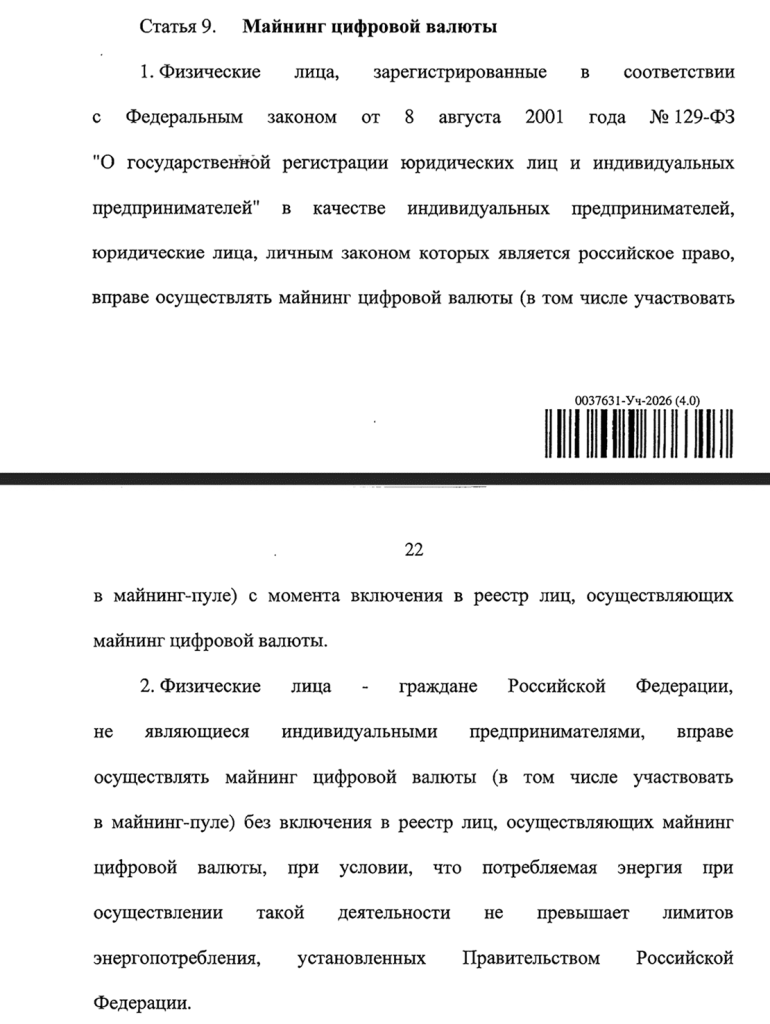
Legal entities and individual entrepreneurs will be required to register in a special registry and operate within the established framework. Individuals retain the ability to mine without registration, but only if they comply with energy consumption limits.
At the same time, mandatory reporting on mined assets is introduced, which effectively means a transition from anonymous mining to a registered model. Mining remains, but becomes part of the regulated economy.