

Bybit is operating in Russia in 2026—and this isn’t just a marketing claim. Russia ranks among the exchange’s top three markets in terms of traffic and trading volume. At the same time, some users occasionally encounter issues: the website won’t load, certain features are unavailable, or transactions fail to process.
In this article, we’ll break down the potential difficulties when logging in and using the exchange: what works, what doesn’t, why it won’t open from Russia, and what to do about it.
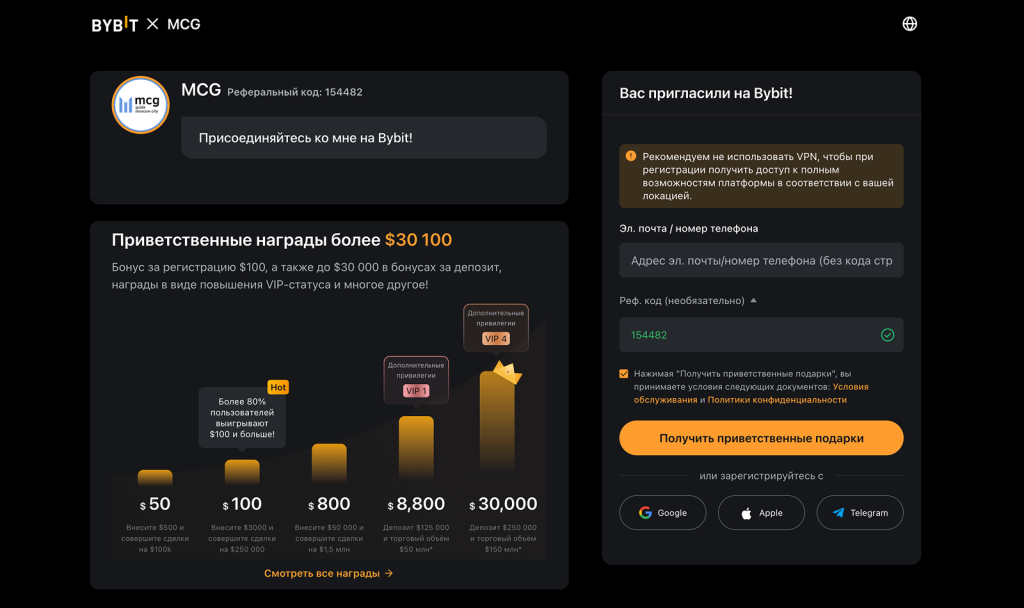
Sign up for Bybit with a bonus: https://bybit.com/ — referral code 154482 will be automatically applied.
Does Bybit work in Russia in 2026 — in short
A direct answer, point by point:
- The bybit.com website opens from Russia without a VPN.
- Registration is available via email or phone number without restrictions.
- KYC verification is completed using a Russian passport without any issues.
- Spot and futures trading are fully available.
- P2P exchange of rubles for crypto and vice versa works through Sberbank, T-Bank, and SBP.
- Staking, bots, and copy trading are available without restrictions.
- Russian-language support is available 24/7.
- Russia is not officially on the exchange’s list of restricted jurisdictions.
What does not work or works with restrictions:
- The exchange’s bank card is officially unavailable in Russia—it must be issued through Georgia or Kazakhstan.
- Direct deposits in rubles via bank transfer are unavailable—only via P2P.
- Access from the territories of Crimea, the DPR, the LPR, and Sevastopol is officially restricted.
- Some features may be unavailable without a VPN depending on your ISP’s settings.
Why Bybit isn’t working: main causes and solutions
This is one of the most common questions, and there are specific answers. The platform may not work for several different reasons—it’s important to understand exactly which one.
- The site won’t open without a VPN. Some Russian ISPs periodically block bybit.com at the DNS level. Solution: change your DNS to 8.8.8.8 (Google) or 1.1.1.1 (Cloudflare)—this is the fastest way without a VPN. If that doesn’t help, enable a VPN. The mobile app usually continues to work stably without a VPN.
- A P2P transaction is failing. Most often, the bank rejects the transfer after identifying the recipient as a crypto exchange. Solution: use SBP instead of a card number transfer—SBP is blocked much less frequently. Also, choose sellers with a rating above 95% and at least 500 transactions—they have fewer issues with banks.
- Account blocked. The exchange blocks accounts if it suspects a violation of the rules: systematic logins from IP addresses in restricted regions (Crimea, DPR, LPR), use of someone else’s payment details on P2P, or suspicious trading activity. Solution: Contact support via chat with supporting documents. Support is available in Russian 24/7.
- KYC verification fails. The automated system rejects blurry photos, documents with glare, or those with mismatched data. Solution: Re-submit verification in good lighting, without glare on the passport, holding it straight in front of the camera. If the system continues to reject it, contact support.
- A specific feature or token is unavailable. Some platform products (certain spot tokens, promotions, specific bonus programs) may be unavailable to Russian IP addresses due to regional restrictions. Solution: Check availability via a VPN with a neutral IP—Germany, the Netherlands, or the UAE.
- Maintenance on the platform. The exchange performs scheduled maintenance, usually at night Moscow time. During this time, some features may be unavailable. You can check the status of all systems on the official page status.bybit.com—it displays the incident history and the current status of the servers.
Bybit and Russia’s Internet Whitelists: What They Are and How They Affect You
Since the fall of 2025, Russia has been testing a “whitelist” system—a fundamentally new approach to internet restrictions. Previously, Roskomnadzor blocked specific websites, while everything else remained accessible. Whitelists work the opposite way: when activated, the entire internet is blocked except for a limited list of permitted resources.
What you need to know as of May 2026:
- The whitelists apply only to mobile internet. Home wired internet operates as usual—the Ministry of Digital Development and Rostelecom officially confirmed this in March 2026. If a website won’t load on your mobile device, switch to your home Wi-Fi.
- The restrictions are applied on a case-by-case basis: in central Moscow in March 2026, the outages lasted more than a week.
- As of May 2026: the system has been activated in 68–71 regions of Russia.
- Bybit is not on the Ministry of Digital Development’s whitelist. When the mode is enabled, the bybit.com website and mobile app are inaccessible via mobile internet. The whitelist includes government portals, several banks (Alfa, VTB, PSB, MTS Bank), and Russian marketplaces.
- Standard VPNs do not work with whitelists—TSPU equipment blocks VPN traffic as well. Only VPNs with traffic obfuscation (Amnezia, Hiddify) work—they must be installed in advance, before the restrictions are activated.
How to prepare: install the app on your smartphone and download a VPN with traffic obfuscation in advance. Once the whitelists are activated, you will no longer be able to download the app. If you need access urgently, switch to your home Wi-Fi or find an access point with a wired internet connection.
Bybit and bank whitelists: why P2P transactions fail
Bank whitelists are a separate issue. This is a different mechanism, unrelated to Roskomnadzor. Under Federal Law No. 115-FZ (anti-money laundering), Russian banks monitor transactions and can automatically block transfers to accounts associated with cryptocurrency transactions. This restriction is imposed by the bank, not the exchange.
Here’s how to avoid problems with P2P:
- Use SBP instead of transferring by card number — SBP is less likely to trigger the bank’s automatic filters.
- Do not include the words “crypto,” “Bybit,” or “USDT” in the payment description—leave the field blank or neutral.
- Avoid making large one-time transfers—it’s better to send several smaller amounts at intervals.
- Choose P2P sellers with individual (natural person) details, not corporate (legal entity) ones.
- T-Bank, Alfa-Bank, and Raiffeisen have historically been more accommodating toward P2P transfers than a number of other banks.
Why Bybit operates in Russia when other exchanges have left
The exchange is registered in the Seychelles, with its headquarters in Dubai. This means independence from Western sanctions and pressure from the U.S. regulator, the SEC. That is precisely why the platform continues to work with Russians where Binance has shut down P2P and limited functionality, and Coinbase is completely inaccessible from Russia.
Russia generates a significant share of the exchange’s traffic and trading volume. This commercial interest makes leaving the Russian market unprofitable for the exchange.
What is available to Russians in 2026
- Spot trading — buying and selling cryptocurrencies at market price.
- Futures — trading with up to 100x leverage on BTC, ETH, TON, Solana, and other assets.
- P2P exchange — buying and selling USDT for rubles via Sberbank, T-Bank, SBP, and other banks.
- Staking — earning passive income from holding cryptocurrency.
- Trading bots — automated trading based on predefined strategies.
- Copy trading — copying trades from successful traders.
- Launchpad and IEO — participation in initial token offerings.
- Exchange virtual card — issued through Georgia or Kazakhstan, works for online payments and subscriptions.
Will the exchange work with Russian accounts in the future?
This question concerns many, and the honest answer is: there are no guarantees, but there are no indications that it will stop either.
The exchange has not made any official statements regarding its intention to restrict operations with Russians. Russia is not officially included in the exchange’s list of prohibited jurisdictions. Discussions regarding restrictions on foreign exchanges in the Russian market at the regulatory level do not yet have legal force.
Risks to consider:
- increased sanctions pressure on companies working with Russian users;
- possible requirements from the Russian regulator for foreign exchanges;
- blocking at the provider level, which already occurs periodically.
Practical advice: Do not keep large amounts on the exchange longer than necessary for trading. Withdrawing crypto to a personal wallet takes just a few minutes.
Bybit in Russia: Verification and Registration for Russians
Registration from Russia works without a VPN—the site opens directly. You can register via email or phone number in 2–3 minutes.
You can register on Bybit with a bonus: https://bybit.com/ — the referral code 154482 will be automatically applied.
Level 1 KYC verification is done using a Russian domestic or international passport. The process is automated: a photo of your passport and a selfie. It takes anywhere from 10 minutes to several hours. After verification, P2P trading, full trading, and withdrawals without base limits become available.
When registering, we recommend entering referral code 154482—it unlocks a 20 USDT coupon for trading fees and a welcome bonus package worth up to 30,100 USDT. You can only add the code during registration or within 14 days afterward.
Register via this link to Bybit with the code: https://bybit.com/invite?ref=154482 (official website)
How to deposit rubles into Bybit in Russia
There is no direct deposit option in rubles via bank transfer. Here’s a workaround for Russians:
- Go to the P2P section on the platform.
- Select a USDT seller with a rating above 95% and at least 500 transactions.
- Enter the amount in rubles and select a convenient bank—Sberbank, T-Bank, SBP, or another.
- Transfer the rubles to the seller using the details provided in the app.
- Confirm the payment—the USDT will be credited to your account within a few minutes.
The exchange acts as a guarantor of the transaction: the crypto is held in an escrow account until the transfer is confirmed. Funds are not lost even in the event of a dispute.
Questions from Russians about Bybit in 2026
Do I need a VPN for Bybit in Russia?
Most users do not need a VPN—the site opens directly. If your ISP blocks bybit.com, simply change your DNS or use a VPN. The mobile app runs more stably without a VPN than the browser version.
Does Bybit work in Crimea?
No. Crimea, Sevastopol, the DPR, and the LPR are territories with official restrictions on access to the platform. Users from these regions cannot fully use the platform.
Can I deposit funds into Bybit directly from a Russian bank card?
No. Direct deposits in rubles via a bank card are not available. Deposits are made via P2P—this involves transferring rubles directly to a crypto seller through your regular bank.
Will Bybit block a Russian user’s account?
The mere fact of residing in Russia is not grounds for blocking. An account may be blocked if you log in from an IP address in a restricted region (Crimea, DPR), use someone else’s payment details, or engage in suspicious activity on P2P.
Does Bybit work on smartphones in Russia?
Yes. The app is available for iOS and Android. On Android, you can download the APK from the official website if the app is unavailable in the regional app store. On iPhone, it can be downloaded via the App Store using a foreign account or through the Russian App Store.
Does Bybit support Russian?
Yes. The interface is fully translated into Russian. Customer support is available in Russian 24/7 via chat on the website and in the app.
Conclusion
Bybit is fully operational in Russia in 2026: registration, verification via a Russian passport, spot and futures trading, and P2P ruble exchange. The site can be accessed without a VPN, and support is available in Russian. Restrictions apply to bank cards (which must be issued through Georgia or Kazakhstan), direct deposits in rubles, and access from Crimea and new regions. If the site isn’t working, in 90% of cases the issue can be resolved by changing your DNS or using a VPN.
Sign up on Bybit: bybit.com/invite?ref=154482
Read also
- Sign-up bonus — how to get 20 USDT and a welcome package
- Promo code and referral code 2026 — what they offer and how to use them
- Card for Russians — how to apply for a Bybit Card in Russia
This material is for informational purposes only. Bybit’s terms of service in Russia are subject to change—please check the official website bybit.com for the latest information. Cryptocurrency transactions involve the risk of losing funds.