

A legal crypto exchange is an organization that carries out the exchange of digital currency and is included in a special state register. The right to conduct such activity is granted after approval from the Bank of Russia (the Central Bank of the Russian Federation), which maintains the relevant registers, makes decisions on the inclusion and exclusion of organizations, and also supervises their activities and receives reports.
Are crypto exchanges legal in Russia in 2026?
To put it plainly, as of April 17, 2026, there is not a single legal licensed crypto exchange in Russia. None of the services can obtain a state license specifically for cryptocurrency exchange and operate under a model similar to banks or other credit institutions.
The current market is in a transitional mode: cryptocurrency exchange is not prohibited, but it is also not formalized as a fully regulated and licensed activity.
Under draft law No. 1194918-8 dated April 1, 2026, a crypto exchange is viewed as a separate participant in the digital currency market, for which admission through a register under the control of the central bank may be introduced in the future. But at the moment, this is only a draft, not an active licensing system.
The current regulation is built around Federal Law No. 259-FZ, the 2024 tax amendments, and new draft laws introduced in 2026.
How crypto exchanges operate without a license
In 2026, crypto exchanges operate as intermediaries between cryptocurrency and fiat (rubles), often disguising themselves as financial services, payment solutions, IT platforms, or “official exchange points,” although they do not have a separate license for crypto exchange.
Step-by-step cryptocurrency exchange scheme:
- The user submits a request (for example, USDT → rubles)
- Receives the details for transferring the cryptocurrency
- Sends the funds from their wallet
- After the transaction is confirmed, receives rubles (to a card or in cash).
In practice, this is not a bank and not a licensed organization, but a service that organizes the transaction, takes on the exchange process and support, while legally it may be structured as almost anything.
The security of the transaction now depends on how transparently the service discloses the terms and whether it hides behind wording that it does not actually fall under.
Is it legal for users themselves to use a crypto exchange
In simple terms and without legal wording, the situation in 2026 looks like this:
- In Russia, you can own, buy, and sell cryptocurrency; this is not prohibited (Federal Law No. 259-FZ). You can safely buy BTC, hold USDT, transfer crypto to a wallet, exchange it for cash rubles, and also withdraw it to a bank card.
- At the same time, cryptocurrency is not considered ordinary money within the country; it cannot be used for payments or accepted as payment. (Federal Law No. 259-FZ states this directly).
That is, you cannot simply walk into a store and pay with bitcoin for goods; the law does not allow this.
If you made money from cryptocurrency (for example, bought low and sold higher), you must pay tax, because for the state it is property, not “virtual money” (Federal Law No. 418-FZ + the Tax Code of the Russian Federation).
How to choose a crypto exchange you can trust
In practice, we recommend paying attention first of all to offline (physical) exchangers, since they provide more control over the transaction and make it possible to reduce risks.
When choosing a crypto exchange, the following factors should be taken into account:
- The presence of a real office.
- A clear exchange format, a cash currency pair, and an appointment with a fixed rate.
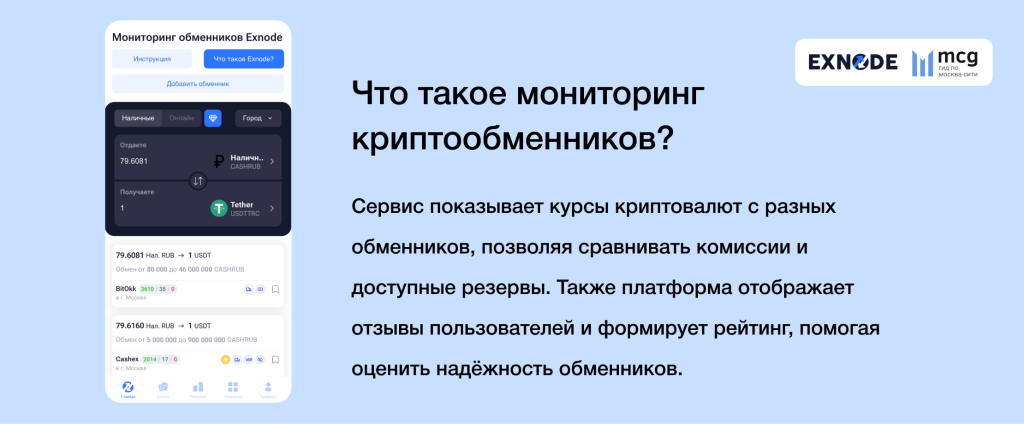
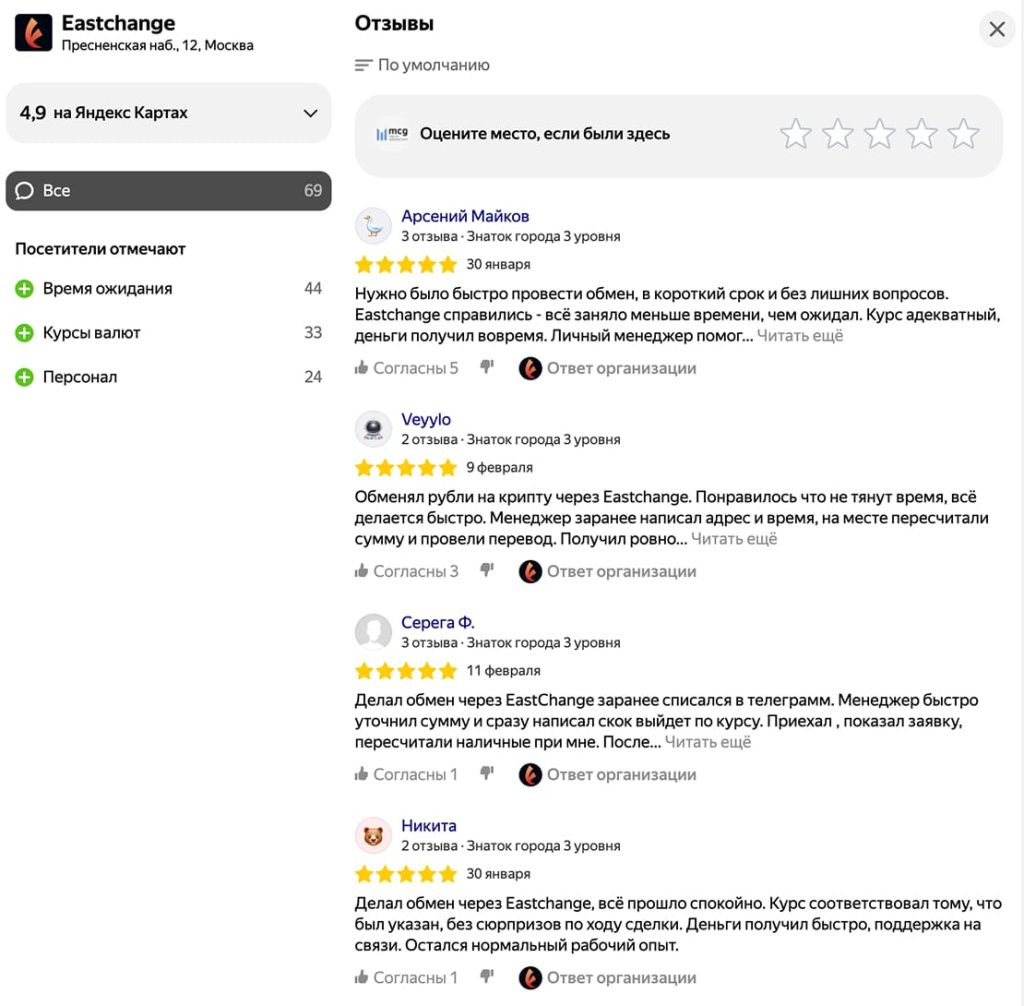
- Verified reviews (not only on the website and monitoring platforms, but also on Yandex and Google maps and aggregators such as 2Gis, Otzovik.com, etc.).
- Participation in exchange monitoring platforms and inclusion in selections of the best or TOP services.
- The availability of reserves and work with large amounts.
These are the parameters that most often distinguish real services from formal or fraudulent schemes.
Reliable crypto exchange in Moscow with an office in Moscow City
Below are the TOP 3 crypto exchanges that stood out based on a combination of factors: reviews, mentions on monitoring platforms, and the general feeling of a “live” service rather than just a storefront:
Insight — offline exchange in an office with Premium support
Insight — a crypto exchange that, according to the service itself, focuses on an office-based transaction format and a pre-agreed exchange procedure. The website separately emphasizes that the client agrees on the visit time, receives a pass to the building, and carries out the operation in person, without the need to transfer money or cryptocurrency in advance. This approach is usually chosen by those who value a calm process, clear stages, and minimizing unnecessary hassle.
- Among the directions that the exchanger itself highlights in its description are USDT, BTC, ETH, rubles, dollars, lira, and dirhams. That means that in addition to basic pairs such as USDT ↔ RUB, BTC ↔ RUB, and ETH ↔ RUB, the service clearly shows work with cash and currency pairs such as BTC ↔ USD cash, ETH ↔ USD cash, USDT ↔ AED, or USDT ↔ TRY.
- The fee benchmark starts from ~0.3%, and the minimum working limit is from 100,000 ₽.
- The public volume of reserves is not disclosed on the website, but Insight separately promotes a Premium format for exchanges from $70,000, work with cash, a private cashier desk, and support for non-standard AML situations.
Because of this, Insight is perceived as a reliable service with a wide selection of currency pairs ready for exchange. The client discusses the direction, amount, and details of the transaction in advance, and then arrives at the office already understanding the terms. For many, this very model appears to be the most comfortable, especially when it is not about a one-time small operation, but about a more serious exchange.
- Main pairs: USDT, BTC, ETH ↔ RUB
- Format: offline, by appointment
- Fee: from ~0.3%
- Limit: from 100,000 ₽
- Address / office: Moscow City, Presnenskaya Embankment, 12 / Federation Tower

- I came by appointment, they met me normally, everything was without crowds or unnecessary nervousness. The deal went calmly.
- I liked that I did not have to send crypto anywhere in advance. Everything was done already in the office, and that really adds confidence.
- Before the visit, it is better to clarify the amount and how the rate is fixed right away. I did not do that at first, but in the end everything was explained and the exchange went through without surprises.
- For a first offline exchange, it turned out to be a convenient option: the manager explained in a very human way how everything works, where the nuances may be, and what to look at.
- I exchanged USDT for rubles, they handled it without rushing and gave out the amount as agreed. The overall impression was normal.
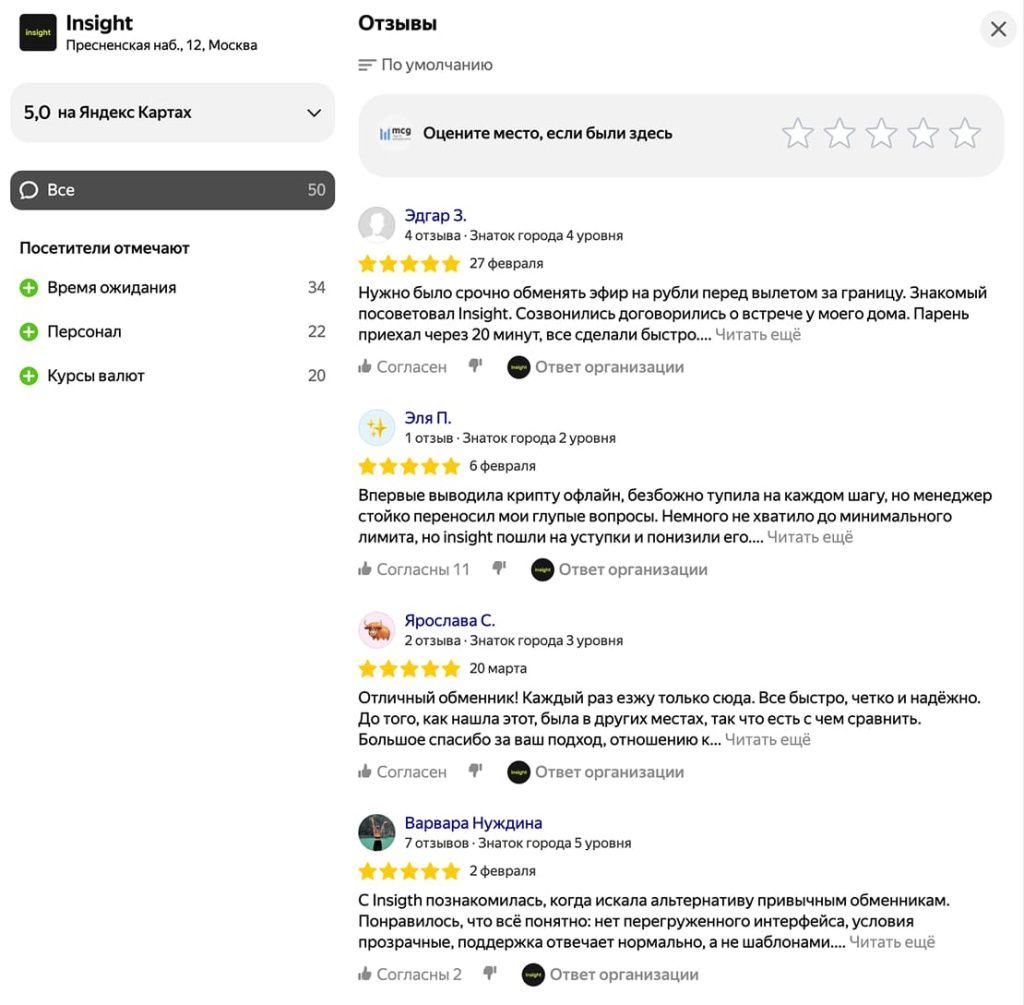
BitOkk — fast exchange with a fixed rate and a wide choice of directions
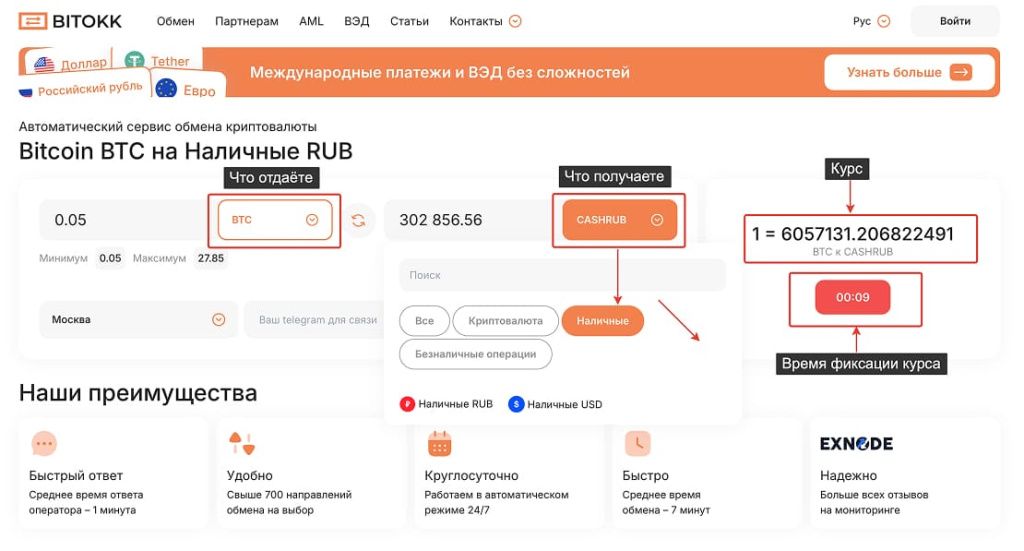
BitOkk — a crypto exchange that on its website emphasizes speed, a wide selection of directions, and clear rules for processing requests. The service states that it has 700+ exchange directions, an average operator response time of about one minute, and an average transaction time of around 7 minutes. Because of this, it is more often perceived as an option for those who want to complete an exchange quickly and without a long wait.
- The basic pairs here are BTC, ETH, USDT ↔ RUB, but judging by the way the service presents itself, the selection is noticeably broader and is not limited to just three coins. BitOkk directly states a multi-currency exchange format, the purchase and sale of digital and electronic currencies, and work with cash.
- In practice, this means that in addition to classic directions such as USDT ↔ RUB, BTC ↔ RUB, and ETH ↔ RUB, the service is also oriented toward transactions with cash rubles, as well as a broader pool of crypto and fiat requests.
- According to the company, the service operates in an offline format, is ориентed toward amounts starting from 50,000 ₽, and the fee is in the ~0.5–1% range. The website separately states that the rate is fixed for 15 minutes, and also mentions its own financial reserves, although their exact volume is not publicly disclosed.
In addition, BitOkk highlights test transactions, AML/KYC support, delivery around the city, choice of banknote denominations, and an office-based service format. In practice, this creates the image of a service suitable for those who want not only speed, but also a more practical set of services: from fast offline exchange to a transaction with clear regulations and rules defined in advance.
- Main pairs: BTC, ETH, USDT ↔ RUB
- Format: offline
- Fee: ~0.5–1%
- Limit: from 50,000 ₽
- Address / office: Moscow City, Presnenskaya Embankment, 12
- I needed a quick exchange without long conversations — here everything went in exactly that mode. I arrived, confirmed the request, and they closed the matter quickly.
- It is convenient that they fix the rate in advance. For me, that was the main advantage, because I did not want to go to the office blindly.
- I exchanged ETH, and the speed was indeed good, but it is better to clarify and compare the fee right away. Then there will be no unnecessary expectations at all.
- There is a sense of a more dynamic service: fewer “ceremonies,” more pace. If the task is to exchange and move on, the format works.
- I would not say it always has the best rate on the market, but in terms of promptness and clarity of the process, it is a strong option.
EastChange — exchange of USDT, cash, and large amounts
EastChange — a crypto exchange that on its website positions itself as a service with more than 5 years of experience and a base of over 1 million transactions. In the description of the exchanger itself, the focus is on the office: the customer leaves a request, the manager contacts them to agree on the time, fixes the rate, after which the transaction takes place in the office, and the whole operation takes about 15 minutes.
- EastChange places its main focus on USDT, BTC ↔ RUB, but the service itself also separately promotes cryptocurrency exchange into cash rubles, dollars, or euros, as well as other international currencies (BTC ↔ CASHRUB, USDT ↔ USD cash, USDT ↔ EUR cash and related requests through a manager.
- The fees are in the ~0.5–1% range, and the limit starts from 100,000 ₽. At the same time, the exact public volume of reserves on the available pages is not disclosed, but the logic of the service itself is clearly tailored to transactions where volume, reservation of the amount, and calm processing of the exchange without splitting are important.
In addition, the following can be highlighted: round-the-clock support, rate fixing before the visit, and clear exchange stages. In combination, EastChange looks like an exchanger for those who need: fast exchange, specific staff in the office (real people), and a cash transaction conducted without unnecessary rush.
- Main pairs: USDT, BTC ↔ RUB
- Format: offline + online
- Fee: ~0.5–1%
- Limit: from 100,000 ₽
- Address / office: Moscow City, Presnenskaya Embankment, 12 / Federation Tower
- I was wary when going there with a large amount, but everything went exactly as discussed in the chat. Nothing was changed on site.
- I liked that they counted the money first and only then conducted the deal. For an offline exchange, that is exactly the right order.
- They exchanged USDT without unnecessary questions, and the rate was the same as agreed in advance. The office was calm, without a sense of fuss.
- The process is not the most “instant,” but you can see there are verification stages and the staff do not rush things just for show. For a large amount, that is rather a plus.
- If you need an exchange not on the run, but with proper support and no surprises along the way, the option looks solid. For the most aggressive rate, of course, it is still better to compare the market.
Important rule:
A reliable exchanger is not the one that promises a low rate, but the one that provides maximum reliability. If the terms of the transaction are agreed in advance and nothing is troubling during the process, these are already strong signs that you are not dealing with a fly-by-night company.
How cryptocurrency exchange is carried out:
An ordinary transaction does not look all that exotic if you break it down into steps.
Step 1. The user determines which currency they are exchanging
First, they choose the asset and the direction: for example, BTC into rubles, USDT into cash, ETH into a transfer to a bank card, or rubles into USDT. At this stage, three things matter: the network, the amount, and the payout format.
A mistake with the network is one of the most expensive ones. If the user sends the asset to the wrong network or enters the wrong address, it is technically impossible to return the funds, not just legally impossible.
Step 2. The user prepares a crypto wallet
Without a crypto wallet, a normal exchange is impossible. This may be a non-custodial wallet, where you hold the keys, or an exchange wallet, if you temporarily keep the asset on a platform.
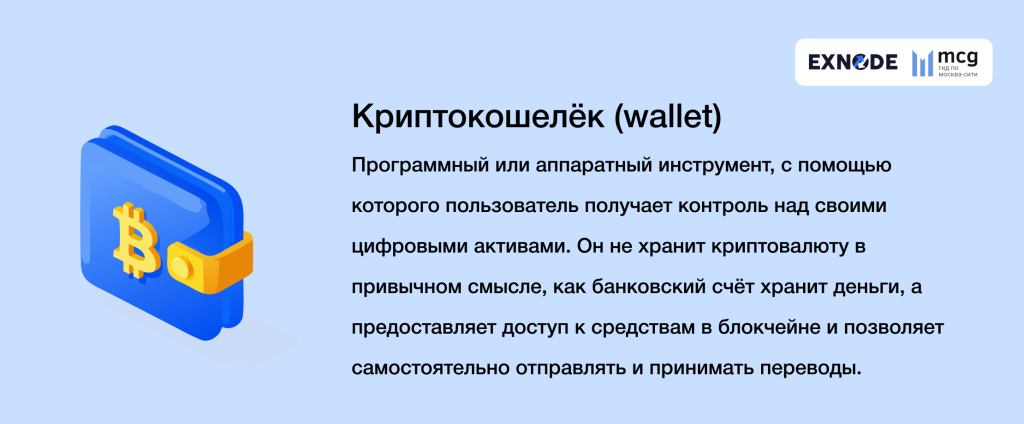
When choosing a wallet, its brand is less important than who actually controls the address, whether the wallet supports the required network, and whether you can later confirm the movement of funds. Simply put, the address must be under your control — as in Trust Wallet, Ledger, or MetaMask — and not just inside someone else’s service. Before sending, be sure to verify both the address itself and the recipient’s network (for example: a USDT TRC-20 address starts with T, while an ERC-20 address starts with 0x). If it is a large amount, it is safer to first send a test transaction for a small amount and only after the transfer is confirmed proceed with the main volume.
Step 3. The crypto exchange provides the details and fixes the terms
A normal crypto exchange informs you in advance:
- Which network is used.
- How long the rate is fixed for.
- What the final payout amount is.
- Which fees are already included.
- What documents or confirmations will be needed.
If before the transfer they cannot clearly and in writing tell you these basic terms, you should not continue further. These are not “process nuances,” this is a lack of predictability.
Step 4. A transfer of cryptocurrency or fiat takes place
Then one side sends the cryptocurrency, while the other prepares the ruble side of the transaction: a bank transfer, a cash desk operation, a cash payout, more rarely a combined format.
At this moment, what matters to the user is not the manager’s nice words, but the four parameters of the transaction:
- TXID or transaction hash.
- The request with the amount and direction,
- A bank statement or cash receipt.
- Confirmation of the final payout of funds.
Step 5. The user receives rubles, cash, or another asset
From a practical point of view, the most common exchange is a withdrawal into rubles. It can go to a card, to an account, through an office, through cash payout, or through settlement in the presence of the parties. On the legal level, what matters for you is not “what the manager called it,” but whether you will later be able to prove the very fact of the transaction, the date, the amount, the fee, and the source of the funds.
What documents and receipts need to be kept
This is where most people make mistakes. People think that crypto is a “paperless” story.
As mentioned earlier, the Federal Tax Service directly states that when calculating the tax base, you can take into account documented purchase expenses, exchange and exchanger fees, and other related costs. For confirmation, for example, statements and receipts are suitable.
Separately, the Federal Tax Service reminds that income from the sale of cryptocurrency is subject to declaration through the 3-NDFL form.
What to keep:
- A screenshot of the request before the deal.
- The wallet address and TXID,
- A receipt or voucher from the service,
- A bank statement for the incoming or outgoing transfer,
- A screenshot of the rate and conditions,
- Correspondence confirming the amount,
- Documents for the purchase of the original cryptocurrency.
The larger the amount, the more important it is not to have one document, but everything with which you can later confirm the origin of the money.
More about taxes and what the Federal Tax Service of the Russian Federation wants to see
Since 2025, for tax purposes, digital currency is property. And this means that the obligation to pay tax arises at the moment of realization: sale for fiat, exchange, as well as other disposal. In 2026, the Federal Tax Service directly writes that income from the sale of cryptocurrency is declared using the 3-NDFL form, and the tax base is determined as the positive difference between the income from realization and the documented expenses for acquisition and realization.
For individuals for 2025, it is necessary to file: 3-NDFL no later than April 30, 2026, and pay the tax no later than July 15, 2026. The Federal Tax Service separately repeats these deadlines as part of the 2026 declaration campaign.
Scammers: how money is usually lost
The most common losses occur because of haste and inattention to detail:
- The first is a fake website or mirror. The user is in a hurry, goes to the wrong place, and sends the asset to someone else’s address.
- The second is a change of conditions at the last moment. Before the transfer, you are promised one thing; after the transfer, it turns out that “the rate has already moved,” “the reserve has run out,” or “you need to pay an additional fee.”
- The third is pressure and haste. The more they rush you, the greater the chance that they are leading you not to a deal, but to a mistake.
- The fourth is the absence of traces. If you do not have the TXID, request, receipt, statement, and correspondence, even a formally normal transaction turns into a story that is later difficult to prove.
There is one simple rule here: a good exchange looks boring. Its steps, amounts, details, and timeframes are clear in advance. Everything that relies on urgency, vagueness, and the phrase “just send it, we’ll figure it out later” is better stopped before the transfer.
1. Do I need to pay tax if the cryptocurrency is just sitting in a wallet?
No, merely storing cryptocurrency in a wallet does not create a tax obligation. What becomes practically significant is the moment of realization: when income arises and can be calculated in rubles. Therefore, for the user, what matters more is not the fact of ownership, but the recording of transactions, the sale dates, the amounts, and the confirmed expenses.
2. Can cryptocurrency be exchanged without your own wallet?
Technically, it is sometimes possible to use an exchange balance as an intermediate point, but in practice it is calmer and safer to have your own wallet for the required network. Then you control the address, can make a test transaction, and do not depend on the internal restrictions of a third-party platform at the moment of withdrawal.
3. Is an office in Moscow City or a beautiful website already a sign of reliability?
No. It is a good external marker, but not proof. Real verification starts elsewhere: does the domain match, can you get the terms of the deal in advance, is the rate fixed, do they give a clear exchange procedure, and are they ready to confirm the payout amount before the funds are transferred.
Checking a crypto exchange in 2 minutes
- Ask four things before transferring. The rate, the network, the fee, and the final payout amount. If evasive answers begin, that is already a signal to stop.
- Clarify how the rate is fixed. For 5 minutes, for 10 minutes, upon receipt, or at the market rate at the time the request is processed. This is one of the most common points of dispute.
- Check the route of the money. Where you are sending the crypto, where the rubles will come from, whether there will be a receipt, voucher, confirmation, or at least a request number.
- Do not fall for haste because of a favorable rate.
- Keep all “traces” of the transaction with you. TXID, a screenshot of the request, the correspondence, the bank statement, the receipt, or confirmation of payout. This is exactly what later works both for taxes and for disputes.
Categories where you can choose a crypto exchange by exchange directions, cities, and current currency rates. Here you can quickly find a service for the operation you need: online exchange, cash transactions, USDT or BTC operations, as well as exchanges with bank cards and transfers.
- Crypto exchanges — choose a crypto exchanger in Moscow City for different directions and amounts.
- Crypto exchanges in Russia — for exchanges with cards and bank transfers within the country.
- Crypto exchanges online — without visiting an office.
- Crypto exchanges offline — exchangers with offices and cash payout points.
- Crypto exchanges USDT — for fiat and other cryptocurrencies.
- Crypto exchanges BTC — a list of services for buying, selling, and withdrawing bitcoin.
Brief conclusion of the article:
In 2026, a “legal licensed crypto exchange” in the Russian Federation is still a term from the future. The current Law No. 259-FZ regulates the circulation of digital currency, Law No. 418-FZ has already integrated crypto into the tax system, and draft law No. 1194918-8 shows where the state wants to move the market next. But a full-fledged retail license specifically for crypto exchanges is still not issued as of April 2026. Therefore, the main selection criterion now is not the loud word “legal,” but transparency and reliability. Can you understand who is in front of you. Can you see the conditions in advance.