

Cryptocurrency mining is the process in which specialized computers verify transactions in a blockchain, add new blocks to the network, and receive rewards in the form of cryptocurrency for doing so. Mining is the foundation behind the existence of cryptocurrencies such as Bitcoin, and it makes decentralized payment systems possible without the participation of banks and government regulators.
In short: miners replace the bank — they confirm transfers, issue new coins, and receive rewards for this.
- Miners verify transfers in the blockchain.
- They receive a reward for a found block.
- Today, Bitcoin is mainly mined with ASIC miners.
- Home mining in 2026 rarely pays off without cheap electricity.
Imagine an accounting book that is simultaneously maintained by thousands of independent participants around the world — each one checks and confirms operations. This is what a blockchain is: a chain of blocks with the history of all transactions, which cannot be changed unilaterally. Miners support this system, receiving new coins as a reward. This is where the name comes from: mining, extraction.
Bitcoin became the first cryptocurrency based on mining; today dozens of other coins work according to its model. However, the context of 2026 is important: network difficulty has increased billions of times, competition has intensified, and the scenario of “installing a program on a laptop and quickly paying it off” has long become a legend. Modern mining requires serious calculation, the right equipment, and an understanding of the economics of the process.
How cryptocurrency mining works in simple words
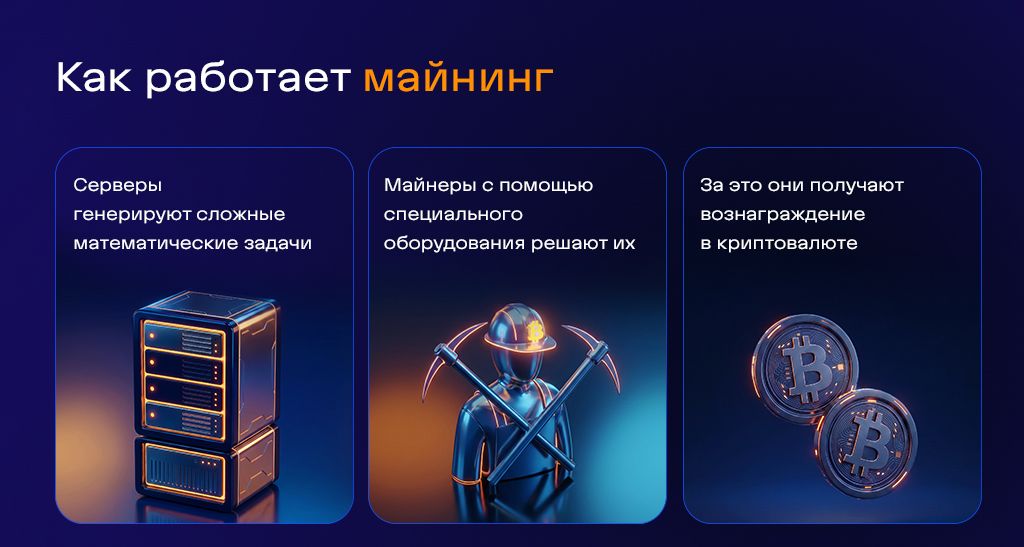
To understand how mining works, you do not need to be a programmer or a mathematician. It is enough to understand several key concepts that form a single system.
At the heart of mining lies a task: to find a special number which, when inserted into a mathematical function, gives a result with certain properties. It sounds abstract, but the meaning is simple: the miner’s computer goes through options again and again until it finds a suitable one. The one who finds it first receives the right to record a new block of transactions in the blockchain and receive a reward.That is why hashrate — the speed at which equipment performs such calculations, is the main indicator of a miner’s performance. The higher the hashrate, the more attempts per second the device makes and the higher the probability of being the first to find the correct answer.
The mechanism underlying this process is called Proof of Work. This is a consensus algorithm that obliges network participants to perform real computational work, otherwise the system simply will not accept their result. PoW protects the blockchain from falsification: in order to rewrite the history of transactions, an attacker would have to use computing power exceeding the power of the entire honest part of the network. This is practically unrealistic.
Decentralization is another key property of the system. In mining, there is no single control center: thousands of independent participants around the world simultaneously work on finding a new block. This is what makes the blockchain resistant to censorship, hacks, and manipulation.
Since the chances of a solo miner finding a block before major players are small, most participants join mining pools. A pool is a collective participant in the network: all members combine their computing power and divide the reward in proportion to their contribution. Income becomes regular and predictable, although smaller than in the hypothetical luck of a solo miner.
What hashing and blocks are in mining
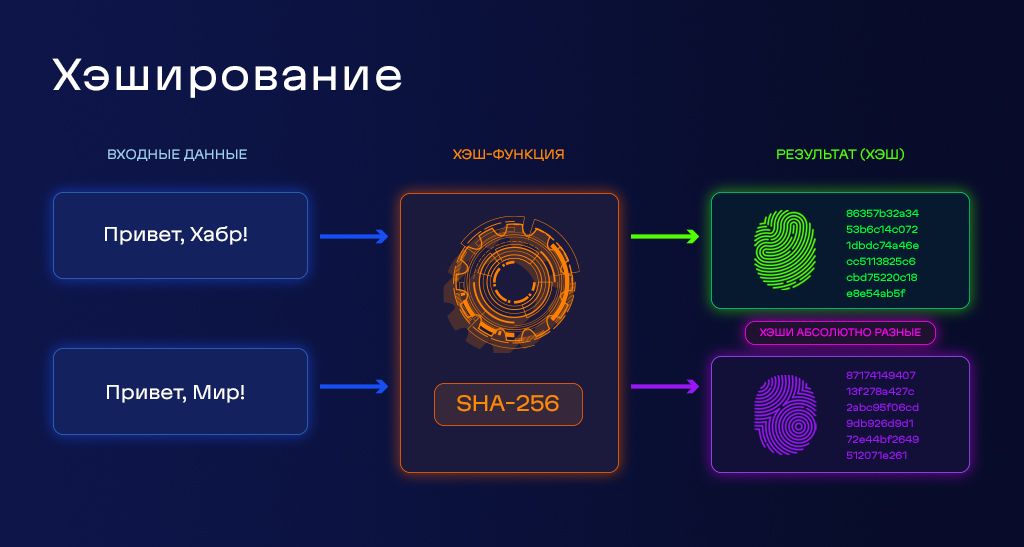
A hash is a kind of digital fingerprint. A mathematical function takes any set of data: transaction text, date, block number and turns it into a fixed-length string. Change even one character in the source data, and the hash will change completely. This property makes hashing the foundation of blockchain security.
Transactions that occur on the network are not recorded instantly. First, they accumulate in the so-called “mempool” (a queue of operations waiting for confirmation). Miners collect these transactions into a block, add service information to it, and start the hashing process. The goal of the process is to find such a version of the block whose hash will meet the requirements of the network (for example, start with a certain number of zeros).
Each new block contains the hash of the previous one. This creates the “chain” — blockchain. If someone tries to change data in an old block, its hash will change, which means all subsequent blocks will also change. The network will detect this immediately.
Cryptography (the science of protecting information) lies at the foundation of this entire mechanism. Thanks to it, the blockchain is protected from forgery mathematically, not administratively.
The role of miners in a blockchain network
A miner is often presented exclusively as a “coin extractor,” but this is a simplified view. In fact, a miner performs the role of a technical participant in the network, on whom its operability depends.
First, miners validate transactions. Before an operation enters the blockchain, it must be checked: whether it is fraudulent, whether the sender is trying to spend the same coins twice (the so-called double spend attack). Miners perform this check automatically as part of their work.
Second, miners ensure network security. The combined computing power of all miners makes the blockchain practically invulnerable to attacks. The more honest participants there are, the more difficult it is for an attacker to gather enough resources for hacking.
Third, miners support decentralization. Their geographic and organizational diversity does not allow any single structure to establish control over the network. The blockchain works according to the rules of code, not according to the will of a central regulator.
Key functions of miners:
- Checking the legitimacy of transactions
- Forming new blocks and recording them in the blockchain
- Protecting the network from attacks through computing power
- Maintaining decentralization and independence of the system
- Receiving rewards in the form of new coins and transaction fees
Basic cryptocurrency mining terms
To confidently navigate the topic, it is important to master the basic vocabulary. Below is a short glossary of key concepts.
- Blockchain (Blockchain) — a distributed data ledger organized as a chain of blocks. It is stored simultaneously by all network participants, which eliminates the possibility of centralized control or falsification.
- Hash (Hash) — a unique digital fingerprint obtained as a result of applying a mathematical function to a set of data. Any change in the input data completely changes the hash.
- Hashrate (Hashrate) — the speed of calculations of mining equipment. It is measured in hashes per second: TH/s (terahashes), PH/s (petahashes). The higher the hashrate, the higher the potential income.
- Proof of Work (PoW) — a consensus algorithm that requires participants to perform real computational work to confirm transactions. It is used in Bitcoin and a number of other coins.
- Proof of Stake (PoS) — an alternative algorithm in which the right to validate blocks depends on the number of coins “staked” by a participant, not on computing power. It requires significantly less energy.
- Mining pool (Mining Pool) — an association of miners who jointly mine cryptocurrency and divide the reward in proportion to each participant’s contribution.
- ASIC — a specialized chip developed exclusively for mining a specific algorithm. It provides maximum performance and energy efficiency but has no other applications.
- GPU (graphics card) — a graphics processor that can be used for mining various algorithms. It is less efficient than an ASIC for a specific coin but is universal.
- Hardware wallet (Hardware Wallet) — a physical device for storing cryptocurrency in offline mode. It provides maximum protection against hacking.
- Fork (Fork) — a change in a cryptocurrency protocol that can lead to the blockchain splitting into two branches. A soft fork is backward compatible, while a hard fork creates a new coin.
- Fiat money (Fiat Money) — traditional government currencies (ruble, dollar, euro), as opposed to cryptocurrencies.
Necessary equipment for mining
Choosing equipment is one of the most important steps when entering mining. Performance, electricity costs, and the payback period of investments directly depend on it. The history of mining hardware is a history of a constant race for efficiency.
At the very beginning of the Bitcoin era, in 2009–2010, coins could be mined on an ordinary processor (CPU) of a home computer. Then miners discovered that graphics cards (GPU) handled this task dozens of times more efficiently. The next step was FPGA modules — programmable integrated circuits. Finally, ASIC miners appeared — specialized devices developed exclusively for cryptocurrency mining. Today, ASIC and GPU define the market.
In 2026, home mining is a difficult but not impossible task. The main change: the economics have become significantly stricter. Casual hobby activity is no longer enough. A thorough calculation of electricity costs, cooling, equipment depreciation, and pool fees is required before buying the first device.
| Type | Performance | Power consumption | Cost | Noise | Versatility |
|---|---|---|---|---|---|
| CPU | Very low | 50–150 W | Already available (PC) | Quiet | High |
| GPU | Medium–high | 100–350 W | 30,000–150,000 ₽ | Moderate | High |
| FPGA | High | 100–300 W | 50,000–200,000 ₽ | Moderate | Medium |
| ASIC | Maximum | 1,000–4,000 W | 100,000–600,000+ ₽ | Loud | Very low |
ASIC miners versus GPU: what to choose
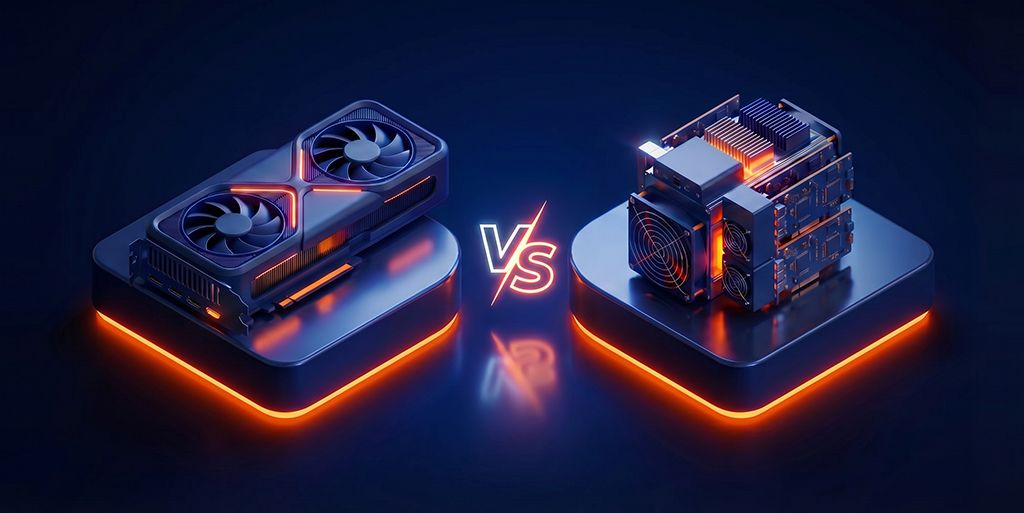
An ASIC miner is like a super-specialist: in its field it has no equal, but outside it, it is useless. Devices such as Antminer S19 or Whatsminer M50 show a hashrate orders of magnitude higher than any graphics card for a specific algorithm — for example, SHA-256 for Bitcoin. Their energy efficiency is also maximum: they produce more hashes for every watt of consumed electricity.
However, ASIC has serious disadvantages. First, attachment to an algorithm: if the coin mined by the device sharply falls in price or changes its algorithm, the ASIC turns into scrap metal. Second, the high cost of entry. Third, the device is as noisy as a small vacuum cleaner, which makes home use extremely uncomfortable.
Pros of ASIC: maximum hashrate; better energy efficiency; high stability of operation.
Cons of ASIC: attachment to one algorithm; high noise; difficulty selling a used device; dependence on the manufacturer.
GPU mining offers a fundamentally different approach. A graphics card is a universal tool: today it mines Kaspa, tomorrow — another coin, and the day after tomorrow it can be sold to a gamer or designer. Flexibility is the main advantage of GPU. In addition, a GPU farm is easier to scale gradually.
Pros of GPU: versatility and switching between algorithms; liquidity on the secondary market; possibility of gradual scaling.
Cons of GPU: inferior to ASIC in performance for a specific algorithm; higher cost per hash; more difficult maintenance at a large scale.
The final choice depends on goals: if you want to mine Bitcoin and are ready for serious investments — ASIC. If you are looking for flexibility and a cautious start — GPU.
Mining farms and their types
A mining farm is several (or several thousand) mining devices working together in one room. A farm is no longer a hobby, but a business infrastructure that requires solving serious tasks: power supply, cooling, technical maintenance, and physical security.
GPU farms consist of graphics cards mounted on open racks. Each “rig” (a separate block) contains 4–12 graphics cards connected to a motherboard. Such farms are relatively flexible: they are easier to reconfigure for another coin or algorithm.
ASIC farms look different: rows of specialized devices connected to powerful power supplies and forced ventilation systems. The noise of such installations can reach 75–85 dB — comparable to an operating production facility. Placing them in residential premises is practically impossible.
FPGA modules are an intermediate solution between GPU and ASIC. They can be reprogrammed for different algorithms, which gives certain flexibility, but they are significantly more difficult to configure.
The key requirement for any farm is a reliable cooling system. Overheating is the main cause of equipment failure. Industrial farms use forced ventilation, evaporative cooling, or immersion cooling (immersing devices in a dielectric liquid). Also critical are: stable power supply of sufficient capacity, high-speed internet, a monitoring system, and the ability to quickly access equipment for maintenance.
Mining methods and their comparison
The method of organizing mining determines income stability, investment size, and the level of technical involvement. Today there are three main approaches, each designed for a different audience.
Solo mining implies independent mining without joining other participants. The miner competes for each block independently. If the computing power is sufficient — the payout is full. The problem is that for most cryptocurrencies in 2026, the probability of finding a block alone is vanishingly small. It is like buying one lottery ticket in the hope of hitting the jackpot. Technically possible, but economically impractical for most private miners.
Pool mining has become the industry standard. Participants combine hashrate, jointly find blocks, and divide the reward in proportion to contribution. Income is regular and predictable. The pool charges a commission — usually 1–3% of payouts. This is a reasonable compromise between stability and profitability.
Cloud mining offers renting computing power from specialized companies. You pay for a contract and receive a share of mined coins. No equipment, no noisy devices, no electricity bills. It sounds attractive, but it is associated with high risks.
| Mining method | Income stability | Investments | Technical knowledge | Control | Fraud risk |
|---|---|---|---|---|---|
| Solo mining | Very low | High | High | Full | None |
| Pool mining | High | Medium–high | Medium | Partial | Low |
| Cloud mining | Medium | Low | Minimal | None | High |
Pool mining: advantages of collective mining
A mining pool works according to the principle of “combine efforts and divide the result.” Participants connect their equipment to the pool’s servers, which coordinates their work and distributes tasks. When the pool finds a block, the reward is divided among all participants.
There are several reward distribution systems. The proportional system pays out a share of the block at the end of the round, in proportion to the number of submitted shares. PPS (Pay Per Share) provides a fixed payout for each accepted share regardless of finding a block — stable, but with a lower rate. PPLNS (Pay Per Last N Shares) takes into account the last N shares, encouraging loyalty and stable participation.
When choosing a pool, consider: its size (large pools find blocks more often, but divide payouts among more participants), commission (1–3%), minimum withdrawal threshold, and geographic location of servers (affects latency). The largest pools in the world — Foundry USA, AntPool, F2Pool — provide stability and transparency of statistics.
For most private miners in 2026, pool mining is the only reasonable operating model that provides real and regular income.
Cloud mining: pros and cons
Cloud mining is the rental of hashrate from a company that owns physical infrastructure. You sign a contract, pay a fee, and receive part of the mined coins. The entry barrier is minimal: no need to understand hardware, configure software, or pay electricity bills.
It is precisely this simplicity that makes cloud mining attractive to scammers. The market is saturated with schemes where there is no real equipment, and early investors receive payouts from the investments of later ones — a classic pyramid scheme.
Signs of a reliable service:
- Physical location of the data center with the possibility of independent verification
- Transparent real-time hashrate statistics
- Clear contract terms with an understandable payout structure
- Long operating history and verifiable reviews
- No guaranteed income and “unique offers”
Red flags:
- Promise of fixed profit regardless of the coin’s price
- Lack of information about real equipment
- Excessively low contract prices compared with the market
- Pressure to make an urgent decision
If you still choose cloud mining, give preference only to well-known platforms with many years of history and use minimum amounts to test the service.
Types of protection for the mining process
Security in mining is not only a lock on the door with equipment. First of all, it is the architecture of the network itself, which determines how difficult it is to attack or falsify the blockchain.
Proof of Work, used in Bitcoin, remains the most tested mechanism. To carry out a 51% attack (seize control over the network), an attacker would need to gather more than half of the total hashrate of the entire network. At the current scale of Bitcoin, this would require tens of billions of dollars in equipment and electricity costs — economically meaningless.
Proof of Stake offers another approach: the right to validate blocks is proportional to the share of coins locked as collateral. PoS requires hundreds of times less energy than PoW and has been actively used in Ethereum after the transition in 2022 (“The Merge”). To attack a PoS network, an attacker would need to buy and lock a huge number of coins — this is economically unprofitable, since the attack would devalue the coins themselves.
There are also other consensus algorithms: Delegated Proof of Stake (DPoS), Proof of Authority (PoA), Proof of Space and Time. Each has its own compromises between security, decentralization, and performance.
| Algorithm | Used in | Energy consumption | Resistance to 51% attack | Mining |
|---|---|---|---|---|
| Proof of Work | Bitcoin, Litecoin, Monero | Very high | Very high | Yes |
| Proof of Stake | Ethereum, Cardano, Solana | Low | High | No (staking) |
| DPoS | EOS, Tron | Very low | Medium | No |
| Proof of Authority | Private blockchains | Minimal | Depends on trust | No |
Mining algorithms of different cryptocurrencies
The choice of algorithm directly determines which equipment is suitable for mining a specific coin. This is why it is impossible to talk about “equipment for cryptocurrency in general” — the link to the algorithm is always important.
SHA-256 — the algorithm of Bitcoin and a number of derivative coins. The most powerful and efficient ASIC miners exist for it. Competition is maximum, and the entry threshold is too.
Ethash — historically the Ethereum algorithm. An important clarification for 2026: Ethereum switched to Proof of Stake back in 2022 and is no longer a PoW coin. Ethash is now used by other coins, such as Ethereum Classic (ETC) and a number of altcoins.
Scrypt — the algorithm of Litecoin and Dogecoin. It was originally created as “ASIC-resistant,” but today specialized miners also exist for it.
| Algorithm | Main coins | Best equipment | Network difficulty | Availability for beginners |
|---|---|---|---|---|
| SHA-256 | Bitcoin (BTC), BCH | ASIC (Antminer S19+) | Maximum | Very low |
| Scrypt | Litecoin (LTC), Dogecoin | ASIC (Antminer L7) | High | Low |
| Ethash | Ethereum Classic (ETC) | GPU (high memory) | Medium | Medium |
| Equihash | Zcash (ZEC) | ASIC or GPU | Medium | Medium |
| CryptoNight | Monero (XMR) | CPU or GPU | Medium | Medium–high |
| X11 | Dash (DASH) | ASIC | Medium | Low |
| KHeavyHash | Kaspa (KAS) | ASIC (new models) | High | Low–medium |
Calculation of mining profitability
Profitability calculation is a key stage before any investment in mining. Attractive figures in advertising materials often do not take into account half of the real costs. Let’s figure out how to calculate honestly.
The simplified profitability formula looks like this: Profit = Mining income − Electricity costs − Pool commission − Depreciation − Other expenses.
Mining income depends on the hashrate of your equipment, network difficulty, and the current cryptocurrency exchange rate. Network difficulty changes automatically: the more miners there are in the network, the higher the difficulty and the fewer coins each participant receives.
Electricity costs are the main item of operating expenses. For an ASIC miner with a power of 3 kW at a tariff of 6 rubles/kWh, monthly expenses will be: 3 kW × 24 h × 30 days × 6 rubles = 12,960 rubles. At a tariff of 10 rubles/kWh, the same installation will cost 21,600 rubles — a significant difference for payback.
To calculate the payback period (Return on Investment): ROI = Equipment cost / (Monthly profit). If an ASIC costs 300,000 rubles and monthly net profit after all expenses is 15,000 rubles, payback is 20 months. But this assumes an unchanged exchange rate and network difficulty, which is impossible in reality.
In 2026, mining profitability is especially sensitive to several variables at the same time: coin price, network difficulty, electricity tariff, and pool fees. All of them change constantly, and there is no “guaranteed” profitability.
| Parameter | ASIC (SHA-256) | GPU x6 (ETC) | GPU x6 (KAS) |
|---|---|---|---|
| Initial investments | 300,000 ₽ | 250,000 ₽ | 250,000 ₽ |
| Power consumption | 3,200 W | 1,200 W | 1,400 W |
| Electricity expense (6 rubles/kWh) | 13,824 ₽/month | 5,184 ₽/month | 6,048 ₽/month |
| Approximate income (June 2025) | 22,000 ₽/month | 8,000 ₽/month | 11,000 ₽/month |
| Net profit (approx.) | ~8,176 ₽/month | ~2,816 ₽/month | ~4,952 ₽/month |
| Rough payback period | ~37 months | ~89 months | ~50 months |
* The data is illustrative. Real figures depend on the current exchange rate, network difficulty, and your electricity tariff.
Hidden expenses that beginners are not told about
Most profitability calculators take into account only the cost of electricity. In reality, the list of expenses is much longer.
Equipment depreciation. An ASIC miner serves 2–4 years before moral obsolescence. GPUs degrade under intensive operation. This means that part of the equipment cost needs to be “written off” monthly as an expense.
Cooling. Ventilation and air conditioning systems can add 10–20% to electricity costs. In summer, cooling expenses rise sharply.
Technical maintenance. Replacing fans (they fail every 6–18 months), cleaning dust, replacing thermal paste, repairing power supplies. The item is small but constant.
- Internet connection (preferably with a backup channel)
- Premises rental or hosting services
- Equipment insurance
- Downtime: planned and emergency
- Sound insulation (for home placement)
- Costs for emergency electrical work and protection against voltage surges
- Taxes (more details in the section on legislation)
Real mining profitability after accounting for all these items often turns out to be 30–50% lower than a basic calculator shows. An honest calculation is a mandatory step before any investment.
What mining payback depends on
Payback in mining is a constantly changing value and depends on several interconnected variables.
- The cryptocurrency exchange rate — the main factor of the income side. Bitcoin can grow 3 times in a year and then equipment bought “at a loss” becomes profitable. Or it can fall by half and all the mathematics changes.
- Network difficulty — grows as new miners connect. The higher the difficulty, the fewer coins each participant receives, all other conditions being equal.
- Electricity tariff — critically important. The difference between tariffs of 4 and 10 rubles per kWh can turn a profitable project into an unprofitable one.
- Equipment power —determines the share of hashrate, and therefore the share of reward. Outdated equipment loses to competitors in efficiency.
- Pool and withdrawal fees — together amount to 2–5% of income, a small thing in one day’s calculation, but noticeable over a year.
It is the interaction of these factors that makes mining unpredictable. Experienced miners model several scenarios: optimistic, base, and pessimistic — and make a decision based on whether the project remains profitable under the most unfavorable scenario.
Services for calculating profitability (mining calculators)
Before buying equipment, be sure to use specialized calculators. They help quickly estimate potential profitability, taking into account current exchange rates and network difficulty.
WhatToMine
Official website: whattomine.com
The most popular tool for GPU miners. It allows you to select a specific graphics card or enter parameters manually, compare profitability for dozens of coins and algorithms, and take the electricity tariff into account. Results are updated in real time.
CoinMarketCap
Official website: coinmarketcap.com
An indispensable source of up-to-date market data: coin prices, trading volumes, capitalization. Use it together with WhatToMine to check current prices.
ASIC Miner Value
Official website: asicminervalue.com
Specialized for ASIC devices. It displays the current profitability of specific models, taking into account their real characteristics.
Important warning: calculators show profitability at the current moment. They do not take into account growth in network difficulty, exchange rate changes, depreciation, and hidden expenses. Always add a realistic buffer to calculations.
Step-by-step guide for a beginner miner
Starting mining in 2026 requires a systematic approach. Acting at random is a direct path to losses. Below is a sequence of steps that will help avoid the most common mistakes.
- Define goals and budget. Decide what amount you are ready to invest, taking into account the risk of total loss. Mining is not a bank deposit.
- Choose a cryptocurrency and algorithm. Study current profitability using WhatToMine. For a small budget, you can consider coins with less competition than Bitcoin.
- Select equipment. ASIC miners are suitable for Bitcoin, GPUs are suitable for altcoins. Compare hashrate, power consumption, and cost. Also consider the power supply, motherboard, and case for a GPU rig.
- Calculate real payback. Take into account all expenses: electricity, cooling, depreciation, and fees. Calculate three scenarios: optimistic, base, and pessimistic.
- Create a cryptocurrency wallet. Each coin needs a separate address. Do not use an exchange address as the main mining wallet.
- Choose a mining pool and register in it. Study fees, payout system, and minimum withdrawal threshold. Create a worker, the device identifier in the pool account.
- Install and configure mining software. Specify the pool address, port, worker name, and wallet address in the program configuration.
- Start monitoring. Track hashrate, equipment temperature, and accruals in the pool account. Set up alerts for abnormal situations.
- Follow the market and regularly recalculate payback. The market changes, so the mining strategy needs to be adjusted periodically.
Choosing a cryptocurrency for mining: what a beginner should focus on
Bitcoin is the benchmark, but not the best choice for most beginners in 2026. Network difficulty has reached record levels, and competing with large data centers on small volumes of equipment is practically impossible.
More accessible options are altcoins with less competition. The key selection criterion is network difficulty in relation to profitability. A coin with moderate difficulty can be significantly more profitable for a small miner than Bitcoin, even with a lower absolute price.
| Coin | Algorithm | Equipment | Difficulty | Note |
|---|---|---|---|---|
| Bitcoin (BTC) | SHA-256 | ASIC only | Maximum | Only large scale |
| Litecoin (LTC) | Scrypt | ASIC (L7) | High | Stable coin |
| Ethereum Classic (ETC) | Ethash | GPU | Medium | Available for GPU farms |
| Monero (XMR) | RandomX | CPU or GPU | Medium | Unique: CPU mining is relevant |
| Kaspa (KAS) | KHeavyHash | ASIC/GPU | High | One of the popular ones in 2025–2026 |
| Zcash (ZEC) | Equihash | GPU or ASIC | Medium | Focus on privacy |
Remember: there is no universally “best” coin for mining. The best coin is the one that, taking into account your equipment, electricity tariff, and the current market, brings maximum net profit right now.
Choosing and configuring software
Mining software is an intermediary between your equipment and the pool. It controls the processor or graphics card, sends completed work to the pool server, and receives tasks.
NiceHash Miner is the best choice for an absolute beginner. It automatically determines the most profitable algorithm for your equipment, has a clear interface, and a built-in wallet. The compromise: NiceHash takes its own reward.
GMiner is a popular miner for GPU with support for many algorithms: Equihash, KHeavyHash, Ethash, and others. It is configured through a configuration file.
lolMiner is another universal GPU miner with good support for AMD and Nvidia cards.
XMRig is specialized for Monero (RandomX algorithm). One of the few current cases where CPU mining makes sense.
BFGMiner / CGMiner are classic miners for ASIC devices. Control is through the command line, but they support fine tuning.
The basic configuration of any miner includes three parameters: the pool address (pool URL with port), your wallet address, and the worker name. Most programs also allow you to set a power consumption limit and temperature thresholds to protect equipment.
Creating a cryptocurrency wallet and choosing a pool
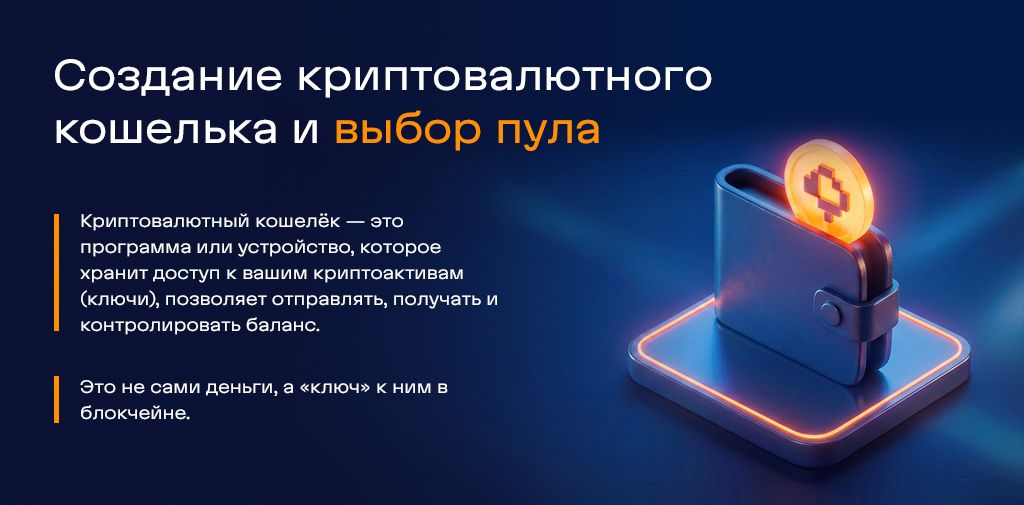
A wallet is a mandatory infrastructure element. This is where all payouts from the pool arrive. Never mine directly to an exchange address: exchanges periodically change deposit addresses, and coins can be lost.
Types of wallets:
- Hardware wallet (Ledger Nano X, Trezor) — maximum security, recommended for amounts from $500+
- Desktop wallet (Electrum for Bitcoin, Exodus for multi-currency) — a good balance of convenience and security
- Mobile wallet (Trust Wallet, BlueWallet) — convenient for monitoring, but less secure
- Exchange wallet — only for quick selling, not for storage
Popular mining pools:
| Pool | Coins | Commission | Payout system | Features |
|---|---|---|---|---|
| Foundry USA Pool | BTC | 0% | FPPS | Largest in the world by BTC |
| AntPool | BTC, LTC, ETH Classic | 0–2% | PPS+ | Owned by Bitmain |
| F2Pool | BTC, LTC, ETH Classic, ZEC | 2–3% | PPS+ | One of the oldest pools |
| EMCD | BTC, LTC | 1.5% | PPS | Popular in Russia and the CIS |
| 2Miners | ETH Classic, ZEC, ETC | 1% | PPLNS/SOLO | Good for GPU miners |
| Kryptex Pool | BTC | 1% | PPS | Payouts in rubles are available |
What is a mining hotel
A mining hotel is a specialized data center designed to place clients’ mining equipment. In essence, it is the rental of space, electricity, and infrastructure: you bring your equipment, and the organization provides power supply, cooling, internet, and physical security.
The concept of mining hotels appeared as a response to a practical problem: ASIC miners are noisy (75–85 dB), consume a huge amount of electricity, and require stable cooling. Placing such equipment in an apartment or small office is problematic. Professional data centers solve all these tasks at once.
Advantages of a mining hotel:
- Cheaper industrial electricity (often 3–5 rubles/kWh versus 6–10 for private users)
- Professional cooling and stable climate
- Physical security and video surveillance
- Technical support and prompt response to malfunctions
- No noise and heat in your premises
Disadvantages:
- Hosting commission (usually included in the electricity tariff or charged separately)
- You do not have physical access to the equipment 24/7
- You need to trust the operator
- Dependence on contract terms and the stability of the operator’s business
A mining hotel makes sense if you have several ASIC devices or more, the industrial electricity tariff is significantly more advantageous than your home tariff in your region, or you do not want to handle infrastructure issues yourself.
Legal regulation of mining in Russia
In Russia, cryptocurrency mining is a legal activity, but it requires compliance with a number of legal requirements. The regulatory framework is actively developing, and in 2026 regulation has become significantly more specific compared with previous years.
The foundational document is Federal Law No. 259-FZ “On Digital Financial Assets,” adopted in 2020. It legalized cryptocurrency as digital currency, established that it can be mined and held, but using it as a means of payment on the territory of Russia is prohibited. In 2024, a mining law was adopted (amendments to 259-FZ and related laws), which introduced additional requirements for industry participants.
Key requirements in 2026:
- Individuals are required to declare income from mining and pay personal income tax (13% or 15% for income over 5 million rubles per year)
- Individuals mining above the established threshold (by energy consumption) are required to register as an individual entrepreneur or legal entity
- Individual entrepreneurs can apply the simplified tax system (6% of income or 15% of profit) — significantly more advantageous than personal income tax at large turnovers
- Legal entities keep standard tax accounting, cryptocurrency is reflected on the balance sheet
- All participants are required to report received cryptocurrency to the Federal Tax Service
| Form of participation | Tax rate | Registration | Reporting | Suitable when |
|---|---|---|---|---|
| Individual | Personal income tax 13–15% | Not required* | 3-NDFL declaration | Small volumes |
| Individual entrepreneur (STS 6%) | 6% of income | Required | STS declaration | Medium volumes |
| Individual entrepreneur (STS 15%) | 15% of profit | Required | STS declaration | High expenses |
| LLC (general taxation system) | 20% profit tax | Required | Full accounting | Professional business |
* If established energy thresholds are exceeded, an individual is required to register. Check current thresholds with the Federal Tax Service or a tax consultant, as parameters may change.
The role of the Federal Tax Service of Russia in mining regulation is constantly increasing. The agency receives information from banks about transactions related to cryptocurrency exchanges. Working “in the gray zone” involves growing risks. Specific taxation questions are recommended to be clarified with a qualified tax consultant.
Mining risks and how to protect yourself from them
Mining is a business with real risks. Understanding each of them and preparing in advance will help minimize losses.
Market risks are primarily related to cryptocurrency price volatility. A coin that brought profit at a price of 5000 USD can go into the negative when falling to 2000 USD with the same electricity cost. The cryptocurrency market has historically been subject to sharp movements: cyclical rises and falls of 50–80% are common.
Technical risks include equipment failure, voltage surges, overheating, internet connection problems, and power supply failures. Every hour of downtime is lost income and a risk of device damage.
Security risks cover physical theft of equipment, wallet hacking, malware, and attacks on mining pools. Miners often become targets precisely because they work with digital assets.
Regulatory risks in Russia are decreasing as legislation develops, but they remain. Changes in tax legislation can significantly affect profitability.
Risk management strategies:
- Diversification: do not invest everything in one coin or one device
- Hedging: periodically convert part of income into stable assets
- Reserve fund: keep 3–6 months of operating expenses in reserve
- Equipment insurance: especially relevant for large farms
- Regular strategy review: recalculate profitability monthly
Technical measures for protecting the mining process
Reliable technical infrastructure is the foundation of stable operation of a mining installation.
An uninterruptible power supply (UPS) protects equipment from sudden power outages and short-term voltage surges. For an ASIC with 3 kW consumption, a UPS with a power of at least 4–5 kVA will be required.
A voltage stabilizer is necessary in regions with an unstable power grid. Voltage drops are a frequent cause of failure of power supplies and the miners themselves.
The cooling system is critically important. Recommended ASIC operating temperature: up to 75°C. When exceeding 85°C, the equipment begins to throttle and quickly degrades. Ensure good airflow, use forced ventilation.
Real-time equipment monitoring allows detecting a problem before it leads to a breakdown. Use specialized software (Hive OS, RaveOS for GPU; ASIC web interface) with configured alerts for temperature and hashrate.
- Clean equipment from dust every 1–3 months
- Change thermal paste once a year on GPU graphics cards
- Check the condition of fans — replace worn ones immediately
- Use a surge protector or voltage relay for additional protection
- Set up a backup internet connection (mobile router as backup)
Alternative ways to earn on mining
It is not necessary to personally manage equipment in order to participate in the mining industry. There are alternative formats with different entry barriers and risk-to-return ratios.
Cloud mining is the rental of computing power from specialized companies. Minimum technical threshold: no equipment, premises, or knowledge of settings is needed. However, the high risk of fraud and opacity makes this format dangerous for those who do not know how to check companies.
Contract mining is the purchase of a contract for mining a certain number of coins or hashrate for a fixed term. Most often it is offered by large platforms with real infrastructure. The advantage is predictability (in some schemes), the disadvantage is lack of control.
Investments in mining farms are the investment of funds in an operating farm in exchange for a share of profit. You can participate through specialized platforms or negotiate directly with operators. It requires a high level of trust in the partner and legally formalized relationships.
| Method | Entry | Control | Profitability | Fraud risk |
|---|---|---|---|---|
| Classic mining | High | Full | High (with luck) | Low |
| Cloud mining | Low | None | Low–medium | High |
| Contract mining | Medium | Minimal | Medium | Medium–high |
| Investments in a farm | Medium | Partial | Medium | Medium |
| Staking | Low–medium | Full | Moderate | Low |
The general principle: the lower the technical entry barrier, the higher the dependence on third parties and the risk of losing funds. Never invest money in alternative schemes that you cannot afford to lose.
Staking as an alternative to classic mining
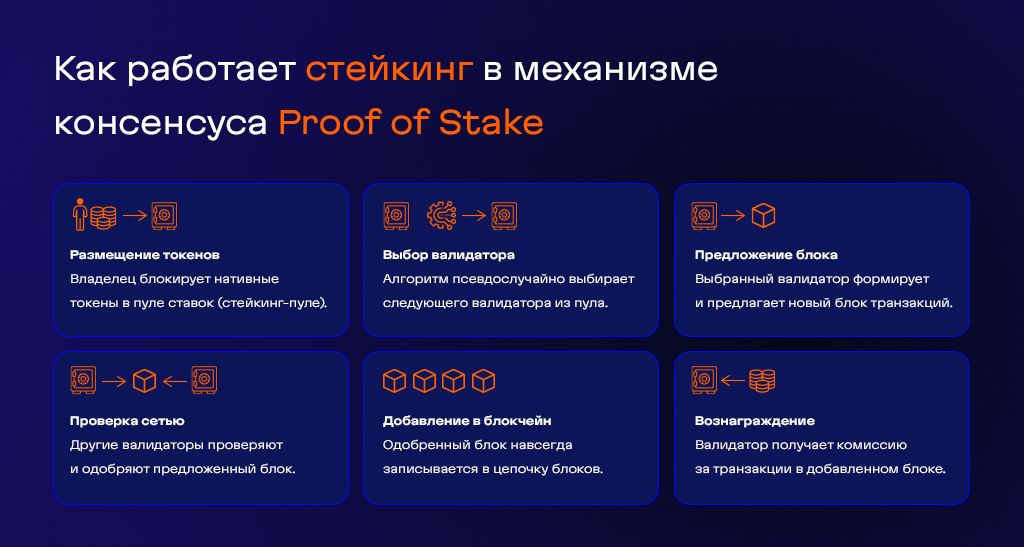
Staking is a mechanism for earning income from cryptocurrency based on the Proof of Stake algorithm. You lock a certain number of coins in a wallet or on a platform and receive a reward for participating in transaction validation. No special devices and huge electricity bills are required.
Ethereum switched to PoS in 2022, and ETH staking became one of the most popular passive income options in the crypto industry. In addition to Ethereum, staking is available in Cardano, Solana, Polkadot, Cosmos, and dozens of other projects.
Comparison of mining and staking:
| Parameter | Mining (PoW) | Staking (PoS) |
|---|---|---|
| Required equipment | Specialized (ASIC/GPU) | Ordinary computer or smartphone |
| Energy consumption | Very high | Minimal |
| Entry barrier | High | Low–medium |
| Type of income | New coins + fees | Interest on the invested amount |
| Profitability (approximately) | Depends on the market | 3–15% per year |
| Main risk | Difficulty growth, price drop | Drop in the coin price |
| Technical knowledge | Medium–high | Minimal |
Staking is not a replacement for mining, but a separate tool. It suits those who want to receive passive income from cryptocurrency they already have without needing to understand hardware. One risk remains — volatility of the coin’s price itself.
Conclusion and expert advice
Mining in 2026 is not the romance of a pioneer with a laptop in a coffee shop. It is a full-fledged industry with serious players, significant infrastructure requirements, and high competition. However, this does not mean that a private miner has no place in this market — there is, provided there is a competent approach.
The future of mining is determined by several trends. First, consolidation continues: large data centers with cheap electricity are pushing small home participants out of Bitcoin mining. Second, part of the market is gradually moving to PoS algorithms, reducing the space for classic PoW mining. Third, new coins continue to appear, creating temporary windows of opportunity for early participants.
Mining remains one of the ways to participate in the crypto economy — alongside investing, trading, and staking. For some it is a business, for others — a way to diversify a portfolio, for others — a technically interesting project.
5 main tips for a successful start:
- Calculate honestly. Take into account all expenses and model a pessimistic scenario. If the project goes deeply negative without reserves when the price falls by 50%, the decision should be reconsidered.
- Start small. One or two ASICs or a small GPU farm will allow you to study the specifics of work without the risk of losing large sums on beginner mistakes.
- Follow the market constantly. Mining is a dynamic environment. Monthly profitability recalculation and readiness to change coin or strategy are mandatory here.
- Comply with legislation. Declare income and keep expense records. Legal cleanliness protects against more expensive problems in the future.
- Diversify. Do not bet everything on one coin and do not invest funds in mining that you need in the short term. Consider combining mining and staking to balance risks.
Who mining makes sense for in 2026: those who have access to cheap electricity (industrial tariff or their own generation), sufficient starting capital, readiness for technical maintenance, and an understanding of risks. For everyone else — consider staking or direct investments in cryptocurrency as less labor-intensive alternatives.
Frequently asked questions about mining
When will all bitcoins run out and what will happen after that?
The last Bitcoin will be mined approximately in 2140: a total of 21 million coins is programmed. After that, miners will stop receiving block rewards, but will continue earning transaction fees. It is assumed that by that time fees will be high enough to support the economics of the network.
How does home mining differ from industrial mining?
Home mining is 1–5 devices in a residential or non-residential premises, a high electricity tariff, and limited cooling capabilities. Industrial mining is hundreds and thousands of devices in specialized data centers with cheap electricity, professional cooling, and round-the-clock maintenance. The difference in the cost of mining one coin can be twofold or higher.
What is a mining hotel and when does it make sense to use it?
A mining hotel is a specialized data center where you place your equipment under responsible storage with power and cooling. It is profitable if you have several ASIC devices and no possibility to provide normal operating conditions at home, or if the operator’s industrial tariff is significantly lower than your home tariff.
Can you earn on mining without buying your own equipment?
Yes — through cloud mining (hashrate rental), contract mining, or investments in mining farms. The entry barrier is lower, but you completely depend on the operator’s integrity. The market is saturated with fraudulent schemes, so careful verification of the platform is mandatory. Staking is another real alternative without equipment.
What should a beginner choose in 2026: mining or staking?
It depends on your resources and readiness. If you have a budget from 200,000+ rubles, access to inexpensive electricity, and interest in the technical part — consider altcoin mining. If you want passive income without equipment and technical knowledge — staking is simpler, safer, and requires lower initial investments. Many experienced market participants combine both tools