
In 2026, there are several ways to buy cryptocurrency with rubles. Some of them do indeed not charge exchange fees. But it’s important to understand that “zero commission” in an exchange’s advertising is not the same thing as a “free purchase.” The actual cost consists of the spread, network fees, and exchange rate differences. Read this article to find out where these costs are lowest and how to avoid paying more than necessary.
What you need to prepare before buying: a payment method (card, e-wallet, or cash), a crypto wallet to receive coins, and an understanding of which cryptocurrency you’re buying—USDT, Bitcoin, or another asset. You don’t need a passport everywhere: for amounts up to 50,000 ₽ via an offline exchange or P2P, you can get by without verification.
Where the crypto is credited: to your personal wallet or to the exchange’s internal balance. The first option is more reliable: the coins belong only to you, and no platform can freeze them or restrict access. The second option is more convenient if you plan to continue trading on the exchange. When buying through an exchange (in cash or online), the crypto is always sent to the personal wallet address you specify.
Legality. Under Federal Law No. 259, cryptocurrency is recognized as property in Russia. Owning, buying, and selling it is legal. The only restriction: you cannot use cryptocurrency as a means of payment within the country, i.e., pay with it in stores. There are no restrictions on personal investments, storing savings, or cross-border transfers.
Where to store crypto: choosing a crypto wallet
What is a crypto wallet
A crypto wallet is a program or physical device that stores the access keys to your coins on the blockchain. The cryptocurrency itself is physically located on the blockchain; the wallet merely grants you the right to manage it. Without a wallet, you cannot receive, store, or send coins to a personal address. You’ll have to keep them on a platform (most often an exchange), which can restrict withdrawals at any time.
Wallets are divided into hot wallets (connected to the internet: mobile apps and browser extensions) and cold wallets (physical devices without a constant connection). Hot wallets are more convenient for daily use, while cold wallets are more secure for long-term storage of large amounts. For more details on how a wallet works and why you need one, read our article: Crypto Wallet — What Is It?
4 types of crypto wallets
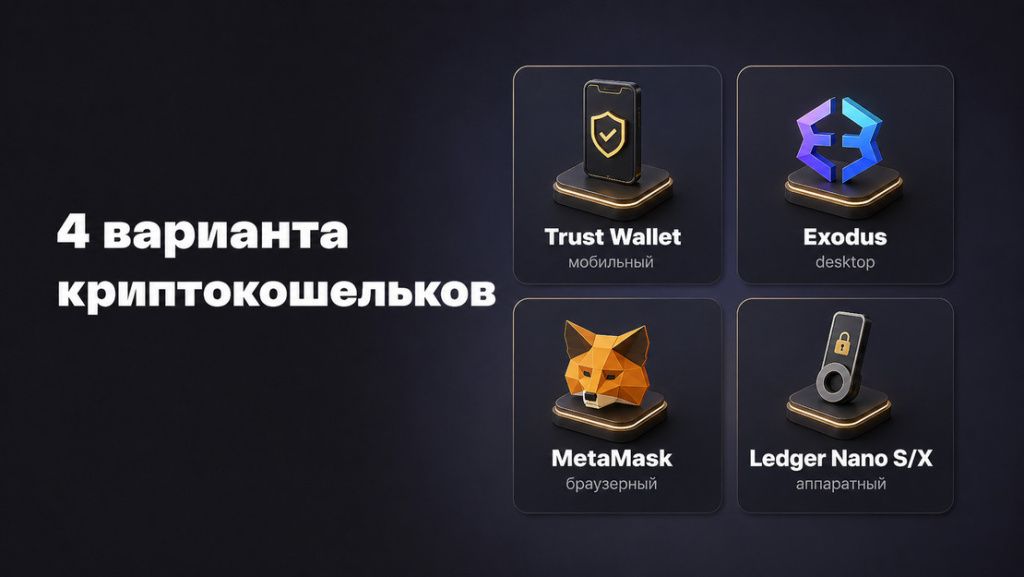
The choice of wallet depends on the amount of money you have, how often you make transactions, and how important security is to you. A mobile app is a good option for beginners with small amounts, but for savings of 500,000 ₽ or more, only a hardware wallet is suitable.
| Wallet | Type | For | Networks | Feature |
|---|---|---|---|---|
| Trust Wallet | Mobile, hot | Beginners, small amounts | USDT TRC-20, BTC, ETH | Free, simple interface, official Binance wallet |
| Exodus | Desktop + mobile | Medium amounts, convenience | BTC, ETH, USDT, and 300+ coins | Built-in exchange, attractive interface |
| MetaMask | Browser-based, hot wallet | ERC-20 tokens, DeFi | ETH, USDT ERC-20, BNB | For Web3 and DeFi services, integration with dApps |
| Ledger Nano S/X | Hardware, cold | Large amounts, long-term storage | All major networks, 5,000+ coins | Maximum security, keys never leave the device |
Where to buy crypto with rubles and what the actual fees are
Why “0% commission” is just marketing
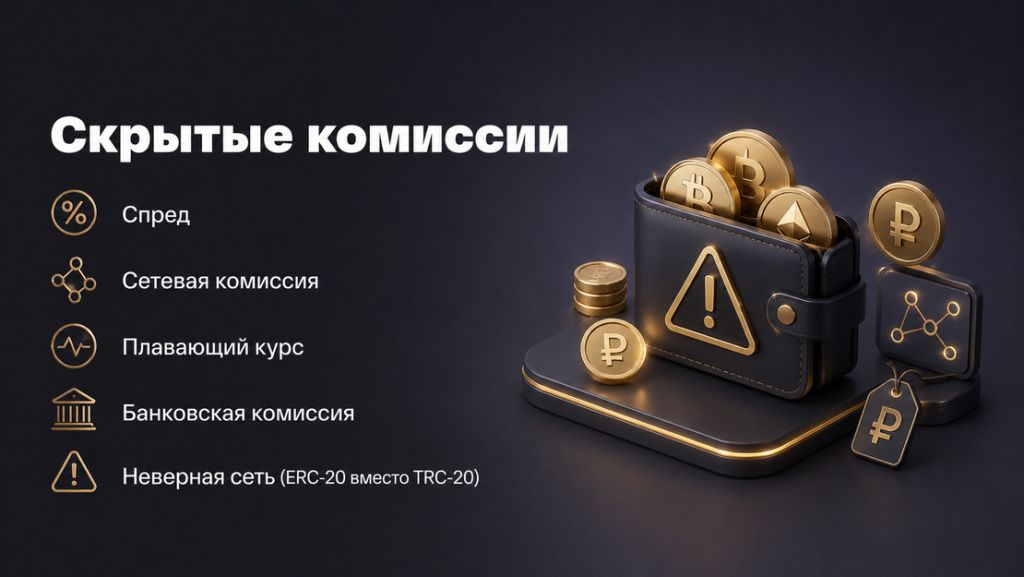
When an exchange or trading platform says “no commission,” it means one thing: they don’t charge a separate fee for their service. But the actual cost of a purchase consists of three components that don’t go away. They’re just not advertised.
The spread is the difference between the purchase price and the market price. On P2P platforms, it’s 1–3%. This means: when buying 10,000 ₽ worth of crypto, you immediately lose 100 to 300 ₽ just on the price difference, even with a “zero commission.” On a total of 100,000 ₽, that’s already 1,000–3,000 ₽ in hidden overpayment.
Network fee — a fee paid to the blockchain for transferring coins to your wallet. On the TRC-20 network, this is $0.5–1 (~50–90 ₽), and on ERC-20, it ranges from $3 to $15 (~270–1,350 ₽) depending on network congestion. When buying a small amount, the ERC-20 network fee can eat up 5–10% of the entire transaction.
Exchange rate difference with a floating rate. If the exchange rate isn’t fixed at the time the order is placed but “floats” until payment is confirmed, you may receive less than expected. In a volatile market, the BTC rate can change by 0.5–2% in 15 minutes.
Example of actual losses when buying 50,000 ₽ worth of USDT:
- P2P exchange: 2% spread = minus 1,000 ₽, TRC-20 network fee ≈ 80 ₽. Total loss ~1,080 ₽ (2.2%)
- Online exchange: 0.8% commission = minus 400 ₽, TRC-20 network fee ≈ 80 ₽. Total ~480 ₽ (0.96%)
- Offline exchange (cash): 0.3–0.5% fee, network fee included in the price. Total ~150–250 ₽ (0.3–0.5%)
- T-Bank / Sber: commission 0.1–0.5% = 50–250 ₽. Transparent, with no hidden fees.
The conclusion is clear: “zero commission” advertising works to create a first impression. Actual losses depend on the method, amount, and selected network. That is why it is correct to compare not the exchange rate, but the final amount of crypto in your wallet after the transaction is completed.
Comparison of all methods for buying crypto with rubles
| Method | Securities and Exchange Commission | Actual losses | Speed | Min. amount | Anonymity | Risk of card being blocked |
|---|---|---|---|---|---|---|
| P2P exchange | 0% | Spread 1–3% | 5–15 min | from 1,000 ₽ | Partial | Average |
| Online exchange | 0.3–1.5% | Fixed, transparent | 10–30 min | from 5,000 ₽ | Partial | Low |
| Offline exchange (cash) | from 0.3% | Min |
Buying crypto with cash rubles: when is it most profitable
Who should buy crypto with cash rubles
In 2026, exchanging cash rubles for cryptocurrency through an offline exchange is not only convenient but also practically the only way to completely bypass the banking system. When transferring from a card, the bank may ask questions or block the transaction. When transferring cash at an office, the bank simply does not participate in the transaction.
The main advantages of buying crypto with cash:
- No banking trail. When handing over cash at an office, no transfer from a card takes place. The bank does not see the transaction, does not apply Federal Law No. 115-FZ, and the “Antidrop” system is not activated. This is especially important for amounts of 100,000 ₽ or more, when transfers from a card attract increased scrutiny.
- Anonymity for small amounts. For exchanges up to 50,000 ₽, most offline exchanges operate without mandatory identity verification. You arrive, hand over the cash, and receive crypto in your wallet without presenting a passport.
- Minimal actual losses. For large amounts (100,000 ₽ and above), offline exchanges offer a better rate than P2P or online services. A spread of 0.3–0.5% versus 1.5–3% on P2P: the difference on a sum of 500,000 ₽ will be 5,000–12,500 ₽.
- AML verification of coins. Reputable offline exchanges perform automatic verification of coins before sending them: this means you receive “clean” USDT or BTC that hasn’t been involved in suspicious transactions, which is important if you plan to withdraw crypto into rubles via a bank in the future.
- Live assistance. For beginners, this is a critical advantage: an office manager walks you through the entire process, helps verify your wallet address, and explains each step. The risk of making a mistake when entering the address is minimal.
How to find an offline cash exchange via Exnode
The fastest way: use the Exnode monitoring tool. In the “Paying” field, select “Cash RUB” (or “Cash RUB”). In the “Receiving” field, select the desired cryptocurrency: USDT TRC-20, BTC, or ETH. The system will display a list of exchanges that actually work with cash, showing current rates, reserves, and ratings.
Before choosing an exchange based on the rate, pay attention to three parameters: the reserve must exceed your transaction amount, the exchange’s rating must be at least 4 out of 5, and it must have a real office address with a verifiable history on maps.
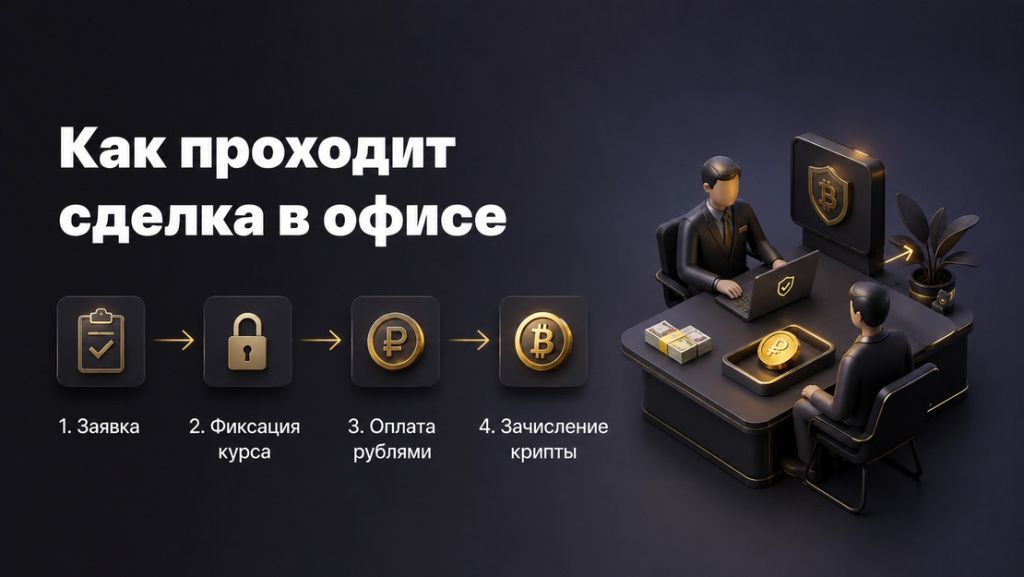
How the transaction works at the office: step-by-step
- Submit a request on the exchange’s website. Select the direction: “Cash rubles → USDT TRC-20” (or another pair). Enter the amount and your wallet address.
- A manager will contact you. They will clarify the transaction details and lock in the exchange rate. Important: The exchange rate must be locked in before your arrival and confirmed in writing (via chat or email).
- Arrive at the office. The Moscow City exchange offices are located in business towers with convenient transportation access. Making an appointment allows you to avoid waiting in line.
- Hand over the cash rubles on site. The manager will count the amount in your presence. Make sure the final amount you receive matches what was agreed upon in advance.
- Verify the wallet address together with the manager. Copy your wallet address via the QR code or clipboard. Never enter it manually. Check the first 6 and last 6 characters. This is the main rule that protects against address spoofing.
- The manager initiates the crypto transfer. The transaction is sent to the blockchain.
- Check for the arrival in your wallet app. USDT TRC-20 arrives in 1–3 minutes. BTC takes 10 to 30 minutes, depending on network congestion. The transaction is complete.
What to look out for when exchanging for cash
Fixed exchange rate before arrival — a must. If the manager doesn’t quote an exact rate in advance and says “we’ll discuss it on the spot” or “it depends on the market” — that’s a red flag. The rate may turn out to be unfavorable once you arrive at the office with your cash.
Choosing a network. When buying USDT, always clarify which network the coins will be sent on. TRC-20 is the cheapest and fastest option. ERC-20 is 10–15 times more expensive in terms of network fees. Make sure your wallet supports the correct network: sending USDT TRC-20 to an ERC-20 address will result in the permanent loss of your funds.
The word “licensed” in an advertisement is a red flag. As of June 2026, no cryptocurrency exchange in Russia has been licensed: the law establishing a registry of licensed intermediaries (Bill No. 1194918-8) is in a transition period until July 1, 2027. If an exchange calls itself “licensed” or “official,” that is a misleading claim.
How to find a profitable crypto exchange
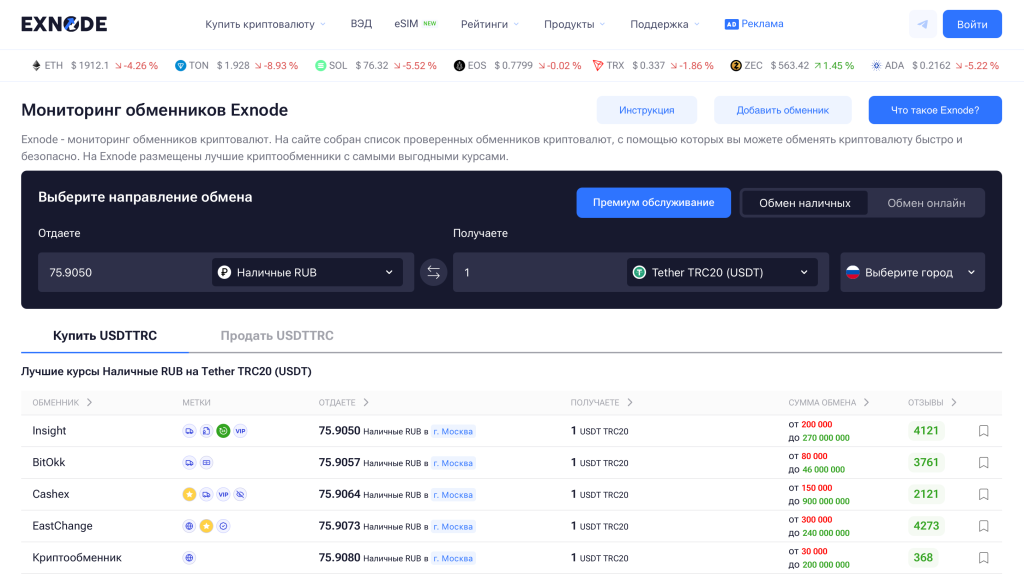
The main rule when using exchange rate trackers: don’t look at the “rate,” but at the total amount of cryptocurrency you’ll receive. This figure reflects the actual profit after all fees are deducted.
Step-by-step guide:
- Open the Exnode website. On the main page, there are two fields: “Give” and “Receive.” This is the direction of your exchange.
- Select a pair. In the “Give” field, choose rubles in the desired format: “Cash RUB,” “Card RUB,” “SBP,” or another option. In the “Receive” field, choose a cryptocurrency: USDT TRC-20, BTC, ETH.
- Enter the amount. The system will calculate and show how much crypto you will receive at each exchange. Compare the total amount in the “Receiving” column, not the exchange rate.
- Check the reserve. The exchange’s reserve must be greater than the amount of your transaction. If the reserve is low, there may be a delay or a refusal to process the transaction. Exchanges with a large reserve consistently handle any amount.
- Read reviews. Each exchange in the list has a rating and user reviews. Pay attention to the content: recurring complaints about delays, rate discrepancies, or rude support are reasons to choose a different service.
- Go to the exchange’s website via the link from Exnode. This is critically important: do not enter the address manually and do not click on ads. Only go through the monitoring service. This way, you eliminate the risk of landing on a fake clone.
Checking reliability (8 criteria)
- Transparent terms before payment. Commission, exchange rate, total amount, and network fee: all of this must be clearly stated before you create a request. If details are “finalized during the process” or change afterward, this violates the basic rule of an honest service.
- Fixed exchange rate. A reliable service locks in the exchange rate for 5–15 minutes when you create a request. During this time, you can complete the payment without worrying that the rate will drop due to market volatility.
Red flags: when to walk away without hesitation
- The words “licensed,” “official,” and “regulated” in advertisements are false as of June 2026.
- The manager is pressuring you to act quickly: “Transfer right now; the rate will change in a minute.”
- The terms of the deal change after agreement: the exchange rate is “recalculated,” a commission is “added.”
- The payment details are registered to an individual without any explanation.
- The "support" Telegram account was created recently; there is no message history or verification.
- The website address differs from the one provided, even by a single letter or second-level domain.
- They promise a rate 5–10% better than the market: there are no real reasons for such a “benefit.”
Hidden fees when buying crypto
The spread and how to calculate it yourself
Spread: this is the difference between the price at which you buy crypto and the actual market price. To calculate it yourself, open CoinMarketCap or CoinGecko and check the current USDT/RUB exchange rate. Then compare it with the rate offered by the exchange or a seller on a P2P platform.
If the market price is 1 USDT = 90 ₽, and the exchange is selling at 91.8 ₽, the spread is 2%. For a total of 100,000 ₽, this amounts to a 2,000 ₽ overpayment, which isn’t visible in the “commission” line but is reflected in the final exchange rate. This is precisely why it’s important to compare the final amount of crypto received by monitoring the transaction, rather than trusting advertised figures.
Network Fee: TRC-20 vs. ERC-20 in Numbers
A network fee is a payment to miners or blockchain validators for processing a transaction. It does not depend on the exchange: it is a parameter of the network itself. The choice of network when buying USDT is one of the most influential factors on the final cost of the transaction.
| Network | Average fee | Transaction speed | When to choose |
|---|---|---|---|
| USDT TRC-20 (Tron) | $0.5–1 (~50–90 ₽) | 1–3 min | Always, unless there are special requirements |
| USDT ERC-20 (Ethereum) | $3–15 (~270–1,350 ₽) | 2–5 min | Only if the recipient specifically requires ERC-20 |
| BTC (Bitcoin) | $1–5 (~90–450 ₽) | 10–60 min | When buying Bitcoin |
| ETH (Ethereum) | $1–8 (~90–720 ₽) | 15–30 sec | When buying Ether |
Exchange rate difference with a floating rate
Some exchanges and P2P platforms do not lock in the exchange rate when an order is placed; instead, it “floats” until payment is confirmed. In a volatile market, the price of BTC can change by 0.5–2% in 5–15 minutes. For a transaction worth 200,000 ₽, that’s a difference of 1,000–4,000 ₽, which you’ll only notice after the money has already been sent.
Protection is simple: insist on locking in the exchange rate before payment. If the exchange doesn’t lock it in, it’s not a scam, but a calculated risk you’re taking on.
Complete table of hidden fees
| Hidden fees | Where it occurs | Amount | How to avoid |
|---|---|---|---|
| Spread | P2P, exchange platforms | 1–3% of the amount | Compare the final amount received via Exnode, not the exchange rate |
| Network fee | All methods when withdrawing to a wallet | $0.5–15 depending on the network | Select TRC-20 for USDT instead of ERC-20 |
| Floating exchange rate | Exchanges without fixed rates | 0.5–2% in a volatile market | Require a fixed rate before payment |
| Bank fee | Card payment | 0–1.5% | Use a debit card instead of a credit card, or pay in cash |
| Wrong network | When selecting ERC-20 instead of TRC-20 | $3–15 extra | Always verify the network before creating a transaction |
Buy crypto via P2P on an exchange
P2P trading involves buying cryptocurrency directly from another user through an intermediary exchange. The crypto exchange does not charge a fee for the transaction itself, but it protects the buyer by holding the seller’s coins in escrow until payment is confirmed. Only after you’ve confirmed the transfer and the seller has received it are the coins released to you. This is the main advantage of P2P over direct trading.
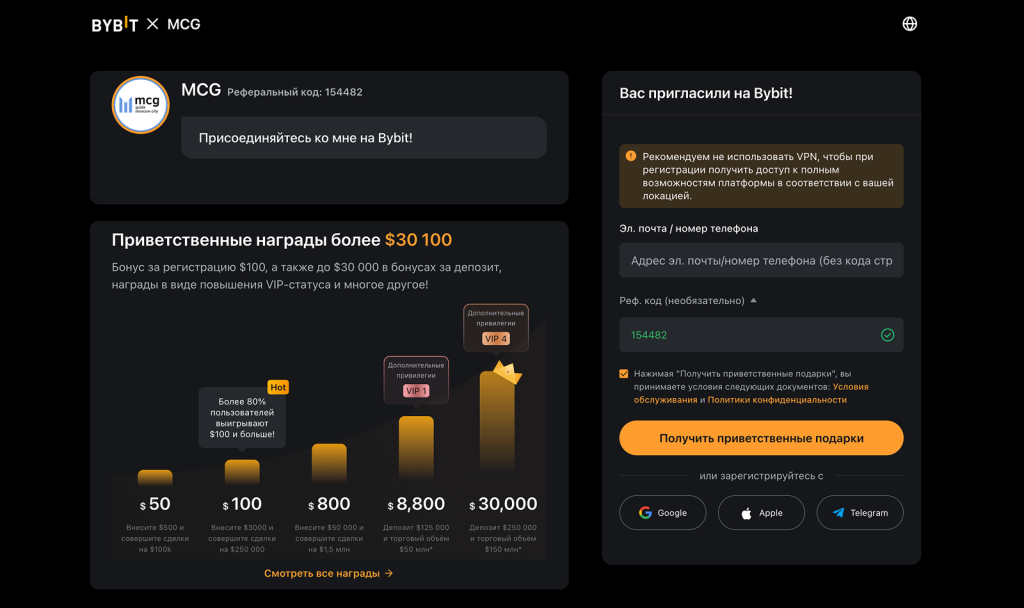
For more details on how Bybit operates in Russia in 2026, read our separate analysis: it covers current terms, P2P trading with rubles, and answers to frequently asked questions about verification.
- Sign up for Bybit. Follow the link Bybit — sign up with a bonus of up to 30,100 USDT. Enter your email or phone number and create a password. Registration takes 2 minutes.
- Complete basic KYC. Upload a photo of your passport and take a selfie. Verification usually takes 5–15 minutes. Without KYC, only minimum limits are available. Verification is required for normal trading with rubles.
- Open the P2P section. In the top menu, click “Buy Crypto” → “P2P Trading.” Select a coin (USDT or BTC) and the payment currency (RUB).
- Set up filters. Payment method: choose SBP or T-Bank: SBP transfers are less likely to raise questions with banks than transfers marked “by card number.” Specify the exact purchase amount in rubles.
- Select a seller. Check their rating: no lower than 98% and at least 200 completed transactions. Sellers with a 95% rating and 10 transactions: high-risk zone. Also check the average response time: no more than 5–10 minutes.
- Create an order. Enter the amount in rubles, click “Buy.” The exchange instantly locks the seller’s coins in escrow. They cannot be moved until payment is made.
- Transfer the funds. Use the details the system displays after you create the order. Important rule: do not mention the words “crypto,” “USDT,” “Bybit,” or “bitcoin” in the payment description—this may cause the bank to block the transfer via the “Anti-drop” system.
- Confirm the payment in the Bybit interface. The seller sees the payment and releases the coins from escrow. This usually takes 2–10 minutes.
Once the USDT has been credited to your Bybit P2P wallet, transfer it to your spot wallet if you plan to trade, or withdraw it to your personal wallet (Trust Wallet, Ledger) for long-term storage.
Buying via an online exchange
- Find an exchange via Exnode. Select the exchange direction and compare the total amounts. Only visit the website via the link from the monitoring service—do not use search engines or click on ads.
- Create a request. Specify the amount in rubles, your wallet address (USDT TRC-20, BTC, or other), and select a payment method: card, SBP, or bank transfer.
- Check all parameters before confirming. The exchange rate, the total amount to be received, the network fee (whether it’s included in the price or not), and the payment time. All of this should be clear before you click “Create Request.”
- Double-check the wallet address. Copy your wallet address again and compare the first 6 and last 6 characters with what you pasted into the form. Do not enter the address manually; use only copy-paste or a QR code.
- Pay using the exchange’s payment details. Do not mention anything about crypto in the payment description. Transfer the exact amount: a difference in rubles may cause a delay in the transaction.
- Wait for the transaction to complete. USDT TRC-20: 2–5 minutes. BTC: 10–60 minutes. ETH: 1–5 minutes. You can track the transaction’s progress using the hash on Tronscan (TRC-20) or Blockchain.com (BTC).
- Check your wallet for the deposit. If the coins haven’t arrived after 30 minutes, contact the exchange’s support team, providing the transaction hash and your order number.
How to Avoid Scammers When Buying Crypto
Top 5 Scams in 2026
- Fake clone exchange. Scammers create a website that looks exactly like a well-known exchange, with a similar domain (bitokk-exchange.com instead of bitokk.biz, exnode-online.ru instead of exnode.ru). The user transfers money and loses it. There’s only one way to protect yourself: access the site only through Exnode, never via a search engine or an ad.
- Wallet address spoofing. A malicious browser extension or app replaces the address in the clipboard: you copied your address, but the scammer’s address was pasted instead. Protection: after pasting, always compare the first 6 and last 6 characters of the address. If there’s a discrepancy in even one character, the money will go to the wrong place and won’t come back.
- Exchange rate change before payment. The exchange platform displays an attractive rate; you create a request and receive a message that “the rate has been updated” and the amount to be received has decreased. Sometimes this happens after the money has already been transferred. Solution: Request that the exchange rate be locked in writing before payment.
Exchange Verification Checklist
- The exchange is listed on Exnode with a history of reviews, not a new service with no reputation.
- The domain on the website matches the one listed in the monitoring service, letter for letter and symbol for symbol.
- There are reviews on Yandex.Maps, Google Maps, or 2GIS: genuine, with different dates and varied content.
- For offline exchangers: the address actually exists, can be verified on a map, and there are photos of the office.
- The terms of the transaction (exchange rate, commission, total amount) are known before the request is created.
- Support provides substantive answers and quotes specific figures, rather than resorting to generalities.
- The advertisement does not contain the words “licensed” or “official”: as of June 2026, this is a false claim.
- Payment details are registered to a legal entity or sole proprietor, not simply to an individual without explanation.
Law 2026, Card Blocking, and Taxes in Russia
What has changed since July 1, 2026
On April 1, 2026, the government submitted Bill No. 1194918-8 “On Digital Currency and Digital Rights” to the State Duma. On April 21, 2026, the State Duma passed it on first reading. Most of the provisions take effect on July 1, 2026, with a transition period for market participants set until July 1, 2027.
What this means for the average cryptocurrency buyer right now:
- Cryptocurrency is not banned. Buying, selling, and storing it remains legal.
- The concept of a licensed intermediary from the Central Bank’s registry is being introduced, but the registry itself is still being formed during the transition period.
- Banks are being granted expanded powers to monitor cryptocurrency-related transfers.
- The "Antidrop" system helps banks identify transfers to drop cards. If your P2P counterparty uses such a card, your account may also be subject to blocking under Federal Law No. 115-FZ, even if you have not violated any regulations.
Risk of card blocking: how much can you transfer
| Purchase amount | Risk of blocking | Recommended method | Important considerations |
|---|---|---|---|
| Up to 50,000 ₽ | Low | P2P, exchange, cash | Do not include the word "crypto" in the transfer description |
| 50,000–300,000 ₽ | Medium | Exchange with AML verification, cash | Splitting the amount is not recommended: frequent small transfers also raise suspicion |
| Over 300,000 ₽ | High for cashless P2P | Offline exchange with cash rubles | Offline transactions completely bypass the banking system; the risk of being blocked is minimal |
Taxes on buying and selling crypto in 2026
Under Federal Laws No. 259 and No. 418, cryptocurrency is recognized as property in Russia. The tax logic is simple:
- Bought and held: no taxes. The tax base arises only at the moment of sale at a profit.
- Sold for more than you bought: the difference between the sale price and the purchase price is subject to a 13% personal income tax (or 15% if your annual income from this source exceeds 5 million rubles).
- Sold for less or at a loss: no tax; the loss can be taken into account when calculating the tax base for the year.
Exchanges and P2P platforms do not automatically report data to the Federal Tax Service, but this does not mean there are no tax obligations. For large transactions, it is recommended to keep your own records of transactions and, if there is a profit, file a 3-NDFL tax return.
Frequently Asked Questions
Can I buy crypto without a passport?
Yes, this is possible for small amounts. Offline exchanges accept cash up to 50,000 ₽ without mandatory identity verification. On P2P exchanges without KYC, minimum limits are available; with basic verification, the limits increase significantly. A number of online exchanges and Telegram services also operate without a passport for amounts up to 15,000–30,000 ₽. For purchases of 50,000 ₽ or more, most services require at least minimal identity verification.
Which is more profitable: P2P or an offline exchange with cash?
It depends on the amount. Up to 30,000–50,000 ₽: P2P on Bybit or MEXC often offers the best rate due to high competition among sellers. For amounts of 100,000 ₽ and above, an offline cash exchange comes out on top: a spread of 0.3–0.5% versus 1.5–3% on P2P, no risk of card blocking under Federal Law No. 115-FZ, AML verification of coins, and live transaction support. For amounts of 500,000 ₽ or more, the difference in the final amount can be 5,000–12,500 ₽ in favor of cash exchange.
TRC-20 or ERC-20 — which should you choose when buying USDT?
For the vast majority of use cases, choose TRC-20. The network fee is 10–20 times lower ($0.5–1 vs. $3–15), and the speed is comparable (1–3 minutes). The only exception: if the receiving party (exchange, other service, partner) has explicitly stated that it only accepts ERC-20. In all other cases, TRC-20 is the obvious choice. Always check which network the recipient accepts before sending.
Will Bybit be available in Russia in 2026?
Yes, Bybit is available to Russians. P2P trading with rubles is available, verification of Russian passports is accepted, and transfers via the SBP and Russian bank cards are supported. An up-to-date breakdown of the terms, available features, and answers to questions about VPNs: in the article Bybit in Russia in 2026: How the Exchange Works.
Where is it safer to store crypto—on an exchange or in a personal wallet?
A personal wallet is safer for storage. An exchange can be hacked, blocked by a regulator, or may restrict withdrawals on its own. In a personal non-custodial wallet (such as Trust Wallet or Ledger), the coins belong solely to you, provided that your seed phrase is stored securely and has not been shared with anyone. For active trading, it’s more convenient to keep the necessary amount on an exchange. Only a personal wallet is suitable for storing savings.
Conclusion
- “Zero commission” is just marketing. The actual cost of a purchase always includes the spread, network fees, and potential exchange rate differences. Compare the final amount of crypto received through Exnode, not the exchange’s advertised rate.
- Cash is an underrated and often the most cost-effective method. For amounts starting at 100,000 ₽, an offline cash exchange minimizes losses, completely bypasses the banking system, and eliminates the risk of card blocking under Federal Law No. 115-FZ. For large sums, this isn’t just more convenient—it’s actually cheaper.
- Exnode monitoring and an exchange verification checklist: these aren’t unnecessary steps, but a mandatory part of a secure transaction. A single five-minute check can save you from losing the entire amount.
- The law is changing, but buying crypto with rubles in Russia is still legal. The key is to understand the real risks, choose trusted services with a proven track record and reputation, and not be swayed by flashy promises in advertisements.