

A card being blocked after a P2P transaction is not related to the transaction itself, but rather to how the bank assesses the risks involved. Banks may suspend transactions under Federal Law No. 115-FZ (suspicion of money laundering or tax evasion) and Federal Law No. 161-FZ (preventive measures against fraud). In such cases, the customer must receive a clear explanation from the bank: under which specific law and which provision the restriction was imposed. This article outlines the key steps: how to find out the reason for the block, what documents to prepare, how to properly draft an explanation for the bank, and where to turn if your initial appeal is unsuccessful.
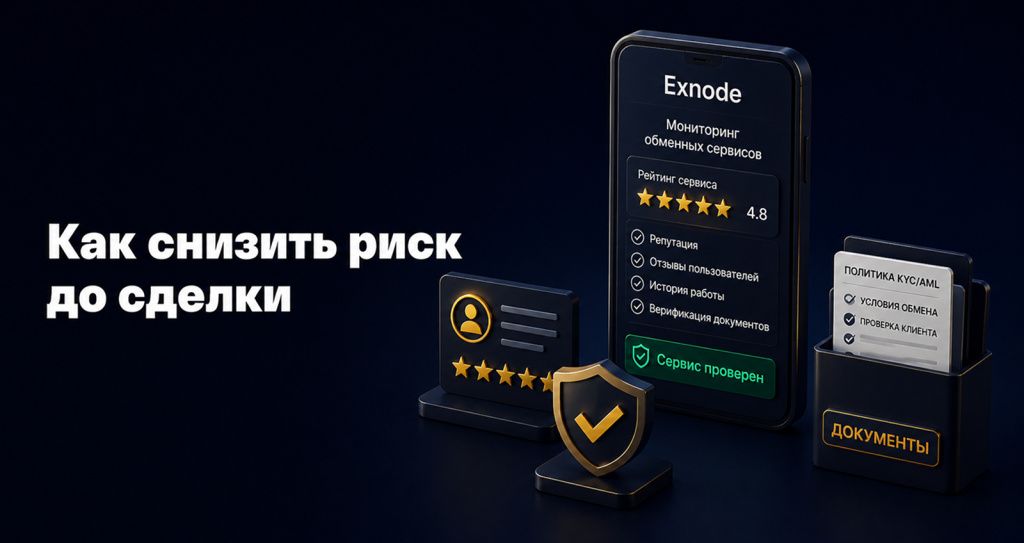
At the very beginning of a cryptocurrency transaction via P2P, it makes sense to use exchange monitoring services—for example, Exnode displays lists of exchange platforms along with reviews. This helps you choose a reputable exchange.
But it’s important to remember: even an exchange listed in a ranking needs to be checked further. The Bank of Russia warns that any schemes involving “shady” exchange services carry high risks: they can lead to account freezes and even draw you into criminal networks. Always keep a record of your transactions and documents—we’ll discuss this further below.
Why Your Card Might Be Blocked After a P2P Transaction
In a P2P transaction, cryptocurrency is transferred within an exchange or blockchain network, while rubles are transferred between banks. The bank only sees a bank transfer from one individual to another and is unaware of the details of the crypto transaction. If the sender or recipient of the transfers is involved in suspicious schemes (for example, their information is already in the Central Bank’s database under Federal Law No. 161-FZ or they are suspected of money laundering), the bank may suspect illegal activity. Essentially, when you buy crypto through illegal exchanges, you risk becoming a participant in shadow economy transactions. When evaluating your profile, the bank looks at: where the money came from, how often you receive transfers, whether the full names match, and whether there have been any complaints from payers. Any anomalous P2P transfers are automatically subject to an AML review based on criteria established by the Central Bank.
The key task is to prove to the bank that the transfers have a legitimate economic purpose and a transparent chain of transactions. If this isn’t obvious (for example, if the money came from an unknown person, in a large amount, and without explanation), the bank may suspend the transaction or block the card in accordance with applicable law.
What happened? Table of possible scenarios
| Situation | Possible cause | What to clarify with the bank |
|---|---|---|
| One transfer has been suspended | Anti-fraud check (Federal Law No. 115-FZ or No. 161-FZ) | Reason for the suspension and expected duration of the check |
| Transfers/withdrawals are not going through | Information in the Central Bank’s database (Federal Law No. 161-FZ) or the bank’s internal risk assessment | Has the entry of details into the Central Bank database under Federal Law No. 161-FZ been verified? |
| Access to online banking or the card is restricted | Anti-fraud mechanism or inclusion in the Central Bank database under Federal Law No. 161-FZ | Which specific services/transactions are blocked, and on what grounds |
| The bank has requested documents | Verification under Federal Law No. 115-FZ (money laundering/taxes) | List of required documents and the bank’s response timeframe |
| The transaction was declined | Suspicious transaction or violation of internal rules | Request a written explanation of the refusal from the bank |
| P2P payer disputes the payment (complaint) | Fraud on the part of the sender (Federal Law No. 161-FZ) | Number of the disputed transfer and verification status at the bank |
The table shows that “card lock” doesn’t always mean the same thing. You need to determine whether a single transaction has been suspended, online services have been restricted, or the entire account has been locked. The steps to take vary depending on the situation.
What is the difference between Federal Law No. 115-FZ and Federal Law No. 161-FZ?
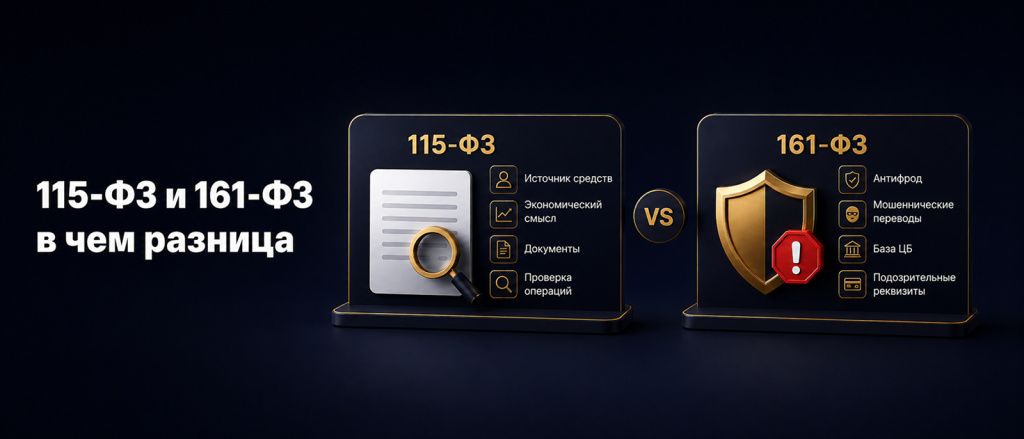
| Criterion | 115-FZ | 161-FZ |
|---|---|---|
| Purpose of the Law | Combating money laundering, terrorist financing, and tax evasion (AML/CFT) | Anti-Fraud Law (protection against payment fraud without the customer’s consent) |
| What the Bank Analyzes | Source of funds, nature of transactions, presence of an “economic rationale” for transactions | Links between account details and fraudulent schemes, complaints from payers |
| What may be blocked | A specific transaction; if necessary, an account or online access | A single transaction, a card, or the entire account in the Central Bank’s unified database (used by all banks) |
| Where to look for the cause | Upon the bank’s request (request for documents) | In the Central Bank’s unified database on “transfers without consent” (information from banks and the Ministry of Internal Affairs) |
| Action after clarification | The bank reviews the documents (up to 7 business days) and unblocks the account if everything is in order | After submitting an application, the information may be removed (Central Bank review—15 business days) |
How to Find Out the Exact Reason for the Restriction
- Check your notifications and attachments. Banks sometimes send push notifications or text messages about the block. These may include a brief explanation of the reason.
- Contact the bank. Call the hotline, use the online chat, or visit a branch. Ask for written confirmation of the reason.
- Clarify the circumstances. Ask whether a specific transaction, the card, or the entire account has been restricted; find out if they are citing Federal Laws No. 115-FZ or No. 161-FZ, or only internal rules.
- Find out what documents are required. The customer should know which documents the bank requires and how long it will take to review their explanations.
- Document the conversation. Whether you’re speaking by phone or at a branch, write down the date, the employee’s full name, and the content of the conversation. Refer to these details in future communications.
The Central Bank reminds you: the bank is required to explain the reason and the steps needed to restore service. Don’t hesitate to ask the bank for details—it’s your right.
What Documents to Prepare
When responding to the bank (or filing a complaint with the Central Bank), it is helpful to include a complete set of supporting documents. For example:
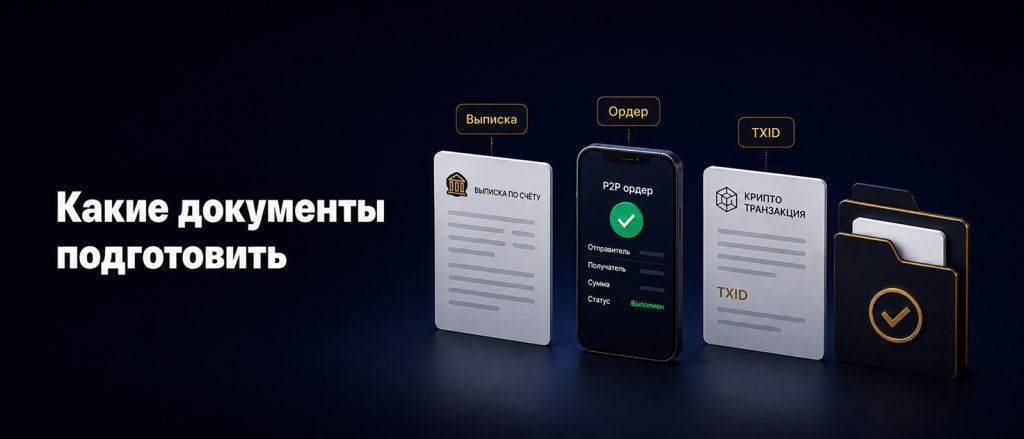
- For a banking transaction: a notice or request from the bank, a bank statement for the relevant period, a receipt or check for a ruble transaction, and confirmation of the transfer date and amount.
- For a P2P transaction: order number, name of the exchange or trading platform, screenshots of the transaction terms, exchange rate, amount, chat history with the counterparty, and a statement from your account on the platform confirming the transaction.
- For cryptocurrency: the transaction identifier (TXID) of the cryptocurrency transfer, the recipient’s and sender’s wallet addresses, a statement from the exchange showing the cryptocurrency transaction history, and details on how and when you acquired the crypto asset.
Important note: All documents must be genuine and gathered in advance. Do not backdate fictitious contracts. It is better to show the entire process from the start of the transaction to its completion.
How to Prepare an Explanation for the Bank
The explanation should clearly describe the facts and rationale behind the transaction. It can be structured as follows:
- Your information: Full name, passport number, account/card number.
- Transaction details: date, transfer amount, name of the P2P platform, order number.
- Purpose of the transaction: exactly what you bought or sold (for example, “sold 0.1 BTC, received 50,000 rubles”).
- Source of the cryptocurrency: where you obtained it (e.g., purchased earlier on an exchange or received as a gift), confirmation of its legality.
- Reason for payment: why the transfer was made by a specific person (for example, it was a client paying for a service rendered).
- Attached documents: List the attached documents (bank statement, screenshots of the order, correspondence, proof of income, etc.).
- Request: for example, “Please review the circumstances of the transaction and unblock the card.”
Example:
In the text, try not to use the words “crime” or “money laundering”—it’s better to phrase things neutrally and stick to the facts. Show that you acted transparently.Funds in the amount of 50,000 rubles were received on May 15, 2026, on my card as payment for the sale of 0.1 BTC via the “ExampleEx” P2P platform. Order number 123456. The buyer is an individual, I.I. Ivanov. I previously purchased this BTC on the “CryptoX” exchange using legal funds. I am attaching a bank statement confirming the transfer, screenshots of the order on the platform, a transaction history, and documentary evidence of the cryptocurrency’s source.
Please unblock my card and resume service.
What to Do During an Investigation Under Federal Law No. 115-FZ
- Respond to the bank’s request. Usually, the bank sends an official letter with a list of questions or documents. Gather everything you have related to the transaction and prepare a brief written explanation.
- Submit the materials to the bank. Upload the documents via online banking, send them by mail, or drop them off at a branch in person. Keep a copy of the submission confirmation.
- Wait for a decision (up to 7 days). The law stipulates that the bank must review your explanation within 7 business days. Feel free to check with the bank on the status of your request.
The Central Bank reminds you that this procedure is called rehabilitation: the bank must evaluate your information without delay. If the issue is not resolved at this level, you can contact the Interdepartmental Commission at any time.
What to Do If You Face Restrictions Under Federal Law No. 161-FZ
- Verify whether you have been included in the database. Ask the bank whether your account or card is listed in the Central Bank’s unified database titled “Transfers Without the Client’s Voluntary Consent.”
- Determine the transaction and its basis. Bank records or materials from the Ministry of Internal Affairs will indicate which transfer served as the basis.
- Submit a request for removal. If your data was included in the database by mistake or following a thorough review, you may request its removal. You can submit the request through your bank (by any convenient method) or directly via the Bank of Russia’s online portal in the “Information Security” section. In your request, briefly describe the transaction and attach documents confirming that the transfer was voluntary and legal.
- Wait for the Central Bank’s decision (up to 15 days). The Bank of Russia reviews such requests within 15 business days. You will receive a response via email, or you can check the status on the website.
- If necessary, file an appeal in court. If the Central Bank denies your request to be removed from the database, you can appeal the decision in court.
Remember: if a card is blocked under Federal Law No. 161-FZ, the funds on it are not debited and remain in your account. Most likely, the bank has restricted only online services. Therefore, you can visit the bank in person and withdraw cash (presenting your passport if necessary).
Can You Get Your Money Back?
- If money remains in the account. A freeze under Federal Law No. 115-FZ or No. 161-FZ does not transfer funds to third parties. Typically, the funds remain in the account and are accessible, for example, at the bank’s teller window. Check with the bank in advance to see if you can withdraw the remaining funds in cash (often a passport is sufficient).
- If the transfer has been suspended: Simply wait for the results of the review. Do not take any independent action to cancel the payment without consulting the bank.
Taxes on Cryptocurrency Transactions
Don’t forget about your tax obligations. By law, cryptocurrency is considered property, and income from its sale is subject to personal income tax. If a P2P transaction resulted in a profit for you (you sold the cryptocurrency for more than you paid for it), you must report this income and pay the tax (Form 3-NDFL must be filed by April 30 of the following year). Failure to comply with tax regulations can make the situation worse: in extreme cases, the bank has the right to report suspicious transactions to the Federal Tax Service. It’s best to prepare your tax return in advance and pay the personal income tax on your profit to avoid raising any additional questions.
How to Reduce the Risk of Problems in Future Transactions
Don’t look for “gray” schemes and don’t split up transfers—this will only raise suspicions. We recommend sticking to a transparent, “white” business model:
- Choose reliable services. Give preference to licensed or well-established exchange platforms and exchanges. Monitoring services like Exnode help you compare exchange options, rates, and reviews, but they are no substitute for your own due diligence. Always research the service’s reputation, verification requirements, and transaction limits.
- Document the entire transaction. Save all orders and receipts: the P2P order number, transfer details, and screenshots of chats with the counterparty. Record the cryptocurrency TXID and wallet address. These documents will be useful during an investigation.
- Verify the counterparty. Make sure the payer’s full name on the bank receipt matches the P2P service user’s name. Do not accept payments from strangers “just like that.” When working with cryptocurrency, you should verify the counterparty’s wallet in advance using public blockchain analytics services.
- Do not use someone else’s account details. Never ask third parties to transfer money to your card, and do not transfer your own funds through someone else’s accounts—this is a surefire way to raise suspicion.
Transparency is paramount. The Bank of Russia officially urges you to specify a clear purpose for transfers and not to use personal accounts for regular business transactions. Act openly—this is the best protection against account freezes.
When to Consult a Lawyer
It’s worth consulting a financial lawyer if the situation has reached an impasse or is complicated:
- The bank continues to deny your request even after you’ve provided all the required documents.
- Several of your cards or accounts at different banks are blocked simultaneously.
- Your details have been added to the Central Bank’s database, and your request for removal has been denied.
- A counterparty has filed a complaint against you, and you have become the subject of an investigation.
- Your account has been frozen, or law enforcement agencies have made claims against you (for example, under Article 159 of the Criminal Code).
- The transaction amounts are very large, and the risks are significant.
- You are unsure of your legal position and do not know how to properly communicate with the bank.
A qualified attorney will help you compile the necessary documents, file complaints with regulatory authorities (the Central Bank, the Ministry of Internal Affairs, and the tax authorities), and effectively defend your interests in court.
A brief step-by-step guide
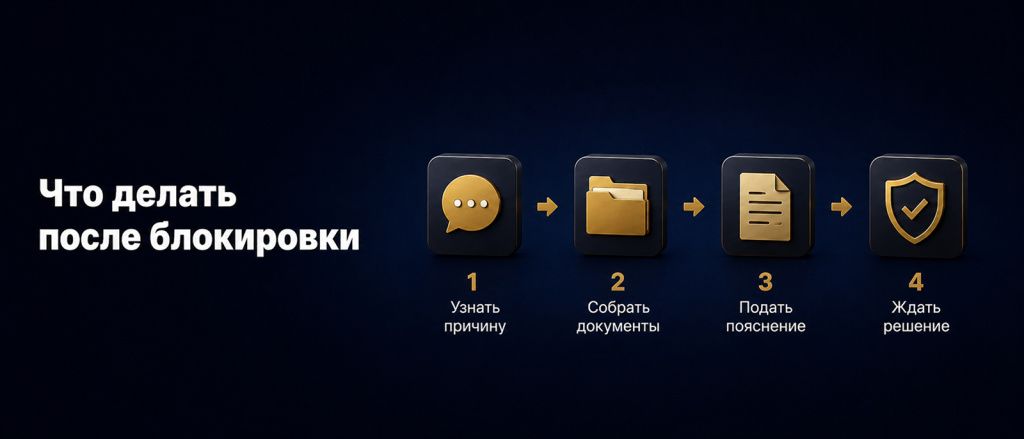
- Stop any new transactions involving the problematic scheme. Do not make P2P transfers until the issue is resolved.
- Clarify the reason with the bank. Contact the bank and find out under which law (Federal Law No. 115-FZ or No. 161-FZ) and why your services have been restricted.
- Obtain a written request. If the bank does not provide anything in writing, ask for an official request or notice.
Frequently Asked Questions (FAQ)
-
Can a bank block a card after a single P2P transaction?
Yes. Any suspicious transaction (including a single transfer) can be grounds for suspension under Federal Law No. 115-FZ or No. 161-FZ. For example, if a transfer comes from someone else’s account or has an unusual purpose, the bank has the right to investigate it and temporarily restrict the card. -
Is a P2P transaction involving the sale of cryptocurrency illegal?
The P2P payment method itself is not prohibited. Cryptocurrency transactions are legal, but they are subject to tax and financial regulations. It is important that you be able to prove the legality of the transaction: the source of the funds and the reason for receiving the payment. -
What is the Bank of Russia’s database under Federal Law No. 161-FZ?
This is a registry of “cases and attempts at transfers without the client’s voluntary consent,” which is compiled based on reports from banks and the Ministry of Internal Affairs. If you are listed in this database (for example, due to a complaint from a victim), banks must suspend transactions using your account details. -
How long does it take to review an application for removal from the 161-FZ database?
The Bank of Russia reviews such an application within 15 business days from the date of registration. -
Is it sufficient to provide the bank with a screenshot of a P2P transfer order?
Usually not. The bank will want to see the complete chain of documents: an account statement, a transfer receipt, the order details, and, preferably, contracts and correspondence as well. A screenshot alone may be considered insufficient evidence. -
Is it possible to start making transfers from another card after the card has been blocked?
Does Exnode’s monitoring guarantee the security of a cryptocurrency exchange?
Indirectly, yes. Exnode is a rating and monitoring service for cryptocurrency exchanges that helps users choose a service. The mere fact that an exchange is listed on Exnode does not guarantee that a block will not occur. The Bank of Russia warns that dealing with illegal exchanges always carries risks. However, users can verify the service themselves by checking reviews and documentation, which significantly reduces the risks.
Do you have to pay taxes on P2P transactions?
If you made a profit from selling or exchanging cryptocurrency, you must report the income and pay personal income tax. By law, cryptocurrency is recognized as property, and income from its sale is subject to taxation. Failure to comply with tax requirements may result in fines and scrutiny from the Federal Tax Service.
Official documents from the Bank of Russia and the Federal Tax Service indicate that banks are required to explain the reasons for account freezes, and erroneous freezes can be lifted through special procedures administered by the Central Bank. Be thorough and gather all necessary documents in advance—this will allow you to resolve the situation quickly.