

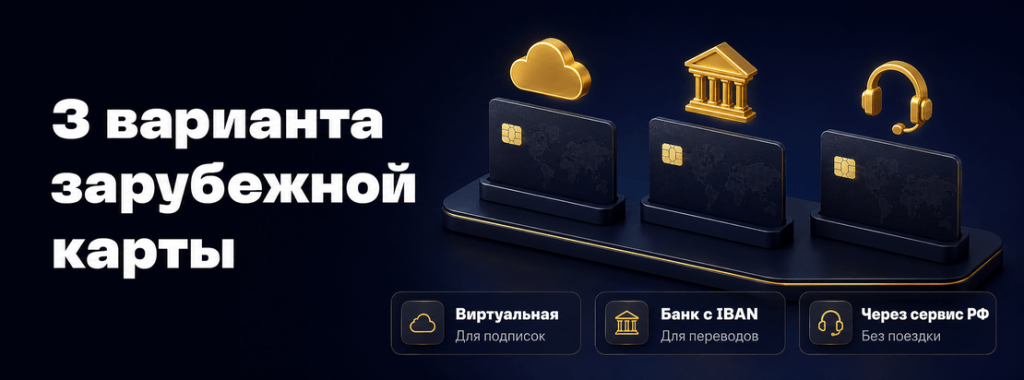
In 2026, Russians can obtain an international bank card in three ways:
- Virtual fintech card – for subscriptions. 10–15 minutes, 1,500–5,000 ₽.
- A physical foreign bank card with an IBAN—for income and large sums. Armenia, Kyrgyzstan, Georgia.
- Officially through Russian services—for example, MTS Pay, a personalized Visa for 24,000 ₽.
You can top up via SBP, crypto, or direct transfer from a Russian card. If you open an account with a foreign bank, notify the Federal Tax Service within a month.
If you’ve already searched for this topic, you’ve seen the same thing over and over. Dozens of articles in a row with the same “TOP 10,” the same services, the same referral links. “Pay worldwide in first place,” and below that, an affiliate code.
This isn’t a review of services. There are no affiliate links here. This is a guide for people who need a working foreign card for Russians and who want to understand what’s actually going on before they go anywhere and pay for anything.
What exactly do people mean by “foreign bank card”?
People search for three completely different things under this phrase. And half the confusion starts right here.
- The first option is a virtual prepaid card from a fintech service. This isn’t a bank. It’s an intermediary that issues card details (number, expiration date, CVV) through a partner bank in Europe or Asia. You don’t have an account, no IBAN, no contract with a bank. You only have the details you can use to pay online. “Pay Around the World,” Card.Club, E.PN—that’s what they all are.
- The second option is a real card from a foreign bank. With an open account, a contract, and an IBAN. You can receive transfers, withdraw cash, and hold large sums. These include Kaspi in Kazakhstan, MBank in Kyrgyzstan, Evocabank in Armenia, and TBC in Georgia.
- The third option is a card issued through a Russian bank or operator. These are UnionPay or personalized cards from CIS banks, which are now being issued by MTS and Gazprombank directly from Russia. We’ll break this down in more detail below: this is a legal option that few people write about honestly.
Most people look for the first option, thinking they’ll get the second. Remember this right away: your choice determines everything—how to top up, what you can pay for, and whether you need to report it to the Federal Tax Service.
What You Need: No Fluff
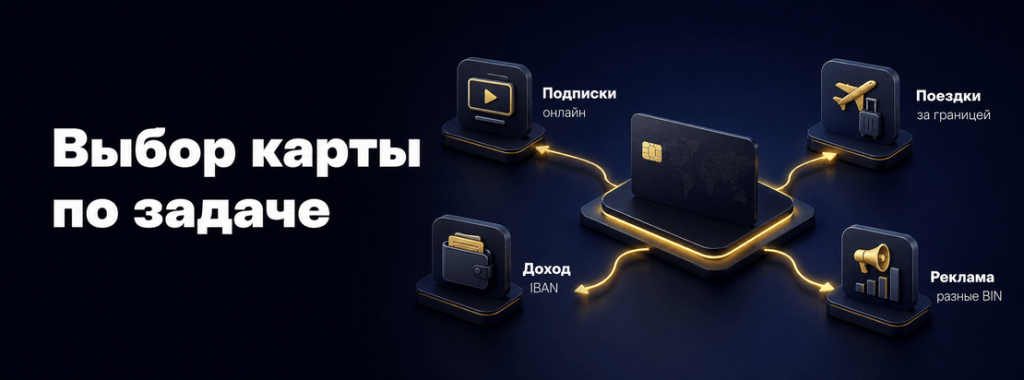
First, ask yourself a simple question: why do you need a foreign bank card in the first place:
- Subscriptions (ChatGPT, Spotify, Adobe, iCloud, etc.). This is the most common scenario. Just get a fintech card and don’t overthink it. It takes 10–15 minutes, you top up via SBP, and you’ll get 2,000–4,000. You can stop reading here if that’s all you need.
- Traveling abroad. Here, too, a fintech card usually comes in handy—the main thing is that the country supports Apple Pay and Google Pay. Turkey, the UAE, Thailand, Georgia—no problem. Some places are trickier; check in advance.
- Money from foreign clients. But here, fintech won’t cut it—it won’t accept SWIFT transfers. You need a real bank account with an IBAN.
- Moving abroad, living overseas. Only a real bank will do. And don’t forget about the Federal Tax Service; more on that below.
- Advertising on Meta, Google Ads, and similar platforms. A whole other headache. You usually can’t get by with just one card here—ad platforms block cards by BIN, so you need to have several from different providers at once.
To avoid guesswork, keep this reference table handy. On the left is the task, on the right is what you need to use for it.
| Your task | What works | Release | Apple Pay | Passport |
|---|---|---|---|---|
| Pay for subscriptions (ChatGPT, Spotify, Adobe) | Virtual fintech card | 1,500–5,000 ₽ | Yes | No |
| Same, but you're already in crypto | Bybit or Gate Card | Free | Yes | Yes |
| Travel, payments abroad | Fintech card with Apple Pay | 1,500–5,000 ₽ | Yes | No |
| Officially, card without travel | MTS Pay, Visa Platinum | 24,000 ₽ | No | Yes |
| Income from foreign clients | Real bank with IBAN (Armenia, online) |
Russian Banks and Operators Offering Foreign Cards as of June 2026
Several major Russian companies now issue personalized cards from foreign banks directly from Russia. No private intermediaries, no travel required. It’s legal and official.
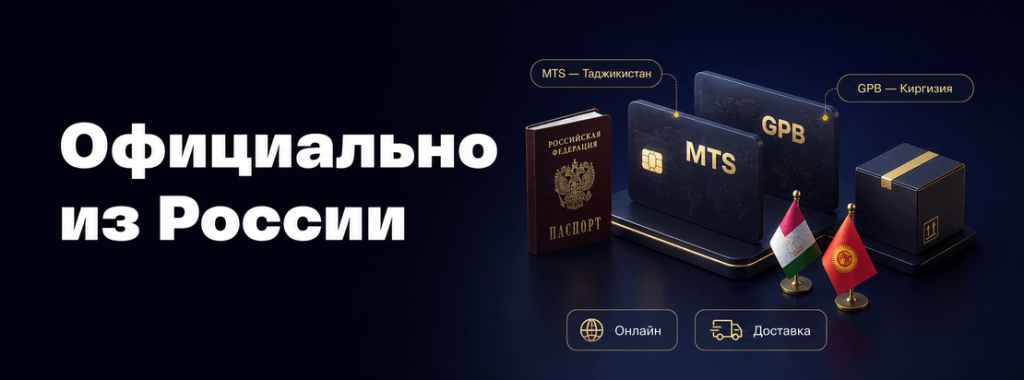
MTS Oplata: Visa Platinum from a Tajik bank
In February 2026, MTS launched the issuance of personalized Visa plastic cards through one of Tajikistan’s largest banks. Available via the “MTS Payment” service.
What it is: a physical Visa Platinum card, valid for 5 years, with your name on it. Currency: USD or EUR, your choice. Application is fully online: passport and application form. Issued within three business days, delivered to Russia.
Terms as of June 2026:
| Parameter | Value |
|---|---|
| Card issuance | 24,000 ₽ (not credited to the balance) |
| Service fee, 1st year | 20 USD (deducted upon first top-up) |
| Maintenance fee, thereafter | 1 USD per month |
| Top-up | From Russian bank cards via phone number/card |
| Apple Pay / Google Pay | No |
| Processing time | Up to 3 business days |
Gazprombank: Premium Concierge
Gazprombank issues an international card through the “Premium Concierge” service, an option for customers with a premium package. You can choose between cards from banks in Tajikistan or Kyrgyzstan.
Application via the app, documents, scanned copies of your domestic and international passports. The fee for the Concierge service is about 30,000 rubles. Visa cards, accepted abroad.
Note: Premium customer status is required. If you already hold large sums there, this is a viable option. If not, it will be cheaper to use another channel.
No longer available: Freedom Banker Card
Important as of June 2026: The Freedom Banker Card (Freedom Finance Bank, Kazakhstan) ceased operations on February 20, 2026, due to new Kazakhstani legislation. If you read about it in articles from 2024–2025, this is no longer relevant for new customers.
Gazprombank’s UnionPay cards, which were recommended in 2023–2024, have been archived. This section is closed.
Fintech cards: how it actually works
Log in to the service (usually a Telegram bot or website), pay for the card issuance, transfer rubles via the Single Bank Payment System (SBP)—and you’ll have the card details in hand.
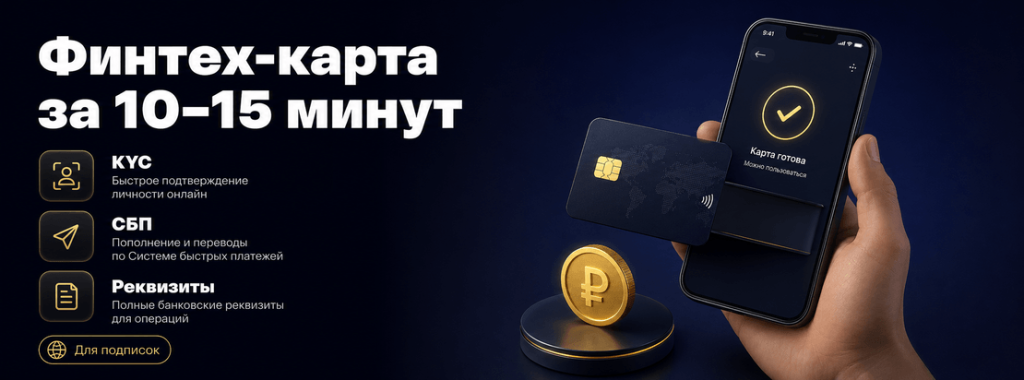
The issuing bank itself is located somewhere abroad: Spain, Hong Kong, Lithuania, sometimes Malta or Cyprus. And this is no small matter. How stores accept the card depends on the issuer’s country: American services are more likely to accept cards with an American BIN, while European subscriptions prefer those with a European one.
What you really need to know:
- Fees. Between 2022 and 2024, they dropped from 20–30% to 7–12% when topping up via the SBP. For every 10,000 rubles converted, you lose an extra 700–1,200 rubles.
- KYC. Some services require verification (passport + selfie), others do not. Without KYC, it’s faster but less reliable.
- Limits. Usually $5,000–$10,000 per month. That’s enough for personal subscriptions.
- Integration with Apple Pay and Google Pay. Almost all reputable services support this. Check before purchasing.
What a fintech card can’t do:
- accept SWIFT transfers – no IBAN;
- withdraw cash from ATMs – no ATM chip;
- function as a full-fledged bank account.
Crypto cards: another viable option
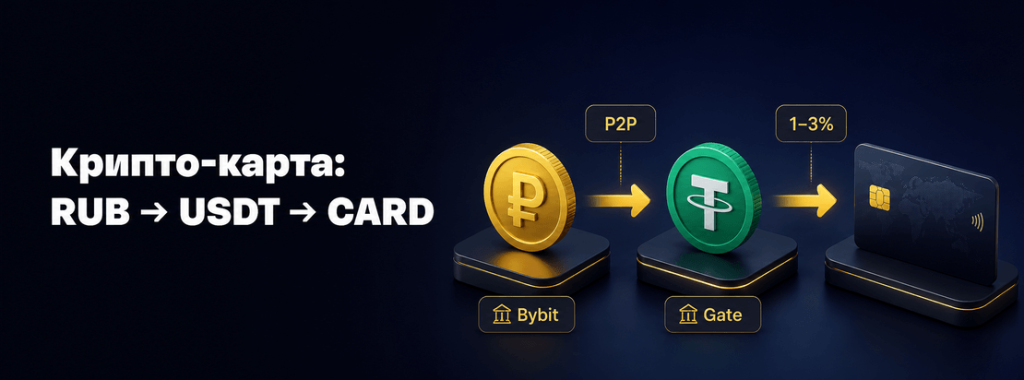
The third option that doesn’t get much attention. Crypto cards work differently: you hold stablecoins (USDT, USDC) on a crypto exchange, and when you make a payment, they’re automatically converted into the desired currency.
Bybit Card
Bybit is one of the few major exchanges that has not officially blocked Russian users. Trading, P2P deposits in rubles, and withdrawals—everything works in 2026 without a VPN or restrictions on Russian IP addresses.
Bybit Card is a virtual Visa card linked to your exchange account. Issuance and maintenance are free. When making a payment, USDT is automatically converted.
A caveat for Russians: Bybit Card is officially unavailable to residents of Russia and Belarus. Some users apply for it using a foreign address (Kazakhstan, Armenia, Georgia, UAE). This works technically, but legally it remains a workaround. Assess the risks yourself.
How to fund your Bybit account with rubles: P2P in 4 steps
- Sign up on Bybit, complete KYC (passport + photo, 15–30 minutes).
- Open the P2P section, select “Buy USDT,” and enter the amount in rubles.
- Select a seller with a good rating (500+ transactions, 99%+), transfer the rubles via your banking app.
- The seller confirms receipt, and the USDT is credited to your account.
The spread on P2P is usually 1–3% of the market rate. This is less than the commission for SBP top-ups at some fintech services.
Gate.io Card
Another working crypto card. Gate.io is available to Russians; the card offers cashback in GT tokens and works anywhere Visa is accepted. The process is the same: rubles → P2P → USDT → card.
Honestly about the downsides of crypto cards
First off, this isn’t for beginners. If you’ve never set foot on a crypto exchange, get ready for a bit of a hassle: registration, KYC, P2P, wallets. It’s doable, but it’s not as simple as “clicking two buttons in a bot in 10 minutes.”
Second, volatility. USDT is fine; it’s pegged to the dollar. But if you decide to pay with BTC or ETH, the rate will be calculated based on the market at the time of payment, and that’s a matter of luck.
And third—regulation. Russia has a law on digital financial assets. Personally, you’re not in any trouble yet, but the rules in this area are changing—and fast.
To make things clearer, here’s a summary of costs and features. The figures are based on June 2026; service rates are subject to change.
| Card Type | Issuer | Apple Pay | SWIFT | Plastic | FTS | Online |
|---|---|---|---|---|---|---|
| Fintech card | 1,500–5,000 ₽ | Yes | No | No | No | Yes |
| MTS Payment | 24,000 ₽ | No | No | Yes | No* | Yes |
| Crypto card (Bybit) | Free | Yes | No | Partially | No | Yes |
| Bank of Armenia/Kyrgyzstan | 5,000–15,000 ₽ |
* A card issued through MTS is an intermediary product, not a bank account; notification to the Federal Tax Service is generally not required.
A separate note on top-up fees. For every 10,000 ₽, you’ll lose approximately: fintech via SBP – 700–1,200 ₽ (7–12%), crypto via P2P on Bybit – 100–300 ₽ (1–3%), direct transfer from a Russian card to Kaspi or MBank – 100–200 ₽ (1–2% plus the bank’s exchange rate), cash when visiting a bank – 0 ₽.
Real account in a foreign bank: countries and reality as of June 2026
Kazakhstan
The most popular option since 2022. Important changes in 2026: Freedom Banker Card closed (February 2026), Kaspi tightened its policy on non-residents and closed some accounts without warning.
What else works: Halyk Bank, Freedom Bank (main cards, in person only with an IIN), Bank CenterCredit. Non-residents are issued cards valid for 1 year instead of 5 (starting January 2025).
An IIN is required to open an account; it is obtained upon entry through the Public Service Center. Online via an intermediary is a gray area.
Refunds: direct transfer from Russian bank cards using the card number (Sberbank, T-Bank, Alfa, Gazprombank, VTB). One of the most convenient ways to top up a CIS card.
Important: Kazakhstan participates in the automatic exchange of tax information with Russia. Account data may be transferred to the Federal Tax Service. This is not “forbidden.” It is “you must properly file a notification.”
Armenia
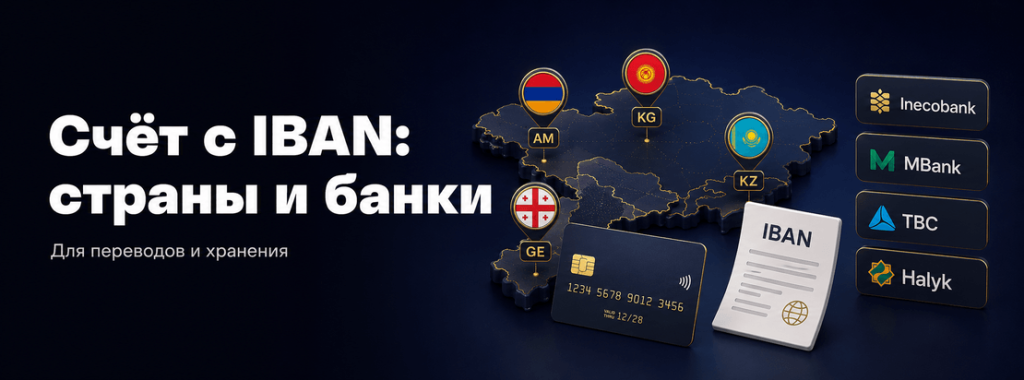
Evocabank, Inecobank, Ameriabank. Inecobank actually opens an account online via the app: international passport, video call with a manager. As of June 2026, this works.
Visa and Mastercard are accepted. Deposits can be made via SWIFT or in cash. Armenia does not have an automatic data exchange with the Federal Tax Service, but a notification must still be submitted (this is a requirement of Russian law).
Kyrgyzstan
MBank, Optima Bank, RSK Bank, Ayil Bank. The most popular country for remote account opening through intermediaries in 2026.
A detail about Ayil Bank: you can top up the card directly from Russian cards using the card number or phone number (Sberbank, T-Bank, Alfa, Gazprombank, VTB). Daily withdrawal limit: 12,000 USD. App available in the Russian App Store. You can open accounts in 14 currencies linked to the main account. There is no automatic data exchange with the Federal Tax Service.
Cost through an intermediary: 5,000–15,000 rubles, including card delivery to Russia.
Georgia
TBC Bank, Bank of Georgia. In-person only. But it’s fast, often on the same day. Banks have tightened their policies in 2025–2026, but they still open accounts for Russians. A passport is required, and sometimes proof of income.
Uzbekistan and Tajikistan
Kapitalbank, Uzum (Uzbekistan), during a personal visit. Tajikistan is interesting because that is where the scheme operates via MTS.
How to top up from Russia, what works
- Direct transfers via the Single Bank Payment System (SBP) to a foreign bank account do not work. However, using fintech services (which accept rubles via SBP and convert them themselves) is a viable method.
- Direct transfers from a Russian card work for Kazakhstan and Kyrgyzstan. Sberbank, T-Bank, Alfa, and VTB transfer funds to cards in these countries using the card number or phone number. The fee is 1–2% plus the bank’s exchange rate.
- SWIFT transfers from major Russian banks rarely go through. They do go through from smaller, non-sanctioned banks. Check individually.
- Cryptocurrency (USDT, USDC). Process: rubles → P2P exchange (Bybit, OKX) → USDT → fintech service or directly. Fees are lower with some providers.
- Cash upon visit – the most reliable method for legitimate banks, with no conversion fees.
- Via third countries. Top up Kaspi with rubles, then transfer via SWIFT from there. It works, but an extra step means extra fees.
Taxes (Federal Tax Service of the Russian Federation): what you need to do to avoid a fine

If you open an account with a foreign bank, you are required to notify the Federal Tax Service.
This requirement is set forth in Part 7 of Article 12 of Federal Law No. 173-FZ dated December 10, 2003, “On Currency Regulation and Currency Control.”
Notification of the account opening must be submitted within one month.
Via Gosuslugi or the “Taxpayer’s Personal Account,” using form KND 1120107. If submitted late or not on the proper form, the fine for individuals is 1,000–1,500 rubles (Part 2 of Article 15.25 of the Code of Administrative Offenses of the Russian Federation). If you fail to submit it at all, the fine is 4,000–5,000 rubles (Part 2.1 of the same article).
Individuals must submit the Annual Report on the Movement of Funds (ODDS) by June 1 of each year for the previous year.
For example, by June 1, 2026, for the year 2025. Form KND 1112520. It is required if the total amount of deposits or withdrawals for the year, or the balance as of December 31, exceeded 600,000 rubles (or the equivalent at the Central Bank’s exchange rate as of the end of the year).
Fines for Russian citizens under Article 15.25 of the Code of Administrative Offenses of the Russian Federation:
| Violation | Rule | Penalty |
|---|---|---|
| Notification of account opening submitted late or not in the prescribed form | Part 2 | 1,000–1,500 ₽ |
| Notification not submitted at all | Section 2.1 | 4,000–5,000 ₽ |
| ODDS report filed late by up to 10 days | Section 6.1 | Warning or 300–500 ₽ |
| ODDS report late by 10 to 30 days | Section 6.2 | 1,000–1,500 ₽ |
| ODDS report late by more than 30 days | Section 6.3 | 2,500–3,000 ₽ |
| Illegal foreign exchange transaction on the account | Part 1 | 20–40% of the transaction amount |
Important: You must report transactions even through services where a bank account is not formally opened (e.g., e-wallets of foreign payment systems) if the annual turnover exceeds 600,000 rubles. This is expressly provided for in Article 12 of Law No. 173-FZ.
About fintech cards. If there is no agreement with a foreign bank (prepaid cards don’t have one), there is technically nothing to report. But if the service issues a real account with an IBAN or an e-wallet with a turnover exceeding 600,000, you must report it. Not sure? Consulting a tax lawyer costs 3,000–5,000 rubles and saves you a lot of stress.
About Kazakhstan. The country is on the list of automatic exchange of financial information with the Russian Federation. Account data may be sent to the Federal Tax Service without your involvement. This is an additional reason to file the notification yourself.
How to choose? What to look for
- The card’s BIN. These are the first 6–8 digits of the number. They tell the store which bank and which country the card is from. Russian BINs will be blocked immediately. Some Western services will also reject cards from various “high-risk” jurisdictions. The most trouble-free option is a European or American BIN.
- The issuer’s country is more important than the service provider’s country. The service provider could be a Russian sole proprietor, while the issuing bank is Lithuanian. The bank’s country is what matters for payment.
- Choose the right currency for the task. Use dollars for American services and euros for European subscriptions. If your card is in dollars and you’re paying for a European subscription, there will be a double conversion: rubles to dollars, then dollars to euros. And you lose money at every step.
- Russian-language support on Telegram—check before purchasing.
- Service track record. The market is young and unstable. If it’s been operating since 2022–2023 and has real user reviews, it’s already more reliable than something launched just three months ago.
A separate note on how not to get lost in all these options. There are dozens of fintech card services now, and comparing them one by one by browsing websites is a bit of a chore. That’s where comparison sites come in handy, gathering all the terms and conditions in one place. One such site is Exnode, which features visual charts: there, you can filter services by fees, deposit methods, currency, and payment acceptance rates to figure out what suits your needs without opening twenty tabs. It’s not a silver bullet or a substitute for your own research, but as a starting point for comparison, it saves time.
Common problems and solutions
- The service does not accept this card. Check the BIN at binlist.net. If the country doesn't match, you'll need a card with a different BIN. ChatGPT is picky about certain countries; it requires a U.S. or European card.
- The transaction is being declined. Check that your balance covers the fee, turn off your VPN before paying, and verify your 3D Secure status.
- The money was debited, but the payment didn’t go through. Standard refunds take 3–30 days. If it takes longer, contact support with a statement.
- Your account has been blocked. Contact support and provide documentation. They usually unblock it if you’ve used the service properly.
- The service has shut down. This has already happened to several players. Don’t keep more than a month’s worth of funds on hand.
Actual value as of June 2026
| Option | Edition | Maintenance | Top-up |
|---|---|---|---|
| Fintech Card (virtual) | 1,500–5,000 ₽ | 0–4,000 ₽/year | 5–12% (SBP) |
| MTS Pay (Tajikistan) | 24,000 ₽ | 20 USD/year, then 1 USD/month | From Russian cards with no additional fee |
| Gazprombank Concierge | ~30,000 ₽ | Depends on the package | Subject to the bank's terms |
| Crypto card (Bybit) | Free | Free | 1–3% P2P spread |
| Bank of Armenia/Kyrgyzstan (intermediary) | 5,000–15,000 ₽ | 0–500 ₽/month | 1–2% + exchange rate / SWIFT |
| Bank of Georgia (in person) | Free | 0–5 USD/month |
Frequently Asked Questions
Can I get an international card without leaving Russia?
Yes. Definitely a fintech card. MTS Pay, officially and online. A real bank remotely, Inecobank Armenia, Kyrgyz banks through intermediaries.
Do foreign cards work in Russia?
Visa and Mastercard cards from foreign banks are accepted wherever the terminal supports these systems. Some locations only accept "Mir."
Do I need a passport?
For fintech without KYC, no. For MTS Pay, yes. For a real bank, almost everywhere, yes.
Can you have multiple foreign cards?
Yes. But each bank account requires a separate notification to the Federal Tax Service.
What if I haven’t notified the Federal Tax Service, but the account is already open?
Submit the notification now. The penalty for late submission is less than for failure to submit at all.
Is it safe to keep money on a fintech card?
To a limited extent. Fintech is not insured. Keep only your working balance on the card, not your savings.
How do I check a card’s BIN?
Go to binlist.net and enter the first 6–8 digits of the number. You’ll see the country of the issuing bank.
How much does it cost to get a foreign bank card in 2026?
Virtual fintech card: 1,500–5,000 ₽. Card via MTS Pay: 24,000 ₽. Bank account in Armenia or Kyrgyzstan through an intermediary, 5,000–15,000 ₽. Bybit crypto card, free. Bank account in Georgia with an in-person visit, free.