

I occasionally delve into the topic of cryptocurrencies and post here whatever I find interesting. Let me make my position clear right away: I have no affiliation with the exchanges mentioned below. This is my analysis of publicly available data, regulatory documents, and how they fit into the bigger picture.
This time, it all started with the latest traffic statistics for crypto exchanges for July 2026.
On August 13, WuBlockchain published the July 2026 Exchange Website Traffic Report. It seemed like just another traffic report, but I dug a little deeper into the geography of visitors, and from there I had to read up on MiCA, the Austrian regulator, and announcements from Bybit itself.
What emerged was a rather interesting story about how a familiar global crypto exchange is gradually transforming into a collection of separate regional entities.
134 million visits to crypto exchanges in a month
According to WuBlockchain, in July 2026, the websites of 12 tracked crypto exchanges collectively received approximately 134.31 million visits. The previous month saw 137.54 million visits, representing a decline of approximately 2.35%.
The top of the list is as expected:
- Binance — 36.04 million visits
- OKX — 25.62 million
- Coinbase — 20.60 million
- KuCoin — 15.58 million
- Bybit — 11.11 million
- HTX — 1.64 million
Binance accounts for about 26.8% of the sample’s traffic, while the top three—Binance, OKX, and Coinbase—account for approximately 61.2%. Bybit gained 2.8% over the month, KuCoin gained 3.2%, while HTX saw a 23% decline in the WuBlockchain sample.
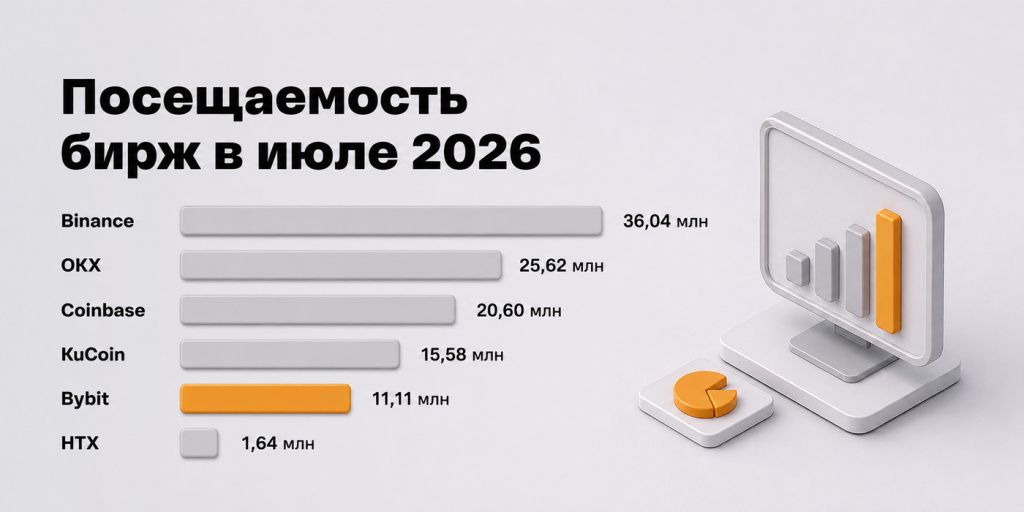
The table itself isn’t particularly surprising. Binance is big, Coinbase is big, and OKX is big too.
The geography is much more interesting.
WuBlockchain specifically notes that India has become the largest source of visitors for Binance, Japan for OKX, and the U.S. for Coinbase.
But for Bybit, the picture is completely different.
A quick affiliate link:
Sign up for Bybit with bonuses: https://partner.bybit.com/b/154482 — this is the page of Bybit’s official partner; referral code 154482 will be automatically applied and will activate the welcome bonuses.
Bybit Russia currently ranks first in desktop traffic
Public statistics from Similarweb for bybit.com in July 2026 show Russia as the site’s largest source of desktop traffic.
The breakdown is as follows:
- Russia — 36.46%
- South Korea — 10.75%
- Ukraine — 7.54%
- United States — 2.83%
- Belarus — 2.56%
In other words, the gap between first and second place is more than three times as large.
The picture is similar for HTX. According to Similarweb data for htx.com, Russia accounts for 25.47% of desktop traffic, Ukraine for 6.68%, and Belarus for 5.12%. Russia also ranks first by a wide margin.
I’ll clarify the methodology right away so the numbers don’t start taking on a life of their own later on.
Website visits, number of clients, trading volume, and exchange revenue are four distinct metrics.
Similarweb provides estimated web analytics, and the country breakdown in the public dashboard is explicitly labeled as “desktop traffic.” Therefore, it would be too bold to multiply 36.46% by WuBlockchain’s total of 11.11 million visits and declare the resulting number as the number of Russian clients.
Mobile apps, APIs, algorithmic trading, and actual trading volumes are completely left out of the picture here.
But even with this caveat, the geographic breakdown is telling: the Russian audience for Bybit’s global site is very noticeable.
And that’s when I became curious to see what Bybit itself is currently doing with another major market—Europe.
Bybit for Europe now operates separately
In May 2025, Bybit EU GmbH was established, and this is now a fully-fledged, regulated European entity.
The Austrian Financial Market Authority announced that, by an administrative decision dated May 28, 2025, Bybit EU GmbH received authorization as a crypto-asset service provider under Article 63 of Regulation (EU) 2023/1114, i.e., MiCA.
The license covers the custody and administration of clients’ cryptoassets, the exchange of cryptoassets for cash, the exchange of one cryptoasset for another, the placement of cryptoassets, and services related to their transfer.
Another year has passed, and the distinction has become much more apparent to users themselves.
On June 29, 2026, Bybit issued an official announcement for users in the European Economic Area.
The company announced the gradual restriction of EEA residents’ access to certain Bybit Global services. At the same time, Bybit EU is explicitly identified as the group’s regulated European platform, operating through a MiCAR-authorized entity. Bybit EU is also obtaining additional licenses in Austria to expand its available product lineup.
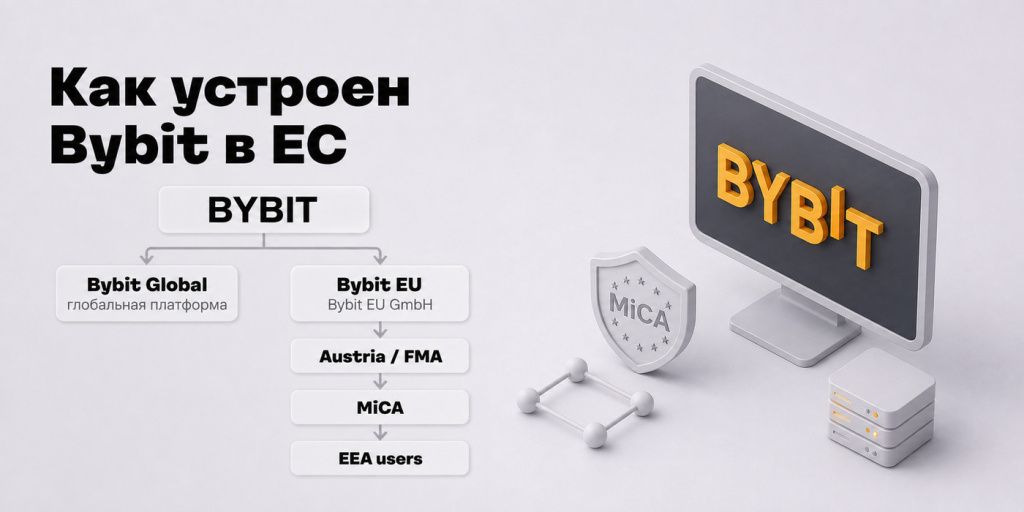
This is merely a simplified diagram of the public structure. Of course, one shouldn’t try to reconstruct Bybit’s internal server architecture based on it.
However, the legal and product-related separation is already quite substantial: a separate legal entity, a separate regulated platform, a separate operating territory, and its own set of available products.
And what about MiCA?
MiCA refers to Regulation (EU) 2023/1114 of the European Parliament and of the Council of May 31, 2023, on markets in crypto-assets.
The document is lengthy—over 160 pages in the Official Journal of the EU—so there’s little point in summarizing it in its entirety here.
To put it very simply in the context of our story, MiCA establishes a unified European framework for certain crypto-assets and crypto-asset service providers: authorization, supervision, requirements for disclosure, customer protection, the operations of service providers, and market infrastructure. The regulation itself explicitly states the goal of reducing regulatory fragmentation within the EU and enabling crypto-asset service providers to scale across countries within a single legal framework.
ESMA describes MiCA in roughly the same terms: uniform rules for the European market, requirements for transparency, disclosure, authorization, and supervision.
What’s more, all of this can already be verified manually.
ESMA maintains the Interim MiCA Register, which includes authorized crypto-asset service providers and a separate list of non-compliant entities. As of this writing, the register was last updated on August 12, 2026, so the data there is quite recent.
From a practical standpoint, this is quite useful: you can now cross-check the name of an exchange on the website with a specific legal entity and its regulatory status.
One brand is beginning to represent several different products
As someone in IT, I find this more interesting than the legal aspects.
Users see the Bybit logo and a familiar interface. Behind this interface, various regulated entities are gradually emerging.
The regional model affects several layers at once:
- the legal entity with which the user enters into a contract;
- the user agreement;
- KYC and AML processes;
- the available list of crypto assets;
- stablecoins;
- spot and derivatives;
- fiat on/off ramp;
- payment partners;
- rules for storing client assets;
- risk management;
- data requirements;
- geographic restrictions;
- compliance;
- set of available interfaces and services.
Public documents clearly show the separation between the legal and product levels. The company does not publicly describe in detail the extent of the separation between the backend, databases, internal services, wallets, and individual components of the risk engine.
But the architectural challenge here is clear to anyone who has ever built a large international service.
One user may be granted access to the product. Another, based on their jurisdiction, requires a different version of the product. For a third user, the list of assets changes. A fourth user needs a different KYC flow. A fifth user has access to one payment infrastructure, while a sixth has access to another.
As a result, the user’s geolocation and legal status begin to influence the business logic practically from the moment they log in.
On the outside, it’s still a single brand.
Internally, routing by jurisdiction comes into play.
And this is where Russia becomes interesting again
Let’s return to the initial statistics.
In the global version of Bybit, Russia currently ranks first in terms of desktop traffic share according to Similarweb—36.46%.
The group is simultaneously transitioning its European market to the regulated Bybit EU platform and gradually separating access to Global and EU products.
This creates a fairly rational model for the international business.
A market with separate regulation receives a local legal entity and a local product suite. The global infrastructure continues to serve the remaining territories in accordance with the rules applicable to them.
For the company, this approach allows it to simultaneously address different requirements regarding products, compliance, payments, and users.
The Russian share of traffic is particularly interesting here from the perspective of the global product’s economics. This audience creates a clear incentive to maintain a functional international framework where its use complies with the company’s applicable requirements.
There is no basis for linking the creation of Bybit EU directly to the Russian audience. In Bybit’s and the FMA’s documents, the European entity is explicitly linked to European regulation and MiCA.
However, the underlying principle is clear: it is becoming more convenient for a major exchange to develop several regulated platforms in parallel.
And I think we’ll see more of these kinds of structures going forward.
Regulation is already capable of redirecting liquidity
While reading about MiCA, I came across another recent study that nicely complements this picture.
On July 10, 2026, Nicola Borri of LUISS University and Kirill Shakhnov of the University of Surrey published a preprint titled “Does Regulation Bite at Gateways? Evidence from MiCA and Stablecoins.”
The authors examined the implications of European stablecoin regulation and the situation surrounding USDT and USDC.
Following the introduction of the relevant MiCA requirements, several exchanges restricted USDT trading pairs for EEA users. The researchers compared platforms focused on the regulated European market with more global exchanges.
I find the result here particularly telling.
The aggregate market shares and trading volumes in the sample under study changed relatively little. At the same time, within the regulated platforms, there was a noticeable shift in the trading structure toward USDC: its share and relative volume increased relative to USDT.
In other words, the regulatory change quite rapidly altered the flow of activity within the market.
User demand continues to exist, while the infrastructure and available tools are adapting to the new set of rules.
For me, this is perhaps the main takeaway from the whole story.
Regulation of the crypto market is already having a noticeable impact on the specific architecture of products: which assets are available, through which legal entity the platform operates, which domain users access, and what set of services they receive.
How to Check an Exchange’s Regulatory Status Yourself
There’s another very practical takeaway.
When an exchange states that it has obtained a European license or launched a separate EU version, it takes just a few minutes to verify the validity of such a claim.
Using Bybit as an example, here’s how it works.
1. Check the legal entity.
Bybit EU GmbH is listed in the European version.
2. Check with the national regulator.
The Austrian FMA has a separate announcement regarding the issuance of a license to Bybit EU GmbH, including the date of the decision and a list of authorized crypto services.
3. Check the European level.
ESMA maintains the central MiCA Register, to which national authorities submit information about authorized CASPs. The register is updated regularly.
4. Read the exchange’s own announcement.
In the case of Bybit, there is a separate notice for the EEA that describes the distinction between Global and EU.
5. Verify which legal entity is specified in your user agreement.
For international services, the brand on the page is gradually becoming merely a top-level identifier. Regulatory status is determined by the specific legal entity and the specific service.
This approach is generally useful for any platform that mentions an “EU license.”
A nice MiCA logo on a landing page can be verified against the registry much faster than marketing text.
What’s Next for All This
One simple fact stands out from the WuBlockchain report: in July, the websites of major crypto exchanges received over 134 million visits.
I’m much more interested in the second layer.
Bybit has a very large Russian web audience. At the same time, the group has already established a separate entity, Bybit EU GmbH, obtained FMA authorization under MiCA, and begun to split EEA user access between the European and global platforms.
This represents a perfectly understandable evolution for an international crypto exchange.
A single brand is gradually evolving into several legal and product entities. For users, the available tools and terms and conditions are changing. For the company, the number of regional compliance scenarios is growing. For developers and architects, another parameter—jurisdiction—is being added to the usual business logic.
And, judging by the direction regulation is taking, the term “global” as it applies to crypto exchanges will increasingly describe the brand, while the structure of the service itself will become much more regional.
That’s why I’d start paying closer attention to the next reports on traffic geography.
Sometimes, a simple traffic table can provide a pretty good indication of which markets an international service will need to target next.