


The growing popularity of altcoins in recent years has made cryptocurrency exchanges key platforms for experimentation and fast trading. For many users, it is important to have access to a variety of trading instruments and liquidity, as well as the ability to trade new tokens without a complicated registration process or lengthy procedures.
MEXC is attracting the attention of Russian users as a centralized cryptocurrency exchange (CEX) offering a wide range of spot and futures markets. The exchange offers trading in more than 1,800 cryptocurrencies and derivatives with leverage of up to 200x, and its native MX token is used to pay fees and participate in the platform’s promotions.
For a basic understanding of how cryptocurrency exchanges work, see the article “Cryptocurrency Exchange: What It Is in Simple Terms,” which explains in detail the principles of spot and futures trading, as well as the functions of the exchange’s main services.
What Is MEXC and Its Position in the Cryptocurrency Market
History and Specialization
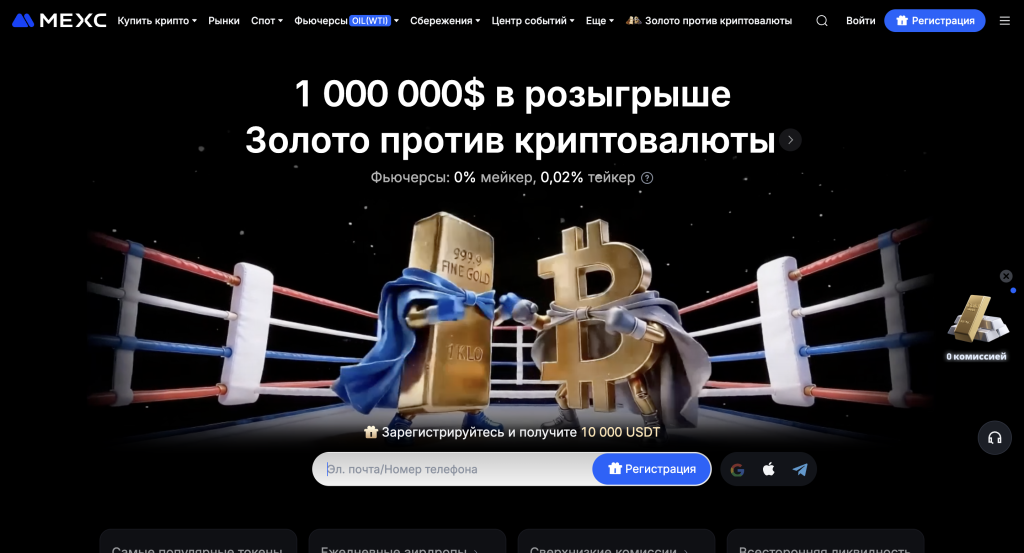
MEXC Global is a centralized cryptocurrency exchange (CEX) founded in 2018. Its headquarters are located in the Seychelles. The platform is registered with the Lithuanian Financial Supervisory Authority as a provider of services related to virtual assets.
MEXC’s main areas of specialization are spot trading and cryptocurrency futures. A key feature of the exchange is its large number of tradable assets.
In 2023, the exchange launched Proof of Reserves, which allows users to verify the availability of funds. As of early 2026, the service ranks near the top of CoinMarketCap and CoinGecko’s rankings based on an overall assessment of liquidity, security, and trading volume.
How MEXC Differs from Major Platforms
MEXC does not compete with top-tier exchanges in terms of trading volume or market depth for major pairs. Its positioning is different.
Binance, Bybit, and OKX are geared toward the mass market. They offer high liquidity for Bitcoin, Ethereum, and stablecoins, a well-developed ecosystem, and a wide range of additional products. However, new and niche tokens do not appear there immediately—or not at all.
MEXC occupies the niche of a “second exchange” for targeted trading. Its advantages:
- Wide selection. You can find coins on the platform that aren’t available on other major exchanges.
- Speed of listing. New projects often launch right here.
KuCoin is MEXC’s closest competitor in terms of positioning. KuCoin is also known for its wide selection of altcoins and early listings. Key differences from MEXC:
- Lower spot trading fees (0% vs. ~0.1% on KuCoin).
- Fewer additional products (no margin trading or options).
- A simpler interface.
User Base and Objectives
MEXC’s user base can be divided into several groups.
Traders who trade altcoins. For them, the exchange is attractive because it allows them to buy or sell assets that aren’t yet listed on top exchanges. This enables them to seek out arbitrage opportunities or invest in projects at an early stage.
Users experimenting with small amounts. Due to the high risks associated with illiquid coins, users on this platform often trade with small deposits. Losing such an amount is not critical, and the potential return when a new token rises in value can be high.
Futures traders. Nearly 400 contracts and leverage of up to 200x attract traders who are looking for specific instruments or want to diversify their risks across different platforms.
MX token holders. This group participates in the exchange’s governance (voting on listings), receives a share of trading fees, and gains access to airdrops of new tokens through the Launchpad.
For most users, the main purpose of using MEXC is not to store all their funds but to carry out specific transactions: purchasing a new asset, speculating on niche futures, or participating in token airdrops. The exchange is used less frequently for the long-term storage of large sums due to objectively higher risks compared to market leaders.
How MEXC Works: Interface and Features
Registration and Verification (KYC)
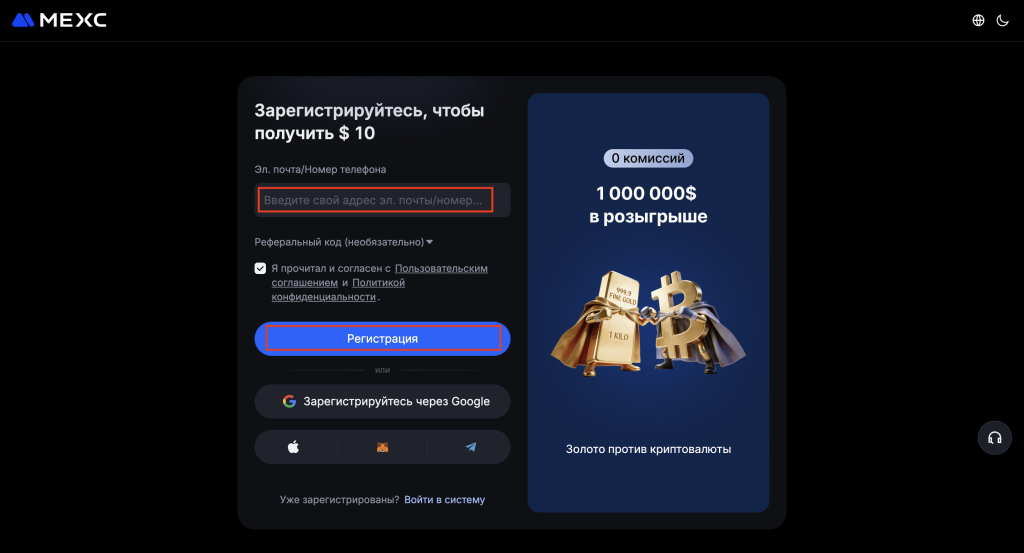
Users from Russia can access the MEXC platform as usual. The mexc.com website opens without the need for any workarounds to bypass blocks.
Registration on the platform is done via email or phone number. After confirming their contact information, users are prompted to set up two-factor authentication, and access to advanced features requires completing the identity verification (KYC) process.
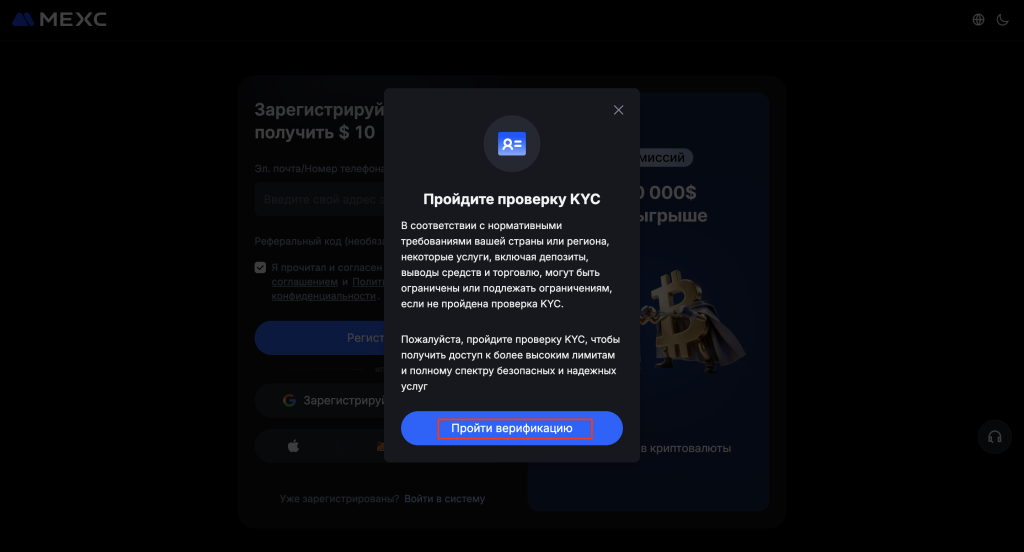
After registration, the account allows you to perform a limited set of operations. To access the full range of features, including P2P trading and the removal of withdrawal limits, identity verification (KYC) is required.
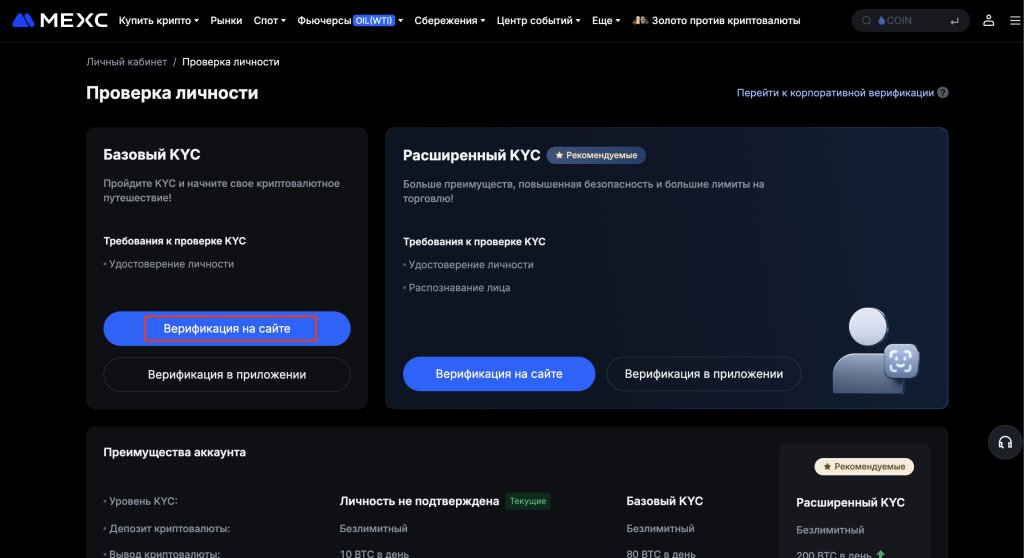
The KYC procedure for Russian citizens is standard:
- Level 1: Submit a photo of the inside pages of your passport showing your personal information and complete the identity verification process (a selfie with the document or a video verification).
- Processing time: 15 minutes to 24 hours, depending on the security team’s workload.
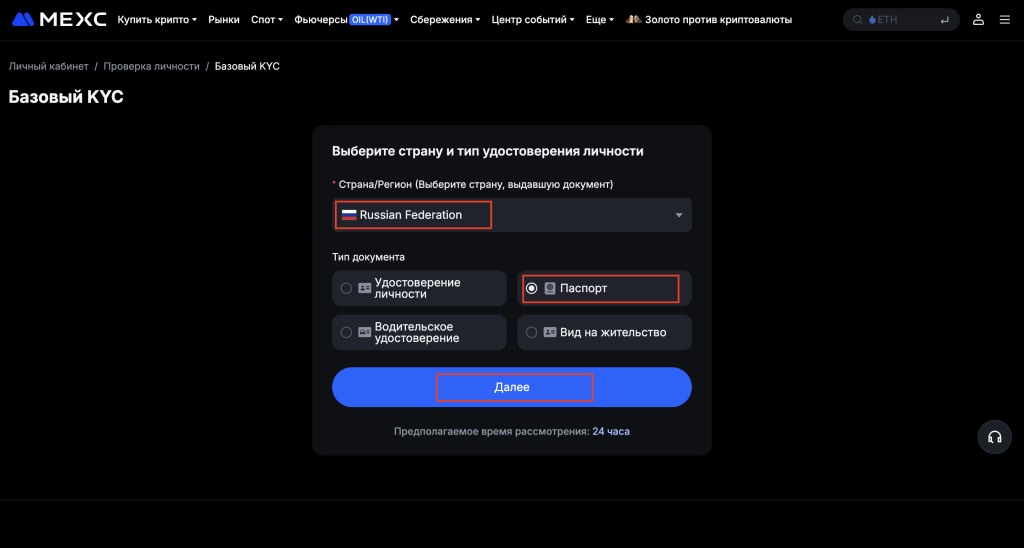
Result: After successful verification, unlimited P2P transactions, cryptocurrency withdrawals, spot and futures trading, and access to investment products become available.
Deposits and Withdrawals
For users in Russia, the main method for depositing and withdrawing fiat rubles is the exchange’s P2P section. Direct deposits from Russian bank cards are not supported.
Depositing via P2P:
- In the “P2P Trading” section, select the “Buy” transaction and the USDT asset.
- Set the filter parameters: currency RUB, payment method (Sberbank, T-Bank, SBP, etc.), and amount.
- From the list of available listings, select a seller with a high rating (95% or higher) and a large number of completed transactions.
- After opening the transaction, the buyer transfers rubles to the seller’s specified account details and clicks the “Paid” button.
- The exchange blocks the seller’s USDT in its account (escrow). Once the seller confirms receipt of the funds, the USDT is credited to the buyer’s balance. There is no fee for the buyer.
Withdrawal via P2P:
The procedure is similar to a purchase but is carried out in reverse order. The user posts a listing to sell USDT for rubles or selects a suitable buyer. The USDT is held in the seller’s account until the rubles are credited to their bank card. The transfer is confirmed only after the funds have actually been credited.
Alternative methods:
- Transfer from another exchange: Users who hold USDT on other platforms (Bybit, OKX, etc.) can transfer it to MEXC. To do this, use the “Deposit” function in the “Assets” section. The recommended network for USDT transfers is TRC20 (low fees).
Spot Trading: Orders, Order Book, Liquidity
The MEXC spot market includes over 1,800 cryptocurrencies and about 2,200 trading pairs. The trading platform’s interface is standard for centralized exchanges:
- The left side of the screen displays the order book (a list of limit orders to buy and sell).
- In the center is a price chart powered by TradingView, with the option to overlay technical indicators.
- On the right is a table of available trading pairs and a search bar.
- Below the chart is a module for placing orders: limit, market, and stop-limit.
Liquidity on MEXC is uneven. For the major pairs (BTC/USDT, ETH/USDT), the order book is deep enough to allow trades to be executed without significant price slippage. However, for many niche altcoins, especially those recently added, liquidity may be low. In such cases, the difference between the buy and sell prices (the spread) widens, and a large order can significantly shift the market price.
Features of Trading New Tokens and Altcoins
MEXC’s main focus is on early listings and a wide selection of altcoins. Tokens from new projects often appear on this exchange before or instead of major competitors.
Access to new tokens is facilitated through the Launchpad and Kickstarter tools, which operate using the exchange’s native MX token. MX holders can vote to list projects they like and receive new tokens as a reward.
When trading new and niche altcoins on MEXC, there are several factors to consider:
- High volatility. Prices of recently added coins may experience sharp fluctuations.
- Limited liquidity. As noted above, the order book is thin for many listings, which increases the risk of slippage.
- Project risks. A large number of listings means that the exchange also adds high-risk and potentially short-lived projects.
Therefore, trading new tokens on MEXC requires users to be aware of the increased risks and, as a rule, to trade only with amounts they can afford to lose.
Fees, Liquidity, and Risks
How Fees and Spreads Are Calculated
MEXC’s fee model is based on a two-tier system. The following rates apply to all users, regardless of trading volume:
| Market | Maker Commission (Order Placer) | Taker Fee (Order Executor) |
|---|---|---|
| Spot | 0% | 0% |
| USDT-M Futures | 0% | 0.03% |
| COIN-M Futures | 0% | 0.03% |
A VIP program is available for high-volume traders. The first tier, “Gold VIP,” is available with a balance of 300,000 USDT or more. Requirements for higher tiers are determined on a case-by-case basis.
In addition to the exchange’s direct commissions, the total cost of a trade is affected by the spread—the difference between the best bid price and the best ask price in the order book. The spread width depends directly on the liquidity of a specific trading pair. The higher the liquidity, the narrower the spread and the closer the execution price is to the market price.
For major pairs (BTC/USDT, ETH/USDT), the spread on MEXC is comparable to that of major exchanges and amounts to hundredths of a percent. For niche altcoins, the spread can reach several percent, which significantly affects the outcome of a trade, especially in short-term trading.
Liquidity Issues with New Tokens
MEXC’s main feature—a large number of newly listed tokens—also creates the platform’s main problem: uneven liquidity.
The term “thin order book” means that there are not enough orders listed in the order book for a specific pair. This leads to the following consequences:
- Wide spread. The difference between the buy and sell prices can range from 1% to 5% or more.
- Slippage. When placing a market order for an amount exceeding the volume of the nearest orders, the trade is executed at several consecutive prices. The final buy or sell price may differ significantly from the expected price.
- Difficulty in exiting a position. It can be challenging to sell a large volume of a token without significantly impacting the market price.
On MEXC, liquidity for new tokens is often created by the project teams themselves or by a small pool of early investors. In the first hours and days after listing, the order book may be extremely thin, which creates both opportunities for quick profits and high risks.
Key Risks for Different User Categories
For beginners:
The most common mistake when trading on MEXC is getting carried away by new tokens without understanding basic market mechanisms. Beginners see the aggressive price surge of a newly listed coin, buy it at market price, and face:
- A sharp price reversal immediately after entering the market.
- The inability to quickly sell the asset without significant loss due to a lack of orders in the order book.
- Losses due to slippage, which they weren’t aware of.
For intermediate-level traders:
The main risk stems from underestimating the impact of liquidity on a trading strategy. Even with a correct forecast of the price direction, a trader may incur a loss due to unfavorable order execution in a thin order book.
For all categories:
Risks associated with the very nature of early-stage listings remain common:
- High price volatility unrelated to fundamental factors.
- The possibility of price manipulation by large holders or project teams.
- The risk of a token being delisted if interest wanes or problems with the project are uncovered.
Pros and Cons of the MEXC Exchange
Advantages of the platform
- A wide selection of assets. One of the largest offerings among centralized exchanges. Users can find tokens not available on other major platforms.
- Early listings. New projects often appear on MEXC before they do on Binance, Bybit, or OKX. This provides an opportunity to invest in assets at the initial stage of public trading.
- The platform is often used for trading rare assets and testing trading strategies.
- Relatively easy onboarding for experienced users. The MEXC interface isn’t cluttered with secondary features. Traders already familiar with how crypto exchanges work can quickly get the hang of the platform. Fees are below the market average.
Disadvantages and Limitations
- Low liquidity in certain trading pairs. This is MEXC’s main drawback. For many niche altcoins, trading volume is low and the order book is thin. This makes large trades unprofitable and sometimes impossible without significantly impacting the price.
- Slippage risk. A direct consequence of low liquidity. Market orders may be filled at a price significantly different from the expected one. This is particularly critical for fast trades and scalping.
- Less predictable reliability compared to top-tier exchanges. Based on a combination of factors (history, trading volumes, regulatory status, proof of reserves), MEXC lags behind other exchanges. This does not imply unreliability, but it does suggest a need for a more careful approach to risk diversification.
- Lack of certain products. The exchange does not offer spot margin trading or options, and trading in leveraged ETF tokens was discontinued in August 2023.
- Risks for beginners. Easy access to a large number of new and risky assets can have a negative impact. Inexperienced users can easily get carried away by “promising new offerings” without assessing the real risks of such investments. High volatility and low liquidity in these assets often lead to financial losses.
MEXC Compared to Other Platforms
A detailed analysis of the leading cryptocurrency platforms available to Russian users is presented in the article “Ranking of the Best Crypto Exchanges for Russians in 2026.” Below, we examine MEXC’s position among its main competitors.
Comparison with the Largest Crypto Exchanges
The table below compares MEXC with the major cryptocurrency exchanges available to Russian users in 2026. The data allows you to assess MEXC’s position among its competitors and understand for which purposes it is best suited.
| Parameter | MEXC | Binance | Bybit | OKX | KuCoin |
|---|---|---|---|---|---|
| Exchange Type | CEX | CEX | CEX | CEX | CEX |
| Year Founded | 2018 | 2017 | 2018 | 2017 | 2017 |
| Number of tokens (spot) | ~1,800+ | ~350+ | ~400+ | ~300+ | ~700+ |
| Daily spot volume | ~$1.7 billion | ~$15–20 billion |
MEXC's Supporting Role
MEXC is not positioned as the primary exchange for storing all assets or executing large trades. Its role is supplementary. The platform is used in the following cases:
- Experimental trades. If a trader wants to test a strategy on a little-known asset with a small budget, MEXC provides this opportunity without high fees.
- Early-stage tokens. To access projects during the listing phase, before they’ve made it to major exchanges. The Launchpad and Kickstarter features allow users to participate in the distribution of new coins.
- Trading with Small Capital. Due to the increased risks associated with low liquidity, relatively small amounts are typically traded on MEXC. Large investors prefer major exchanges.
Thus, MEXC should be viewed as an additional tool in a trader’s portfolio, one that expands opportunities for trading altcoins but does not replace major exchanges with high liquidity and reliability.
Conclusion
MEXC occupies a specific niche in the cryptocurrency market, distinct from large, general-purpose platforms. The exchange is geared toward users who need access to a wide range of altcoins and the opportunity to participate in early listings of new projects.
Key platform features:
- over 1,800 tradable cryptocurrencies and approximately 2,200 spot trading pairs;
- spot market fees — 0% for all user categories;
- a futures market with nearly 400 contracts and leverage of up to 200x;
- its own MX token, used to participate in Launchpad and Kickstarter;
- accessibility for Russian users without IP restrictions, with support for P2P transactions in rubles.
However, MEXC is not a direct alternative to the largest international crypto exchanges. The most sensible strategy for using this platform is to treat it as a supplementary venue to your primary exchange. This approach allows you to expand your opportunities for trading altcoins without putting your primary funds at risk.