




Getting acquainted with cryptocurrencies almost always leads to one key term — blockchain (Blockchain). This is the technology on which digital currencies and the entire crypto economy are built. To understand how transfers happen, how transaction data is stored, and why cryptocurrencies can work without banks, you first need to understand what blockchain is and how it is structured.
In simple terms, Blockchain is a data storage technology where information is recorded in blocks and connected into one последовательную chain. The entire chain of blocks is called the blockchain ledger: in fact, it is a table with information that is stored simultaneously on all devices connected to the blockchain network (including miners).
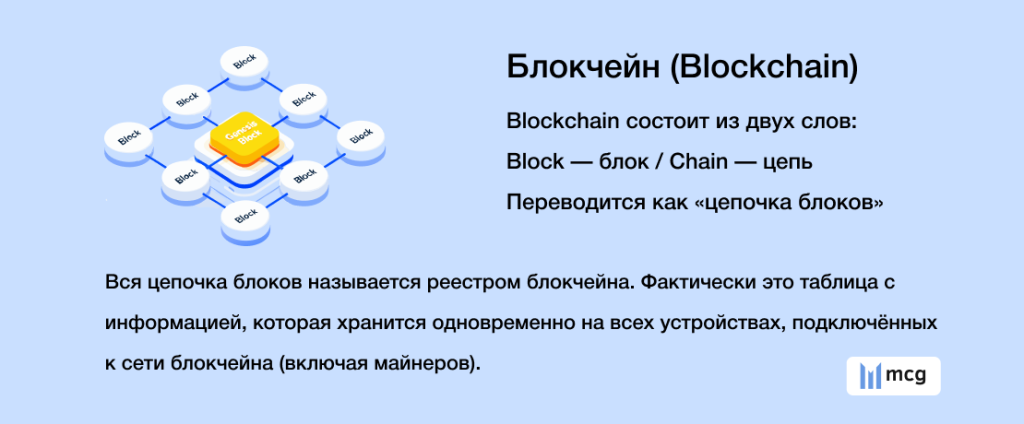
In cryptocurrencies, blockchain acts as a shared ledger of operations. Every transfer, purchase, or exchange is recorded in the system as a separate entry, which is added to a new block. After confirmation by the network, this block becomes part of the overall chain, and the transaction information is stored forever. Such a system allows cryptocurrencies to operate without a central controlling authority, where instead of a bank or payment company, transfer data is stored simultaneously on many computers of network participants. Thanks to this, no one can single-handedly change the history of operations or delete a record of a transfer.
Blockchain also determines how much funds are on each crypto wallet and who owns the digital assets. When a user sends cryptocurrency, the network checks the balance and confirms that the sender really has the required amount. After that, the information is updated throughout the system, and wallet balances change.
Next, we will look at how it works, how blockchain differs from a regular database, why it is needed outside crypto, and what its real pros and cons are. We will give examples from everyday life, because blockchain is best understood when it can be imagined as a concrete scenario, not as a “technology of the future.”
History of Blockchain
Before blockchain, almost all digital systems were built according to the usual scheme — there is a center and there is a database. A bank stores customer balances, a marketplace stores orders, a state registry stores property rights. In such systems, truth lives in one place. This is convenient, fast, and cheap.
But the center has power and risks. It can:
- change the rules
- block operations
- correct a record (by mistake or by decision)
- become a single point of failure if it gets hacked or “goes down”
Sometimes a centralized model is absolutely the right one. For example, when support, refunds, cancellations, and investigations are needed. But sometimes a different logic is needed — so that accounting is shared, verifiable, and does not depend on one organization.
This is exactly where blockchain appears — distributed accounting, where the network itself confirms that the record is correct, and the network itself stores the history. That is how decentralization emerged.
How blockchain technology works
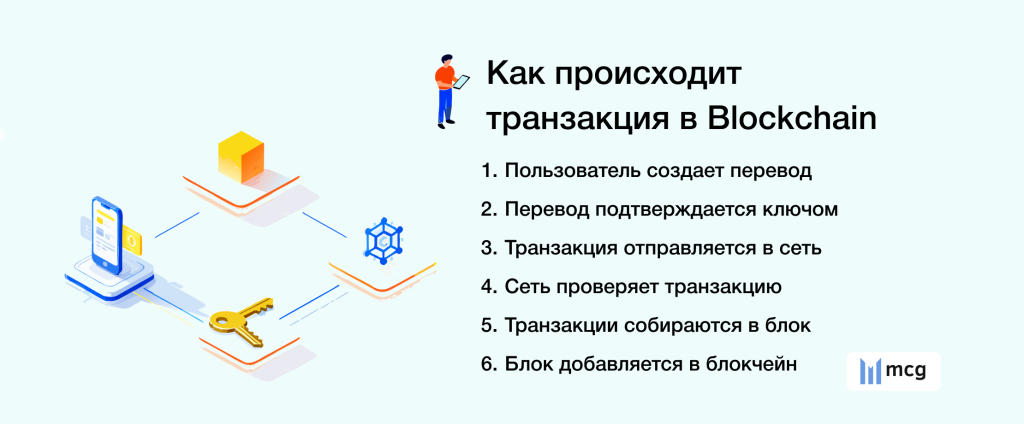
Let’s take a simple scenario — you transfer 100 USDT to an acquaintance.
- The wallet creates a transaction — what, from where, to where, and how much.
- The transaction is signed with your private key.
- The transaction spreads across the network — nodes can see it.
- Nodes check the basic things — the signature is valid, the funds are sufficient, the format is correct.
- The transaction gets into a block together with other transactions.
- The block is confirmed according to the network rules and added to the chain.
After that, the transaction is considered confirmed.
What this looks like in practice — in the Tron network, confirmation often takes minutes. In Ethereum, during periods of heavy load, it can take longer and cost more because of gas fees. This is not an “exchange whim,” it is the mechanics of a specific network.
What is a block, a hash, and a “chain”
Blocks of information in blockchain are data containers. In simple networks, a block stores a list of transactions: who sent funds to whom and how much. In more complex networks, a block can also contain other information about the state of the system. For example:
- a list of user transactions
- data on address balances after operations
- changes that occurred in smart contracts
- service information of the network
Simply put, a block is a package of records about actions in the network. In our analogy, it can be imagined as one notebook among thousands of identical notebooks with records stored on the computers of network participants all over the world.
In order to connect blocks to each other and protect them from changes, a hash is used — a digital fingerprint of the block. It is created from all the data inside the block. It has one important feature:
- if you change even one character in the data, the hash changes completely
- each new block stores the hash of the previous block
- if you change an old block, the chain will no longer match
- the network will immediately see an attempt to substitute data
It is important to understand one more thing. Blockchain does not make data “true” or “correct.” It makes it fixed after the network has accepted and recorded it. That is why blockchain projects pay special attention to the quality of incoming data, because the technology:
- protects the history of records
- does not allow changing data retroactively
- but cannot correct erroneous information if it was added initially
Who confirms blocks and why the network “works honestly” at all
This is the point where people usually expect magic, but it is economics.
Different networks have different models:
- Proof of Work (mining) — as in Bitcoin, participants spend computational power and receive a reward. That is, to create a new block in the chain and take the reward, they need to calculate (solve) a mathematical problem (hash).
- Proof of Stake — as in Ethereum, participants lock up (stake) coins and confirm blocks. The more ETH coins you stake, the larger your share of the rewards will be. It works like an analogue of a bank deposit.
- Permissioned networks — corporate blockchains where nodes are known and access is restricted.
The general idea is that confirming blocks is profitable, while cheating is usually unprofitable. In PoS networks, a validator risks their stake. In PoW — resources and electricity. In corporate networks — reputation and legal consequences.
Why blockchain is hard to fake
Sometimes people say “blockchain cannot be hacked.” That wording is too bold. More accurately — rewriting history is extremely difficult without control over a significant part of the network.
For public networks, a 51% attack is often mentioned. If an attacker controls most of the computing power (in PoW) or stake (in PoS), they can try to rewrite part of the recent history. Usually this refers to double spending — when someone wants to spend the same coins twice.
But this has an unpleasant side for the attacker. The bigger the network, the more expensive the attack. And if the attack succeeds, trust in the network falls, the asset becomes cheaper, and the whole idea becomes questionable. It is like trying to break open a safe that is worth more than its contents, while all cameras are pointed at you.
Blockchain and a database — what is the difference in simple terms
Regular database
- stored by the owner
- changes quickly
- can be edited and rolled back
- has an administrator who decides what is true
Blockchain
- stored by many participants
- changes by adding new records
- a “rollback” is not built in as a basic function
- the rules are common for the network, the administrator is not the main authority
Honestly speaking, a database is almost always faster and cheaper. There is no need to move absolutely every industry to blockchain and decentralization, as some enthusiasts believe. That is why blockchain makes sense where:
- there are many participants
- they do not trust one center 100%
- a verifiable history of changes is important
If a project has one owner and everyone trusts them, blockchain often turns into an expensive and slow detail that gives no benefit to the user.
The difference between databases and blockchain
| Parameter | Blockchain | Regular database |
|---|---|---|
| Simple explanation | A chain of blocks with records that cannot be changed retroactively | An electronic table or data storage system managed by the owner |
| Data storage | Data is grouped into blocks and linked cryptographically | Data is stored in tables on one server or in the cloud |
| Control | Decentralized — there is no single owner, the network is managed by participants | Centralized — there is an administrator or an owner company |
| Data mutability | Practically immutable — changing it requires the network’s consent | Records can be edited, deleted, and updated |
| Transparency | All transactions are open and verifiable by network participants | Access is limited by user permissions |
| Security | Protection through cryptography and distribution of copies across the network | Protection depends on server settings and the security system |
| Speed of operation | Lower due to the need for network confirmation of operations | High — operations are processed centrally |
| Example of use | Cryptocurrencies, smart contracts, NFTs, international transfers | Banking systems, online stores, CRM, and corporate services |
What kinds of blockchains exist — public and private
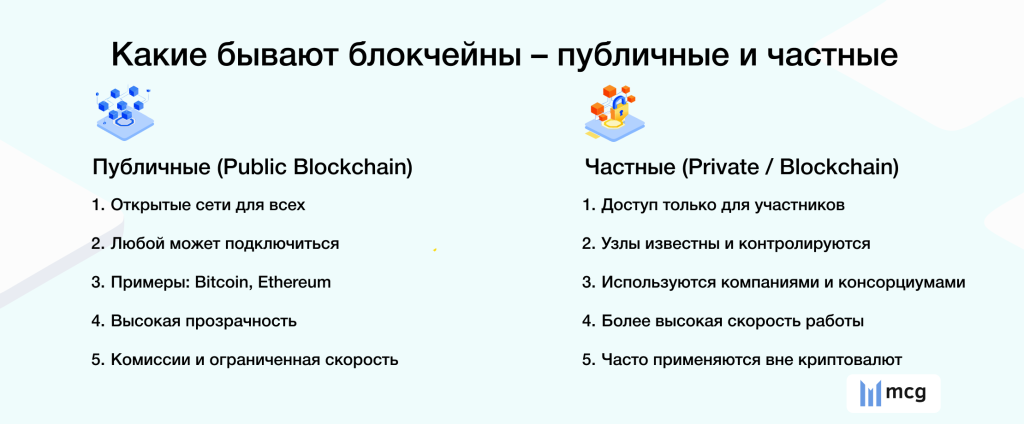
Public
Open networks that anyone can join. Examples are Bitcoin and Ethereum. The advantage is that the network is as neutral as possible, the downside is fees and limited speed, because the network is shared by everyone.
Private and permissioned
Networks where participants are known and access is restricted. Companies and consortia like them because the rules, speed, and privacy can be customized.
In reality, blockchain outside crypto is often exactly this kind — permissioned. There, the task is not “money without a bank,” but “a shared event log between companies.”
Examples in crypto — where blockchain can be felt in practice
Transfers and P2P with stablecoins
In Russia, mass entry into blockchain often happened through USDT. The scenario is routine — buy USDT via P2P on a crypto exchange (Bybit, OKX, HTX), send it to a wallet or another person, then sell it back into rubles.
The benefit is clear — speed, accessibility, and independence from some banking restrictions. The risks are also clear — choosing the correct network, not making a mistake in the address, and not signing anything unnecessary.
DeFi — a “bank in code”
DeFi protocols allow users to lend against collateral, exchange tokens, and earn income in liquidity pools. There is no manager who calls to clarify what you meant. The smart contract executes what you signed.
A useful nuance — in DeFi, it is important to read what you are signing. A mistake does not look like “oops, cancel it,” but like “the transaction has been executed, the money is gone.”
When a CEX breaks down
Stories like the FTX bankruptcy show a simple thing. On an exchange, you use someone else’s wallets. On a personal wallet — your own keys. Blockchain makes it possible to store assets not with an intermediary. This does not eliminate market risks, but it removes part of the counterparty risk.
Areas of blockchain technology use outside cryptocurrencies
Let us look at examples where peer-to-peer distributed ledger technology (blockchain) can be used in real life. Outside crypto, blockchain is rarely used as a “money network.” More often, it works as a trust layer — a shared journal where it is important not to rewrite history.
Blockchain in logistics
In logistics, many disputes begin with something simple — “who handed it over, who received it, and in what condition.” Data is often stored by different companies. And if someone changes a record on their side, proving otherwise becomes difficult.
Blockchain is used as a shared event log. Not so that “everything becomes honest,” but so that all participants have the same history.
What it looks like in practice — a batch of goods has events
- sent from the warehouse
- received at the terminal
- cleared customs
- arrived at the store
If events are recorded in a shared system and cannot be rewritten retroactively without agreement, the number of conflicts decreases. This is especially noticeable in long chains involving the manufacturer, carrier, warehouse, distributor, and retailer.
Blockchain in banking and finance
In the financial industry, blockchain technology is considered a way to speed up settlements and reduce the number of intermediaries. International bank transfers can take several days because different organizations and checks are involved.
In blockchain networks, a transfer record is confirmed by a network of participants and fixed in a distributed ledger. This makes it possible to carry out settlements faster and also use the technology for asset accounting, issuing digital bonds, and automating financial operations through smart contracts.
Blockchain in business
Companies use blockchain as a tool for transparent accounting of operations between partners. When several organizations participate in one process — for example, a manufacturer, supplier, and distributor — it is important that everyone has the same version of the data.
Blockchain makes it possible to store a shared event log that is difficult to change retroactively. This can be used for supply accounting, product quality control, verification of product origin, or automation of contractual obligations between companies.
Document flow and document version fixation
Here, blockchain often works as a “notary for digital files.” The document itself is usually stored in a standard storage system. The document hash and timestamp are placed into the blockchain.
A practical example: a contract was sent to a counterparty, and a month later a dispute begins over which version was signed. If you have a fixed fingerprint of the file, you can show that this exact version existed at a certain moment.
Blockchain in education
In the educational field, blockchain is considered a way of storing and confirming academic data. For example, diplomas, certificates, and exam results can be recorded in a distributed ledger.
This helps solve the problem of fake diplomas and simplifies qualification verification. An employer or university can quickly verify the authenticity of a document without contacting the educational institution directly.
Rights accounting and registries
In registries, the history of changes is important. Who was the owner, when the transfer happened, and on what basis. In an ideal world, this is already controlled by regulations. In the real world, there is human error, mistakes, and conflicts of interest.
Blockchain is used here as an audit layer — so that changing a record leaves a trace that is difficult to hide. It is important to understand that in most such projects, blockchain does not completely replace the state registry. It more often adds transparency to the history.
Blockchain in law
In legal practice, blockchain is used to record facts and confirm the immutability of documents. A file hash and a timestamp can be recorded in the system, showing that the document existed at a specific moment.
This mechanism is used for contracts, copyrighted works, licenses, and other legally significant documents. Blockchain does not replace the court or state registries, but it helps prove that the data was not changed after fixation.
Medicine and access control to data
In medicine, there is an eternal pain point — data is fragmented. Test results are in one system, scans in another, visit history in a third. The patient has to gather it manually.
Here blockchain is not used to store medical data “directly in the chain.” Almost no one does that because of privacy and volume issues. They do it differently — the data is stored separately, while blockchain records who got access, when, and that the record was not changed.
The practical meaning is that a system can be built where a patient gives a doctor access for a limited time, then the access is revoked, and this is recorded. It is difficult to implement, but the logic is clear.
Voting and decision logging
The topic is controversial, because voting is not only about accounting, but also about identification, secrecy, and protection from pressure. But blockchain is sometimes used at least for logging — so that after the vote, it is visible that the results were not substituted. Blockchain by itself does not solve the problem of “who is voting.” It solves the problem of “not quietly rewriting the result.” These are different tasks.
Copyright and digital certificates
For authors, developers, photographers, and designers, blockchain is sometimes used as proof of primacy. Not “I am definitely the author because I said so,” but “here is the file fingerprint fixed on such-and-such date.” This does not replace court proceedings 100%, but it helps in disputes.
Tokenization — when an asset gets a digital оболочку
Tokenization sounds like hype, but the idea is grounded. There is an asset — a fund share, a claim right, bonuses, access, sometimes real estate. It is represented as a token that can be managed according to the rules of a smart contract.
Examples of application:
- issuing tokens that provide access to a service or the right to a discount
- corporate bonds in the form of tokens to simplify accounting and settlements. Or ownership shares in real estate are measured in tokens.
IoT and accounting of events between devices
There are niche cases where blockchain is used as an event log for devices. For example, sensors in a supply chain record temperature, and the network stores the history in such a way that it cannot be falsified. This is important when it comes to medicines, food products, and the cold chain.
What is “stored” in blockchain (keys, addresses, and wallet)
This is where beginners’ logic often breaks down. It seems that a wallet is the place where coins are kept. But in blockchain, coins physically do not “lie” anywhere in your phone. The chain stores a record that a certain address has a certain amount of an asset. And a wallet is the tool that allows you to manage that address.
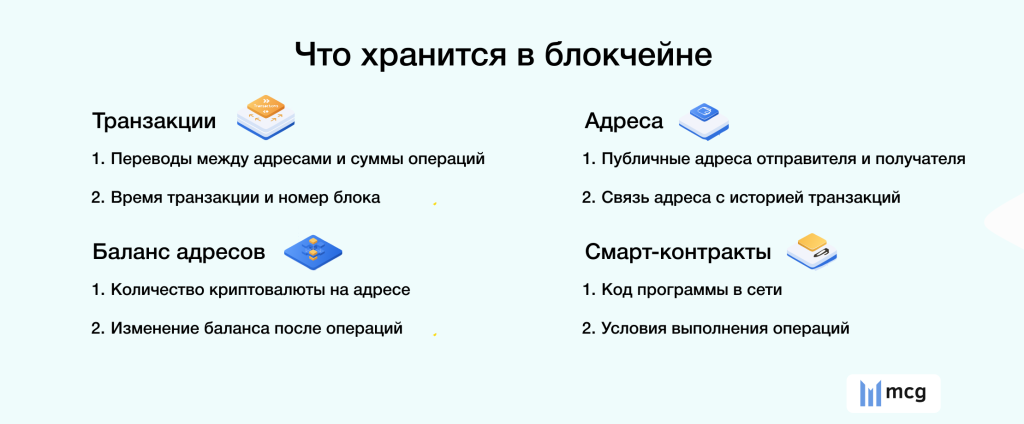
The most important thing in a wallet is the private key. It proves to the network that you are the one who has the right to sign transactions on behalf of the address. That is why the phrase “do not store your private key in notes” sounds like nagging until a typical scenario happens — the phone is lost, the notes get synchronized, access leaks, and then everything develops quickly with no chance of rollback.
A blockchain address is the public part. It can be given to others, like an account number. A private key is like a signature and seal at the same time. A normal everyday check before a transfer looks like this — first a small test amount is sent, and only then the main amount. For large transfers, this precaution definitely will not hurt.
To put it very briefly, a wallet does three things:
- stores your private key (or helps store it)
- shows the balance of the address
- lets you sign a transaction and send it to the network.
Fees, gas, and “why a transfer gets stuck”
A fee in blockchain networks is the payment for the network to include your transaction in a block. In different networks this is arranged differently, but the idea is the same — network resources are limited, and priority must be paid for.
In practice, a beginner encounters it like this. They see that USDT in the Tron network is transferred for pennies, while in Ethereum the fee can suddenly be 5–20 dollars, and even higher at peak moments. This is not because someone decided to “rip you off,” but because there is a lot of activity in the Ethereum network, and there is competition for space in a block.
A useful habit is to look not only at the wallet fee, but also at network load. If the transfer is not urgent, sometimes it is more profitable to wait an hour or two than to pay for urgency. And if it is urgent, it is better to pay right away than to get nervous because of a stuck transaction and later figure out what acceleration is.
In smart contracts, the fee is even more important. Exchanging tokens on a DEX or interacting with a DeFi protocol is not one transfer, but code execution. Therefore, “sending USDT” and “doing a swap on Uniswap” can differ in price several times over, even if the amount is the same.
When blockchain is not needed — briefly but honestly
Blockchain is most often not needed if
- participants already trust one owner
- data is often edited and a “rollback” is needed
- maximum speed and minimal cost are important
- the system does not imply a shared audit for many parties
A practical sign — if blockchain was added, but it only made things more complicated and expensive for the user, then the technology was chosen for the sake of a fashionable word, not for the sake of solving the task.
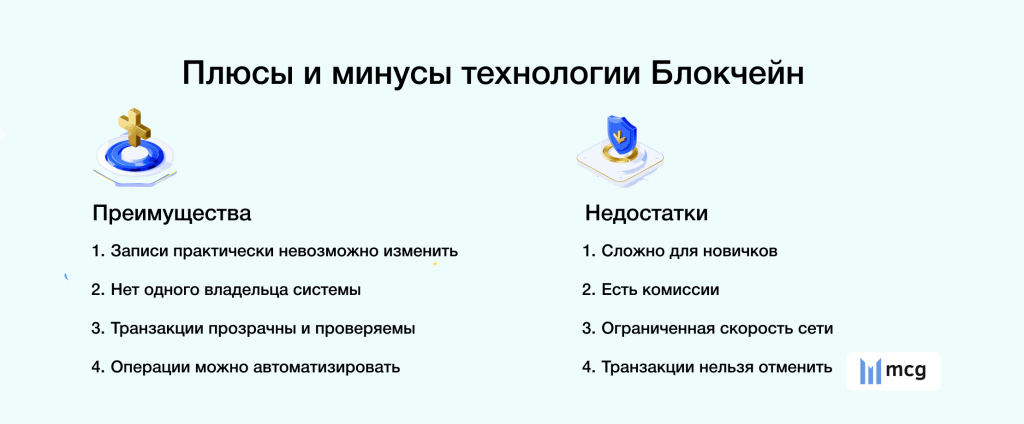
Pros and cons of blockchain technology
Pros
- it is harder to falsify history retroactively
- shared accounting for many participants without a single owner
- transparent rules and verifiability
- the possibility of automation through smart contracts
Cons
- more difficult for beginners, especially with keys and addresses
- fees and speed limitations in public networks
- mistakes are often irreversible
- the quality of input data still matters
Typical beginner mistakes — where people usually stumble
The first is to confuse blockchain with a specific coin. Blockchain is the technology, Bitcoin is its application.
The second is to think blockchain is anonymous. In most public networks, transactions are public. An address is not equal to a name, but a lot can often be seen through transfer chains.
The third is to think blockchain will “protect everything by itself.” It protects against silent substitution of history, but not against phishing, replacing an address in the clipboard, or inattention when signing a transaction.
The fourth is to think everything in blockchain is free. Fees can be small, and they can also be unpleasantly large. Especially when the network is overloaded.
Frequently asked questions and answers about blockchain
Where is blockchain actually stored?
It often seems that blockchain is some single server or cloud storage. In practice, everything is arranged differently. Copies of the entire blockchain are distributed among the computers of network participants. Such computers are called nodes. Each node can store a full or partial copy of the blockchain and participate in transaction verification. When a new block appears in the network, information about it spreads to other nodes, and their copies of the chain are updated. Thanks to such distribution, the data does not depend on one owner or one server.
Can a cryptocurrency transfer be canceled?
No. If a transaction has already entered a block and received network confirmations, it cannot be canceled. In blockchain systems, records are added sequentially and are not edited retroactively. That is why before sending cryptocurrency, it is always recommended to check the recipient address and the network, and sometimes first send a small test amount.
What happens if you lose your private key or seed phrase?
The private key and seed phrase are the main access to a crypto wallet. They confirm to the network that you are the owner of the address and have the right to sign transactions. If this data is lost, restoring access to the funds is almost impossible. Unlike banking services or ordinary applications, blockchain has no “reset password” button and no support center that can restore access. That is why keys are usually written down on paper, stored in hardware wallets, or protected with special backup storage methods.
Why do fees differ across networks?
A fee in crypto networks is the payment for processing a transaction. It is needed so that network participants include your operation in a new block. The size of the fee depends on the specific network and its load. For example, in some networks transfers are very cheap because the network processes many operations and the blocks fill up slowly. In other networks, activity is higher, so users compete for space in a block, and the fee can increase. That is why the same transfer can cost completely different amounts in different networks.
What is a smart contract in simple words?
A smart contract is a program that works inside blockchain and automatically executes specified rules. For example, a contract can exchange one token for another, issue a loan against collateral, or distribute payouts among project participants. After launch, such programs operate according to the rules of the network and do not require an intermediary. Smart contracts are exactly what made areas such as DeFi, NFT platforms, and decentralized applications possible.
Conclusion — what is important for a beginner to remember
Blockchain is a way to agree on a single version of history when there are many participants and there is no desire to give control to one center. In crypto, this gives money and services without intermediaries. Outside crypto, it is more often an audit and trust layer — a shared event log, document version fixation, access control, and a verifiable history of changes.
Blockchain technology itself does not make the world honest. It makes falsifying history expensive and visible. And after that, the human factor, habits, rules, and common sense still remain. We simply get a tool that sometimes really helps, especially where before people had to take someone’s word for it.