




What is cryptocurrency?
(digital money that exists only on the Internet)
Cryptocurrency is money that exists exclusively in digital form. You can't touch it, put it in your pocket, or withdraw it from an ATM in the traditional sense. All you have is an account in the system and access to it through an e-wallet.
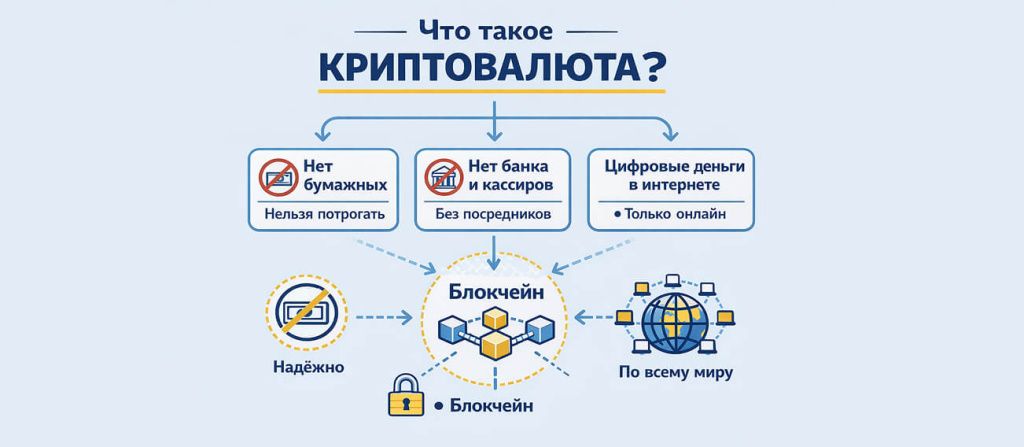
The main difference between cryptocurrency and conventional money is that it isn't issued by a government. It doesn't have a central bank that decides how much money to print, whether to raise interest rates, or whether to freeze accounts. Cryptocurrency operates by predetermined rules that can't be simply changed by a single decision.
For beginners, it's important to understand one simple thing. Cryptocurrency isn't "magic money" or a get-rich-quick scheme. It's a financial instrument. It has pros, cons, risks, and its own unique characteristics. Some people use cryptocurrency for investments, some for transfers, and still others simply out of curiosity about the technology.
To put it simply, cryptocurrency is an alternative form of money that operates online and is independent of banks.
How does blockchain work?
(a general digital accounting system that cannot be rewritten retroactively)
For cryptocurrency to exist at all, a technology that replaces banks is needed. Blockchain fulfills this role.
Blockchain is a way to store information about transfers. Imagine a notebook where all transactions are recorded. But this notebook isn't shared by just one person, but by thousands. And every new entry must match everyone's. If the entries don't match, the system simply rejects the changes.
Every cryptocurrency transfer is included in a new block. This block is linked to previous blocks and becomes part of the chain. Therefore, it is impossible to change an old transaction. To do so, the entire chain would have to be rewritten simultaneously by most network participants, which is practically impossible.

An important point for beginners: Blockchain doesn't store people's names, addresses, or passport information. It stores only technical information: the sender's address, the recipient's address, and the amount. This makes the system transparent, but not directly tied to individuals.
Blockchain operates without a central authority. There's no central server and no "master" who can shut everything down. This is why cryptocurrencies are called decentralized.
Forms of cryptocurrency
(different digital assets with different purposes)
Not all cryptocurrency is created equal. This is a common mistake made by beginners.
Coins
Coins are basic digital coins that operate within their own system. The most well-known example is Bitcoin (BTC). Coins can be transferred, stored, bought, and sold. They are what people most often mean when they hear the word "cryptocurrency."
Tokens
Tokens are created on the basis of existing blockchains. Typically, tokens are needed for the operation of a specific project. They can grant access to a service, voting rights, or a stake in the ecosystem.
Simply put, a coin is money within a system. A token is a digital instrument with a specific function. Sometimes tokens are purchased to increase their price, sometimes for use within a project.
For beginners, it's important to understand that not every cryptocurrency is intended for payment or storage. Different assets have different purposes.
How to get cryptocurrency
(simple and complex methods for ordinary people)
The easiest and most straightforward way to obtain cryptocurrency is to buy it. This is done through exchanges, money exchangers, or P2P services. You pay rubles and receive the cryptocurrency in your wallet. For most people, this is the primary option.
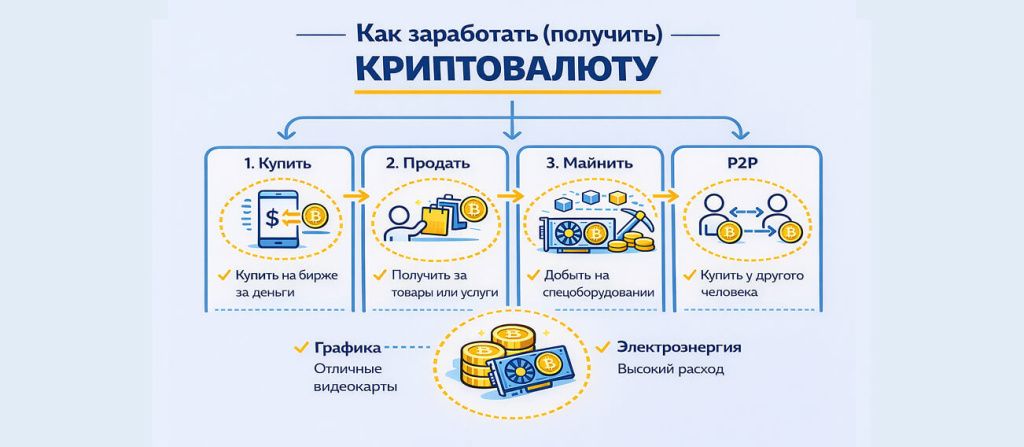
Mining
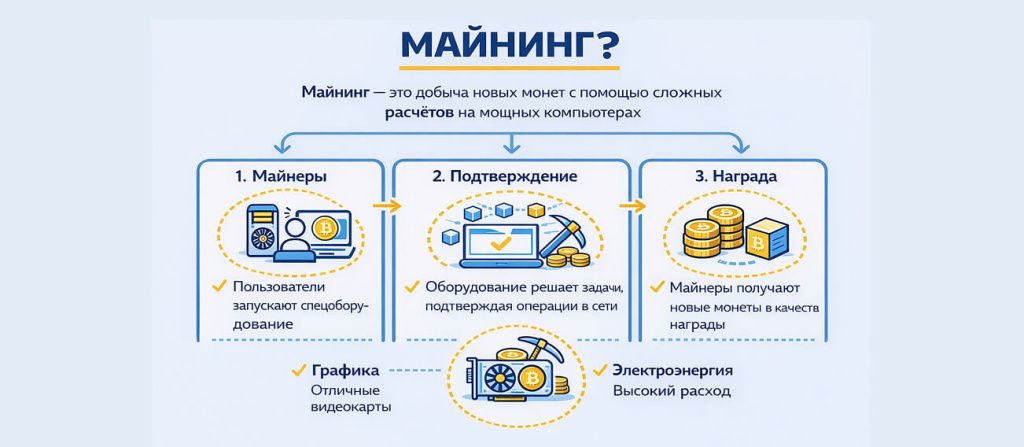
Cryptocurrency mining (a popular search term for earning or mining crypto) is the process of maintaining a network using computing power. While mining was once accessible to almost anyone, it now requires expensive equipment and cheap electricity. For beginners, it's more theoretical than practical.
A simple diagram to understand the basic steps of cryptocurrency mining:
Staking
Staking is a way to earn money using cryptocurrency you already own. You temporarily lock your coins in the system and receive a reward. It's similar to investing, but without guarantees.
Sometimes you can earn cryptocurrency for participating in projects, completing tasks, or as payment for work. However, these are less common options.
It's important to remember. Cryptocurrency isn't stored "somewhere on the internet," but in your wallet. Losing access to your wallet means losing your funds.
How is cryptocurrency used?
(real scenarios, not myths)
Cryptocurrency is most often used as an investment tool. People buy it in the hopes of a price increase. Some hold it for years, others sell it at the first sign of growth.
The second popular area is trading. Cryptocurrency prices fluctuate frequently, and traders try to profit from this. This is risky and requires experience.
In some countries, cryptocurrency can be used to pay for goods and services. This is prohibited in Russia. There, cryptocurrency is officially considered an investment asset, not a means of payment.
For some, cryptocurrency is a way to keep some of their wealth outside of banks. For others, it's an opportunity to participate in new digital projects. For others, it's simply an interesting technology to observe.
Why is cryptocurrency considered safe?
When discussing cryptocurrency security, it's important to clarify: we're not talking about absolute protection from all risks, but about the high reliability of the technology itself. It's similar to medical equipment: it may be technically safe, but improper use can still lead to problems.
The foundation of cryptocurrency security is its blockchain architecture. All transactions are recorded in a distributed system, where data is stored simultaneously by multiple independent participants. Information is encrypted, blocks are linked, and each new transaction is verified by the network. This eliminates the possibility of undetected retroactive data modification.
In practical terms, this means that if a cryptocurrency transfer is confirmed by the network, it cannot be reversed, forged, or rolled back at someone's request. There is no administrator who can intervene. This reduces the risk of fraud at the system level, but simultaneously increases user responsibility.
Unique addresses are used for transfers. They contain no personal information. All transactions are public and verifiable, but linking a specific address to a specific person without additional information is extremely difficult. This ensures transparency while maintaining relative anonymity.
The key system deserves special attention. Every crypto wallet has a public and private key. The public key is the address to which funds can be sent. The private key is the only way to access them. Losing the private key is equivalent to losing the funds. Recovery is impossible. This is a fundamental difference from the banking system and one of the key points that beginners need to understand in advance.
What determines the price of cryptocurrency?
The price of cryptocurrency is determined by the same basic economic laws as the price of any asset. It's based on supply and demand. When user interest grows, the price rises. When interest declines, the price falls.
However, cryptocurrencies have additional factors that exacerbate fluctuations. A key factor is the supply cap. If the number of coins is predetermined, this creates a scarcity effect. Technological advancements, regulatory news, the actions of major investors, and the overall state of the global economy also influence the price.
For beginners, it's important to understand that the cryptocurrency market is emotional. It reacts sharply to statements by public figures, news, and rumors. Sharp fluctuations are the norm, not the exception. For miners, the price also includes the cost of production, which depends on equipment and electricity. These factors also influence the market balance.
Types of cryptocurrencies
In terms of structure and management, cryptocurrencies can be divided into several groups.
-
Decentralized cryptocurrencies operate without a single central authority. The network rules are the same for all participants, and production occurs through mining or similar mechanisms. This is the most "classic" version of cryptocurrency, where trust is built solely on technology.
Pseudo-decentralized projects superficially resemble cryptocurrencies, but are actually managed by a limited number of individuals or companies. They may develop faster, but their level of independence and sustainability is lower. Users should understand that such projects carry additional management risks.
-
Stablecoins are a separate category. Their value is pegged to real assets, most often the US dollar. This reduces volatility but makes these currencies centralized. Their reliability directly depends on the issuing company and the quality of its reserves.
Risks
Despite its technological stability, cryptocurrency remains a high-risk instrument. The main risk stems from the lack of traditional security mechanisms typical of the banking system. User errors are irreversible. Losing access to a wallet means losing funds without the possibility of recovery.
Market risks are also present. Exchange rates can fluctuate sharply, and individual projects may lose their value entirely. This requires a cautious approach and avoiding impulsive decisions.
Cryptocurrency isn't for everyone. It requires discipline, attention to detail, and a willingness to take responsibility. It's a tool that expands financial opportunities, but it doesn't forgive carelessness.
The legality of cryptocurrency in the world and in Russia
Internationally, cryptocurrency is viewed primarily as a financial asset. Most countries permit its ownership and trading, but impose requirements on exchanges, reporting, and taxation. There is no universal approach; each jurisdiction develops its own regulatory model.
In the Russian Federation, cryptocurrency is regulated by Federal Law No. 259-FZ "On Digital Financial Assets." The law permits the purchase, sale, and storage of cryptocurrency as an investment, but prohibits its use as a means of payment for goods and services. Cryptocurrency is not an official means of payment.
Income from cryptocurrency transactions is subject to taxation. Banks and financial institutions have the right to monitor transactions under Federal Law No. 115-FZ on combating money laundering. Therefore, cryptocurrency is permitted in Russia, but its use is limited to investment and property purposes.
Terms for beginners with simple examples:
1. Cryptocurrency
Cryptocurrency is digital money that exists only on the internet. It is not printed, minted, or stored in a bank. It exists in a special digital system and belongs only to those who have access to it.
A simple example: it's like money on a card, but without a bank between you and the money.
2. Blockchain
Blockchain is a method of storing transaction information that cannot be counterfeited. All transactions are recorded in the blockchain and copied to thousands of computers worldwide.
Example: like a general ledger where every entry is visible to everyone and cannot be rewritten retroactively.
3. Bitcoin
Bitcoin (BTC) is the first and most famous cryptocurrency. It started it all.
Example: like the dollar or gold in the crypto world. Even if you don't buy Bitcoin, its price influences almost the entire market.
4. Crypto wallet
A crypto wallet is a tool for accessing cryptocurrency, not a place where it is physically stored.
Example: like a banking app, but without support or recovery. If you lose access, your money cannot be returned.
5. Public and private key
The public key is the address to which you can receive cryptocurrency.
A private key is a secret code that gives access to money.
Example: card number and PIN. The number can be shown, but the PIN never.
6. Exchange
A crypto exchange is a platform where people buy and sell cryptocurrency.
Example: like a currency exchange or brokerage app, but for digital assets.
7. P2P
P2P is the act of buying cryptocurrency directly from another person, rather than from a company.
Example: you transfer rubles to someone, and the system ensures that the cryptocurrency arrives to you honestly and without deception.
8. Stablecoin
A stablecoin is a cryptocurrency pegged to the dollar or another asset.
Example: the digital dollar. If you have 100 USDT, that's roughly $100, without any sudden fluctuations.
9. Mining
Mining is the process by which users use computers to maintain the blockchain. They verify transactions, create new blocks, and receive a reward in cryptocurrency.
Example: like system maintenance. The person doing the maintenance gets paid, but they waste electricity and equipment.
10. Volatility
Volatility is how much and how quickly the price changes.
Example: today a cryptocurrency costs 100, tomorrow 85, and in a week 120. This is normal for crypto.