



There are several ways to buy cryptocurrency in Moscow, each with different transaction terms, processing speeds, and levels of control. The specific choice depends on the amount, payment method, and requirements for transaction predictability—for some tasks, a fixed exchange rate and cash transactions are important, while for others, flexibility and the ability to conduct transactions online are key.
This market structure did not emerge by chance. Moscow has become the largest hub for cryptocurrency activity in Russia thanks to its concentration of capital, developed financial infrastructure, and access to international markets. This is where the main demand for major cryptocurrencies is concentrated—primarily Bitcoin (BTC), Ethereum (ETH), and stablecoins, among which USDT dominates as the digital equivalent of the dollar.
Interest in cryptocurrency remains steady and is largely practical in nature. Digital assets are used not only as an investment tool but also as a means of preserving capital, settling accounts with foreign counterparties, and transferring funds outside the banking system. Therefore, searches related to buying and exchanging cryptocurrency in Moscow remain consistently popular and reflect a real need for functional channels to enter the market.
At the same time, traditional financial instruments have gradually lost their versatility for such transactions. Banks have tightened controls on transfers between individuals, especially in P2P transactions, while centralized crypto exchanges have restricted direct trading in rubles. This has shifted demand toward alternative solutions.
As a result, a multi-tiered infrastructure for purchasing cryptocurrency has emerged in Moscow, where, alongside traditional exchanges, the following are actively used:
- offline crypto exchange offices, including locations in business districts and Moscow City
- online exchanges with fast transaction execution
- P2P platforms for direct transactions between users
Each of these channels offers its own balance between exchange rate, speed, and risk level. In practice, the task is not to find a single “best” option, but to choose the right model depending on the amount, goals, and acceptable costs.
How to buy cryptocurrency in Moscow
In reality, the choice of purchasing channel is determined not only by convenience but also by the balance between transaction control, transparency of terms, and operational risks. Below are the key models used in the market.
1. Offline and online exchanges
Exchange services form a separate market segment where cryptocurrency purchases take place outside the exchange infrastructure. They operate both online (via websites) and through physical offices—including in Moscow’s business districts and Moscow City.
The offline format involves conducting the transaction at a physical office. The user hands over cash and receives cryptocurrency sent to the specified wallet. Such locations are more often geared toward transactions involving medium and large amounts, where speed of settlement and a fixed exchange rate at the time of the transaction are important.
Online exchanges are specialized services through which rubles are exchanged for cryptocurrency and transferred to the user’s wallet. The transaction takes place remotely: after submitting a request, the user transfers funds to the specified account details, and the service sends the crypto assets. The exchange rate is determined based on an internal margin.
List of cryptocurrency exchanges in Moscow and Moscow City
Insight (Moscow City — offline)
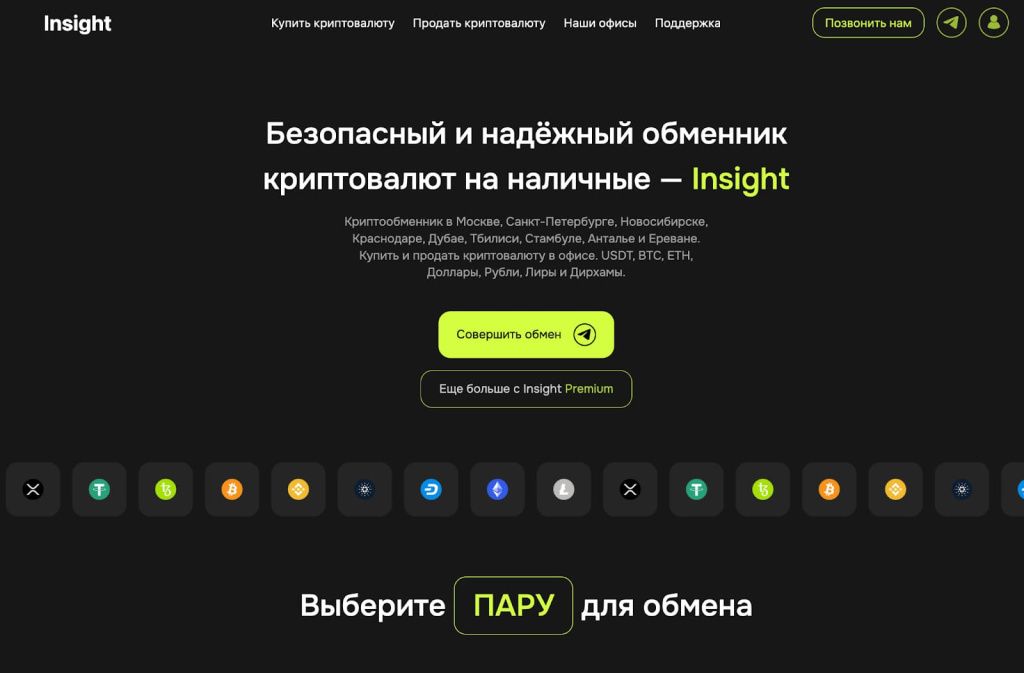
Insight is chosen for its cash transactions in Moscow City, exchange rate locking before the transaction, and the ability to quickly transfer large sums without splitting. Major networks (TRC-20, ERC-20) are supported, and transactions are conducted by appointment.
BitOkk
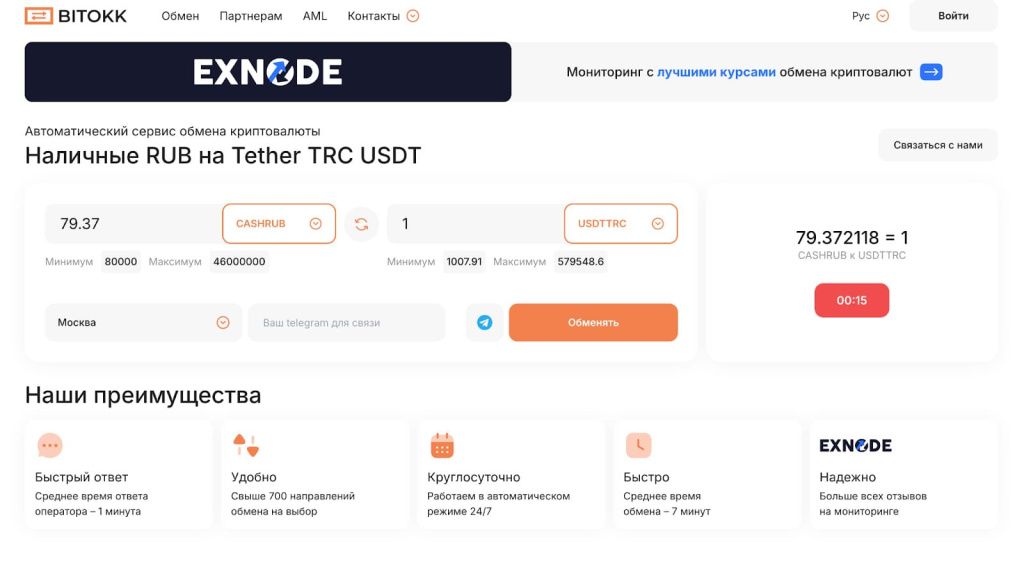
BitOkk is used for fast transactions and a wide range of options: in addition to BTC and USDT, altcoins are available, along with various networks and transfer options. It’s suitable when you need to exchange quickly and aren’t limited to basic pairs.
EastChange (Moscow — offline)
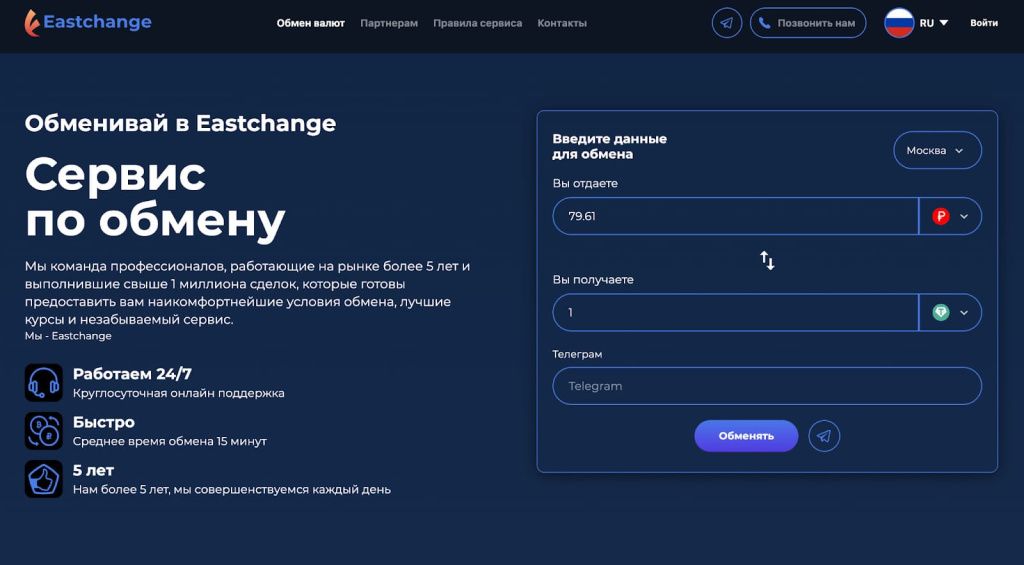
EastChange is used when volume is needed: the service executes trades without splitting orders and maintains reserves in USDT and BTC. Transactions are conducted in person at the office, accepting both cash and non-cash payments.
RENATKO Exchange
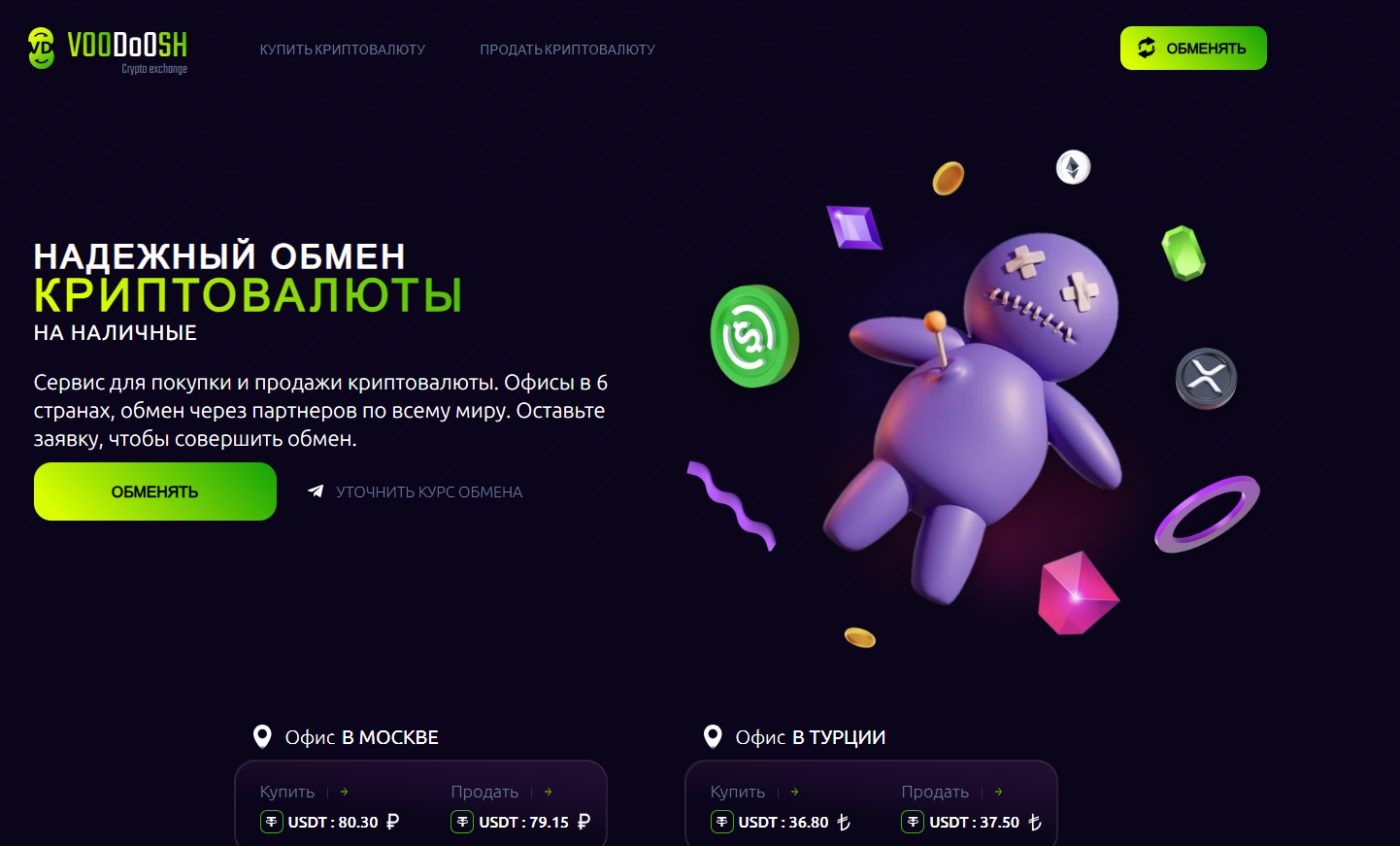
RENATKO Exchange is used when you need to link crypto and fiat: it offers transactions in USD, transfers, and combined schemes (crypto → fiat and vice versa).
Cashex
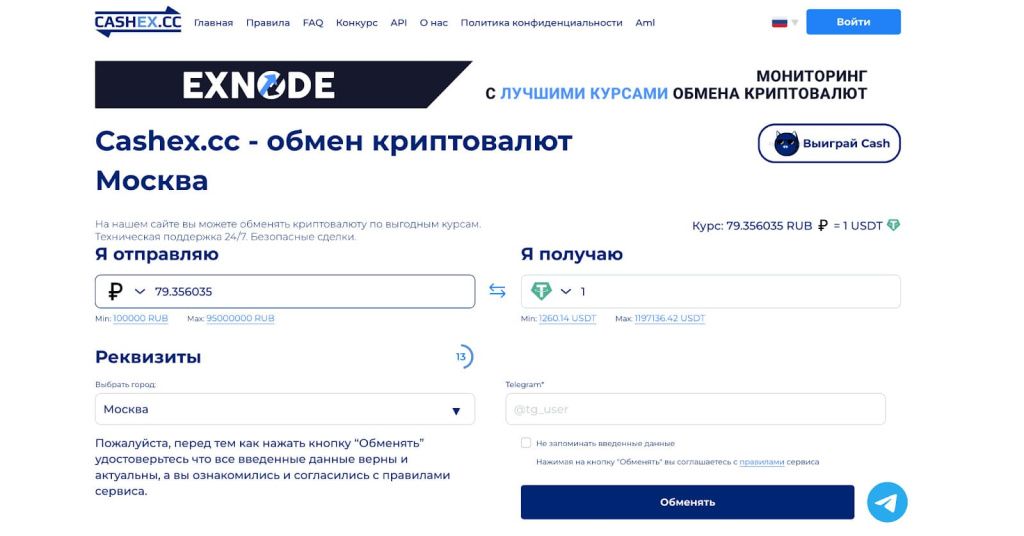
Cashex is chosen for large transactions: the exchange rate is agreed upon in advance, reserves are available, and it works with popular networks (TRC-20, ERC-20); funds can be transferred without price fluctuations.
Exchange rate and platform monitoring services
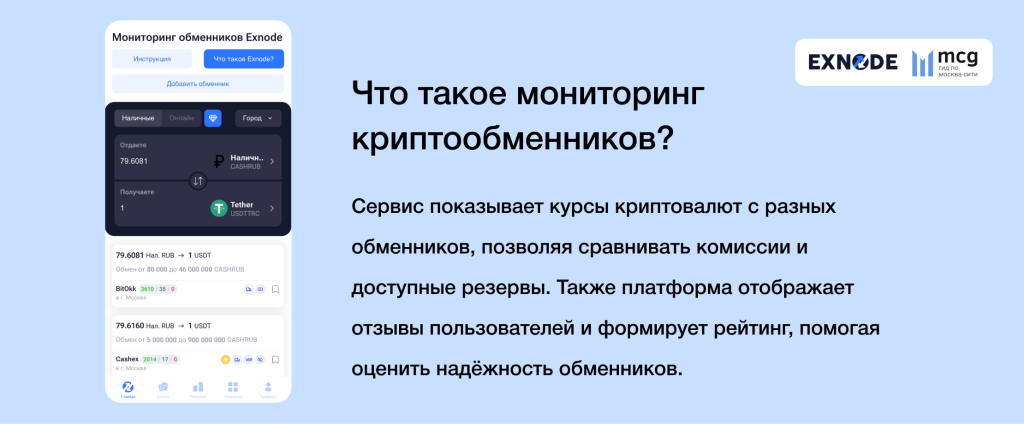
To choose the right service, people most often use exchange trackers, such as Exnode—an aggregator that lets you compare rates, reserves, and available exchange pairs. This reduces search time and lowers the risk of dealing with little-known platforms.
Advantages of buying through an exchange:
- fixed transaction terms at the time of the request
- the ability to use cash
- no need to store funds on the platform
- a simple and straightforward process without complex infrastructure
Disadvantages of exchange platforms:
- The exchange rate usually includes a service fee
- The quality of terms depends on the specific exchange
- Limited reserves for large amounts
Under current conditions, exchange services—especially offline ones—are often seen as the most predictable way to buy in terms of transaction execution and control over the process.
2. P2P platforms and crypto exchanges
The P2P model is based on direct interaction between users. One participant posts an offer to sell cryptocurrency, while the other accepts the terms and makes the payment directly. The platform acts as a guarantor, holding the asset until the transaction is completed.
Payments are most often made via bank transfers, which makes this format dependent on the payment infrastructure. Execution time and final terms may vary depending on the specific counterparty.
Advantages of buying via P2P:
- flexibility in choosing payment methods
- the ability to find a rate close to the market rate
- a wide selection of offers
Disadvantages of P2P platforms:
- dependence on the counterparty’s behavior
- Probability of delays on the part of banks
- the need to assess ratings and transaction history
3. OTC and private transactions
The over-the-counter (OTC) format is used for large-volume transactions where standard market mechanisms can have an excessive impact on the price. The terms of the transaction are negotiated individually, including the exchange rate, payment method, and settlement procedure.
Such transactions can take place either directly between the parties or through intermediaries.
Advantages of private transactions:
- the ability to handle large sums
- customized transaction terms
- minimal impact on the market
Disadvantages and risks of OTC transactions:
- lack of standard safeguards
- dependence on the counterparty’s reputation
- Limited transparency
4. Telegram bots and informal services
An informal channel for purchasing cryptocurrency through bots or specialized services within the messenger. Transactions are completed in a minimal number of steps; however, the level of standardization and transparency of such operations is significantly lower compared to other options.
However, these channels lack uniform operating standards and often do not provide built-in transaction protection mechanisms.
Pros of buying via Telegram:
- high transaction speed
- low entry barrier
- simplified user interface
Cons of Telegram bots and other platforms:
- high risk of fraud
- lack of transparent terms
- Limited dispute resolution options
Comparison of ways to buy cryptocurrency
| Method | Fee / Spread | Transaction speed | Payment method | Level of control | Main risks |
| Exchanges (online/offline) | 1–3% (included in the exchange rate) | 5–30 minutes | Cards / cash | High | Service quality, reserve |
| P2P | 0% (via exchange rate) | 5–30 minutes | Bank transfers | Average | Counterparty, bank holds |
| OTC / private transactions | On a case-by-case basis | By agreement | Any | Low | Counterparty reliability |
| Telegram services | 1–3% and higher | 1–10 minutes | Cards / transfers | Low | Fraud, lack of guarantees |
The established market structure shows that there is no universal channel for purchasing cryptocurrency: each format serves a specific purpose and is used in certain scenarios.
At the same time, exchange services—especially when combined with monitoring tools and offline infrastructure—stand out for their more predictable transaction execution model, whereas other options require a higher level of user involvement in the process and an assessment of associated risks.
Where to Buy Cryptocurrency Safely
The choice of a channel for buying cryptocurrency in Moscow is determined not only by the availability of a specific service but also by a set of parameters that affect the final transaction cost and the level of operational risks. Below are the key factors that shape the terms of purchase.
Liquidity
Liquidity reflects the market’s ability to execute trades without significant deviation from the current price. On highly liquid platforms, large volumes are bought and sold quickly with minimal impact on the exchange rate. In segments with limited supply—for example, when trading through individual exchange offices or in private transactions—situations may arise where the price changes even while the order is being executed.
Rate and Spread
The displayed rate does not always match the market value of the asset. The difference between the buy price and the average market level forms the spread, which can act as a hidden commission. In some models, it is minimal and transparent; in others, it is included in the final cost without being explicitly stated. Under identical external conditions, it is often the spread that determines the actual overpayment.
Fees
The commission structure depends on the purchase method and may include several tiers:
- funding fee
- trading fee or internal margin
- commission for withdrawing cryptocurrency on the selected network
Even if there is no explicit fee, it may be built into the exchange rate. Therefore, the total cost of the transaction is calculated as a sum, rather than based on a single indicator.
Transaction Speed
Execution time ranges from instant transactions to transactions requiring confirmation from multiple participants. Speed is influenced by:
- settlement format (automatic or manual)
- blockchain network congestion
- the specifics of bank transfers
In some cases, delays occur not on the part of the crypto service, but within the payment infrastructure.
KYC Requirements
User identification requirements vary depending on the platform. Some services require full verification with the submission of documents, while others allow transactions without KYC or with simplified verification. The presence or absence of identification affects available limits, processing speed, and the ability to restore access in disputed situations.
Risks of Bank Transactions Being Blocked
Financial institutions monitor transactions between individuals, especially in cases of frequent or atypical transfers. In the context of cryptocurrency transactions, this can lead to temporary restrictions, requests for supporting documents, or the blocking of specific transactions. The likelihood of such situations depends on the frequency of transfers, their volume, and the nature of the counterparties.
The combination of these factors determines not only the cost of purchasing cryptocurrency but also the long-term sustainability of the chosen model.
Legal Status of Cryptocurrencies in Russia
Legal regulation of cryptocurrencies in Russia is limited and largely framework-based. The main provisions are enshrined in Federal Law No. 259-FZ “On Digital Financial Assets and Digital Currency,” which defines the state’s general approach to the circulation of such assets.
Cryptocurrency as property. From a legal standpoint, cryptocurrency is considered not as money, but as property. This means that transactions involving digital assets are subject to general civil law provisions, including ownership, purchase, sale, and other forms of disposal.
At the same time, the possession and purchase of cryptocurrency by individuals are not prohibited. Market participants are free to acquire and hold digital assets, including through foreign platforms, P2P services, or exchange channels.
Restriction on Use as a Means of Payment
The key restriction concerns the use of cryptocurrencies within the country. The law explicitly prohibits the use of digital currency as a means of payment for goods and services within Russia.
This means that:
- settlements between companies or individuals in cryptocurrency are formally prohibited
- any purchase and sale transactions must be denominated in rubles
In practice, cryptocurrency is used as an investment or settlement instrument outside the official payment system.
Bank Transactions and Transaction Monitoring
Despite the absence of a direct ban on purchasing cryptocurrency, transactions involving rubles go through the banking system, which is subject to financial monitoring requirements.
Banks analyze:
- the frequency of transfers
- transaction volumes
- the nature of counterparties
If atypical activity is detected, the following may occur:
- temporary restrictions on transactions
- requests for supporting documents
- blocking of individual transactions
Thus, the legal status of cryptocurrency is supplemented by de facto oversight by financial institutions.
Taxation of Transactions
Since cryptocurrency is recognized as property, income from transactions involving it may be subject to taxation. The basic principle is the taxation of the difference between the purchase price and the sale price.
Taxable transactions may include:
- the sale of cryptocurrency for rubles or foreign currency
- exchanging one cryptocurrency for another (in certain interpretations)
The practice of applying these rules is still evolving, but the general approach to accounting for such transactions has already been established.
Lack of comprehensive market regulation
Currently, Russia lacks:
- a unified licensing system for crypto exchanges
- clear regulation of P2P transactions
- standardized requirements for private services
This results in a significant portion of the market operating outside a strictly regulated environment, and the responsibility for choosing a channel and assessing risks effectively falls on the transaction participant themselves.
Sanctions and infrastructure restrictions
An additional factor is restrictions imposed by international platforms and payment systems. These may affect:
- access to certain exchange features
- methods of depositing and withdrawing funds
- verification procedures
As a result, the availability of certain channels for purchasing cryptocurrency may vary depending on the current external environment.
The legal framework in Russia permits the ownership and purchase of cryptocurrency but restricts its use as a means of payment and does not establish a fully regulated market infrastructure.
This creates a hybrid environment in which transactions with digital assets are possible but are accompanied by both legal and operational peculiarities that influence the choice of purchase method and interaction with the financial system.
How cryptocurrency is typically purchased: a step-by-step guide
The process of acquiring cryptocurrency, regardless of the method chosen, usually boils down to a sequence of basic steps. Specific details may vary, but the general logic remains similar.
1. Defining the transaction parameters
In the first step, the initial conditions are established:
- which cryptocurrency is being purchased (e.g., BTC, ETH, USDT)
- the transaction amount
- acceptable commission level and deviation from the market rate
- priority—speed, anonymity, or minimal costs
2. Determining the purchase method
Depending on your goals, the transaction format is determined:
- exchange services (online or offline)
- P2P platforms
- over-the-counter (OTC) transactions
- other available options
At this stage, the terms of specific services are also evaluated: exchange rate, reserves, payment method.
3. Setting up a crypto wallet
To receive funds, you need a wallet address on the selected network.
The following are taken into account:
- wallet type (exchange or external)
- supported networks (e.g., TRC-20, ERC-20, etc.)
- correctness of the address for receiving funds
4. Agreement on transaction terms or submission of a request
Key parameters are set:
- purchase rate
- Amount in rubles and volume of cryptocurrency
- payment method
- network used for the transfer
In some exchanges, these terms are set automatically via a request through the monitoring system or the exchange service’s website; in others, they are determined through an offer or mutual agreement.
5. Making the payment
Funds are transferred in accordance with the selected format:
- bank transfer
- transfer using account details
- cash transfer
At this stage, it is important to ensure the accuracy of the payment details and compliance with the terms of the transaction.
6. Receiving cryptocurrency
Once payment is confirmed, the digital asset is sent:
- to the specified wallet address
- on the selected network
The transaction is recorded on the blockchain, after which the funds become available to the recipient.
7. Verification and confirmation of the transaction
The final stage includes:
- verifying the receipt of funds
- verifying the amount and network
- if necessary, saving the transaction data
Buying cryptocurrency involves a sequence of technical steps: from selecting the channel and transaction parameters to receiving the asset in your wallet. The differences between the methods lie not in the logic of the process itself, but in the level of automation, the fee structure, and the degree of involvement of the parties.
Conclusion
The cryptocurrency market has evolved into a multi-tiered system where various transaction models coexist—from exchange and P2P transactions to exchange services and over-the-counter formats. Each serves a specific purpose and is chosen based on requirements for speed, volume, and the level of control over the transaction.
In fact, the key factor is not the method of purchase itself, but an understanding of the transaction structure: what determines the exchange rate, what fees are included in the transaction, and what risks accompany a specific format. It is these parameters that determine the final cost and the predictability of the outcome.
Given current restrictions imposed by banks and infrastructure, the most stable models are those in which terms are fixed in advance and the influence of external factors is minimized. In this context, exchange services—especially when using monitoring tools and offline infrastructure—play a prominent role due to their more transparent execution logic.
At the same time, P2P, OTC, and informal channels retain their role, offering alternative scenarios for working with cryptocurrency, but requiring a more careful approach to assessing terms and counterparties.
Thus, buying cryptocurrency in Moscow remains a feasible task, though its effectiveness directly depends on the chosen transaction model and an understanding of how the market works.