



According to research by think tanks, by September 2025, despite all the restrictions, Russia ranked 10th in the global cryptocurrency adoption index. In the fourth quarter of 2026, interest in cryptocurrencies remains, but has become more cautious and pragmatic.
According to 2025 data, 50% of investors over 20 have already invested in cryptocurrency, and more than 35% plan to do so.
At the time of writing, there are five ways to buy cryptocurrency in Russia: through P2P exchanges, online exchangers, cash transactions, bank transfers, and Telegram bots/services. These options vary in fees, speed, and risk levels, which are important to consider when choosing. There is currently no universally accepted method at the legislative level.
Exchanges with P2P platforms
P2P exchanges remain the most relevant and straightforward way to buy cryptocurrency in Russia in 2026. As of January 2026, the P2P service Bybit is stable and available for Russian users. It allows you to buy USDT and then exchange it for BTC (Bitcoin), ETH (Ether), and other coins using rubles and traditional transfer methods. This approach isn't entirely straightforward and requires attention, but it is entirely possible.
The main convenience of P2P (Peer-to-Peer), a currency exchange where users interact directly with each other, is that the exchange acts not as a seller but as a guarantor (a kind of intermediary) for the transaction. Money is transferred directly, but the cryptocurrency is temporarily locked in escrow until both parties confirm compliance. This greatly minimizes risk, practically reducing it to zero.
How to buy cryptocurrency via P2P on Bybit
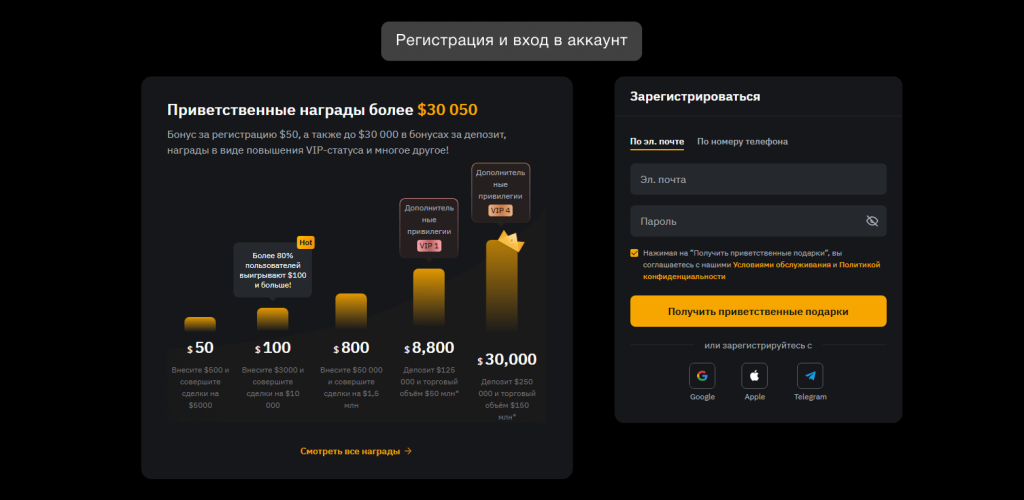
Step 1. Register and log in to your account
It all starts in the standard way:
-
go to the registration page;
-
Please provide your email or phone number.
In practice, the post office is more reliable - the number can be changed or lost, and no one knows how the rules will change in the future; -
Create a password between 8 and 30 characters long, with uppercase and lowercase letters and numbers;
-
confirm your agreement with the rules;
-
Please complete a simple captcha.
Nothing unusual, the whole process takes a couple of minutes.
Step 2. Proceed to verification (KYC)
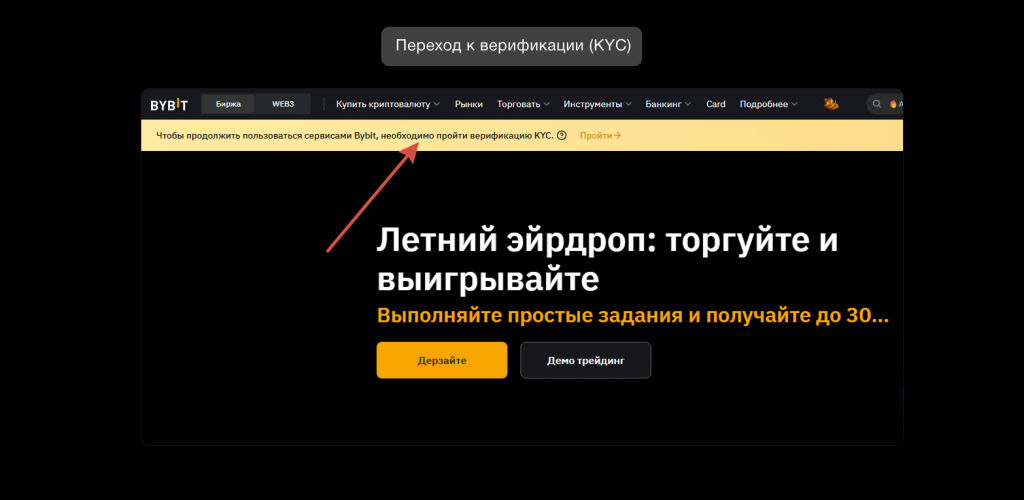
After logging in, the exchange will almost immediately remind you to verify your identity. The notification usually appears at the top of the screen—you can click it. If you missed it, the path is as follows: avatar → "Account" → verification section.
It's important to understand in advance which documents are acceptable. Bybit only accepts documents issued in the country of residence. These are most commonly:
-
passport;
-
identity card;
-
resident card;
-
driver license.
Visas (tourist, work, student) and passports of foreign countries are not accepted - at this stage, many people waste time.
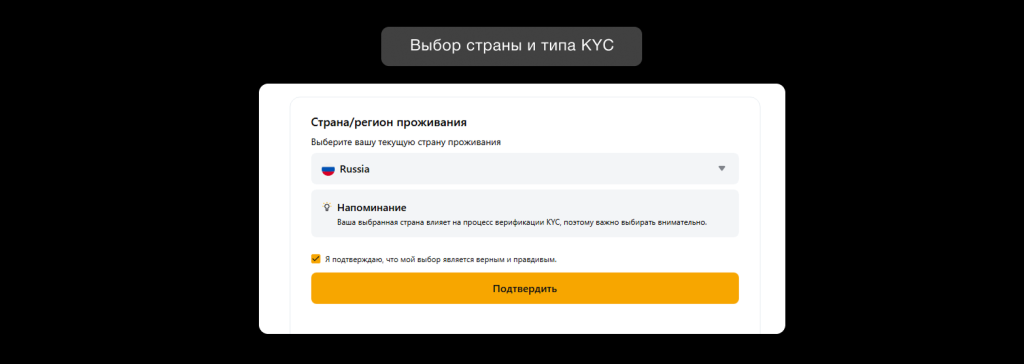
Step 3: Selecting a Country and KYC Level
Next, you'll need to select your country of residence and the verification type. Enter the information carefully and avoid "approximately" errors—any discrepancies will result in a resubmission.
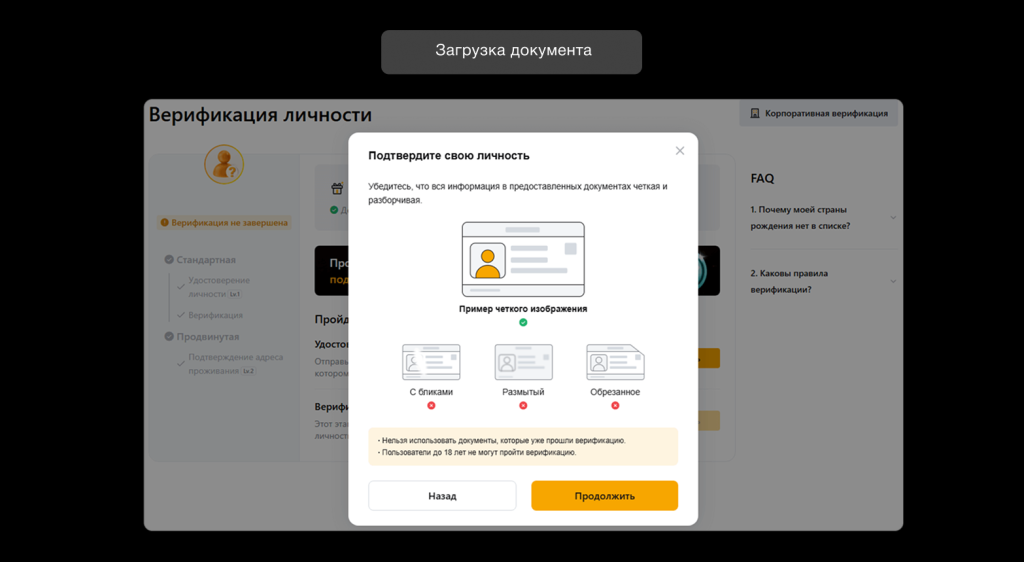
Step 4. Uploading the document
Select the document type and upload your photos. Pay attention to the quality: blurry photos, cropped edges, or poor lighting are common causes of delays. It's better to retake them immediately than to wait for a rejection.
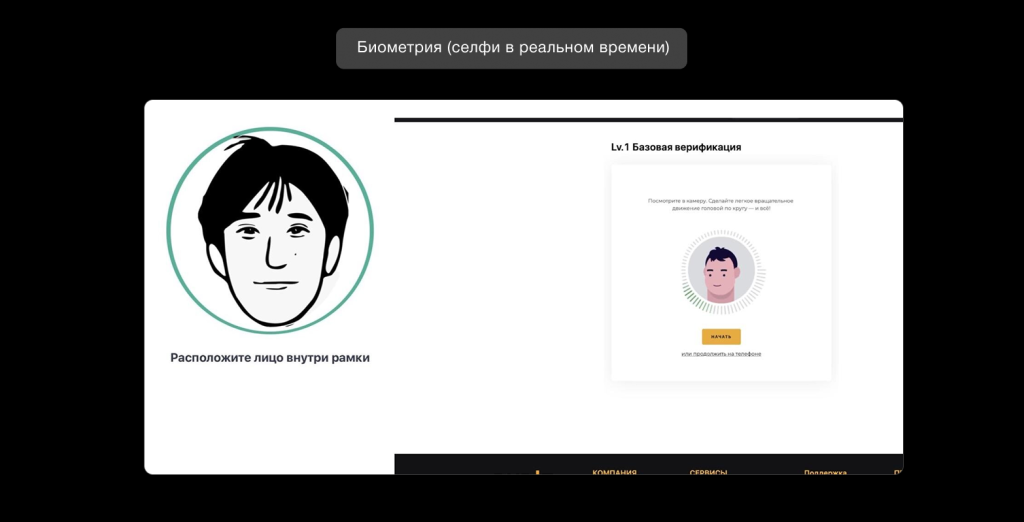
Step 5. Biometrics (real-time selfie)
At this stage, you need to verify your face via camera. No filters, masks, or "enhancements."
The working formula is simple:
-
neutral background;
-
normal light;
-
VPN turned off.
That's enough. Extended verification also asks for confirmation of your residential address.
Step 6. Waiting for confirmation
In most cases, a response arrives quickly—within 10–15 minutes. However, sometimes the verification process can take up to a day or two, especially during peak periods.
If there is no answer:
-
check your account status;
-
check your email (including spam);
-
If necessary, write to support - they will tell you whether to wait further or what to fix.
In case of refusal, the reason is usually stated directly in the notification.
Step 7. Go to the P2P section
After successful verification, open the "Buy Cryptocurrency" section and select P2P. The names of the options may vary slightly, but the logic is always the same.
Step 8. Select USDT and trade parameters
In the list of currencies, select USDT, then:
-
fiat (RUB);
-
payment method (card, SBP, transfer);
-
amount range;
-
if desired - time limit and ad type.
Filters save a lot of time and help you immediately filter out unsuitable offers.
Step 9. Selecting a seller
A list of sellers will appear. Don't hesitate to open their profile:
-
see rating;
-
number of completed transactions;
-
reviews.
It's better to overpay a couple of tenths of a percent than to deal with a dubious account.
Step 10. Transfer rubles and complete the transaction
-
select an ad and indicate the required amount;
-
Please read the terms and conditions carefully;
-
transfer rubles using the specified details or via the order chat;
-
confirm payment;
-
After confirmation from the seller, USDT will automatically be transferred to your internal wallet.
This completes the purchase.
What to do next with USDT
USDT is a stablecoin pegged to the dollar. Simply put, 100 USDT is equivalent to 100 dollars. Within the exchange, you can exchange it for BTC, ETH, and other coins via spot trading.
If you're buying for the long term, it's best to withdraw your funds ( read about withdrawing cryptocurrency ) to a cold wallet. If you're buying for trading, keep only the amount you actually use on the exchange.
Basic safety rules
-
If the rate differs from the market by more than 2%, this is a reason to be wary;
-
It is better to split large amounts into several transactions;
-
take your time and always reread the order terms;
-
After P2P purchasing, use spot rather than third-party exchanges.
Interfaces may vary slightly between exchanges, but the underlying logic of a P2P transaction is almost identical. Once you've figured it out, everything else is automatic and stress-free.
Purchasing through exchangers
Exchangers are a simple "log in, pay, and receive" option. They don't have any unnecessary interfaces, charts, or jargon. In practice, they're well-suited for one-time purchases of up to 100,000 rubles. If you plan to buy cryptocurrency regularly or in larger amounts, it's almost always more profitable to use an exchange—they offer lower fees and more options.
To avoid manually browsing websites, people often use exchange rate aggregators. The most well-known is BestChange. It compares offers from hundreds of exchange services and shows you the best rate right now.
Importantly, the aggregator isn't just about price. It also filters out downright questionable services. To be listed on BestChange, an exchanger must meet a number of requirements:
-
work for at least six months (young projects are only allowed upon recommendation or guarantee);
-
have a reserve of at least $10,000;
-
show the exchange terms in advance and transparently;
-
Provide Russian-language support with clear response times.
Steps to purchase through a crypto exchange
The algorithm is extremely simple:
-
On BestChange, select the direction RUB → the desired cryptocurrency.
-
Go to the exchanger's website.
-
Pay for the transfer using the details provided.
-
Specify the wallet address.
-
You receive coins - usually within 5-30 minutes.
This is the main advantage of exchangers: speed and minimal formalities. But there's also a downside: the rate is almost always higher than the exchange rate, and there are no other tools available other than regular exchange.
Safety rules that actually work:
-
For large amounts, make a test exchange first;
-
save screenshots and receipts;
-
Check the website domain carefully - clones are encountered regularly.
Another caveat: the availability of aggregators in Russia can fluctuate. Sometimes services are unavailable due to regulators' decisions, and you simply need to be prepared for this.
Buying cryptocurrency with cash
Purchasing cryptocurrency with cash is done through in-person meetings, OTC brokers, or crypto ATMs. There are currently approximately 27-30 crypto ATMs operating in Russia, and their number is not expected to increase significantly (the main advantage of this method is anonymity, while the disadvantage is increased risk and low liquidity).
If you decide to use this option, the safety rules are as follows:
-
meet only in public places with cameras;
-
Check the transaction immediately through the blockchain explorer;
-
divide large sums into parts;
-
Work only with trusted OTC offices, not with "friends of friends."
This method is rarely chosen by beginners - and frankly, for good reason.
This method is not recommended due to security concerns and weak legal protections from legal regulators.
A review article about reliable crypto exchangers in Moscow City .
Buying cryptocurrency through a bank (bank cards)
Let's note right away: Russian banks don't sell cryptocurrency directly. Not now, nor in the foreseeable future. However, bank cards are actively used as a payment instrument for P2P transactions.
The most commonly used are Sber and T-Bank (formerly Tinkoff).
Sberbank makes it convenient to work through the SBP - on P2P platforms (for example, Bybit), you can choose to pay via the SBP or transfer to a card.
With T-Bank, things are even simpler: transfers within the bank take 20–30 seconds, which is convenient for transactions with limited time.
There are also limitations:
-
banks closely monitor transfers;
-
you shouldn’t do dozens of similar operations a day;
-
For corporate accounts, it is advisable to have a justification for payments in advance.
This is not a ban, but rather a question of accuracy.
Purchasing via Telegram bots
TG bots are the most controversial option. They can be technically convenient: some aggregate exchanges, while others act as a front for P2P. But this is where scams most often occur.
If you use bots (please be careful):
-
Check the link to the bot on the service's official website;
-
Do not transfer money via private messages without escrow;
-
start with small amounts, even if everything looks “safe”.
Telegram is a convenient tool, but it's not a default place for trust. This approach is more for experienced users who understand the risks and how to manage them.
Safe Cryptocurrency Purchasing Guidelines in Russia
Theory aside, cryptocurrency security isn't about "complex schemes" but rather a set of everyday habits. Almost all user problems arise not from technology, but from haste, inattention, and the desire to save a few percent.
Always check your counterparty
On P2P platforms, this can be done in literally a minute. A good benchmark is a seller rating of 95% and at least 1,000 completed transactions. If the account is new, there are few reviews, or the terms seem "too favorable," it's better to scroll further. The market is liquid, and good deals are always available.
Work only with proven platforms
Services like Bybit and BestChange have been around for a long time and have weathered numerous ups and downs—blocks, increased traffic, and rule changes. This isn't a guarantee of perfection, but it greatly reduces the likelihood of running into outright fraud.
Large sums - always in parts
If the amount is over 500,000 rubles, it's wise to split the purchase into 3-5 separate transactions. This simply reduces risk: even if something goes wrong, you don't lose everything at once. Plus, it's easier to pass bank security without attracting unnecessary attention.
Keep an eye on fees, not just the rate
Online exchangers typically charge 1-3%, while offline exchanges charge up to 10%. Often, the "favorable rate" is actually eaten up by hidden fees. Before making a transaction, it's a good idea to compare prices from at least three or four sources—the differences can sometimes be unpleasantly surprising.
With Telegram - no trust
Yes, bots can be convenient, but they're the most toxic environment for scams. Use only bots with a live audience of at least 10,000 users, verify links on official websites, and never transfer money to strangers via private messages without a guarantor.
Storing cryptocurrency
If you're buying cryptocurrency not for a quick transaction but for a "storage" purpose, it's best to immediately transfer it to a non-custodial wallet. Hardware devices like Ledger or Trezor remain the most reliable option for long-term storage. Exchanges are convenient, but not a place for savings.
Conclusions
In 2025, Russians still have several viable ways to buy cryptocurrency for rubles—without exotic or shady schemes.
-
Exchanges are the optimal choice for approximately 80% of users. They offer minimal fees, trade protection, high liquidity, and additional tools like spot, futures, and Earn products.
-
Online exchangers are a fast and easy option, but almost always more expensive. They're suitable for amounts up to 100,000 rubles if speed is important and a 1-3% overpayment isn't a concern.
-
Cash transactions are a niche format for those who value anonymity and are willing to pay a 5-10% commission, understanding all the risks.
-
Telegram bots are an option for small amounts and only with extreme caution.
A note on the legality of purchasing cryptocurrency in Russia in 2026
In Russia, the purchase of cryptocurrency is not prohibited, but it is strictly regulated. The fundamental document here is Federal Law No. 259-FZ "On Digital Financial Assets, Digital Currency, and Amendments to Certain Legislative Acts of the Russian Federation," which has been in effect since 2021. It expressly permits the ownership and purchase of digital currency, but prohibits its use as a means of payment for goods and services within the country.
In practice, legal (official) methods of purchasing cryptocurrency for rubles are those in which payments are made in fiat currency, and the cryptocurrency itself is an object of ownership, not payment.
It's important to consider the requirements of Federal Law No. 115-FZ "On Combating Income Laundering": banks and platforms have the right to request clarification on transactions, especially for large amounts. Also, income from cryptocurrency transactions is subject to taxation—profits must be declared and subject to income tax.
Purchasing and storing cryptocurrency in Russia is legal if used as an investment asset and in compliance with financial and tax laws.
Recommended option for buying and selling
If you're looking for the most balanced scenario without unnecessary compromises, P2P purchasing on Bybit remains the most rational option. Escrow, high liquidity, and no transaction fees make this method convenient for both beginners and experienced users.