



In the previous article, it was explained in detail what the Tether (USDT) stablecoin is, which blockchain networks (what is blockchain?) it operates on, and how it differs from other cryptocurrencies. For users who are already familiar with the basic principles of this asset, the next practical question is how to purchase it with rubles.
Demand for the digital dollar in Russia remains consistently high. The stablecoin is used as a digital equivalent of the dollar for storing funds, making international transfers, and settling accounts with foreign partners. In addition, USDT often serves as a base asset for trading on crypto exchanges and for working with decentralized finance services.
At the same time, purchase conditions can vary significantly depending on the platform chosen. The final cost is influenced by the exchange rate, the service fee, and the specifics of the transfer network. In some cases, expenses are limited to fractions of a percent; in others, the total costs may reach several percent of the transaction amount. Understanding the purchase mechanisms and the fee structure makes it possible to reduce these expenses noticeably.
Why digital assets are bought: main scenarios
Before moving on to the overview of platforms, it is important to understand for what purposes private investors and companies buy USDT. This helps to immediately choose the right purchase method and the appropriate transfer network.
- Capital preservation. During periods of ruble weakening, part of savings is converted into stablecoins. USDT allows value to be fixed relative to the dollar while remaining in the digital environment.
- Cross-border transfers. Sending Tether abroad is often faster and cheaper than making a traditional bank transfer. The recipient can then exchange the tokens for local currency through local P2P platforms or exchanges.
- Trading on crypto exchanges. USDT is the main base currency on most trading platforms. By holding this asset, a trader can quickly switch between different cryptocurrencies without having to return to fiat.
- Working with decentralized finance (DeFi). Many lending protocols, staking products, and yield strategies use Tether as a liquid settlement instrument.
What affects the cost of buying Tether
The price of purchasing USDT consists not only of the rate that the user sees on the screen. There are several layers of expenses, and each of them affects the final cost of the transaction.
- Fee for depositing rubles. It depends on the method of funding the account on the platform. P2P transfers from card to card are most often free of charge. Direct bank transfers through fiat gateways may involve a fee of around 0.5–1%. When paying directly with a bank card, an acquiring fee may sometimes also be added.
- Trading fee or margin. On exchanges, this is a fixed percentage per trade — usually around 0.1–0.2%, depending on turnover and the user’s status. On P2P platforms, the transaction fee is often absent, but the spread may be built into the rate. In exchangers, the fee is usually hidden in a less favorable rate.
- Withdrawal fee. This is an especially important point if the tokens are intended to be stored not on the exchange, but in a personal crypto wallet. The withdrawal cost depends on the network selected. The networks were already described in detail in the article about Tether. A mistake when choosing the network can lead not only to unnecessary expenses, but also to irreversible loss of funds.
- Spread and exchange rate difference. Even if the platform does not show the fee separately, it may already be included in the rate. For example, selling USDT at 86 rubles when the market rate is 85.5 rubles means a hidden overpayment. When buying 1000 USDT, such a difference turns into an additional 500 rubles in costs.
Where USDT is bought: three main methods
All options for buying digital dollars with rubles can generally be divided into three main categories. Each model has its own conditions, level of control, cost, and convenience.
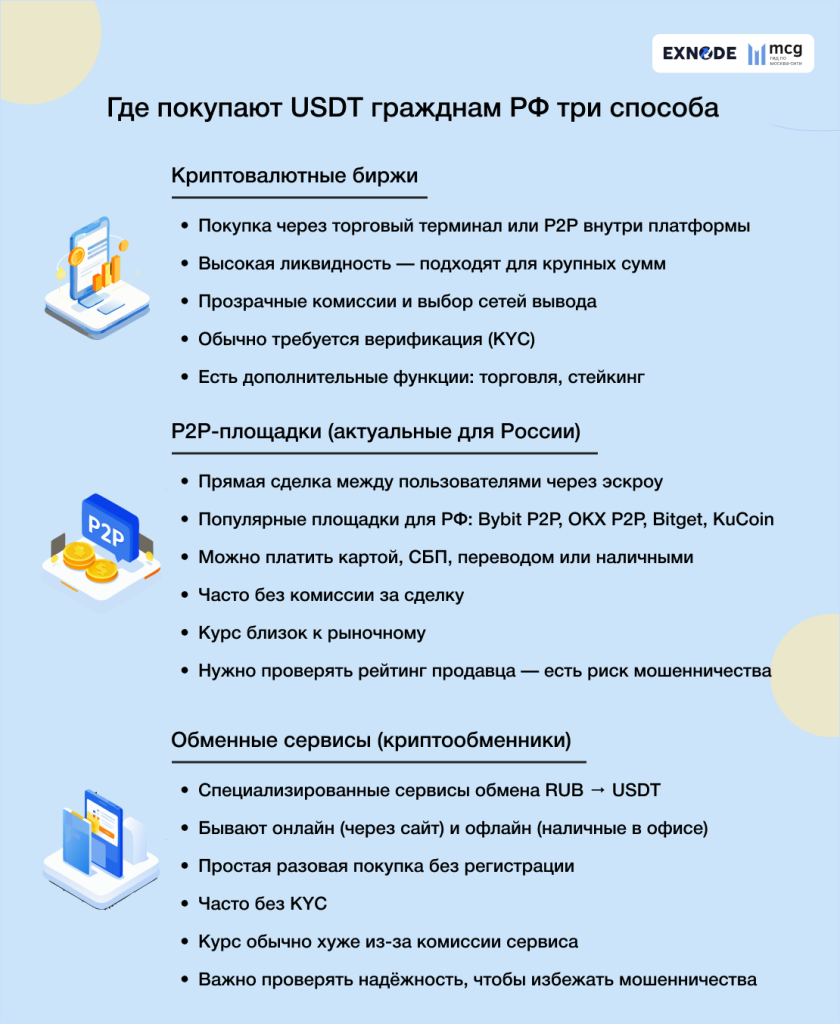
Cryptocurrency exchanges
Exchanges remain one of the most popular ways to buy USDT regularly. The user registers on the platform, completes identification, and buys tokens either through the trading terminal or through the built-in P2P section.
On the spot market, the user places an order to buy USDT for rubles at the current price or creates a limit order. After the order is executed, the tokens are credited to the main account. They can then be withdrawn to an external wallet or used for trading.
Not all exchanges directly support ruble pairs. In many cases, rubles are first deposited through the exchange’s own P2P platform or through third-party payment methods. Some platforms focused on the CIS market support direct ruble deposits.
Pros:
- high liquidity — large amounts can be purchased without a strong deviation in the rate
- transparent fees — the conditions are usually known in advance
- a wide choice of withdrawal networks
- additional opportunities: trading, staking, lending
Cons:
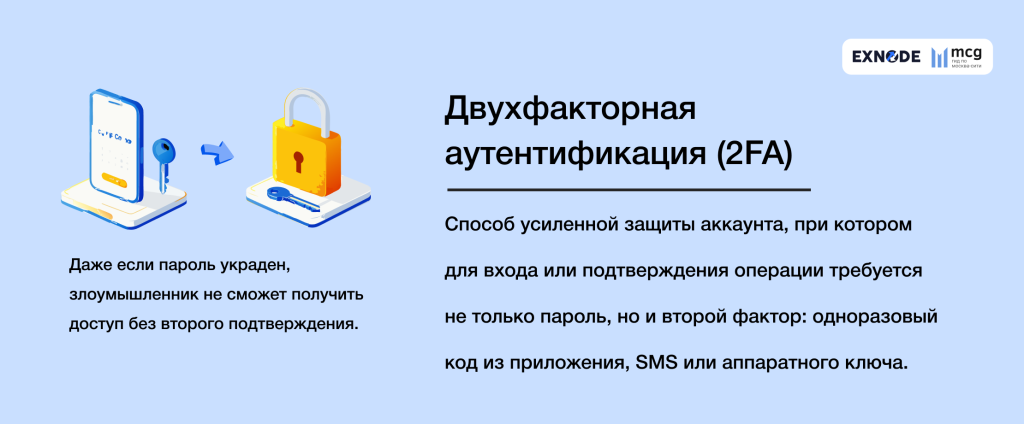
- identity verification (KYC) is most often required
- beginners may find the interface difficult to understand
- there are risks related to the platform itself: hacks, account freezes, sanctions restrictions
P2P platforms
P2P (peer-to-peer) is a format of direct trading between users. The seller places an offer with the rate and available payment methods, the buyer selects a suitable offer and transfers rubles to the specified payment details, and the platform holds the seller’s assets until payment is confirmed.
The escrow mechanism works as follows: when an order is created, the required amount of USDT is locked in the seller’s account. The buyer sees that the tokens are reserved and can safely transfer the money. After payment is confirmed, the coins are automatically transferred to the buyer. If a dispute arises, the platform’s support team steps in and analyzes the transfer confirmations.
Features:
- in some cases, it is possible to work without full verification
- the rate is often closer to the market rate than in exchangers
- the speed of the transaction depends on the counterparty and the bank, usually from 1 to 15 minutes
Pros:
- there is often no fee for the transaction itself
- you can choose a convenient payment method: Faster Payments System, bank cards, account, sometimes cash
- for large volumes, some sellers are willing to discuss the rate
Cons:
- there is still a risk of fraud if you work carelessly
- you need to monitor the seller’s rating and reviews
- transfers may be delayed or declined by the bank
Such offers can usually be found in the P2P sections of major international exchanges or on specialized P2P services.
Exchange services (crypto exchangers)
Exchangers are specialized websites that accept rubles and send USDT to the specified wallet address. To search for favorable conditions, monitoring services are often used, for example Exnode, where the rates of dozens of exchange services are aggregated.
The scenario usually looks like this: the user opens a monitoring service, selects the exchange direction, for example “Sberbank RUB → USDT TRC-20,” studies the list of platforms with rates, reserves, and reviews, then goes to the website of a specific exchanger and creates an order.
Features:
- registration and storage of funds on the platform are not required
- the interface is usually as simple as possible
- the rate most often already includes the service margin — from 1% to 3% and higher
Pros:
- simplicity — suitable for one-time transactions
- KYC is often not required
- a wide choice of payment methods is available, sometimes including cash
Cons:
- the rate is usually less favorable than on exchanges and P2P
- there is a high risk of phishing and clone websites
- for large amounts, the exchanger may not have enough reserve
- if problems arise with the service, getting the money back is much more difficult
When working with exchangers, it is important always to check the website address, study fresh reviews, and not follow advertising links or links in emails.
Additional purchase methods
In addition to the three main models, there are also less common options that are sometimes used in specific situations.
- Crypto ATMs. In some large cities, terminals are installed for buying cryptocurrency with cash. The user inserts banknotes, scans the wallet QR code, and receives tokens. The format is convenient, but the fee can reach 5–7%, and the limits are usually restricted.
- Telegram bots. There are services that allow exchanging rubles for USDT directly in the messenger. This is convenient for small amounts, but only projects with a good reputation and a long operating history should be trusted. The risk of fraud is noticeably higher here.
- Personal meetings. Offline exchange with a trusted counterparty is more often used for large amounts, when confidentiality and personal control of the transaction are important. This format requires increased caution.
Comparison of fees and conditions
For clarity, the differences between purchase methods can conveniently be summarized in a table. The example uses an amount of 50,000 rubles and an indicative USDT rate of 85 rubles, that is, about 588 USDT.
| Method | Approximate transaction fee | Approximate withdrawal fee (TRC-20) | Verification | Transaction time | Risks |
|---|---|---|---|---|---|
| Exchange (spot) | 0.1% (about 50 rubles) | 1 USDT (about 85 rubles) | Required | Instantly after order execution | Technical failures, account freeze |
| P2P (through an exchange) | 0% as a separate fee, but the price is built into the offer | 1 USDT (about 85 rubles) | Often required | 5–30 minutes | Counterparty fraud, banking delays |
| Exchanger | 1–3% hidden in the rate (about 500–1500 rubles) | Depends on the exchanger | Usually not required | 5–15 minutes | Phishing, insufficient reserve, service shutdown |
| Crypto ATM | 5–7% (about 2500–3500 rubles) | Depends on the wallet and network | Usually not required | Instantly | High fee, limits |
| Telegram bot | 1–3% (about 500–1500 rubles) | Often already included in the rate | Usually not required | 1–5 minutes | High risk of fraud |
For regular purchases, from a cost perspective, it is more often advantageous to use exchanges or P2P platforms. Exchangers and crypto ATMs are more often suitable for one-time transactions, when speed, simplicity, or the absence of registration is important.
How to choose a withdrawal network and not lose funds
USDT exists on several blockchains at once. When sending tokens, you must always understand exactly which network the recipient supports. A mistake at this stage can lead to loss of funds.
Main networks
| Network | Average withdrawal fee | Speed | When to use |
|---|---|---|---|
| TRC-20 (TRON) | 0.5–1 USDT | High | For most transfers between exchanges and to hot wallets |
| BEP-20 (BSC) | 0.2–0.5 USDT | High | For DeFi services and operations in the BNB Smart Chain ecosystem |
| ERC-20 (Ethereum) | 5–20 USDT | Medium | When the recipient does not support cheaper networks |
| Solana | Less than 0.01 USDT | Very high | For fast and cheap transfers within the Solana ecosystem |
| Polygon | 0.02–0.1 USDT | High | For working in Ethereum layer-2 networks and compatible services |
This is important because sending USDT on the wrong network can lead to irreversible loss of funds. For example, if you transfer tokens in ERC-20 format to an address intended only for TRC-20, it may be impossible to recover them. Before withdrawing, you should always verify the network on both the sender’s and the recipient’s side.
For universal use, TRC-20 is most often chosen, since this network is supported by a large number of exchanges, exchangers, and wallets, while the fee usually remains moderate.
Factors that help reduce costs when buying
To buy USDT truly profitably, it is useful to follow several basic rules.
- Use P2P to enter cryptocurrency. On the P2P platforms of major exchanges, tokens are purchased directly from other users, and the platform fee for the transaction is most often absent. At the same time, the rate still needs to be compared carefully, because the seller may include their margin in the price.
- Choose TRC-20 or BEP-20 networks for withdrawal. This is one of the simplest ways to reduce costs. The fee in these networks is usually noticeably lower than in Ethereum.
- Calculate the final cost, not just the rate. Sometimes a seller offers an attractive price but works only in an expensive network. In other cases, the rate is slightly higher, but the withdrawal is almost free. What should be evaluated is the total amount: the rate plus the network fee.
- Do not store large amounts on an exchange without necessity. If the tokens were purchased not for active trading, it is reasonable to transfer them to a personal wallet in order to control access to the assets independently.
- Track the market rate through aggregators and monitoring services. This helps to understand how favorable the seller’s or exchanger’s offer really is.
Buying Tether through online crypto exchangers: how the process works
One of the common ways to buy USDT for rubles remains the use of online exchange services. Usually, such transactions are carried out through monitoring websites that collect offers from dozens of exchange points and allow rates and conditions to be compared in real time. This format is especially convenient for one-time transactions, since funds are not stored on the platform, and the exchange is carried out directly between the user and the service.
- First, a crypto wallet is prepared to which the tokens will be credited. Most often, USDT is sent on one of the popular networks, and the most common option remains TRC-20 on the TRON blockchain. To receive funds, a regular wallet address is used, which is specified when creating the order. It is important that the receiving network matches the sending network.
- Next, a specific exchange point is selected. The monitoring service shows a list of services ready to perform the exchange, as well as the rate, the amount of available reserve, reviews, and working hours. Since the exchanger’s fee is usually already built into the rate, the final price of Tether may differ from the exchange price.
- After choosing a service, the user goes to the exchanger’s website and fills out an order. It specifies the amount, the wallet address for receiving USDT, and, if necessary, contact details. The service then provides the payment details for transferring rubles — usually a bank card or another payment instrument.
- When the transfer of rubles is confirmed, the exchanger checks the receipt of funds and sends the tokens to the specified address. The processing time depends on the rules of the specific service and the speed of the bank transfer, but usually fits within a range from a few minutes to half an hour.
- After sending, the transaction is recorded on the blockchain, and its status can be checked through a public network explorer.
The crediting of USDT to the wallet usually happens quickly — from a few seconds to a few minutes, depending on the blockchain selected and its current load.
Security when buying: how not to become a victim of scammers
Cryptocurrency transactions are irreversible. An error in the address, the wrong network, or a fraudulent scheme can lead to irreversible loss of funds. Therefore, when buying USDT, it is especially important to follow basic security rules.
- Do not leave the internal chat of the P2P platform. If communication is moved to a messenger, it is harder for the service to protect the user in the event of a dispute.
- Check the recipient’s payment details before making the transfer. They must match the data specified on the platform.
- Do not agree to change the amount, the card, or the payment method after the deal has been opened. Such requests are often used in fraudulent schemes.
- Always double-check the wallet address when withdrawing, especially the first and last characters. There are malicious programs that replace the address in the clipboard.
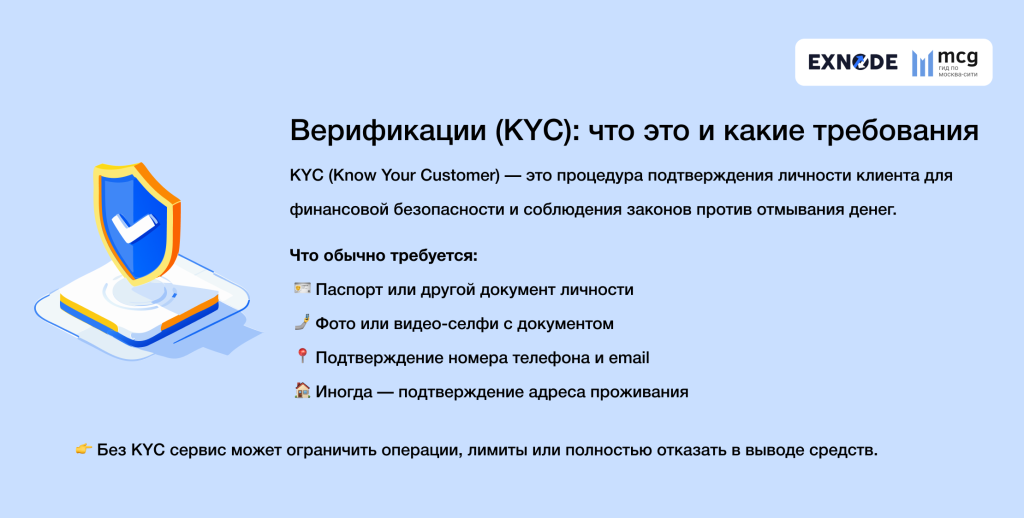
- Enable two-factor authentication (2FA) on the exchange or in the service where possible.
- Beware of phishing. It is better to enter the platform address manually rather than follow links from emails, messages, or advertisements.
- For the first transfer to a new wallet or through a new counterparty, it is useful first to make a test transaction for a small amount.
Two-factor authentication (2FA)
Legal aspects of buying USDT in Russia
The legal framework regarding cryptocurrencies in Russia continues to develop, but even now there are several important points that must be taken into account.
Is it legal to buy Tether
Yes, the purchase, sale, and ownership of cryptocurrency by individuals in Russia are not prohibited. Federal Law No. 259-FZ “On Digital Financial Assets and Digital Currency” treats cryptocurrency as property, but prohibits its use as an official means of payment for goods and services within the country.
Taxation
Income from the sale of cryptocurrency may be subject to personal income tax. In general terms, the tax is calculated on the positive difference between the sale price and the acquisition cost of the asset. Therefore, when dealing with USDT and other digital assets, it is important to keep proof of expenses and the transaction history.
Even if the user did not withdraw rubles directly to a bank, but exchanged one cryptocurrency for another, such transactions may also be considered an asset disposal. Therefore, the issue of tax accounting should not be ignored.
Risks of bank card blocking
Banks closely monitor atypical transfers between individuals. This is especially true of frequent and large P2P transactions. To reduce the risk of restrictions from the bank, it is usually recommended to:
- not conduct a large number of similar P2P transfers within a short period of time
- avoid mass incoming transfers from different persons to one card
- not indicate words related to cryptocurrency and exchange in the transfer comments
- have backup cards from different banks to distribute transactions
Sanctions restrictions
Some banks and international platforms may restrict operations for users from Russia. This applies both to the deposit and withdrawal of fiat funds and to certain methods of verification or settlement. Therefore, before buying USDT, it is always worth additionally studying the current conditions of the specific exchange, exchanger, or P2P service.
Conclusion
Buying USDT for rubles is a technically simple operation that usually comes down to choosing between an exchange, a P2P platform, and an exchanger. From a cost perspective, exchanges and P2P most often turn out to be the most advantageous, especially if the user is ready to complete basic verification and carefully compares not only the rate but also the withdrawal fee.
Understanding how different platforms work, the ability to assess sellers’ ratings, and knowledge of the features of blockchain networks make it possible to buy Tether with lower costs and a higher level of control over assets. At the same time, security remains a mandatory condition of any transaction: two-factor authentication, address verification, and caution in communication with counterparties help avoid the most common mistakes.
Tether (USDT) remains one of the most liquid and convenient instruments for entering the crypto economy. A competent approach to buying it makes it possible to use this asset for storing funds, transfers, and settlements with minimal unnecessary costs and risks.