




The Russian infrastructure for exchanging cryptocurrencies exists predominantly in the online environment. The absence of legal exchange points similar to bank branches, as well as sanctions restrictions affecting international payment systems, make digital channels the main way to access the bitcoin market.
The purchase of BTC via the internet is carried out through three types of platforms: P2P platforms operating on the model of direct deals between users, cryptocurrency exchanges with fiat deposit/withdrawal functionality, and specialized exchange services. Each of these channels has its own fee structure, user identification requirements, and transaction processing speed.
Cryptocurrency purchase transactions are associated with a number of risks. These include the possible blocking of a bank transfer on the grounds of Federal Law No. 115-FZ, the actions of fraudsters creating phishing resources or fake ads on trading platforms, as well as the volatility of the asset itself, which may change the value of the deal during the time it takes for the transaction to be confirmed on the network.
The process of exiting into fiat (ordinary government-issued money) after selling bitcoin and receiving rubles to a bank card or account has its own specifics and is discussed in detail in a separate article, “How to Cash Out Bitcoins in Russia.”
What online bitcoin exchange means
The term “online bitcoin exchange” means the transfer of a digital asset between users through a specialized platform.
The basic conversion scheme looks as follows:
User (BTC) → Platform (processing) → User (rubles or another cryptocurrency)
Regardless of the type of service — whether it is an exchange, a P2P platform, or an exchanger — the logic of the operation is the same: one party transfers bitcoins, the other party transfers the equivalent in the agreed asset. The platform records this exchange, ensuring the technical side of the settlement.
The difference between buying and selling
From the user’s point of view, operations are divided into two opposite vectors:
| Parameter | Buying BTC | Selling BTC |
|---|---|---|
| Initial asset | Rubles (RUB) or stablecoins (USDT) | Bitcoin (BTC) |
| Final asset | Bitcoin (BTC) | Rubles (RUB) or stablecoins (USDT) |
| Purpose of the transaction | Entering a position, accumulation, transferring funds into the crypto environment | Profit-taking, exiting into fiat for everyday expenses |
| Counterparty | Bitcoin seller | Bitcoin buyer |
Although technically both processes are exchanges, for the user these are different scenarios. When buying, the speed of crediting BTC to the wallet and the reliability of the source are critically important (so as not to receive blocked or “tainted” coins). When selling, the speed of ruble crediting to the card and the withdrawal fee come to the forefront.
How bitcoin is purchased through the internet
The process of acquiring cryptocurrency through online services, regardless of the chosen type of platform (P2P platform, crypto exchange, or exchanger), follows a single logical scheme that includes several последовательных stages.
Choosing a service and currency pair
The user determines the platform through which the operation will be carried out. The selection criteria are: availability of the required exchange direction (RUB → BTC), current rate, liquidity volume, available payment methods, and identification requirements. At this stage, the reputation of the service is also assessed — through independent monitoring services (for exchangers) or transaction statistics (for P2P platforms).
Specifying the amount and locking in the rate
After choosing the platform, the user specifies the amount they plan to spend (in rubles) or the quantity of bitcoins being purchased. The service displays the final amount to be received, taking into account fees and spread. On P2P platforms, the rate is fixed at the moment the seller’s ad is accepted; on exchanges — at the moment a limit order is placed or a market order is executed; in exchangers — for a limited time (usually 15–30 minutes).
Transferring funds to the platform or counterparty
The transfer method depends on the type of service:
- P2P platforms: the buyer transfers rubles directly to the seller using the details specified by the seller (card, Faster Payments System, electronic wallet) within the framework of an open deal. At this time, bitcoin is locked in the platform’s escrow account.
- Crypto exchanges: the user tops up their ruble balance on the exchange (through a built-in P2P service or direct bank transfer, if supported), after which they place a buy order.
- Exchangers: the user sends rubles to the bank details of the exchange service according to the instructions on the website.
Transaction confirmation and receiving BTC
After the rubles are credited, the seller (on P2P) or the platform itself (on the exchange/exchanger) confirms receipt of the payment. For P2P deals, the buyer clicks the “Confirmed” button only after the money has actually been received by the seller. Then the bitcoin is transferred to the address specified by the buyer. The time of receipt depends on the load of the Bitcoin network and the rules of the service (the number of required confirmations). On exchanges, the purchased BTC is credited immediately to the user’s spot balance.
Important: to receive and store the purchased bitcoin, a cryptocurrency wallet is required. The process of creating a wallet, choosing its type (custodial/non-custodial, hot/cold), and ensuring security is described in detail in a separate article, “How to Create a Bitcoin Wallet in Russia.”
Where bitcoin can be exchanged online
The infrastructure for online bitcoin exchange in Russia is represented by several types of services that differ in their operating model, the degree of intermediary involvement, and the level of control over the transaction. The choice of a specific channel depends on the required speed, amount, and the user’s willingness to go through identification procedures.
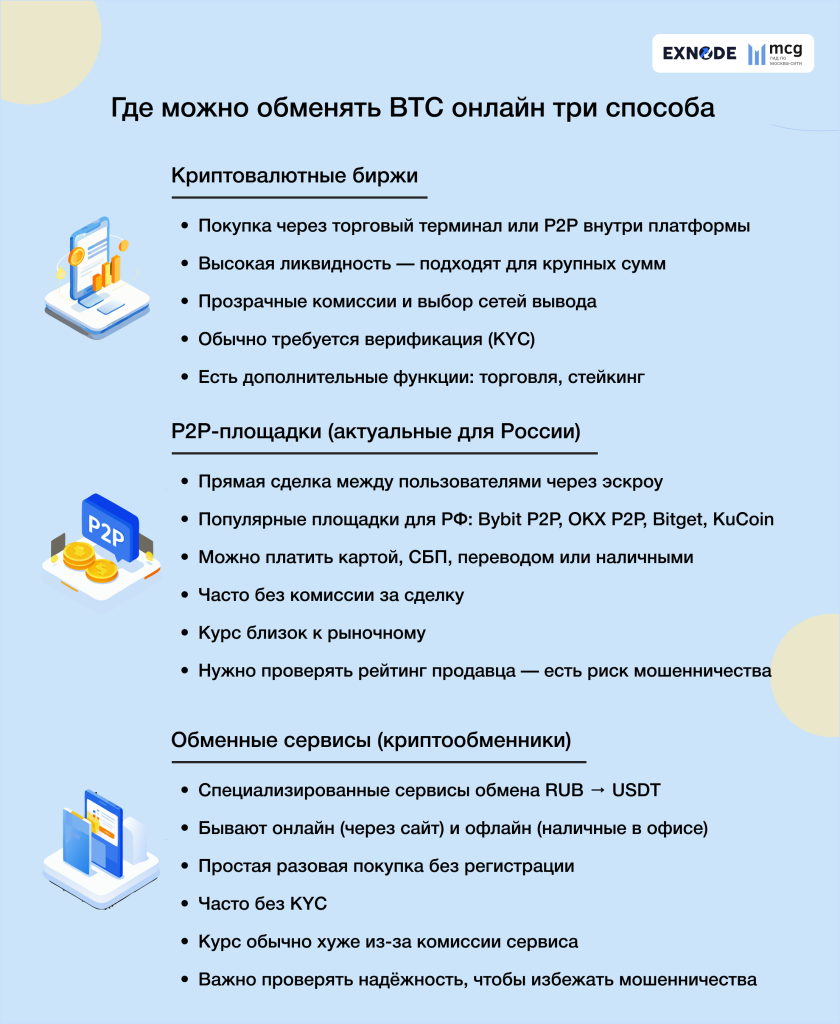
Online crypto exchangers
Specialized websites (online crypto exchangers or a monitoring service) offering automated or semi-automated conversion of cryptocurrencies into rubles and back. The service acts as the sole counterparty in the deal, setting a fixed exchange rate.
- Features: high transaction speed (from 5 to 30 minutes), fixed rate at the moment the request is created, minimal verification requirements for small amounts.
- Limitations: the rate includes the service’s margin (spread), which can amount to 1–5% of the market value; identity verification may be required for large amounts.
P2P platforms
Platforms providing infrastructure for direct deals between users (P2P). The service does not participate in settlements, but acts as a guarantor of security through an escrow mechanism (locking the cryptocurrency for the duration of the deal).
- Features: a wide choice of payment methods (cards of any banks, Faster Payments System, electronic wallets), a rate as close as possible to the exchange rate, the ability to choose a counterparty by rating and transaction history.
- Limitations: the speed of the transaction depends on the counterparty’s response time, and the seller’s reliability must be assessed.
Cryptocurrency exchanges
Cryptocurrency exchanges that provide access to the cryptocurrency market through an order book with limit and market orders.
- Features: high liquidity, minimal trading fees (usually 0.1–0.2%), the ability to work with various trading pairs (BTC/USDT, BTC/RUB).
- Limitations: mandatory KYC (identity verification) for withdrawals, difficulties with direct ruble deposit/withdrawal due to sanctions restrictions, risks associated with the blocking of assets on the platform.
Online aggregator services (exchange monitoring services)
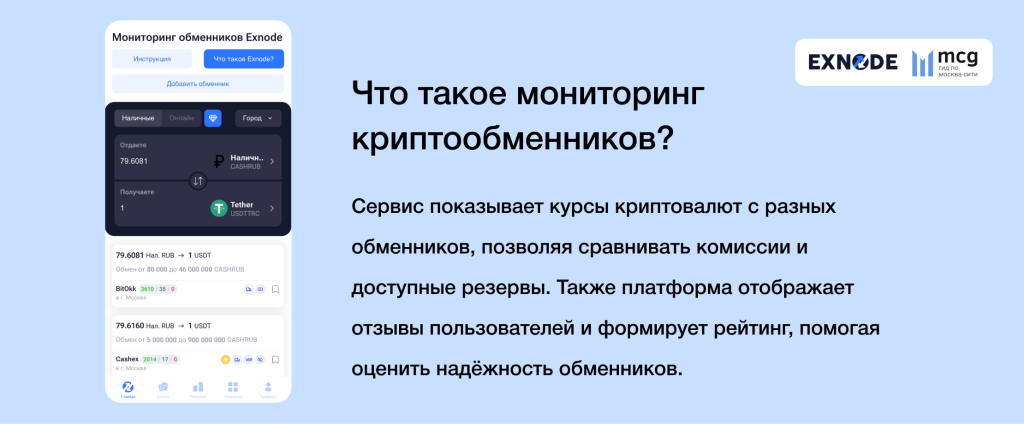
Monitoring platforms that do not carry out exchanges themselves, but collect and compare current rates of various exchange services in real time.
- Features: the ability to quickly compare rates and choose the most profitable offer, the presence of a rating and review system for each exchanger, information about reserves of a specific currency.
- Limitations: the final transaction always takes place on a third-party resource, and the aggregator is not responsible for the actions of the exchange service.
Comparative characteristics of exchange methods
| Type of service | Operating model | Rate | Speed | Verification |
|---|---|---|---|---|
| Online exchanger | Service as counterparty | Fixed, with a 1–5% margin | High (5–30 min) | Minimal or absent |
| P2P platform | Direct deal between users | Market or close to it | Medium (depends on the counterparty) | Not required for the buyer |
| Crypto exchange | Trading platform | Exchange-based (market/limit) | High (instant) | Mandatory (KYC) |
| Exchange monitoring | Offer aggregator | Comparison of exchanger rates | Redirects to the exchanger’s website | Not required |
Safety when exchanging bitcoin online
Cryptocurrency transactions are irreversible. An erroneous transfer or interaction with a fraudulent service leads to a loss of funds without the possibility of recovery through a bank or other institutions. Risks in online exchange are associated with three main factors: the actions of attackers (phishing sites, fake ads), technical errors (incorrect address, choosing the wrong network), and the compromise of account credentials.
A set of practices has developed in the market that makes it possible to minimize these risks. Compliance with them does not guarantee absolute protection, but it reduces the probability of loss of funds to the level of a statistical error.
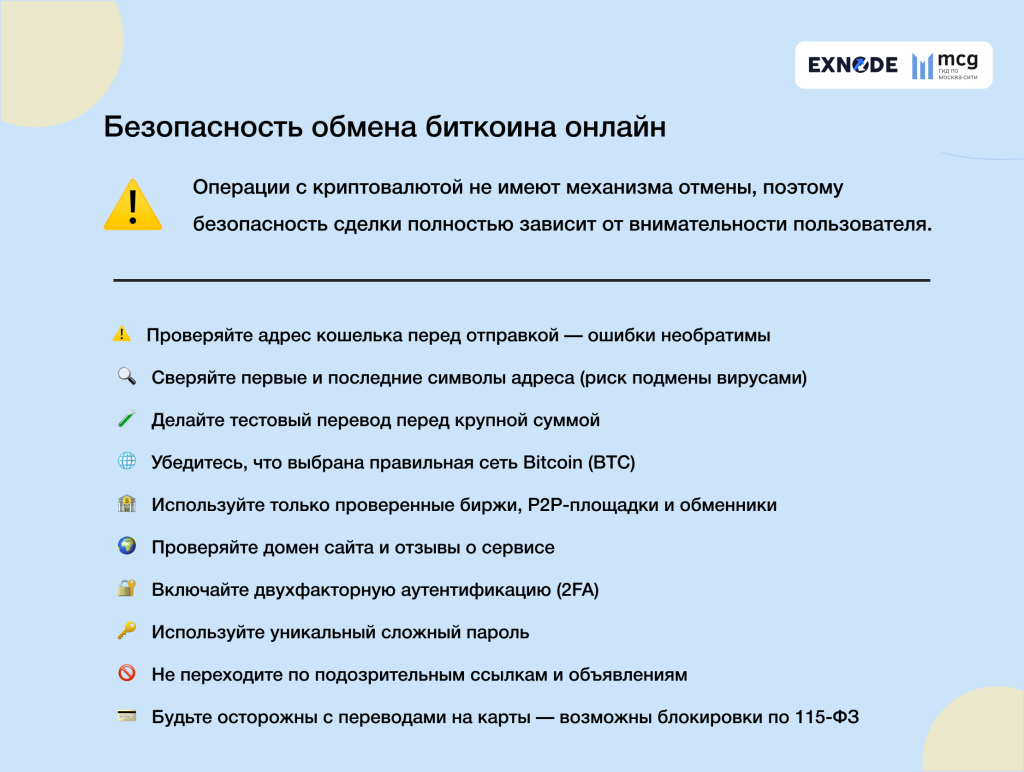
Checking the wallet address
A bitcoin wallet address is a long string of letters and numbers. An error in even one character leads to the sending of funds to a non-existent or someone else’s wallet. A transaction on the Bitcoin network is irreversible.
When copying an address from the clipboard, there is a risk of it being replaced by malicious software (clipper viruses). The program monitors the clipboard and, when it detects a crypto wallet address, replaces it with the fraudster’s address.
Before sending funds, it is necessary to compare the first and last 4–6 characters of the address displayed in the input field with the address that was copied. When transferring large amounts, it is recommended to verify the address by phone with the recipient or use QR code verification, if possible.
Test transaction
When working with a new service (exchanger, P2P seller) or when transferring to a new wallet address, it is advisable to first send a small amount — the equivalent of 100–500 rubles. A test transaction makes it possible to:
- confirm the correctness of the entered address;
- check the speed of the service and its readiness to fulfill its obligations;
- make sure that the network was chosen correctly (BTC transfer is possible only on the Bitcoin network; sending to an address on the Ethereum or BSC network will lead to loss of funds).
Only after the successful receipt of the test amount and confirmation from the service can the main payment be made.
Checking the reputation of the service
Choosing a platform for exchange requires a preliminary assessment of its reliability. The verification tools differ depending on the type of service.
- For exchangers: use of independent monitoring services (Exnode, BestChange). These aggregators collect data on rates, reserves, and, more importantly, reviews from real users. The presence of a service in a monitoring service with a long history and positive statistics is a significant indicator of reliability.
- For P2P platforms: analysis of the seller’s profile. Number of completed deals (preferably 100 or more), percentage of successful transactions (close to 100%), registration date on the platform, text reviews from other buyers.
- For exchanges: use only official domains, check information about the platform’s status in industry media and news aggregators.
Account protection
If the exchange service involves creating a personal account (relevant for exchanges and some exchangers with cumulative discounts), it is necessary to use:
- a unique complex password not used on other websites;
- two-factor authentication (2FA) through an authenticator app (Google Authenticator, Authy), not via SMS, which may be intercepted;
- backup recovery codes issued when setting up 2FA (stored separately from passwords).
Risks associated with bank transfers
When transferring rubles to an individual’s card (on P2P platforms or when paying an exchanger), there is a probability of a bank transfer being blocked on the grounds of Federal Law No. 115-FZ. The bank may regard the transaction as suspicious if:
- the transfer is made to the card of a person whose account is used for mass cash-outs;
- the nature of the transactions on the recipient’s card does not correspond to their usual financial activity.
The probability of blocking can be reduced by using separate bank cards for cryptocurrency transactions, as well as by analyzing the rating and history of the counterparty on the P2P platform. The presence of a large number of successful deals with the seller indirectly indicates that their bank details do not raise concerns on the part of credit institutions.
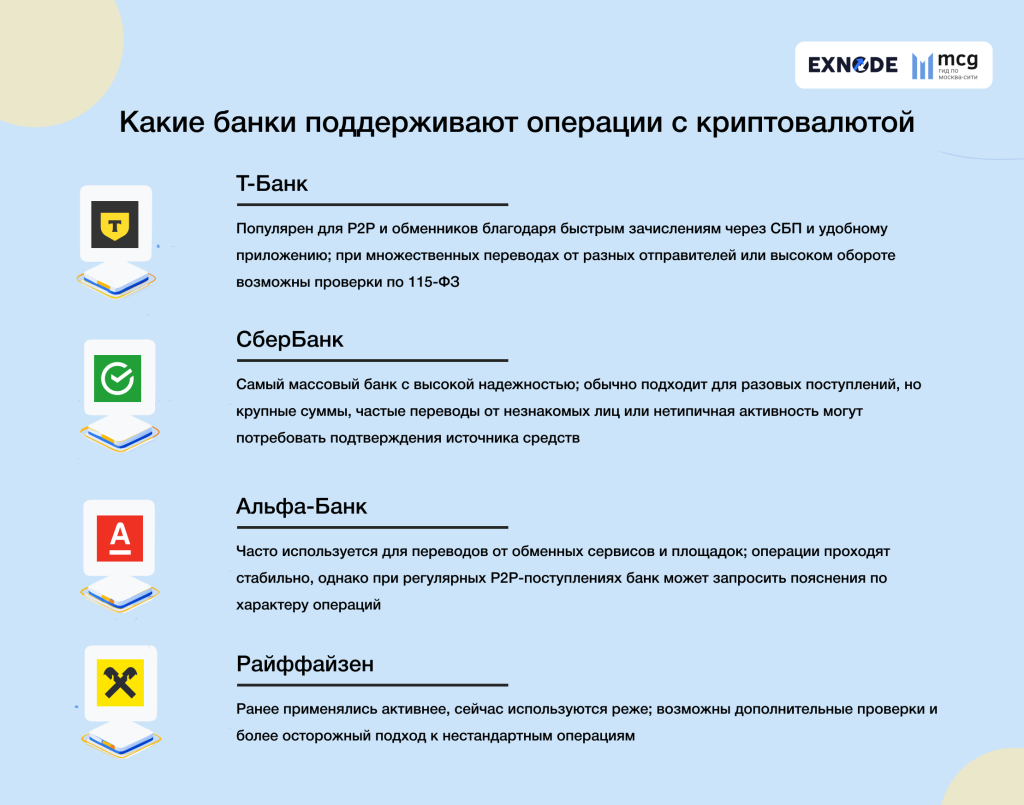
The most common banks used for cryptocurrency exchange in the Russian Federation and their features:
How to choose a service for bitcoin exchange: expanded criteria
In addition to the basic parameters — rate, fees, and limits — experienced market participants evaluate services by a number of additional characteristics. These criteria make it possible to predict the behavior of the platform in non-standard situations: during a failure, during a sharp market movement, or when attempting to conduct a large transaction.
Direction liquidity
Liquidity shows whether the service is able to fulfill the user’s request at the current rate without delays and without a shortage of funds.
- For exchangers: checked through monitoring services. If the “Reserve” column indicates 0.5 BTC and the user wants to buy 1 BTC, the deal will not take place or will be split into parts with an unpredictable rate.
- For P2P platforms: the availability of a sufficient number of active sellers with the required limit. If for the selected amount (for example, 500,000 rubles) there is only one ad, there is a risk of being left without a deal if the counterparty refuses.
- For exchanges: assessed through order book depth. The larger the volume of limit orders near the market price, the lower the slippage (the difference between the expected and actual execution price). For buying large amounts, this parameter is critical.
Transparency of rate formation and hidden costs
Non-transparent services may include additional charges in the rate without directly announcing them.
- The presence of an “internal rate”: some exchangers show an attractive rate on the main page, but when moving to payment the spread increases due to an “urgency fee” or “request processing” fee.
- Withdrawal cost: on exchanges, a low trading fee may be combined with an inflated BTC withdrawal fee. Before purchasing, it is advisable to check what fee is set specifically for bitcoin withdrawal (not USDT, not ETH), since it may be fixed and significant (especially during periods of high network load).
- Double conversion: on some platforms, the direct BTC/RUB pair is absent. Buying through an intermediate USDT adds an additional spread and fees.
Legal and technical stability of the service
Parameters that become important when working with medium and large amounts.
- Jurisdiction and sanctions risks: exchanges registered in unfriendly countries may impose restrictions on Russian users (account blocking, refusal of withdrawal). Before choosing a platform, it is advisable to check its policy toward citizens of the Russian Federation (usually published in the blog or news section).
- Availability of offline contacts: for exchangers and P2P platforms working with large amounts, a sign of reliability is the presence of a physical office, a legal entity, or at least a verified phone number with feedback.
- Technical protection: use of HSM modules (hardware key storage), the presence of a reward for found bugs (bug bounty), history of hacks, and speed of reimbursement of funds. This information is available in specialized media and platform reports.
Quality and availability of customer support
The speed and competence of support are indicators of the maturity of the service. Problems during exchange (a stuck transaction, technical failure) occur regularly, and the safety of funds depends on how quickly they are resolved.
- Communication channels: availability of several channels (website chat, Telegram, email).
- Response time: checked through reviews. If support responds in hours or days, funds may be lost in the event of an urgent problem (for example, an error in payment details).
- Dispute resolution (for P2P): availability of arbitration and a clear escalation procedure for conflicts. It is important that arbitrators make decisions not automatically, but based on the evidence provided (screenshots, receipts).
Supported networks and addresses
Bitcoin exists only on the Bitcoin network (the main blockchain, often referred to as BTC or Bitcoin Core). However, on some platforms it is possible to mistakenly choose another network (BEP-20, ERC-20) when withdrawing, which will lead to loss of funds.
- Important: the service must clearly indicate through which network BTC is being sent. If the platform offers to send bitcoin through the Ethereum network (as an ERC-20 token), this means that the user will receive not real BTC, but its wrapper (Wrapped Bitcoin), which operates on other blockchains and requires additional actions for conversion.
- For a regular purchase with withdrawal to a cold wallet, only the Bitcoin network should be selected.
Availability of automation and API
Advanced users evaluate the possibility of integration with external services.
- Trading bots and API: for exchanges, the availability of a documented API and the possibility of connecting trading bots are important (if necessary).
- Mass payouts: for businesses and partner networks — the presence of a mass payout function and the ability to automate exchanges through API keys without manual confirmation of each transaction.
Final table of expanded criteria
| Criterion | What is checked | Which services it is relevant for |
|---|---|---|
| Liquidity | Reserves in monitoring services, order book depth | Exchangers, exchanges |
| Cost transparency | Hidden fees, withdrawal cost, double conversion | All types |
| Legal stability | Jurisdiction, sanctions risks, presence of a legal entity | Exchanges, large exchangers |
| Support quality | Response time, communication channels, arbitration | All types |
| Networks and addresses | Correct indication of the Bitcoin network | All types |
| API and automation | Availability of a documented interface | Exchanges, exchangers for business |
Frequently asked questions about buying bitcoin online
Safety and risks
How can you avoid scammers when buying bitcoin?
The main risks are associated with phishing websites (copies of well-known exchangers) and dishonest counterparties on P2P platforms. For exchangers, it is recommended to use only trusted monitoring services (Exnode, BestChange) that verify services. On P2P platforms, you should choose sellers with a long history (more than 100 deals), a high percentage of successful transactions, and positive written reviews. Fraudulent ads often offer a rate significantly above the market and require moving to third-party messengers to discuss the deal.
What should you do if the transaction is stuck and the bitcoin does not arrive?
A stuck transaction is usually related to a low Bitcoin network fee or a high blockchain load. In this case:
- Check the transaction status in a blockchain explorer using the txid (transaction identifier).
- If the transaction is not confirmed for more than 6–12 hours, some wallets support an acceleration function (CPFP or RBF).
- When buying through an exchanger or exchange — contact the service’s support team, providing the txid and payment confirmation.
Why can a bank block a transfer when buying bitcoin?
Banks are guided by Federal Law No. 115-FZ “On Counteracting the Legalization of Proceeds.” A transfer may be blocked if:
- the recipient of the funds (the seller) is in the “gray” zone and their account is used for mass cash-outs;
- the transaction is unusual for the client’s normal activity (for example, a large transfer to a new counterparty).
The risk can be reduced by using a separate card for cryptocurrency transactions and carefully selecting the counterparty on the P2P platform.
Technical questions
To which address should bitcoin be transferred after purchase?
To receive bitcoin, a cryptocurrency wallet address is required. It is important to use an address specifically on the Bitcoin network (the main blockchain). Addresses on other networks are not suitable — sending to them will lead to loss of funds. Before entering the address, it is recommended to compare the characters to protect against clipboard substitution.
How long should you wait for bitcoin to arrive after payment?
The arrival time consists of:
- the time it takes for rubles to be credited to the service’s or seller’s account (from seconds to several hours depending on the payment method);
- the time it takes for the transaction to be confirmed on the Bitcoin network (usually from 10 to 60 minutes).
On average, the operation takes from 15 minutes to 2 hours.
What is a network confirmation and why do you need to wait for it?
A network confirmation is the fact that a transaction has been included in a new block of the Bitcoin blockchain. Each subsequent confirmation (a new block added after the transaction) makes reversing the operation practically impossible. Services wait for several confirmations to eliminate the risk of double spending — a situation in which the sender tries to use the same coins twice.
Financial questions
Which method of buying bitcoin is the most cost-effective in terms of fees?
The lowest fees are offered by:
- Crypto exchanges: a trading fee of 0.1–0.2% + a BTC withdrawal fee (usually fixed).
- P2P platforms: there is often no fee for the buyer, and the rate is close to the market rate.
Online exchangers are the least profitable, since their rate includes a 1–5% margin. However, for one-time small purchases, the difference in fees may be offset by speed and simplicity.
Is there a minimum amount for buying bitcoin?
The minimum amount depends on the service:
- Exchangers: from 500 to 3000 rubles.
- P2P platforms: from 500–1000 rubles (depending on sellers’ ads).
- Exchanges: the minimum order may be from 500–1000 rubles equivalent.
There is no technical minimum in bitcoin itself — you can buy any fraction of a coin (down to 0.00001 BTC and less).
Legal questions
Do you need to pay tax when buying bitcoin?
The purchase of bitcoin itself (exchange of rubles for cryptocurrency) is not a taxable event. Personal income tax (13–15%) arises only when selling bitcoin and making a profit, that is, when the sale price exceeds the purchase price. It is the income received that must be declared, not the fact of ownership.
Is buying bitcoin legal in Russia?
Yes, buying bitcoin is not prohibited by current legislation. Cryptocurrency is recognized as property (Federal Law No. 259-FZ). Citizens may freely acquire, store, and dispose of digital assets. The restriction concerns the use of cryptocurrency as a means of payment for goods and services in the territory of the Russian Federation — settlements must be made in rubles.
Purchase process
Is it possible to buy bitcoin anonymously?
The highest degree of anonymity is provided by:
- Online exchangers: many do not require registration and KYC for small amounts.
- P2P platforms: as a rule, the buyer does not undergo verification, but their bank details are known to the seller.
Crypto exchanges require mandatory identity verification (KYC) for withdrawal of funds. It is important to understand that complete anonymity in the Bitcoin blockchain is relative — all transactions are public and traceable.
What should you do with bitcoin after purchase?
Short-term strategies:
- leave it on the exchange for further trading (risk of hacking or platform blocking);
- withdraw it to your own wallet for long-term storage.
For medium and large amounts, it is recommended to withdraw bitcoin to a non-custodial wallet (hot for active use or cold for savings), where the private keys belong only to the owner.
Is it possible to buy bitcoin with a card from a foreign bank?
The possibility depends on the specific service. P2P platforms allow you to choose sellers (payment agents) working with various payment methods, including transfers to cards of foreign banks. Exchangers and exchanges may have geolocation restrictions and support only Russian payment systems. Before the transaction, it is worth уточнить the available payment methods in the service description.
Conclusion
Buying bitcoin through online services is a standard financial transaction for which a stable infrastructure has developed in Russia. The market offers several channels for entering cryptocurrency: P2P platforms with direct settlements between users, cryptocurrency exchanges with an exchange order book, and online exchangers with a fixed rate. Each of these tools has its own pricing model, execution speed, and identification requirements.
Regardless of the chosen method, the final safety of the deal is determined by the user’s actions at the stages of preparation and execution of the transaction. Checking the recipient’s address, testing a new counterparty with small amounts, using independent monitoring services to assess the service’s reputation, and controlling the correctness of the Bitcoin network selection remain the main measures reducing the risks of losing funds. Technical parameters — direction liquidity, exchange order book depth, withdrawal fees, and the platform’s policy toward Russian users — affect the final acquisition cost and the availability of assets after the deal.