




Cryptocurrency in Russia remains within a special legal regulatory framework. Formally, digital assets are not prohibited; however, their use as a means of payment within the country is restricted. Despite this, an infrastructure of services has formed around the crypto market that allows converting digital assets into rubles.
Sell bitcoins (BTC) in Russia
The question of whether it is possible to sell bitcoin in Russia and withdraw funds in rubles is directly related to the legal status of cryptocurrency. Russian legislation does not prohibit ownership of digital assets and operations with them, but it establishes certain restrictions on their use.
Status of cryptocurrency in Russia
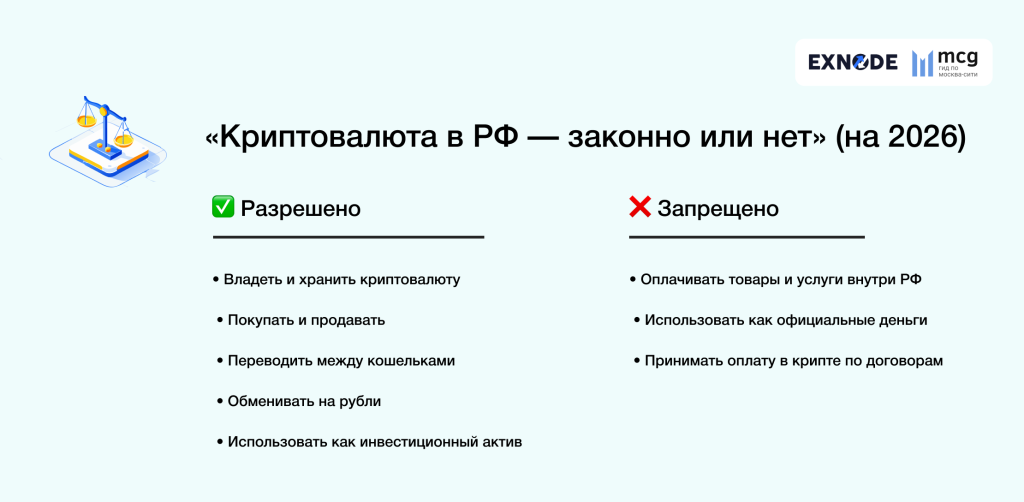
The legal regime of digital assets (including BTC) is закреплён in Federal Law No. 259-FZ “On Digital Financial Assets and Digital Currency,” which came into force in 2021. The document defines cryptocurrency as digital currency that is legally considered property.
This means that cryptocurrency can:
- belong to individuals and legal entities
- be transferred to other market participants
- be sold or exchanged for money
Why cryptocurrency is not considered a means of payment
Despite recognizing cryptocurrency as property, the law establishes an important restriction: digital currency is not a legal means of payment in Russia.
This means that:
- goods and services within the Russian Federation must be paid for in rubles
- companies and entrepreneurs cannot accept cryptocurrency directly as payment
This regulatory model allows the state to control financial settlements within the country and preserve the ruble as the only official currency.
What cryptocurrency operations are permitted
Although cryptocurrency is not used as a payment instrument, most operations with it are not prohibited. Users can legally:
- buy cryptocurrency
- store it in crypto wallets
- exchange one cryptocurrency for another
- sell digital assets for fiat money
- transfer cryptocurrency between wallets
That is why, in practice, the infrastructure of crypto exchanges, exchangers, and P2P platforms is actively used.
Is cashing out cryptocurrency legal
From a legal standpoint, cashing out cryptocurrency represents its sale followed by receiving rubles. The user transfers BTC to the other party to the transaction and receives money to a bank account, card, or in cash.
Such an operation is considered legal if it complies with basic legal requirements:
- cryptocurrency is not used to pay for goods or services within the country
- the operation is effectively a sale of a digital asset
- tax obligations are considered if profit is received
Therefore, the answer to the popular question — is it legal to cash out cryptocurrency — is positive in most cases. The law allows ownership, purchase, and sale of digital assets, which means selling bitcoin in Russia and receiving rubles is possible if the operation is structured as an exchange or sale of property through the existing crypto market infrastructure.
Main methods of cashing out bitcoins
Before considering specific services and instructions, it is important to understand the general logic of converting cryptocurrency into fiat. In practice, there are several main exchange models that differ in the level of intermediation, transaction speed, identification requirements, and risk level.
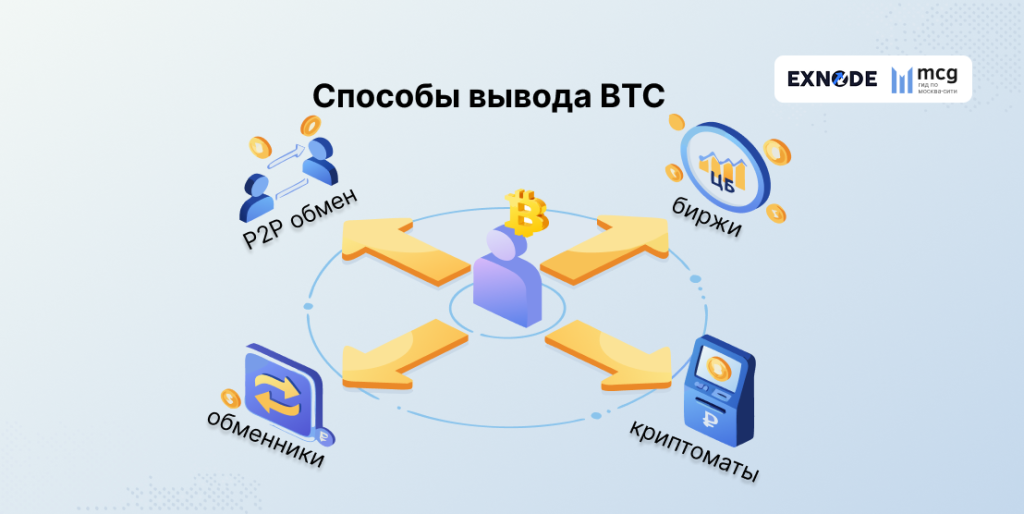
Below is a brief overview of the most common methods of cashing out bitcoins.
Crypto exchangers
This format involves a personal meeting or visiting a specialized office. The user transfers cryptocurrency to a specified address and receives cash in return. Offline exchange is used in large cities and often for large amounts.
P2P platforms
P2P services operate on a model of direct transactions between users. The platform acts as an intermediary by providing an escrow mechanism — temporary blocking of cryptocurrency until payment confirmation. The buyer transfers fiat directly to the seller, after which BTC is released.
Crypto exchanges
On centralized exchanges, a user can sell BTC for fiat via a trading pair or internal withdrawal services. After selling, funds can be withdrawn to a bank account, card, or payment systems if supported.
Crypto ATMs
A crypto ATM is a physical device similar to a bank ATM that allows buying or selling cryptocurrency for cash. Some models support selling BTC for cash, though such machines are rare and have high fees.
Direct deals
Sometimes users exchange cryptocurrency directly without platforms. Terms are agreed in advance; BTC is transferred after payment. This format requires trust and carries higher risks.
Next, we will examine the most popular methods in more detail, including features, fees, and possible limitations.
Offline crypto exchangers
Offline crypto exchangers are services with real offices where users can exchange cryptocurrency for fiat during a personal meeting. Unlike online platforms, operations are conducted through company staff: the client visits the office, transfers crypto, and receives cash or a bank transfer at a pre-agreed rate.
Such services are especially common in large cities and for large or cash transactions.
How it works
The mechanics of offline exchange resemble traditional currency exchange offices. The user agrees on terms in advance and comes to the office to complete the deal.
A typical process looks like this:
- The user submits a BTC → RUB exchange request on the website or via a manager.
- The service fixes the rate and schedules the office visit.
- The client arrives at the crypto exchanger office.
- After transaction confirmation in the blockchain, the client receives rubles in cash or by transfer.
This format allows personal control of the deal and reduces transfer errors.
How BTC → rubles exchange occurs
The procedure usually goes through several stages:
- Select BTC → RUB direction and specify the amount.
- The rate is fixed in advance.
- The user sends BTC to the exchanger address.
- After confirmation, rubles are issued in cash or by transfer.
The operation often takes one visit and lasts from minutes to an hour.
You can find suitable exchangers and compare rates via a crypto exchanger monitoring service.
Therefore, offline exchangers are often chosen for BTC conversion to rubles.
Fees
Fees are usually included in the exchange rate.
The difference from market price is typically 2–8%, depending on:
- transaction amount
- cash or transfer payout
- market liquidity
Network fees may also apply.
Verification requirements
Identification depends on the service and amount:
- no verification — small amounts
- minimal — phone or basic data
- KYC — large or suspicious transactions
Verification is often done in the office before completion.
Thus, offline exchangers provide a balance between speed and control.
P2P platforms
P2P platforms are services where users exchange crypto directly with each other. The platform provides infrastructure, not acting as a party to the deal.
Many users choose P2P when they want to sell BTC directly to a buyer.
What is P2P exchange
P2P exchange is a model where buyer and seller agree directly. The seller posts an offer specifying:
- exchange rate
- payment methods
- minimum and maximum amounts
Another user selects and initiates the trade. Funds are locked until completion.
Often used for BTC → RUB transactions.
How escrow works
Platforms use escrow to protect participants.
- Seller posts BTC offer.
- Buyer opens trade.
- BTC is locked in escrow.
- Buyer sends fiat to seller.
- Seller confirms payment and BTC is released.
In disputes, the platform arbitrates.
Examples of platforms
- Bybit P2P
- OKX P2P
- MEXC P2P
- Binance P2P
Transfer to card
- card transfer
- bank account
- e-payment systems
This is essentially a bank transfer between individuals.
Fees
- platform fees
- rate spread
- Bitcoin network fee
Buyers often pay no fee; sellers include it in price.
Therefore, P2P is considered a low-cost way to sell BTC.
Crypto exchanges
Centralized crypto exchanges remain a primary way to convert assets into fiat.
To sell BTC on an exchange, users convert it into fiat or stablecoin first.
Selling BTC via exchange
Steps usually include deposit, trade, and withdrawal.
- BTC/USDT
- BTC/USD
- BTC/RUB
- market order
- limit order
Withdrawal of funds
- bank card or account
- payment systems
- P2P service inside exchange
Often BTC → USDT → fiat via P2P is used.
Restrictions for Russian users
- restrictions on Russian bank cards
- limits on fiat transfers
- blocked payment methods
- limits without verification
KYC
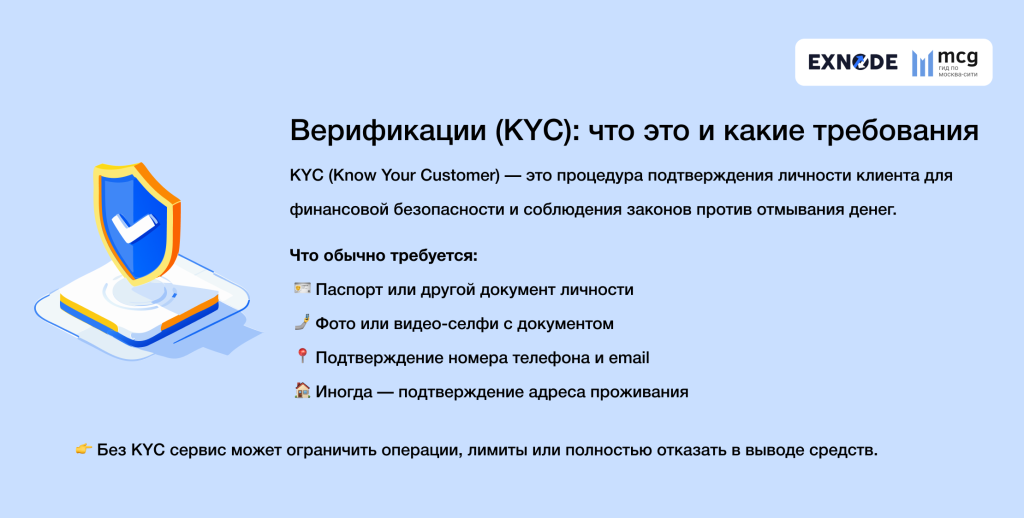
- ID document
- address confirmation
- video/selfie check
Without KYC, only limited functions are available.
What fees arise when withdrawing bitcoin
Multiple fees apply during BTC conversion to fiat.
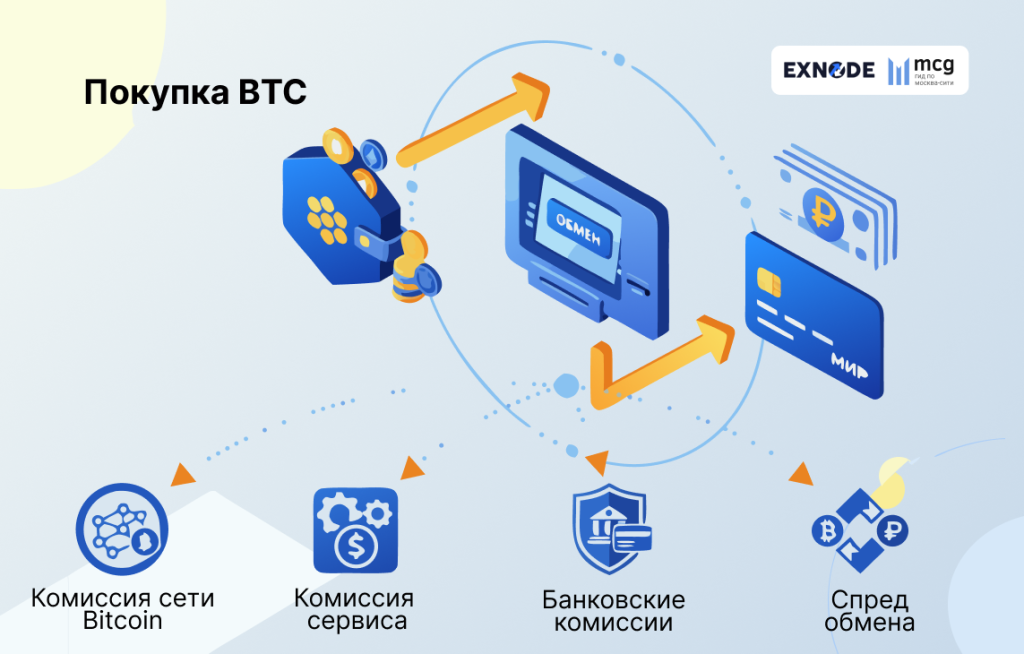
Bitcoin network fee
- paid to miners
- depends on network load
- calculated in satoshis per byte
Service fee
- percentage of transaction
- processing fee
- included in rate
Bank fees
- card transfer fee
- international transfer fee
- payment system fees
Exchange spread
- fee included in rate
- market fluctuations
- buy/sell price difference
Total cost is the sum of all these components.
Do you need to pay tax when selling bitcoin
In most countries, crypto profits may be taxable.
Taxation of cryptocurrency
- sale for fiat
- exchange for another asset
- payment for goods/services
Personal income tax
Profit is treated as individual income.
- sale price
- purchase cost
When income arises
- selling BTC for fiat
- exchanging crypto
- receiving payment in crypto
Declaration
- income amount
- purchase expenses
- final profit
Ownership itself is usually not taxed, but profits may be.
What to choose: comparison of BTC withdrawal methods
Different methods vary by speed, fees, and risk.
Online exchangers are fast, P2P may be cheaper, exchanges offer trading infrastructure, offline exchange is used for cash deals.
| Method | Speed | Fees | Risks |
|---|---|---|---|
| Exchanger | High — minutes to an hour | Medium, included in rate | Risk of unreliable service |
| P2P | Medium — depends on payment speed | Low, possible spread | Counterparty risk |
| Exchange | Medium — transfer, sell, withdraw | Low trading fees, possible withdrawal fees | Platform limits and KYC |
| Offline exchange | Medium — in-person | Medium or higher | Need personal visit and trust |
There is no universal method. Each suits different needs.
How BTC is typically converted to rubles
The process usually includes several steps.
1. Choosing a platform
- offline exchanger
- P2P platform
- crypto exchange
2. Sending BTC
- send BTC from wallet
- transaction enters blockchain
- network confirms
3. Creating a request
- BTC amount
- rubles payout method
- transfer details
4. Transaction confirmation
The service waits for confirmations.
5. Receiving rubles
- bank card transfer
- bank transfer
- payment system
- cash
After completion, rubles are received.
Conclusion
Cashing out bitcoins in Russia is possible through exchangers, P2P platforms, exchanges, and offline services. All represent selling a digital asset for fiat.
The choice depends on amount, speed, fees, and willingness to undergo verification. Online and P2P services are used for small to medium transactions, offline exchangers for large cash operations.
Cryptocurrency is treated as property in Russian law, so sales may create tax obligations. It is important to consider network fees, service commissions, and banking costs.
Thus, cashing out bitcoins comes down to choosing suitable infrastructure and correctly executing the transaction. Understanding the crypto market, fees, and legal status helps perform such operations safely and consciously.