




In 2026, many Russians continue to seek reliable ways to convert their cryptocurrency holdings into rubles, especially in cash. Due to sanctions and restrictions, major foreign exchanges do not support the ruble, and banks closely monitor cryptocurrency transactions. Nevertheless, it is possible to legally cash out Bitcoin, Ether, and other assets if you choose the right exchange channel. Below is a compilation of all the options available in 2026, the pros and cons of each, as well as practical tips for safe exchanges.
A Brief Overview of Blockchain and Cryptocurrency Networks
Before transferring cryptocurrency, it is important to understand how blockchain networks work. A blockchain is a chain of linked blocks, each of which contains transaction data. It is virtually impossible to alter data on the blockchain, as a copy of the chain is stored on numerous computers worldwide. Cryptocurrency networks, such as Bitcoin, Ethereum, Tron, Solana, and others, are built on blockchain technology, and each has its own rules and transaction fees.
- Transaction costs (gas fees) vary by network. For example, the Ethereum network is often congested, and fees can reach $20–$100. On the Binance Smart Chain network, transactions typically cost less than $0.10. On the Tron network, they cost around $1–3. Arbitrum and Solana are very cheap, literally costing just a few cents. TON costs about $0.05. Bitcoin is a relatively expensive network, averaging $5–25 per transaction.
- Transaction speeds also vary. With Bitcoin, you usually have to wait 10 to 60 minutes for confirmations. Layer-2 networks and fast blockchains, such as Arbitrum, Solana, or BSC, process transactions in seconds.
- Choosing the right network is critical when exchanging. Many coins exist on multiple networks simultaneously. For example, USDT is available on Ethereum (ERC-20), Tron (TRC-20), Binance Smart Chain (BEP-20), and other networks. But these are essentially different versions of the same asset, and they are incompatible with each other. If you send ERC-20 USDT to a TRC-20 address, the coins will be lost. Therefore, always verify the correct token standard: ERC-20 for Ethereum, TRC-20 for Tron, and so on.
Understanding blockchain networks is essential for transferring crypto between wallets, exchanges, and exchange platforms without loss. In the article below, we will specify which networks are used by each service when withdrawing funds.
The Legality of Cryptocurrency Transactions in Russia
In Russia, cryptocurrencies are legally recognized as property, not as currency. You can trade or buy cryptocurrency, but using it to pay for goods and services is prohibited by law. In other words, Bitcoin is not a ruble: the ruble remains the only legal tender within the country.
Because of this, crypto transactions are treated as property transactions rather than ordinary financial transactions. The legal framework is primarily based on Federal Law No. 259-FZ “On Digital Financial Assets, Digital Currency…,” as well as anti-money laundering regulations, including Federal Law No. 115-FZ. This means that it is possible to buy, sell, store, and exchange cryptocurrency in Russia, but banks and other financial market participants have the right to monitor such transactions if they appear unusual or raise questions about the origin of the funds.
What will change in 2026. In 2026, the market continues to move toward more formalized regulation. In practice, this means stricter requirements for exchange services, increased focus on KYC/AML procedures, and a gradual transition to a more transparent operating model for crypto exchanges. Therefore, when choosing a platform, it is especially important to consider not only the exchange rate but also the legal structure, reputation, presence of a physical office, clear transaction rules, and documentation for the transaction.
Taxes and Reporting. Exchanging cryptocurrency for rubles may give rise to a tax liability. If you sell cryptocurrency for more than you paid for it, you generate income that must be reported. In practice, this involves independently filing a 3-NDFL form and calculating the tax based on the positive difference between the income from the sale and the verified purchase costs. If the transaction results in a loss, there is no tax, but it is still best to handle the reporting carefully. Therefore, it is advisable to keep all documents related to purchases, sales, withdrawals, bank statements, screenshots of exchange transactions, and transfer confirmations.
Main Methods of Cashing Out Cryptocurrency
By “cashing out cryptocurrency,” we do not mean literally “withdrawing money” as in the banking system, but rather converting a crypto asset into rubles and subsequently receiving fiat currency—either in cash or via bank transfer. Essentially, this is the process of selling cryptocurrency (BTC, ETH, USDT, and others) through an exchange, P2P platform, or other service, after which the user receives rubles in a convenient form.
1. Offline crypto exchanges
Offline crypto exchanges are physical cryptocurrency exchange locations where transactions take place during a face-to-face meeting. This format is most often used when you need to exchange crypto for cash in Moscow or buy crypto with rubles without involving bank transfers.
The main feature is direct interaction: the client visits the office, transfers cryptocurrency to the service’s wallet, and receives rubles in cash on the spot. In major cities, especially in the Moscow City business district, transactions usually take place quickly and at a pre-agreed rate.
This format is chosen when speed, handling large sums, and minimal reliance on banking infrastructure are important. At the same time, it’s important to consider the details of the transaction: the transfer network, wallet address, exchange rate fixation terms, and payment method.
Here’s how it works: you find an exchange, submit a request, agree on a time, go to the office, transfer the crypto, and receive cash after the transaction is confirmed.
2. Online cryptocurrency exchanges
Online exchanges are services that allow you to convert cryptocurrency into rubles and withdraw the funds to a card without visiting an office. The user submits a request on the website, locks in the exchange rate, and completes the transaction without visiting an office.
This method is most often used when you need to exchange a small amount remotely or quickly. Online exchanges provide access to a wide range of cryptocurrency pairs and networks, and the transaction itself takes anywhere from a few minutes to half an hour.
The final exchange rate already includes the service’s margin, so when comparing offers, it’s better to focus on the final amount rather than the advertised “0% commission.”
The process is standard: select the direction (e.g., BTC → RUB or USDT → card), specify the amount, and then the user transfers the cryptocurrency and receives rubles to their card or account.
3. P2P platforms and exchanges
P2P is a format where users exchange cryptocurrency directly. The platform acts as a guarantor of the transaction, holding the asset in escrow until the transaction is completed.
The main difference is that you’re dealing with another person, not a service. That’s why the exchange rate is often closer to the market rate, and the range of payment methods is as wide as possible: bank transfers, cards, and e-wallets.
In this case, the key factor is not the platform, but the counterparty. When working through P2P, it is important to check the rating and number of transactions and to stay within the internal chat.
In practice, the process looks like this: you select a listing, transfer rubles, and then receive the cryptocurrency released from escrow.
4. Accounts and Infrastructure in Neighboring Countries
A separate scenario involves using banks and exchange infrastructure outside the Russian Federation.
The idea is that the cryptocurrency is first converted to fiat in another jurisdiction, and then the funds are transferred between accounts as regular banking transactions. For some users, this reduces issues with Russian banks.
However, this option requires an understanding of tax and legal aspects: account notifications, reporting, and compliance with currency laws. Therefore, it is used less frequently and more often when dealing with large sums.
Top Exchange Services and Platforms in 2026
In 2026, the market continues to see demand for both offline exchange services with physical offices and online services and P2P platforms. In practice, users most often choose a service based on a combination of four factors: exchange rate, reputation, speed, and clarity of the process.
For offline exchanges, people typically look for companies with physical offices, a solid reputation, a straightforward application process, manager support, and the ability to handle large-scale transactions. For online exchanges, people focus on major industry rankings, reviews, the service’s track record, and the actual transparency of its terms. For P2P, they look at liquidity, counterparty ratings, and the stability of the platform itself.
The choice of a specific service always depends on your goals: whether you specifically need cash transactions, the transaction amount, how important speed is, whether you’re ready for verification, and which network your assets are on.
The Best Crypto Exchanges in Moscow (Offline)
When deciding where to buy cryptocurrency in Moscow or exchange it for cash, it’s important to consider not only the exchange rate but also the service’s reputation, the transparency of its terms, and the transaction format. Below is a list of major offline exchanges with offices in the capital that are regularly mentioned in market reports and user reviews.
Insight (Moscow City — offline)
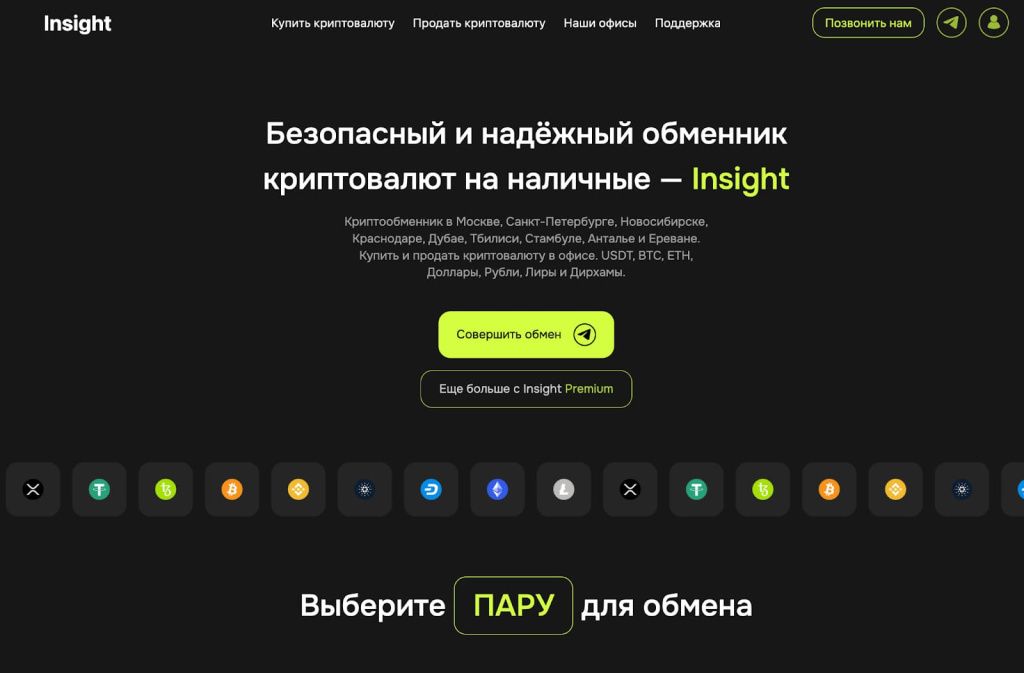
Insight is an exchange that focuses on controlled transactions and pre-agreed terms. Here, the exchange is not conducted “on the spot,” but through prior agreement on all key terms: amount, network, payment method, and final payout. This reduces market slippage and eliminates the risk of sudden rate fluctuations.
The office in Moscow City provides a corresponding level of service: access by appointment, transaction support, and handling large volumes without unnecessary fuss. The transaction proceeds as a structured operation, rather than a quick “on-the-spot” exchange.
This format is particularly convenient when process transparency and clean execution are important: from the first contact to the final settlement. As a result, the client receives not just an exchange, but a clear transaction logic with minimal deviations.
BitOkk
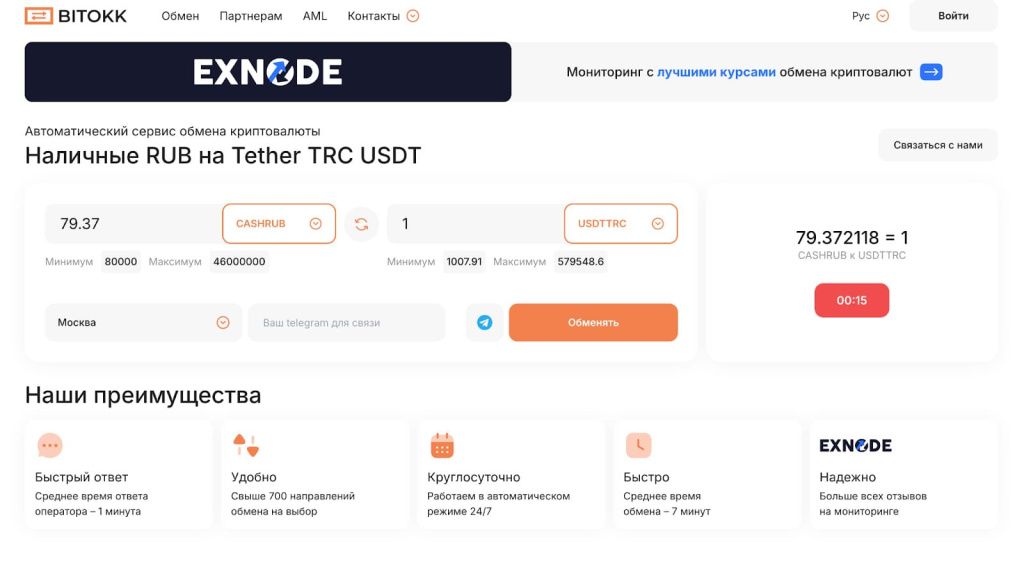
BitOkk is all about execution speed and asset variety. Unlike many services, there is no strict tie to core assets: in addition to BTC and USDT, a wide pool of altcoins is available, allowing for more flexible strategies.
A key feature is the short transaction cycle: the time from order placement to settlement is minimal, and the rate is fixed in advance. This is crucial in volatile conditions, where even a slight delay can affect the outcome.
EastChange (Moscow — offline)
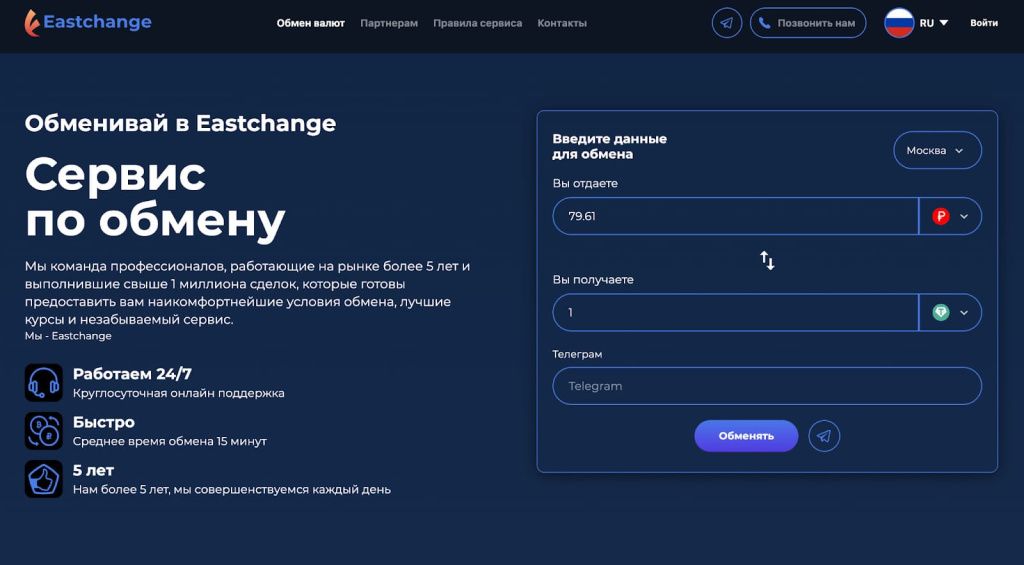
EastChange is a service perceived as a “liquid channel” for exchange. Here, the main focus is not on the interface or speed, but on the ability to close trades with the desired volume without splitting orders or additional steps.
The Moscow office allows for a traditional workflow: without unnecessary digital intermediaries, with direct interaction and straightforward mechanics. This reduces operational risks and makes the process more predictable.
It is often used in scenarios where reserves and liquidity depth are critical. This is particularly evident in stablecoin exchanges, where what matters is not just the exchange rate, but the ability to execute a large volume without compromising terms.
EastChange isn’t about “user-friendly interfaces,” but about reliable execution: when the result itself matters, not the packaging around it.
Crypto Exchange
“Crypto Exchange” is an exchange with the most straightforward logic possible. There is no attempt to complicate the process or add extra layers of interaction—trades follow a basic structure and are completed without unnecessary steps.
Major trading pairs are supported, and transactions are processed quickly, without overcomplicated workflows. It is more of a tool for solving a specific problem than a full-fledged ecosystem.
RENATKO Exchange
RENATKO Exchange stands out because it works not only with cryptocurrency but also with currency flows. This expands the range of use cases: exchanges can be structured via a USD bridge, combining crypto and fiat within a single framework.
This approach allows for flexible management of fund flows, especially in situations where it is important not just to convert an asset, but to optimize the structure of the transaction itself.
As a result, RENATKO appears as a more “instrumental” service, used not only for exchange but also as part of a more complex financial scheme.
VOODoOSH

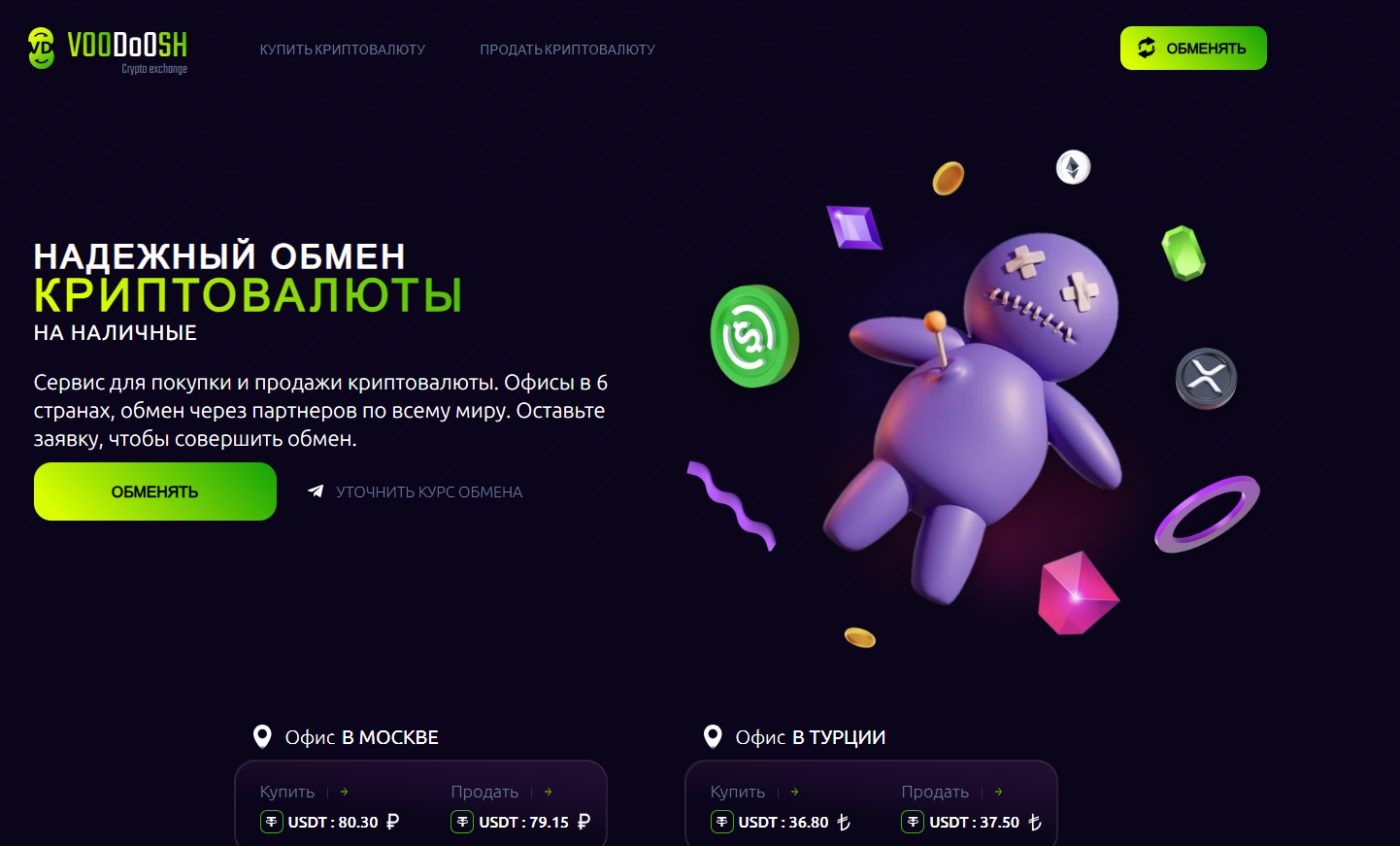
VOODoOSH is a crypto exchange focused on fast cryptocurrency withdrawals, primarily Bitcoin. There are no unnecessary steps or complex logic here: the process is structured as linearly as possible and optimized for rapid execution.
The exchange rate is based on market prices, and the transaction itself is completed in a short time. This makes the service convenient in situations where speed and minimal time-to-cash are important.
VOODoOSH is often used as a tool for a “quick exit” from a position when there’s no need to set up a complex scheme, but you simply need to lock in the result.
Cashex
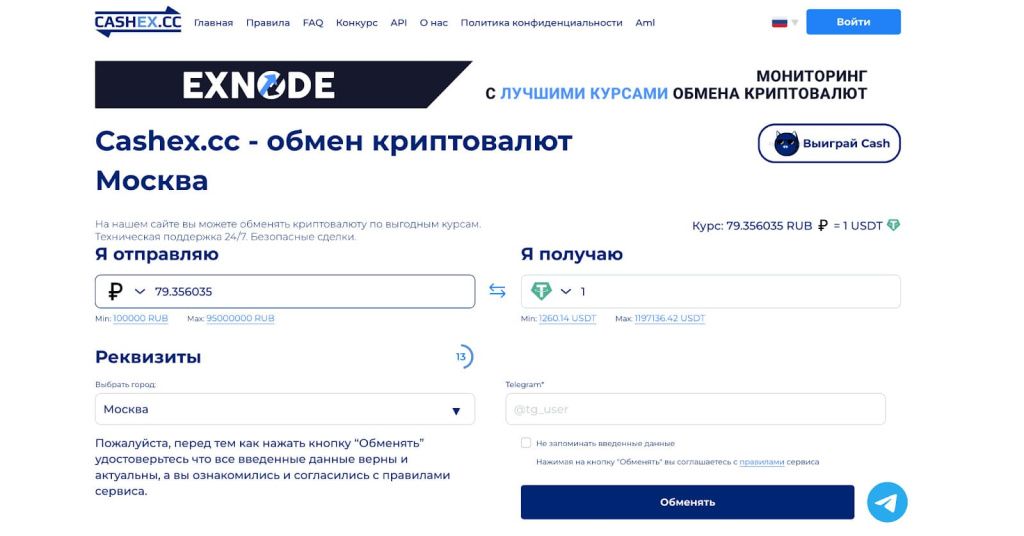
Cashex is a service focused on transactions where the accuracy of terms and control over parameters are critical. Here, the exchange goes beyond simple conversion: attention is paid to every detail—from the exchange rate to the settlement format.
It is often used when dealing with large volumes, where even a difference of a fraction of a percent is critical. In such scenarios, it is not speed that matters, but the accuracy of execution and the stability of conditions.
Cashex can be viewed as a service for “customized” transactions—where parameters are agreed upon in advance, and the result must not deviate from expectations.
This makes it a convenient tool for recurring operations, where systematic exchange management is more important than a one-time profit.
Exchange Monitoring
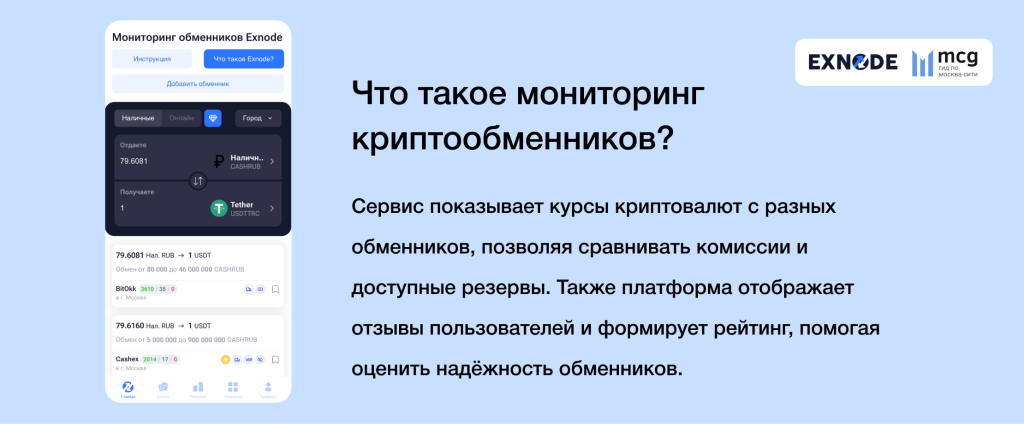
In 2026, monitoring Exnode exchanges is not just about finding the best rate, but a tool for initial verification. It allows you to assess not only the numbers but also the service’s behavior: update frequency, liquidity availability, and order activity.
This approach helps filter out unstable platforms and reveal the true state of the market. This is especially important when dealing with large volumes, where a mistake in choosing an exchange can cost significantly more than the difference in the exchange rate.
Using monitoring becomes standard practice: analysis first, then the order. This reduces risk and makes the exchange a more manageable process.
Criteria for choosing a reliable exchange
- Reputation and experience. The longer a service has been operating, the higher the chance that its processes are well-established. Companies with a track record and a large number of genuine reviews are usually more reliable than random new platforms.
- Security. An offline exchange should have a physical office, a clear point of contact, transaction support, and a transparent exchange algorithm. An online service should have a secure website, clear rules, a track record, and verifiable reviews.
- Rate and hidden fees. Always compare not only the advertised rate but also the final amount you’ll receive. Sometimes the commission isn’t listed separately but is already “built into” the rate.
- Transparency of terms. Before the transaction, you should understand which network the asset is sent through, how long the exchange takes, whether the rate is fixed, what happens if the transaction is delayed, and what documents confirm the transaction.
- Reserves and limits. If you’re dealing with a large amount, you need to clarify in advance whether the exchange is ready to handle such a volume and whether it has sufficient reserves in rubles.
- User reviews. Research not only the exchange’s own website, but also independent reviews, discussions, ratings, maps, forums, and specialized chat rooms.
Step-by-step guide: how to cash out cryptocurrency
- Choose an exchange method. First, determine what matters most to you: cash, speed, privacy, the best exchange rate, or minimizing the risk of banking issues.
- Choose a service. To do this, compare exchange platforms based on reputation, exchange rate, physical office availability, reviews, and transaction terms.
- Submit a request. Specify the exchange direction, amount, desired network, city, and contact information.
- Confirm the details with the operator. Verify the exchange rate, address, payment method, reserve, required documents, and transaction terms.
- Double-check the transfer network. This is one of the most important steps. An error in the network can lead to the loss of assets.
- Make a test transfer. If the amount is large, it’s wise to first send a small amount to ensure everything works correctly.
- Complete the transaction and save the confirmations. After receiving cash or rubles in your account, save screenshots, receipts, correspondence, transfer confirmations, and other documents.
Network and Wallet Considerations for Exchanges
When exchanging cryptocurrency, you need to clearly understand which network the transfer is taking place on. In practice, this is where users most often make critical mistakes.
For example, Tether (USDT) exists in several popular formats: ERC-20, TRC-20, BEP-20, and others. If you send one version of the token to an address intended for a different network, the funds will be lost. Therefore, when exchanging, you must always verify not only the asset’s name but also the network.
- Check with the operator or in the exchange interface to see which network accepts the transfer.
- Check the address format and match it to the correct network.
- Do not send the asset to an address if you have any doubts.
- Keep network fees in mind: sometimes it’s cheaper to first convert the asset within your wallet or exchange to a more convenient network, and then withdraw it.
Hot, cold, and custodial wallets for exchanges
When exchanging cryptocurrency, you should consider not only the network but also the type of wallet from which you are sending funds. This determines the transaction speed, level of control, and risks.
All wallets can be broadly categorized based on two parameters: network connectivity (hot/cold) and access control model (custodial/non-custodial).
- Hot wallets are wallets that are constantly connected to the internet (mobile apps, web wallets, exchanges). They are convenient for trading: you can send a transfer immediately, quickly select a network, and view the transaction status.
- Cold wallets are offline storage solutions (e.g., hardware devices). They are not constantly connected to the network and are used for storage. Before making a transaction, you need to connect them and manually confirm the transaction, so the process is slower but more secure.
- Custodial wallets are services where access to funds is effectively controlled by the platform (most often crypto exchanges). You see your balance, but the private keys are not stored with you. This is convenient and fast, but requires trust in the service.
- Non-custodial wallets are wallets where you hold the private keys yourself. Only you control the funds, and no one can freeze them or restrict access. However, all responsibility for errors (incorrect address, network) lies with the user.
In practice, people most often use a combination: storing funds in a cold or non-custodial wallet and transferring a portion of the funds to a hot wallet before the exchange. This allows you to maintain control over your assets without sacrificing transaction speed.
The key principle is simple: the greater the control, the greater the responsibility, and vice versa. Therefore, the choice of wallet always depends on the task at hand: storage, quick exchange, or handling large sums.
Popular cryptocurrencies for conversion to rubles
In practice, the following assets are most commonly converted into rubles and cash:
- Bitcoin (BTC). The most recognizable asset, supported by almost all exchanges, but network fees may be higher than for stablecoins.
- Ethereum (ETH). Widely supported, but transfers on the Ethereum network are often expensive.
- USDT. One of the most convenient assets for exchange thanks to its stable exchange rate and widespread support. It is especially popular on the TRC-20 and BEP-20 networks.
- USDC and other stablecoins. These are also used for withdrawals, but in terms of prevalence in the Russian-speaking segment, they are often less common than USDT.
- Major altcoins. These are exchanged less frequently and not everywhere, especially when it comes to offline offices.
The choice of asset depends on where your funds are concentrated, which network the selected exchange supports, and how important fees and transfer speed are to you.
Taxes and Risks
- Tax risk. If you sell cryptocurrency at a profit, you shouldn’t ignore the issue of tax reporting. The more transparent your transaction history is, the easier it will be to explain the origin of the funds later.
- Banking risk. Even if the cryptocurrency transaction itself is legal, the bank may ask questions about incoming or outgoing transfers if they appear unusual. This is especially true for P2P transactions and transactions between individuals.
- Network error risk. One of the most common and costly risks. Choosing the wrong network or address leads to the irreversible loss of assets.
- Risk of fraud. Phishing sites, fake managers, fraudulent Telegram accounts, third-party links, and an “too-good-to-be-true” exchange rate are classic red flags.
- Risk of sanctions or compliance checks. Some services analyze the origin of cryptocurrency. If the asset has already passed through problematic addresses, the transaction may be sent for additional verification.
Conclusions and Recommendations
Cashing out cryptocurrency into rubles in Russia in 2026 remains a viable option, but requires a careful approach. There is no one-size-fits-all solution. If you need personal control and are dealing with a large sum, offline exchanges are often the preferred choice. If speed and a remote format are important, online services are the way to go. If you need a flexible exchange rate and have experience, P2P is the best option.
Key rules for safe withdrawal:
- Choose a service based on reputation and clear terms, not advertising.
- Always verify the transfer network and wallet address.
- Conduct a test transaction before a large exchange.
- Keep all transaction confirmations.
- Consider the banking and tax implications in advance, especially if the amount is substantial.
If you proceed calmly, verify the details, and avoid chasing suspiciously favorable exchange rates, you can cash out cryptocurrency in Russia in 2026 without unnecessary problems and with a manageable level of risk.
Please note: cryptocurrencies are associated with high volatility and risks. All transactions are conducted at your own risk.