



What is a crypto exchanger
In simple terms, a crypto exchanger is an online or offline service that lets you exchange cryptocurrency without a trading terminal or the complex interfaces of exchanges. It can be a website, an app, or another interface. In most cases, crypto exchangers are used for one-off operations: buying Bitcoin with rubles, cashing out BTC to a bank card, exchanging stablecoins (other cryptocurrencies besides Bitcoin), or transferring funds between wallets. A crypto exchanger acts as an intermediary: it receives one currency and sends another at a pre-fixed rate.
Unlike a crypto exchange where trades happen between participants via an order book (often P2P), a crypto exchanger works with ready-made exchange directions. The user simply chooses a pair, for example Bitcoin to rubles or USDT to a card, creates a request, and follows the instructions.
How it works
The way a crypto exchanger works is quite simple and clear even for beginners. First, the user selects an exchange direction, for example BTC to rubles, enters the amount, and provides payout details. After that, the service creates a request and shows an address or payment details for the transfer.
When the user sends cryptocurrency, the transaction goes to the blockchain. After the required number of network confirmations, the exchanger confirms receipt of the funds and sends the payout. The whole process can take from a few minutes to an hour, depending on network congestion and the service’s operating mode.
Online vs offline
Most modern services operate online. An online crypto exchanger lets you exchange cryptocurrency directly via a website: the user creates a request, sends funds, and receives the result to a card, account, or crypto wallet. This format is convenient for small and mid-sized amounts as well as quick transactions.
Offline crypto exchangers operate through offices or cash points. They are usually used for large amounts or cash deals. The user creates a request on the website in advance, then comes to the office and completes the exchange in person. This format is more common in major cities, including Moscow.
Crypto exchange rate when swapping
The rate in a crypto exchanger is formed based on prices from major crypto exchanges. The service tracks the price of Bitcoin, stablecoins, and other assets, then adds its own fee and forms the final rate for the user.
- the exchanger’s reserves
- payment fees
- liquidity of the direction
- request processing speed
- reputation and reliability (you can pay for this)
That’s why rates can differ across exchangers even for the same asset, such as BTC or Bitcoin.
How crypto exchangers make money
The main income of a crypto exchanger is the spread between the buy and sell price of cryptocurrency. This spread is already included in the rate the user sees when creating a request. In essence, the service earns from turnover: the more swaps go through the exchanger, the higher its income.
- payment system fees
- affiliate programs
- servicing corporate clients
- working with large liquidity volumes
How an exchange happens
The crypto exchange process is as follows: the user chooses a direction, for example swapping BTC to a card, enters the amount, and creates a request. After that, they receive a transfer address and send funds from their crypto wallet.
When the BTC transaction receives the required number of confirmations, the crypto exchanger sends the payout. If the exchange runs in automatic mode, funds may arrive within a few minutes. In a semi-automatic format, processing depends on the operators’ schedule.
The same principle applies to other cryptocurrencies: USDT, ETH, and stablecoins. Only the confirmation time and network fees differ.
Step-by-step exchange flow, risks, and how to reduce them
| Step | Who acts | What happens | Risk zone | How to reduce risk |
|---|---|---|---|---|
| Step 1 | User | Opens the exchanger website and chooses the exchange direction | You may land on a phishing website | Check the site address, use bookmarks and trusted monitoring lists |
| Step 2 | Crypto exchanger | Pulls the rate and calculates the final amount including the fee | No risk | Check the final amount before creating the request |
| Step 3 | User | Enters the amount and payout details | Mistake in the address or details | Double-check the address, copy instead of typing manually |
| Step 4 | Crypto exchanger | Creates the request and locks the rate for the payment window | No risk | Pay the request within the allotted time |
| Step 5 | User | Sends money or cryptocurrency to the provided details | Wrong network choice or transfer mistakes | Verify the network, amount, and address before confirming |
| Step 6 | Crypto exchanger | Tracks the incoming funds and runs a check (AML) | Delay is possible or KYC may be requested | Use “clean” wallets and your own personal payout details |
| Step 7 | Crypto exchanger | Creates and sends the payout | No risk | Wait for blockchain or bank confirmation |
| Step 8 | User | Receives funds to a wallet or bank card (in Russia, often via SBP) | No risk, the exchange is completed | Confirm receipt and save the request details |
KYC, AML, and security
Some crypto exchangers operate without mandatory verification, which allows you to exchange cryptocurrency quickly without registration. This format is suitable for one-off operations with small amounts. However, for suspicious transactions, the service may request additional checks.
Exchangers with KYC require identity verification, but they offer higher limits and more stable operation with bank transfers. This option is more often used for regular operations or large amounts.
- check the exchanger’s reputation
- start with a small amount
- don’t keep funds on the service longer than necessary
How crypto exchangers work in Russia
In Russia, crypto exchangers most often operate online and support bank cards, transfers by bank details, and SBP. This approach allows users to quickly exchange Bitcoin and other cryptocurrencies without visiting an office.
In major cities, including Moscow, you can also find offline services for cash operations and large amounts. But most transactions still go through online crypto exchangers, especially when exchanging BTC to rubles or buying Bitcoin.
How an exchange looks for the user and for the exchanger
In summary, crypto exchangers operate in a way that is clear for the user, but internally the process is technically complex.
For the user
From the client’s side, everything looks as simple as possible: they choose the exchange direction, enter the amount, provide payout details, and receive a transfer address. After sending cryptocurrency, the transaction goes to the network, gets confirmations, and is recorded by the exchanger’s system. At this moment, the user effectively performs only one action — sending the funds — while the rest of the process runs automatically on the service side.
Exchanger side
On the crypto exchanger’s side, the operation is processed through several internal stages. First, a request is created in the order processing system, where the rate, amount, direction, and time limit are locked. After the transaction is received, the service tracks it in the mempool and on-chain, waiting for the required number of confirmations. In parallel, an AML check is launched via external analytics providers to assess the risk of the incoming address.
After the transaction is confirmed, the system performs internal settlement: it reconciles the actual received amount, the request rate, and the network fees. Next, the payout module is triggered, which creates the outgoing transfer via a payment gateway, a banking API, or an internal crypto wallet. In automatic exchangers, this process is managed by scripts and background services that handle requests in real time.
At the infrastructure level, a crypto exchanger uses a hot wallet for fast operations, cold storage for holding reserves, liquidity management systems for balancing assets, and a rate engine for updating rates based on exchange data. The full cycle — from request creation to final payout — typically takes from a few minutes to an hour, depending on network load, the payment channel, and the processing mode.
Crypto exchanger comparison services in Russia
Crypto exchanger comparison services are aggregators that collect rates from different exchangers and show them in one list. The user selects an exchange direction, for example BTC to rubles, and gets a table of services with rates, reserves, and reviews. The key differences between such platforms are the level of exchanger vetting, the number of supported directions, and extra features like ratings, KYC filters, and rate history.
In Russia, people most often use several popular aggregators
BestChange ★5
BestChange — one of the oldest and best-known aggregators, operating since 2007. Over the years, it has built a reputation as a reliable platform with strict exchanger moderation and a user review system. The database includes dozens of verified services, and rates update automatically several times per minute.
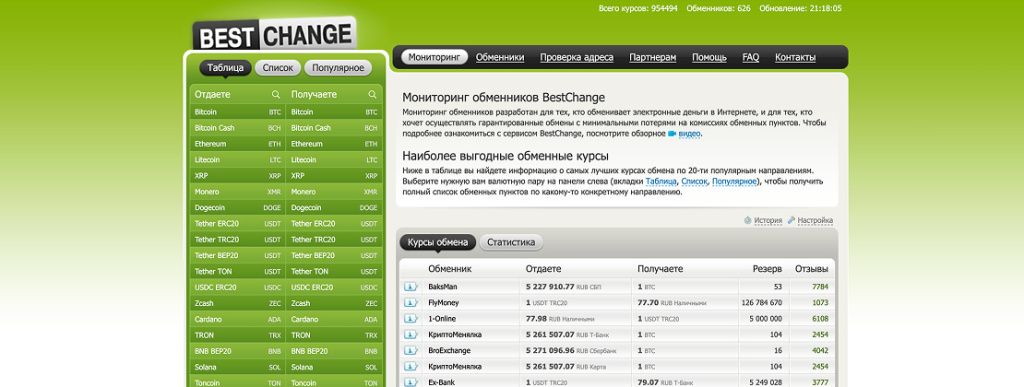
The service is considered a benchmark tool for selecting exchangers and is widely trusted by users. Over the years, BestChange has collected many positive reviews and became the main source for finding exchangers for Bitcoin, stablecoins, and fiat operations.
OKChanger ★4.5
OKChanger — an aggregator launched in 2016. It offers a wide list of exchange directions and its own exchanger rating system. The service is focused on Russian-speaking users and regularly adds new exchange points.
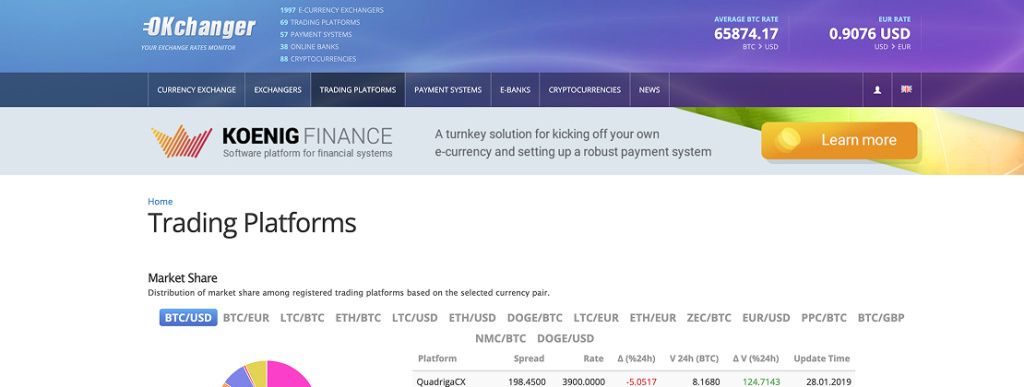
OKChanger has been operating for several years and has built a stable exchanger base with constant rate updates. Users note the convenient interface and the presence of ratings, which helps assess the reliability of a selected service faster.
Kurs.Expert ★4.5
Kurs.Expert — an aggregator operating since 2016. It stands out for a large number of directions, including rare payment systems and regional payment methods. The service pays attention to reserve monitoring and request processing speed.
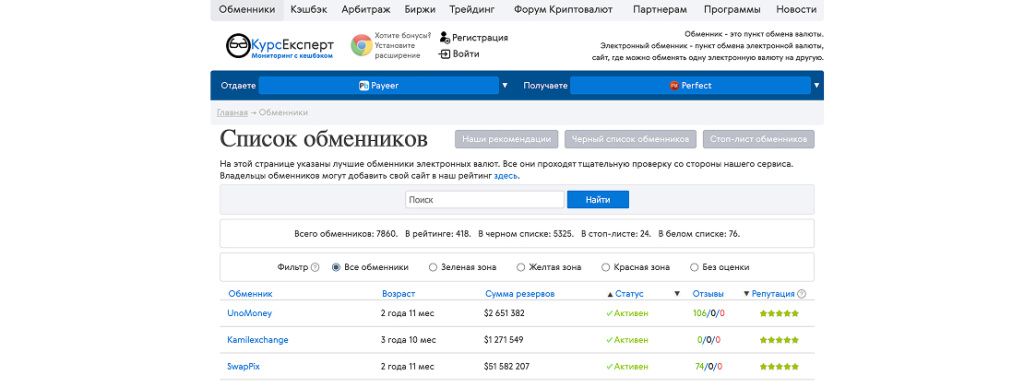
Over time, the platform built a steady audience and is used as an alternative source for checking rates. Many users use Kurs.Expert to compare conditions and find directions that are not available on other aggregators.
Exnode ★4
Exnode — a newer aggregator that appeared in the early 2020s. It focuses on modern interfaces, direction filters, and working with current exchangers. The service base is smaller than older aggregators, but it is updated regularly.
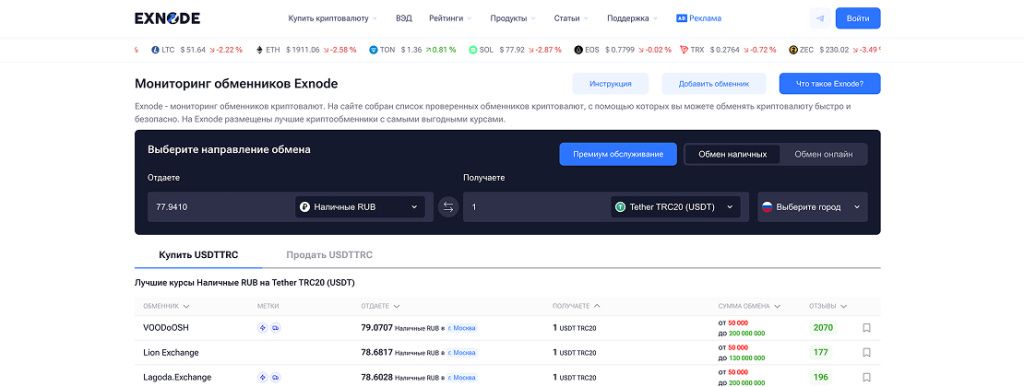
Despite a shorter operating history, the service is gradually gaining an audience thanks to a modern interface and a focus on current exchangers. Users note convenient navigation and fast direction selection.
All these services solve a similar task — helping you quickly find a suitable crypto exchanger. The main differences between them are operating history, the number of exchangers in the database, rate update speed, and the verification process before adding services to monitoring.
Choosing a crypto exchanger
On our website, we collected popular crypto exchangers for different tasks: a general service catalog, exchanges in Russia, fast online operations, offline deals, and dedicated selections for USDT and BTC. Each section lists exchangers with current directions, clear terms, and available reserves, making it easier to pick a service for a specific task.
- Crypto exchangers — a general section with a list of services for exchanging cryptocurrency, where you can choose an exchanger for different directions and amounts.
- Crypto exchangers in Russia — a section with services for exchanging cryptocurrency using cards, transfers, and other popular domestic payment methods.
- Online crypto exchangers — services for fast cryptocurrency exchange via a website, without visiting an office.
- Offline crypto exchangers — a selection of exchangers with offices and cash points for in-person deals.
- USDT crypto exchangers — services where you can swap the USDT stablecoin to fiat, other coins, or transfer funds between wallets.
- BTC / Bitcoin crypto exchangers — a section with services for exchanging Bitcoin, buying BTC with rubles, and cashing out Bitcoin to a card or account.
Frequently asked questions
How long does a crypto exchange take?
Exchange time depends on several technical factors. First, it depends on the number of confirmations required on the blockchain. For Bitcoin, exchangers typically require 1 to 3 confirmations, which under normal network load takes 10 to 40 minutes. It also depends on the miner fee you choose: the higher the fee, the faster the transaction is included in a block. After the required confirmations are received, the crypto exchanger runs an internal request check and sends the payout. In automatic mode, the whole operation can take 5–20 minutes after confirmation; in semi-automatic mode, up to 60 minutes.
Can I exchange Bitcoin without verification (KYC)?
Yes, some crypto exchangers operate without mandatory KYC. In such services, the user does not go through identity verification and can exchange immediately after creating a request. However, most platforms apply AML filtering to incoming transactions. If the cryptocurrency has a high risk score in analytics services, the request may be paused until the origin of funds is clarified. Also, no-KYC exchange is usually associated with lower limits and stricter internal checks.
How is a crypto exchanger different from a crypto exchange?
A crypto exchange works using an order book model, where trades are executed between market participants. The user places a buy or sell order and waits for a matching order. A crypto exchanger works differently: it acts as the counterparty to the trade. The rate is formed based on exchange quotes and the service’s internal liquidity. The user does not interact with other traders and instead receives a fixed rate at the moment the request is created. This simplifies the process, but does not allow placing your own orders.
What happens after I send BTC to the exchanger’s address?
After sending BTC, the transaction enters the mempool — a queue of unconfirmed transactions. Miners include it in a block based on the fee size. After the first confirmation, the exchanger receives a signal that funds arrived, but final crediting happens after reaching the required number of confirmations. Then the exchanger system performs an internal AML check via analytics services, reconciles the amount and request rate, and triggers the payout. In automatic services, this happens without an operator; in manual ones, after a staff check.
Is it safe to use crypto exchangers?
Safety depends on the service’s reputation and on following basic rules on the user side. Reliable crypto exchangers use secure connections, internal request accounting systems, AML checks, and automated transaction processing scripts. The main risks are not the exchange itself, but using unknown services or sending funds to the wrong address. To reduce issues, it is recommended to check reviews, start with a small amount, carefully verify details, and not keep cryptocurrency on third-party platforms longer than required for the operation.
How much does it cost to open a crypto exchanger?
Launching a crypto exchanger requires starting capital across several key directions. The minimum budget for a small online service usually starts at $15,000–$30,000. This includes building or buying an exchanger script, server setup, payment gateway integrations, liquidity for early operations, and basic marketing. For a more serious project with a brand, automated processes, an API, and reserves for large deals, the budget can reach $80,000–$150,000 or more.
The main challenges are not so much the website as the infrastructure. You need stable payment channels, work with banks or payment intermediaries, constant liquidity in crypto and fiat, and configured AML checks and risk management. Beyond the technical side, reputation, user support, and turnover matter, because an exchanger starts earning only when it has a sufficient volume of requests.
What are reserves, and can they differ from the actual amount?
An exchanger’s reserves are the amount of funds the service is ready to use to fulfill requests for a specific direction. They are usually shown on the site as the available amount for exchange, for example a certain number of rubles, USDT, or BTC. These numbers indicate the maximum transaction you can do right now without waiting for liquidity to be replenished.
Reserves can differ from the actual balance on a single wallet or account. An exchanger may distribute funds across multiple wallets, bank accounts, payment gateways, and partner services. Also, part of the reserves may be tied up in current requests or in internal transfers. So the displayed numbers are not always a direct balance on one address, but rather calculated liquidity available to process new exchanges. Reserve data may update with a delay, especially under high load or manual request processing. Because of this, the actual available amount may slightly differ from the number shown on the site. Ideally, reserves are synchronized automatically, and if funds are insufficient, the direction is temporarily closed or limited by amount.
Why can a crypto exchanger pause a deal?
A paused deal is most often related to checks and mismatches in the request. A typical scenario is an AML check showing increased risk for an incoming transaction, and the service temporarily puts the request on hold until details are clarified. An exchange can also be paused if the received amount does not match the request, the rate moved outside the allowed corridor, the transfer arrived after the timer expired, or the payout details were entered incorrectly.
This can happen to users who sent BTC from a wallet or exchange with a “dirty” history, sent funds with a low fee and the transaction stayed in the mempool for a long time, or made a mistake with the network and address. In practice, “my exchange was stopped” is most often due to AML risk, confirmation delays, or mismatched amount/details.
Can a crypto exchanger keep the money if a deal is paused?
If funds actually arrived at the exchanger’s address or account, reputable services usually cannot “keep them forever” at will, but a refund can be delayed or processed with a fee withheld. Most often, the exchanger returns the cryptocurrency to the original sending address after the check is completed, or offers to complete the exchange under updated terms. In disputed cases, refunds take longer when the user fails compliance, cannot confirm the origin of funds, or asks to refund to a different address not linked to the sender. Common cases look like: “the exchanger stopped the deal and asks for documents,” “the request is frozen due to AML,” “the funds arrived but they ask for verification,” “they refunded not the full amount due to network fees,” “refund only to the sender’s address.” To avoid dead ends, save the TXID, request screenshots, proof of payment, and keep communication within one support thread; when refunding, account for network fees and the service’s refund rules.
Are crypto exchangers legal in Russia in 2026?
In 2026, cryptocurrency in Russia is regulated by the law on digital financial assets. Bitcoin and other cryptocurrencies are not banned; you can own them, buy them, and sell them. At the same time, they are not considered an official means of payment, so direct payments for goods and services in cryptocurrency are formally restricted. Crypto exchangers operate as services for exchanging digital assets, but their activity is in a “gray zone” because there is still no separate law specifically about exchangers. In practice, crypto exchange via online services in Russia continues, but users should consider bank checks, AML filters, and possible questions about the origin of funds. Liability most often arises not for the exchange itself, but for operations related to illegal activity, money laundering, or tax evasion.
What is a crypto ATM, and how is it different from a crypto exchanger?
A crypto ATM is a physical terminal that allows you to buy or sell cryptocurrency for cash or via a bank card. In essence, it is an offline version of a crypto exchanger, but in an ATM format. The user selects the currency, inserts money, enters a wallet address, and receives cryptocurrency after the transaction is processed.
The difference from an online crypto exchanger is the format. A crypto ATM requires in-person presence at the device, often has higher fees, and offers a limited number of exchange directions. An online exchanger works through a website, supports more currencies and payment methods, and the exchange happens remotely without visiting a terminal.