




Bybit is an international cryptocurrency exchange with a broad set of earning tools, suitable for both beginners and experienced market participants.
If we talk about how to make money on the Bybit exchange, different directions are available: spot trading and derivatives (including perpetual futures, where the trader does not buy the coin itself but earns from changes in its price). In addition, margin trades, P2P operations with fiat currencies, and investment products with fixed and floating yields are available.
Initially, the exchange specialized in derivatives; however, over time it expanded its functionality and became a full-fledged ecosystem with a developed trading infrastructure, built-in risk management mechanisms, and additional services for diversifying strategies.
Next, we will take a detailed look at the main ways to earn on Bybit, explain in simple language which tools are suitable for beginners, and show which strategies may be relevant in 2026 given current market conditions.
Main ways to earn on the Bybit exchange
We will review each of the listed tools, explain how they work, their potential returns and risks. We will consider who each method is best suited for.
List of earning tools on Bybit:
| № | Earning tool | Income type | Risk level | Suitable for | Core earning idea |
|---|---|---|---|---|---|
| 1 | Spot trading | Active trading | Medium | Beginners and intermediate level | Buy lower — sell higher |
| 2 | Margin trading | Active with leverage | Increased | Experienced | Increasing position size using borrowed funds |
| 3 | Futures (perpetual) | Trading both up and down | High | Advanced traders | Earning on price movement with leverage |
| 4 | Options | Strategic trading | High | Professionals | Hedging and complex strategies |
| 5 | Leveraged tokens | Simplified leverage | Medium-high | Intermediate level | Profit growth without liquidation risk |
| 6 | Long-term investing | Passive growth | Medium | Beginners and investors | Holding an asset in expectation of market growth |
| 7 | P2P arbitrage | Arbitrage income | Low-medium | Beginners and intermediate level | Difference between buy and sell rates |
| 8 | Bybit Earn | Passive income | Low | Beginners | Placing funds for interest |
| 9 | On-chain Earn | DeFi direction | Medium | Intermediate level | Income via blockchain protocols |
| 10 | Dual-currency investments | Structured product | Medium-high | Advanced | Higher interest under price conditions |
| 11 | Structured Products (formerly Shark Fin) | Fixed + bonus | Medium | Investors | Guaranteed rate + extra income |
| 12 | Liquidity mining | Liquidity rewards | Medium | Experienced | Providing funds to trading pairs |
| 13 | Launchpad (Spot X / Token Launch Platform) | Early access to tokens | Medium | Investors | Participation in initial distribution |
| 14 | Launchpool | Staking for new tokens | Low-medium | Beginners and investors | Receiving tokens for placing assets |
| 15 | Referral and partner programs | Commission income | Low | Bloggers, traders, influencers | Percentage of invited users’ turnover |
1. Spot trading on ByBit
The spot market is the foundation of earning on the Bybit crypto exchange. It is a format where a user buys and sells cryptocurrency at the market price and owns it directly. Profit is formed due to price movement, and closing a position is a regular sale of the asset on spot. The spot trading fee depends on maker/taker status and trading volume.
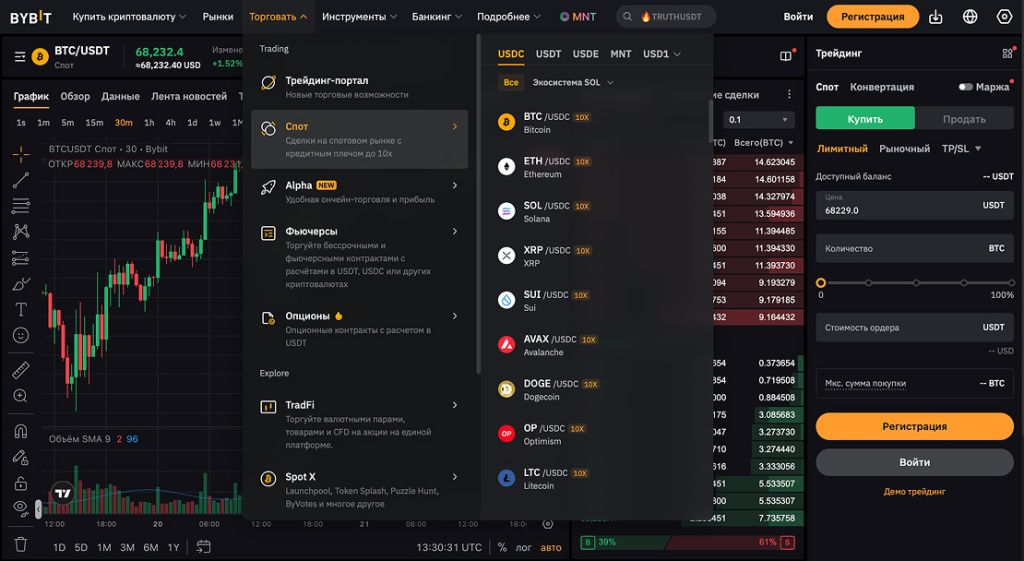
Spot is suitable for:
- short-term trades within a trend;
- building a position in strong projects;
- phased entry during corrections;
- medium-term investing during the market growth phase.
The main advantage of spot is the absence of liquidation. A position cannot be closed automatically due to market fluctuations. This reduces pressure and allows you to work systematically.
Returns depend on the market phase. In a bull cycle (a period of active market growth when cryptocurrency prices rise steadily), a spot strategy provides stable capital growth. In a sideways market, effectiveness is achieved through precise entries from support and resistance levels.
For stable work, it is important to:
- split capital across multiple trades;
- take partial profits during strong impulses;
- avoid concentrating the entire deposit in one asset.
2. Margin trading
Margin trading on the Bybit cryptocurrency exchange allows you to open a position for an amount larger than your deposit. This is achieved via leverage — the exchange temporarily provides borrowed funds secured by your capital.
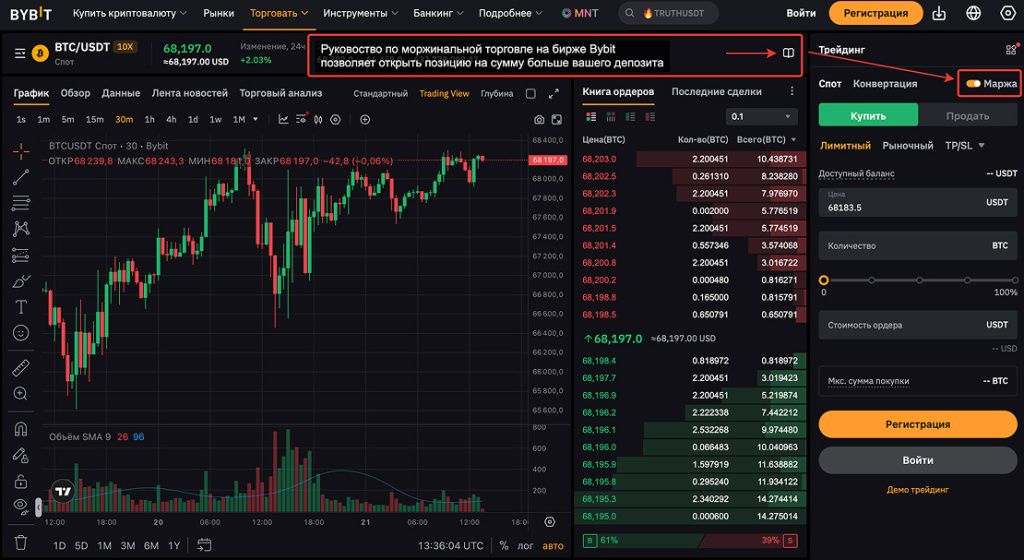
Simply put, you trade with an increased volume. If you have 100 USDT in your account and use 10x leverage, the position is opened for 1,000 USDT. Of that, 100 USDT is your margin and 900 USDT is provided by the platform.
If the market moves in the right direction, leverage accelerates deposit growth. For example, a 5% price increase will give about 50 USDT profit (5% of 1,000), which is roughly 50% return relative to your own funds. However, if the market moves against the position, the loss is also calculated from the full size. A 5% drop will reduce the deposit by about 50 USDT. If the price continues to go against you, the margin will decrease further. When collateral becomes insufficient to cover the risk, the system automatically closes the position — liquidation occurs. This is a forced closing of the trade at the current market price, necessary to return the borrowed funds.
A small clarification: liquidation is not a scary word from a horror movie — it is ordinary market math. If you treat leverage like an energy drink, it’s important to remember: it boosts quickly, but too much can end abruptly. The higher the leverage, the closer the liquidation level is to the entry point. With 10x leverage, a move of about 10% against the position is enough for the deposit to be fully exhausted. Therefore, margin trading requires discipline and precise risk calculation. Leverage amplifies not only potential profit but also the speed of capital loss.
- leverage size;
- maintenance margin level;
- liquidation price;
- interest for using borrowed funds;
- fees and funding rate;
- acceptable drawdown relative to the deposit.
The margin model is used to strengthen a position in a confirmed trend or for short-term speculation. However, without clear risk management, using leverage quickly leads to high result volatility.
3. Futures (perpetual)
Futures trading is the main instrument for active earning on Bybit. The user trades contracts on the change in an asset’s price without owning the cryptocurrency itself.
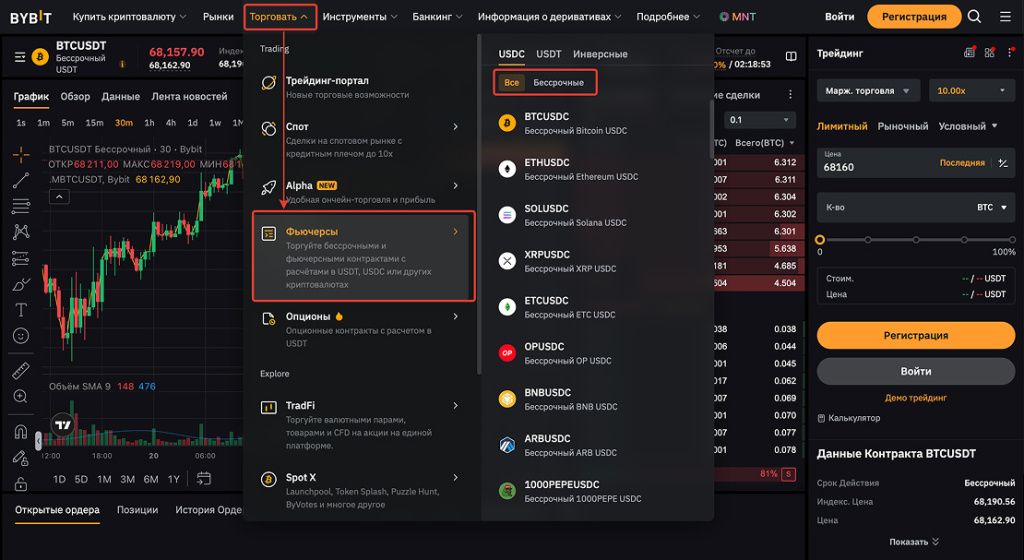
Features of perpetual contracts:
- ability to open long and short positions;
- wide leverage range;
- funding rate mechanism between market participants;
- high liquidity on major trading pairs.
Futures are used for:
- intraday trading on high volatility;
- breakout trading;
- hedging spot assets;
- algorithmic strategies.
Returns in derivatives are significantly higher than on spot, but the risk also increases. Even a small move against the position with high leverage can lead to a forced closure. On futures, it is also important to consider the funding rate and open interest: they help you understand where the current imbalance in longs/shorts is and how “overheated” the market is. For more precise entries, traders often use limit orders and Post-Only mode so as not to become a taker at market.
If we put it in very simple terms: futures are a place where the market tests your discipline faster than you can read a message in Telegram. Attention, control, and decision-making speed are the key skills for this mechanism.
4. ByBit options
Options are derivative contracts that provide the right to buy or sell an asset at a specified price within a set period. On Bybit, options settled in USDC are available for major cryptocurrencies.
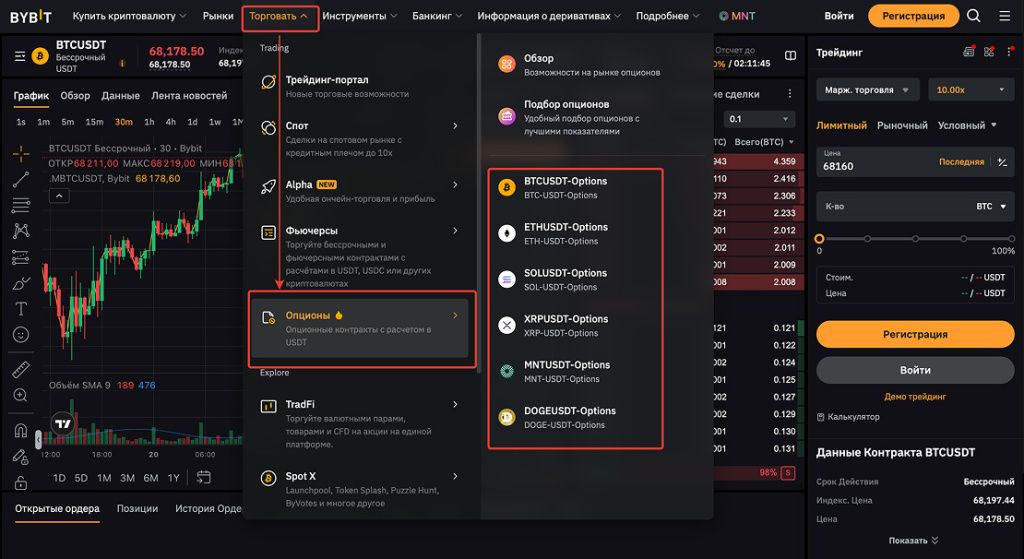
Options strategies are used for:
- earning on market volatility;
- receiving income from the premium;
- insuring open positions;
- combined strategies with risk limitation.
Options require understanding strike price, expiration, and the time value of the contract. The tool is suitable for traders working with more complex analysis models.
5. Leveraged tokens
Leveraged tokens are derivative instruments for working on the Bybit exchange that trade on the spot market, but already contain built-in leverage inside (for example, 2x or 3x). In fact, these are structured positions on futures contracts packaged into a single asset.
How it works:
- the growth of the underlying asset is amplified according to the leverage coefficient;
- a price decline is also amplified proportionally;
- rebalancing happens automatically.
The key difference from margin and futures is the absence of direct liquidation. The user simply buys the token like a regular coin. At the same time, volatility is higher than usual.
Leveraged tokens are used for:
- short-term speculation on a strong impulse;
- working within a confirmed trend;
- an alternative to margin trading without a separate margin account.
The instrument is sensitive to sideways markets due to the daily rebalancing mechanism. Over a long horizon, efficiency is lower than with targeted work in a trend.
Leveraged tokens explained for beginners
Leveraged tokens are coins that move stronger than usual. If the market rises, they rise faster; if it falls, they fall faster. They are suitable for short trades, but not very convenient for long-term holding.
For example, if BTC rises by 1%, then the BTC3L token may rise by about 3%.
If BTC falls by 1%, the same token will fall by about 3%.
3L is short for 3x Long.
Simple decoding:
- 3 — triple leverage (movement is amplified by 3 times);
- L (Long) — a bet on growth.
So BTC3L means: a token with triple leverage on Bitcoin’s upside.
If you see BTC3S, then:
- 3 — triple leverage;
- S (Short) — a bet on decline.
This is a token with triple leverage on a decrease in BTC price.
6. Long-term investing
A long-term holding strategy (HODL) is based on the cyclical nature of the crypto market. An asset is purchased with the expectation of multi-month or multi-year growth. Simply put, you buy and, without reacting to the market, hold for the long term 1–2–3 years and so on.

Most often, the portfolio includes:
- BTC as a base asset;
- ETH as an infrastructure coin;
- large altcoins with a sustainable ecosystem;
- projects from growing sectors (AI, Layer-2, DeFi).
Income is formed by the expansion of the market cycle. In the bull market phase, an investment approach can show multiple growth of capital without active trading.
For a long-term strategy, these are important:
- diversification by sectors;
- phased entry during corrections;
- partial profit-taking at cycle peaks.
The investment approach reduces operational load and suits those focused on strategic capital growth.
7. P2P arbitrage on ByBit
Bybit’s P2P platform allows users to buy and sell cryptocurrency directly with other users using bank transfers and payment systems. Differences in rates create arbitrage opportunities.
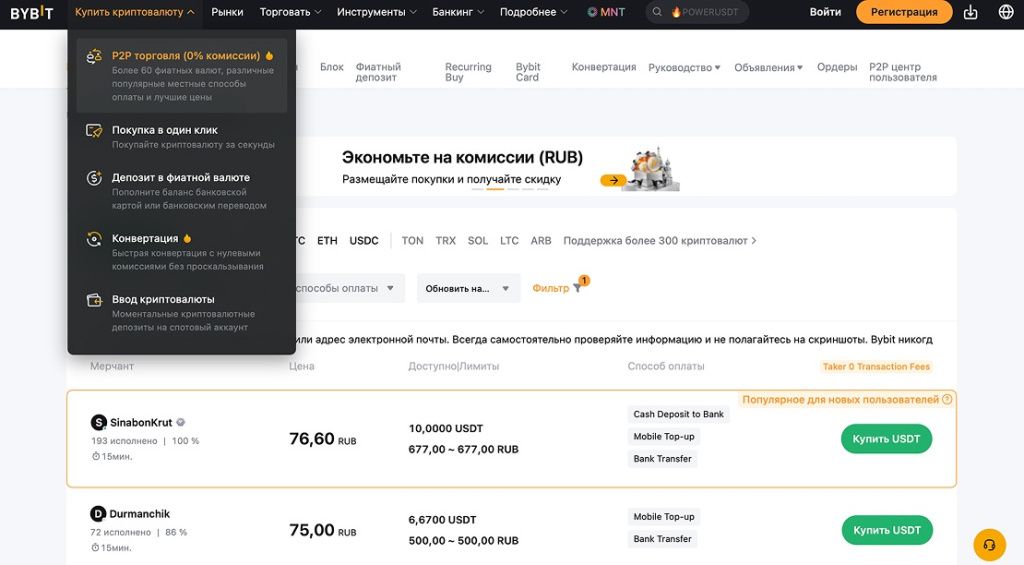
Main earning models:
- buying USDT cheaper from one seller and reselling higher;
- using differences between banks and payment channels;
- bundles between P2P and the spot market.
Income is formed due to the spread (the difference between the purchase price and the sale price). With high turnover, even a small price difference produces a noticeable financial result.
The P2P model requires:
- control of request processing speed;
- working with several banks;
- managing payment system limits;
- constant monitoring of rates.
With systematic work, P2P can become a stable turnover business inside the exchange. For large volumes, many aim to obtain merchant status (a verified seller) — this increases user trust, speeds up deals, and improves application conversion.
Earnings in P2P are built on the spread between buy and sell prices. In essence, this is arbitrage inside the platform: the trader buys an asset cheaper via one payment method and posts a sell ad at a higher price via another channel. With high turnover, even a small difference of 0.3–1% turns into noticeable income.
Main earning models in P2P:
- buying USDT at an undervalued rate and reselling higher within the exchange;
- working with different banks and payment systems to obtain a better spread;
- arbitrage between P2P and the spot market during sharp price moves;
- working both ways — simultaneously placing buy and sell ads;
- scaling through multiple accounts and different payment channels (while following platform rules).
Example: with a deposit of 300,000 ₽ and an average spread of 0.6%, one deal brings about 1,800 ₽. If you do 5–7 turns per day, gross profit can be 9,000–12,000 ₽ before fees and bank limits. If turnover increases to 1–2 million ₽, profitability scales proportionally, provided the spread remains stable.
Earnings level directly depends on turnover. Beginners more often start with small amounts (100–300 thousand ₽) to understand the mechanics and test bundles. More experienced market participants work with large limits and strive to obtain merchant status, which gives:
- increased limits for posting ads;
- priority display in listings;
- a higher level of trust from buyers;
- the ability to work with large volumes without losing turnover speed.
For a stable result, it is important to consider bank limits, transfer confirmation speed, the risk of card blocks, and the need to distribute turnover across several payment methods. Professional P2P work is no longer occasional deals, but a systematic model with risk management, fee accounting, and constant market monitoring.
In simple terms, you can earn on P2P trading in Bybit through regular turnover and discipline. It is not a one-off deal, but systematic work with spread and volume.
A P2P merchant is a user with a verified reputation and increased limits. To become a merchant on Bybit, you need to meet requirements on trading volume, order fulfillment level, and service quality. After obtaining the status, ads are shown higher in the list, which increases deal flow.
That is why, for those who plan to scale arbitrage on Bybit, moving to merchant status becomes a logical development stage.
8. Bybit Earn
Earn is a passive income direction: essentially “deposits” in cryptocurrency and staking in different formats. The user places an asset for interest and receives a reward in the form of APR, choosing flexible savings (withdraw anytime) or a fixed term. In essence, Earn works like crypto deposits: an asset is placed under flexible or fixed conditions, and income accrues daily or at the end of the term. Many users choose this section to receive passive income without active trading.
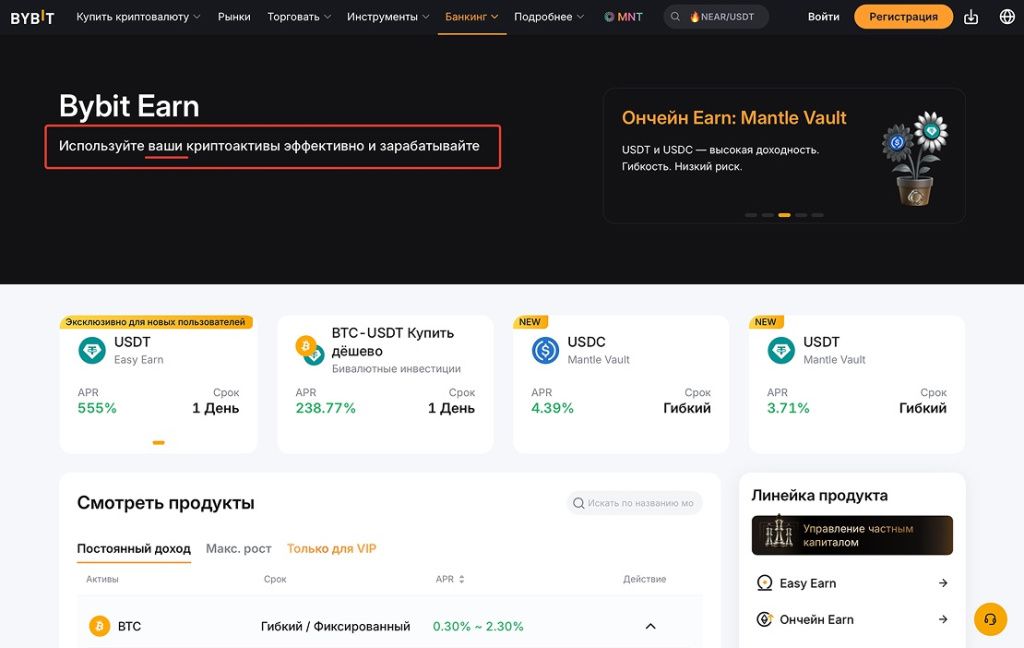
A separate direction is staking, where income is formed by participating in the network mechanism (Proof-of-Stake). Before placing, it is important to consider the lock-up period and potential yield.
Placement formats:
- flexible products with the ability to withdraw at any time;
- fixed deposits with an increased rate;
- periodic promo programs with increased yield.
Yield depends on the asset and market conditions. Stablecoins more often provide a moderate rate, altcoins a higher one.
Earn is used for:
- monetizing idle capital;
- receiving passive interest without active trading;
- diversifying a portfolio.
The tool is oriented toward users who prefer a more conservative income model.
9. On-chain Earn on Bybit
On-chain Earn combines products based on real blockchain staking. Income is formed by participating in the network consensus mechanism.
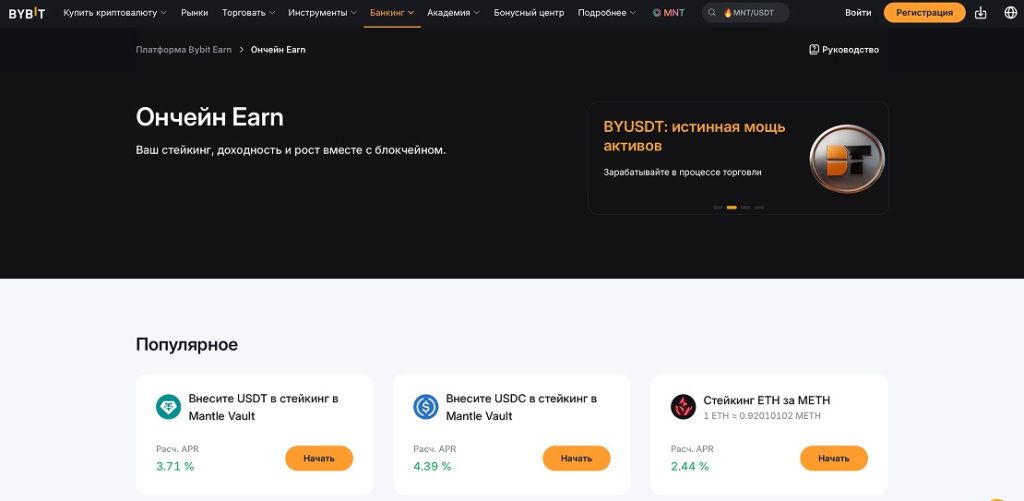
Features:
- yield depends on the protocol;
- rewards accrue in the native coin;
- lock-up periods may differ.
The on-chain model allows you to receive income directly from the network, not only due to the exchange’s internal liquidity.
Staking is in demand for large assets with a developed ecosystem and a stable token economy.
10. Dual-currency investments (Dual Asset)
Dual-currency investments on Bybit are a structured product designed for operation under moderate volatility. The user chooses an asset, strike price, and placement term. The final settlement depends on where the price ends up by expiration.
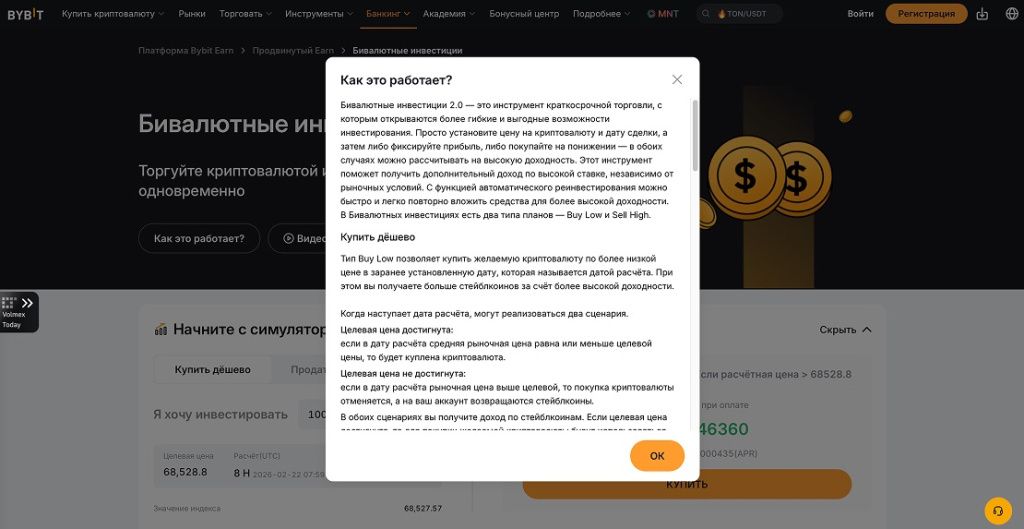
How it works:
- capital is placed for a fixed term;
- yield is known in percentage terms in advance;
- payout can be made in the alternative currency of the pair.
For example, when placing USDT linked to the BTC price, you may receive either interest in USDT, or settlement in BTC — if the price reaches the selected level.
The instrument is used:
- in a sideways market;
- when a price range is forecast;
- to increase stablecoin yield.
Dual Asset is suitable for users who are ready to accept the alternative currency if conditions are met. Yield is higher than standard deposit products, but the final asset may differ from the initial one.
11. Bybit structured products (relevant for 2026)
In 2026, Bybit structured products are available in the Earn section and include several high-yield instruments. Profit depends on the behavior of the asset’s price by the end of the term.
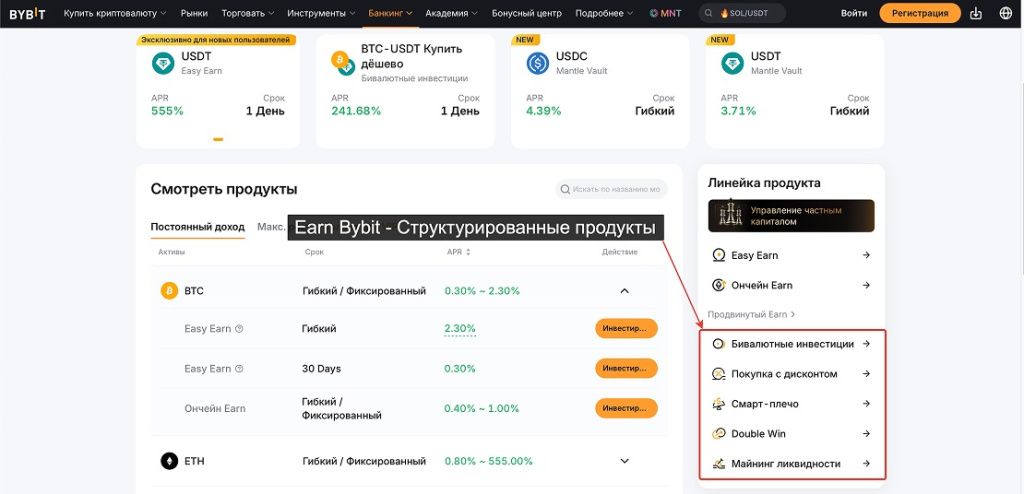
The Structured Products lineup includes:
- Dual-currency investments (Dual Asset) — placing an asset with the possibility of receiving income in USDT or cryptocurrency depending on the price at settlement.
- Double Win — a product with returns when the price moves strongly up or down.
- Discount Buy — the opportunity to buy cryptocurrency at a pre-set price below the market if conditions are met.
- Smart Leverage — a structured tool that amplifies price movement without classic liquidation until settlement.
- Liquidity mining (item 12 below) — providing liquidity to trading pairs with income from fees and APR.
The mechanics are simple: you place USDT, USDC, or cryptocurrency for a short term (usually from 1 to 21 days) and choose a strategy. If the market scenario plays out — yield is higher than standard Earn. If not — yield is lower or settlement occurs in the alternative currency.
Comparison with Easy Earn:
- Easy Earn — fixed or floating interest without being tied to price movement.
- Structured Products — higher yield, but it depends on market conditions and the selected strategy.
Shark Fin was suspended in 2023 (product history)
Shark Fin was launched on Bybit in July 2022 as a separate structured product with a range-based yield model. The idea was choosing a price corridor. If the asset price at the end of the plan remained within the range, the maximum yield was accrued. If it went beyond, the interest decreased.
In 2023, Shark Fin was gradually discontinued as a standalone product, and its mechanics were integrated into updated structured strategies within Earn.
12. Liquidity mining
Liquidity mining is based on the pool principle. The user adds assets to a trading pair and receives rewards for providing liquidity. It belongs to the Earn product line.
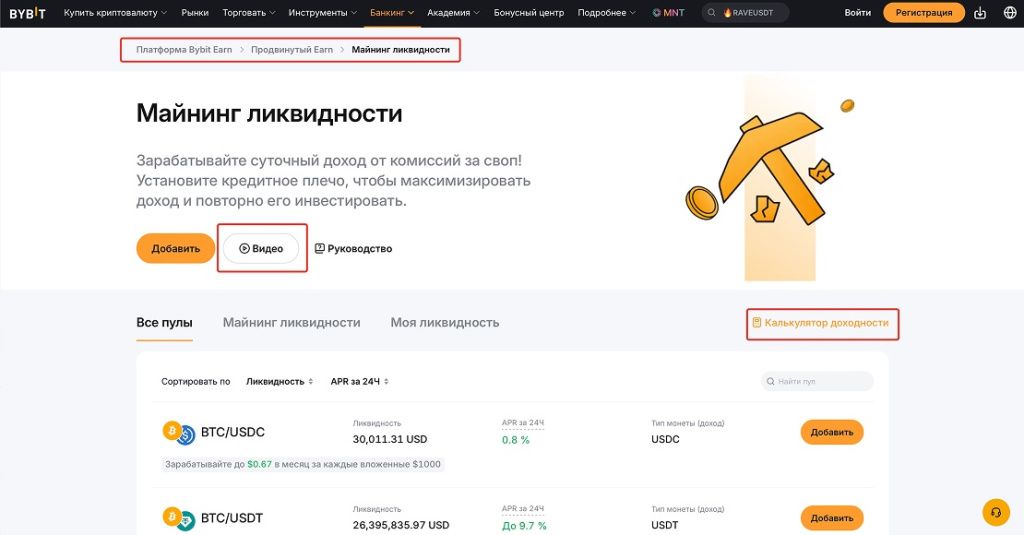
Income is formed from:
- fees from trades within the pool;
- additional platform incentives;
- possible bonus programs.
The mechanics предполагают placing two assets in a specific proportion. With active trading inside the pair, yield increases.
An important factor is the change in the ratio of assets as the price moves. Income depends not only on fees but also on market dynamics.
Liquidity mining is suitable for users willing to manage an asset pair and track market structure.
13. Launchpad (Spot X / Token Launch Platform)
Launchpad is a platform for initial token offerings of new projects on the Bybit exchange. In 2026, the product is effectively integrated into the Spot X ecosystem — a unified section for all activities related to new listings, token sales, and project launches.
In other words, the classic Launchpad as a separate tab may not be displayed in the menu, since it became part of the broader Spot X platform. This does not отменяет the token sale mechanism — it continues to work, but is now presented inside a unified block of new spot launches.
Launchpad (within Spot X) is a place where users get the opportunity to participate in token distribution before they reach the open market.
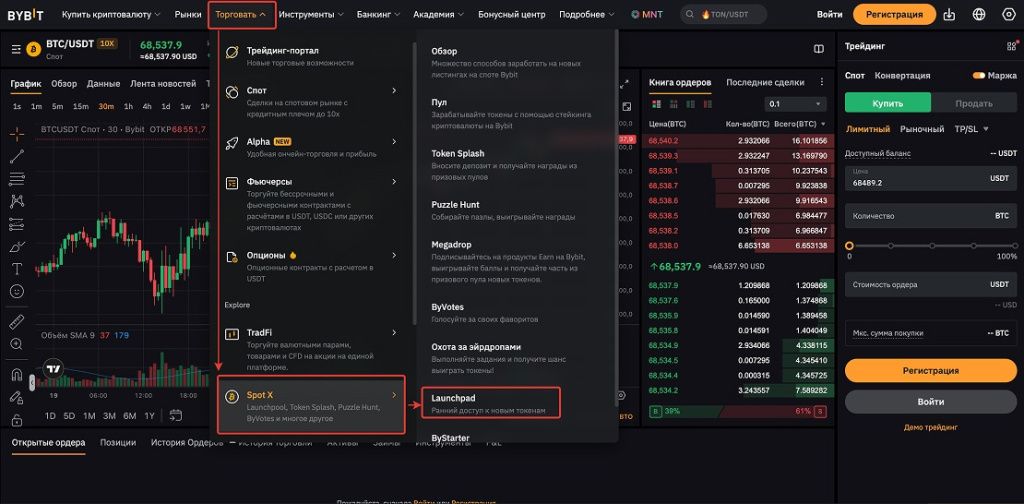
Participation model:
- holding a certain amount of tokens (for example, MNT or USDT — depending on the conditions of a specific launch);
- snapshotting the balance during the calculation period;
- allocation distribution proportional to the average amount held;
- subsequent listing of the token on the spot market and opening free trading.
Profitability is formed by the difference between the distribution price and the market price after listing. In some cases, projects showed multiple growth in the first days of trading, but the final result always depends on market conditions, demand, and the project’s fundamentals.
It is important to note that in 2026 the exchange gradually moved to the unified Spot X platform format: Launchpad, Launchpool, and other token launch mechanisms are integrated into one ecosystem block. This is more an evolution of the interface and product structure than its cancellation — the logic of participation and distribution principles have been preserved.
Launchpad is used by investors to diversify a portfolio and gain access to new ecosystems at an early stage of project development, before a full market valuation forms.
14. Launchpool (Pool in Spot X)
Launchpool by ByBit is a way to receive new tokens without buying them. You temporarily place coins you already have (for example, USDT or MNT) in a special pool and receive a reward in the form of the new project’s token.
What is launchpool in cryptocurrency in simple terms: you “put” your cryptocurrency into a common pool, and the exchange accrues new coins to you daily. Your main asset remains yours and is usually available for withdrawal.
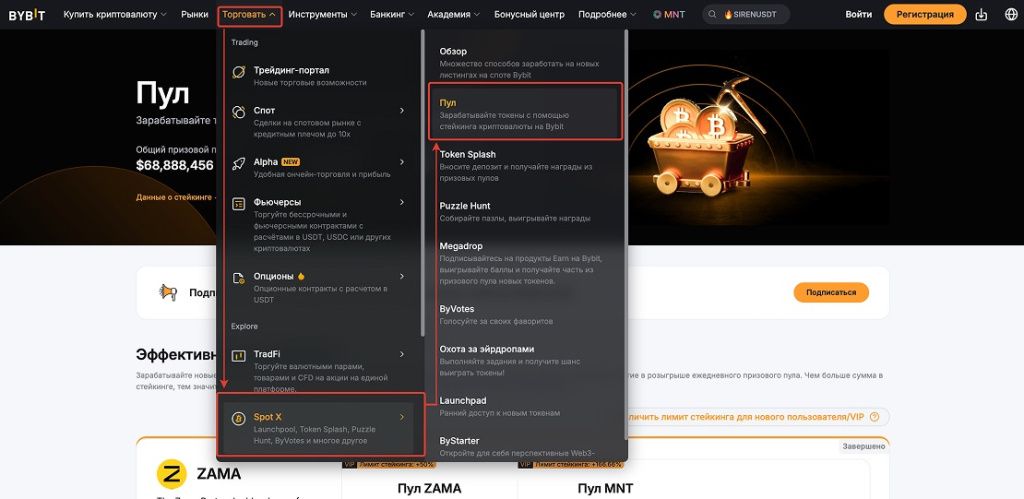
How it works:
- choose an available pool;
- deposit the supported asset;
- receive daily accruals of the new token;
- after the campaign ends, the token enters spot trading.
Features:
- flexible withdrawal of funds (if no separate conditions are specified);
- daily accruals;
- does not require active trading.
Yield depends on your participation volume, the number of participants, and the token’s price after listing.
15. ByBit referral and partner programs
Referral and partner programs for earning on ByBit without investment are favorite tools for monetizing an audience inside a crypto exchange. They allow you to receive rewards for attracting new users and their trading activity.
The referral program is aimed at individual users and implies receiving a percentage of the fees paid by invited traders.
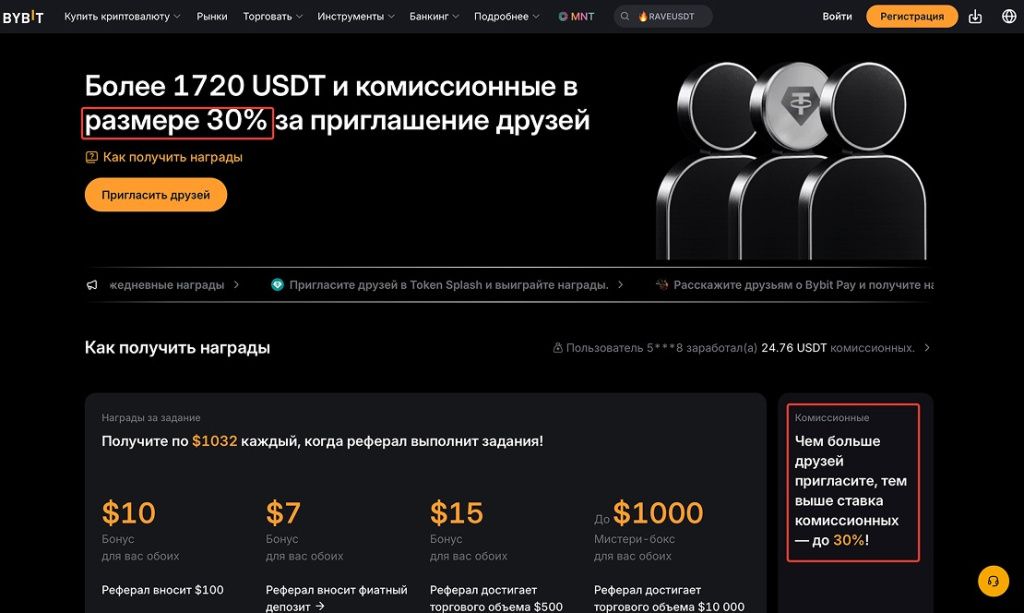
The partner program is intended for media, bloggers, arbitrage teams, and professional communities and предполагает extended cooperation conditions.
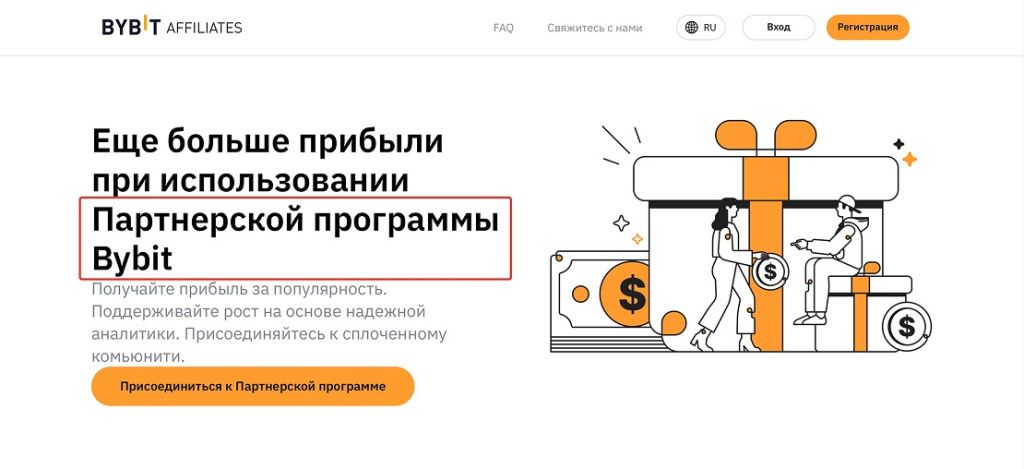
Income is formed due to:
- a percentage of trading fees paid by attracted users;
- bonus programs and promotions;
- sub-partner payouts;
- individual conditions for large traffic volumes.
Comparison of terms
| Parameter | ByBit referral program | ByBit partner program |
|---|---|---|
| Target audience | Individual users | Media, bloggers, teams, communities |
| Source of income | Percentage of referral fees | Higher percentage + bonus programs |
| Reward size | Base fixed percentage | Individual rates depending on traffic volume |
| Scalability | Limited to your personal circle | High — with systematic audience acquisition |
| Sub-partner model | Usually absent | Available (income from attracted partners) |
| Dependence on your own trading | Does not depend | Does not depend |
The partner model from Bybit (affiliate program) is considered a more professional tool for monetizing traffic and forming stable commission income when you have an audience and systematic user acquisition. It requires verification and, as they write, takes up to 5 days, but in practice it can be faster — 1–2 days.
Comparison of earning methods on Bybit
The exchange’s tools differ by risk level, required capital, and the nature of returns. условно, they can be split into three categories.
High profitability and high volatility
- futures;
- margin trading;
- options;
- leveraged tokens.
These tools are suitable for active trading and require strict position control. Income can form quickly, but the result is sensitive to market impulses.
Moderate profitability with controlled risk
- spot trading;
- dual-currency investments;
- Shark Fin;
- liquidity mining.
These models are applied with a more systematic approach and allow you to manage capital without постоянного presence at the terminal.
Passive and infrastructure models
- Bybit Earn;
- on-chain staking;
- Launchpool;
- referral programs.
Income is formed by placing assets or attracting an audience. Operational load is lower.
How to choose an earning strategy
Choosing an earning model on Bybit depends not only on capital but also on your level of preparation. The mistake most beginners make is starting with complex instruments without understanding risk mechanics.
Before choosing futures, margin, or P2P, it is important to soberly assess:
- the size of available capital;
- the acceptable drawdown of the deposit;
- experience working with a volatile market;
- the ability to follow risk management.
Different experience levels imply different loads on the deposit and different tools. Below is a условное segmentation of traders by experience and suitable strategies.
| Trader level | Experience | Typical capital | Acceptable drawdown | Suitable tools | Main goal |
|---|---|---|---|---|---|
| Beginner | 0–3 months | 100–500 USDT | Often not controlled | Spot, Bybit Earn, basic staking | Understand market mechanics and not lose the deposit |
| Advanced beginner | 3–6 months | 500–2,000 USDT | 10–30% | Spot, futures 2x–5x, P2P (testing) | Stabilize results and master risk management |
| Intermediate trader | 6–18 months | 2,000–15,000 USDT | 5–15% | Futures, margin, P2P bundles, Launchpad, staking | Regular returns and systematic trading |
| Advanced trader | 1.5–3 years | 20,000–100,000 USDT | Up to 10% | Futures with flexible leverage, options, arbitrage, Dual Asset | Capital management and reducing result volatility |
| Professional | 3+ years | 100,000+ USDT | Strictly regulated | Strategy комплекс, algorithms, hedging, large P2P | Stability and drawdown control |
Risk management
Income on a crypto exchange is determined not only by the choice of tool but also by risk management.
Basic principles:
- limiting position size relative to the deposit;
- diversification across assets and directions;
- taking profit in parts;
- leverage control;
- accounting for the market cycle.
The cryptocurrency market goes through phases of growth, distribution, decline, and accumulation. Tool effectiveness differs in each phase. Active trading shows results during periods of high volatility. Investment products demonstrate stability in more stable dynamics.
How much can you earn on Bybit
Returns depend on the selected model, financial assets, experience, and risks. In active trading, significant percentage moves are possible over a short period. In passive products, income is expressed as an annual rate.
If we translate it into numbers, in active trading the average working range for a disciplined trader is 0.5–3% per day of capital with moderate risk. During periods of high volatility the result can be higher, but the risk of drawdown increases proportionally.
In passive products (Earn, staking, Dual Asset), yield usually ranges from 5–20% per year depending on the asset and placement conditions. This is not daily income but accrual in APR format.
An example of the most popular format — futures with moderate leverage (from and to)
Initial data:
- Capital: 1,000 USDT
- Instrument: BTCUSDT futures
- Leverage: 3x
- Position size: 3,000 USDT
- Risk per trade: 2% of the deposit (20 USDT)
The trader opens a position in the direction of the trend. The market move is +1.5% on the underlying asset.
Profit calculation:
- BTC rises by 1.5%
- With 3x leverage, the resulting position move ≈ 4.5%
- 4.5% of 3,000 USDT = 135 USDT
Part of it can be locked in. If the strategy implies closing 50% of the position on the first impulse, about 60–70 USDT net profit is fixed per trade (taking the fee into account).
With 1–2 quality trades per day, the working income range can be 20–80 USDT per day with 1,000 USDT capital. This is a 2–8% daily result in an active market phase.
At the same time, it is important to consider the downside: a −1.5% market move at the same leverage will give a comparable loss. Without a stop order, the drawdown can quickly go beyond acceptable risk.
An example of a passive option — Earn
- Capital: 5,000 USDT
- Annual rate: 10% APR
10% per year = about 500 USDT per year. Per day, that is around 1.3–1.4 USDT. The income is small, but stable and without active trading.
A realistic approach is built on systematic work and drawdown control. A strategy without risk management leads to a high amplitude of results. In practice, most sustainable models combine active trading and passive tools to smooth income volatility.
Conclusion
Bybit provides a wide set of earning tools: from basic spot trading to structured investment products and participation in new projects. The choice of model depends on the user’s goals, acceptable risk, and investment horizon.
The combination of active and passive tools allows you to build a stable capital management model within one platform.
FAQ — Frequently asked questions about earning on Bybit
Is it реально possible to earn on Bybit in 2026?
Yes, earning on Bybit is realistic through active trading, investment products, and participation in new projects. Income is formed from market volatility, interest on placed capital, and arbitrage opportunities. The result depends on the chosen strategy and risk management.
How can a beginner earn on Bybit?
For beginners, it is rational to start with spot trading and Bybit Earn products. Spot allows you to work without leverage, and Earn provides passive yield. After mastering the basic principles, you can gradually add margin or futures with minimal leverage.
How to earn on Bybit without investment?
Without starting capital, the following are available:
- referral program;
- partner model if you have an audience;
- participation in promo campaigns and trading tournaments;
- periodic airdrops and bonus campaigns.
The no-investment model requires time and active work with traffic.
How much can you earn on Bybit?
Returns vary depending on the instrument. In active trading, the result depends on volatility and discipline. In Earn products, income is expressed as an annual rate. In Launchpad, profit is formed when the token grows after listing. There is no universal процент return — the result is determined by the strategy.
Which earning method on Bybit is the most profitable?
The highest income potential comes from futures and margin trading due to the use of leverage. However, the risk level is also higher. For a more stable result, a combined model is used: part of the capital in active trading, part in passive products.
Is it safe to store funds on Bybit?
The platform uses a multi-layer security system and cold storage of assets. At the same time, for long-term investing, it is reasonable to distribute large amounts between the exchange and an external wallet.
What fees are charged when trading?
Fees differ for spot and derivatives. On futures there is a maker/taker split. Fee reductions are possible by increasing trading volume or participating in the VIP program.
What is more profitable — spot or futures?
Spot provides a more stable model with lower volatility of results. Futures make it possible to earn both on price rises and declines, but require strict position control. The choice depends on the level of preparation.
How does P2P arbitrage work on Bybit?
P2P arbitrage is based on the difference in rates between platform participants or bundles between payment methods. Income is formed from the spread. As turnover increases, total profit grows.
Is Bybit suitable for long-term investing?
Yes, the platform supports buying and holding cryptocurrencies, placing assets in Earn, and participating in staking. This makes it possible to combine trading and investment strategies within one account.
What are the risks of earning on Bybit?
The main risks are related to crypto market volatility, the use of leverage, and changes in the market cycle. Controlling position size and diversification reduce the impact of drawdowns.
Can you combine several earning methods?
Yes. In practice, combining active trading, Earn, and Launchpool allows you to allocate capital across different risk levels and smooth income volatility.
How to minimize risk when trading on Bybit?
Basic risk management methods:
- limiting position size;
- using stop orders;
- diversifying assets;
- working with moderate leverage;
- accounting for market cycle phases.
Which strategy is considered the most sustainable?
A balanced model that includes spot holding, partial active trading, and placing free capital in Earn or staking shows stable dynamics in different market phases.
How to view purchase and trade history on Bybit?
Operation history is available in the orders and trade history section: it stores spot purchases, closed derivatives positions, and account movements. This is convenient for controlling results and accounting for fees.
What is the funding account on Bybit?
This is a separate balance used for P2P and transfers between exchange sections. It helps separate trading funds from operations related to deposits/withdrawals and P2P deals.
Can you start trading on Bybit from a phone?
Yes, basic spot, Earn, and P2P operations are convenient to perform via the app. Beginners usually find it easier to start from a phone on spot without leverage, and move to futures after learning the interface and risk management.