



The cryptocurrency market is changing rapidly: financial parameters fluctuate every day, new exchange platforms appear, and old ones may turn out to be questionable. In a dynamic market environment, it is important to choose an exchanger with the best rates and high reliability.
Differences in rates and commissions between platforms can significantly affect the final exchange amount. To make the right decisions, it is important to be able to assess the market situation and choose the optimal moment and platform for exchange.
What is exchanger monitoring, why is it needed, and how does it help navigate this dynamic world?
What is exchanger monitoring and why is it needed
Exchanger monitoring is an aggregator that collects data from various crypto exchange services and allows you to compare rates, commissions, and available reserves. It makes it possible to evaluate the rates of USDT, USDC, Tether, and other popular tokens, as well as check available reserves, commissions, and withdrawal methods to a bank account, card, or in cash.
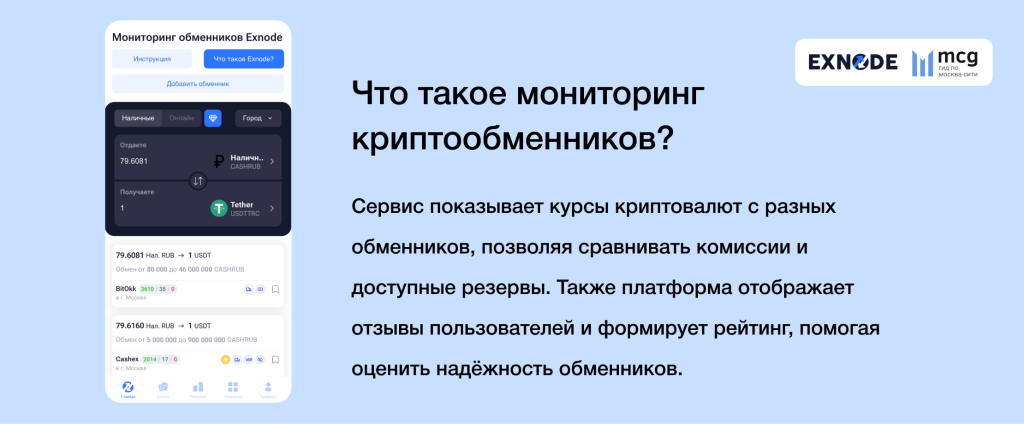
How the service works: information is updated in real time, including the transfer option (for example, USD → RUB), minimum and maximum amounts, as well as the rating of each platform. The service displays current offers taking reserves and commissions into account.
Why is this needed? Because different exchange points offer different conditions: some work with TRC20, others with bank transfers or cards, and some limit the withdrawal amount. Using an aggregator allows you to compare the conditions of different platforms and choose a service with suitable exchange parameters.
Example: if you want to exchange USDT to RUB, the service will show which crypto exchangers have sufficient liquidity, the best rates, and support a convenient receiving method for you — a bank account, card, or cash. Thus, the user immediately sees the optimal options without manually visiting each exchanger.
How a crypto exchanger comparison service works
Technologically, the operation of exchanger aggregators is built on two main principles: API integration with official partners and data parsing from websites that do not provide open access to data. This makes it possible to track in real time such a critical parameter as the platform's liquidity for each individual direction.
- Data collection. The service receives data through open exchanger APIs or website parsing where no API is available. This allows it to track current rates of USDT, USDC, BTC, and other tokens, as well as available reserves and withdrawal methods to a bank account, card, or in cash.
- Information updates. Data is updated every few minutes. Thanks to this, the user sees fresh rates, current minimum and maximum exchange amounts, as well as changes in exchanger ratings in real time.
- Filtering and sorting. The user can choose a transfer option, specify the required amount, the preferred withdrawal method (card, bank account, cash), and sort the results by rating. This makes it possible to quickly find optimal options without checking each exchanger manually.
Advantages of using monitoring platforms
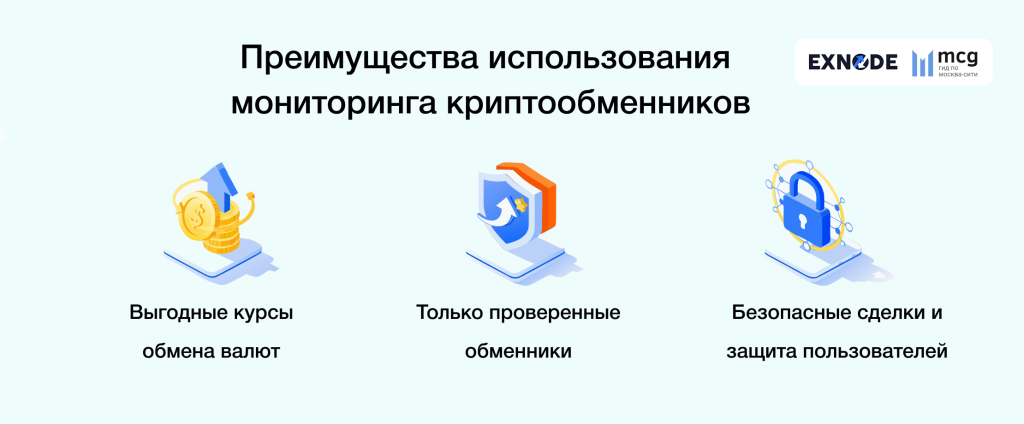
Service aggregators allow users to quickly find profitable exchanges. Different platforms set their own prices for USDT, USDC, BTC, and other cryptocurrencies, and the service collects this information in one place. The user can immediately see where the rate is the most favorable and minimize losses during a transfer, for example, USDT → RUB or USD → RUB.
In addition, the aggregator helps users work only with verified exchangers. Platform ratings and user reviews make it possible to assess the reliability of a service and reduce the risk of fraud. This way, the user sees which exchangers consistently carry out exchanges and comply with the stated conditions.
The service helps the user find current offers, avoiding unnecessary site visits and minimizing financial losses. All exchange conditions are collected in one interface and updated automatically. There is no need to go to separate websites to compare offers and choose the optimal option.
Finally, monitoring increases transaction security. The service controls the relevance of rates and reserves, integrates user reviews, and allows users to choose safe methods of receiving funds. This makes the exchange process transparent, minimizes the risk of transfer errors, and provides confidence that the transaction will be completed correctly.
Comparison of popular exchanger monitoring services
There are several major crypto exchanger monitoring services on the market. They differ in the number of connected exchange platforms, the depth of analytics, the rating system, and the convenience of filters. Let us consider the main features of the best-known monitoring services.
| Monitoring service | Key features | Number of exchangers | Rating system | Additional functions |
|---|---|---|---|---|
| Exnode | Crypto exchanger monitoring with a focus on current rates and reserves for large transactions | More than 100 | Platform rating and analytical data (the rating is based on the best rate) | Filters by reserves, payment methods, reviews, and exchange directions |
| BestChange | One of the exchanger aggregators, working with a large number of exchange directions | More than 100 | User reviews and its own verification system | Rate history, exchange rate change notifications |
| Kurs Expert | Rate comparison service with a large number of currency exchange directions | More than 300 | User ratings and comments | Notifications about favorable rates |
Each of these services solves the same task — it helps the user quickly find a suitable exchanger for a specific transaction. However, the differences between platforms can affect ease of use.
Some services focus on the maximum number of connected exchangers and a wide choice of exchange directions. Others rely on a narrower list of partners but pay more attention to platform verification and data analytics.
Differences are also visible in the interface and filtering system. For example, some monitoring services allow users to sort exchangers by reserves, rating, or transaction speed, as well as track exchange rate changes in real time. This is especially important when working with popular exchange directions such as USDT → RUB or BTC → bank card.
Thus, the choice of a monitoring service depends on the user's tasks. If the widest possible market overview is required, platforms with a large number of connected exchangers can be used. If analytics, transparency of conditions, and convenient filters by reserves and payment methods are more important, it is worth paying attention to specialized monitoring services.
How to use monitoring services: process overview
The use of monitoring platforms usually begins with visiting the relevant website, where information about rates, reserves, commissions, and platform ratings is collected.

On the platform, you can choose the exchange direction — for example, USDT → RUB or BTC → bank card — to see current offers for a specific transaction.
The service combines information about dozens of exchangers for convenient comparison of offers. Platform ratings and user reviews are also displayed, which makes it possible to assess the reliability of each service and pay attention to possible nuances of working with it.
After analyzing the information, the user can go to the selected exchanger to complete the exchange. At this stage, the payment details and transaction details are usually checked to make sure the conditions and available amounts are correct. Therefore, the monitoring aggregator acts as a market overview tool, allowing users to see current offers and assess them comparatively without having to visit each exchanger separately.
Types of exchange directions
There are several popular types of transactions on the exchanger market that reflect the ways of transferring cryptocurrencies into fiat money or between different digital assets.
| Exchange direction | Payment methods | Speed | Features |
|---|---|---|---|
| USDT → RUB | Bank account, card, cash | Medium / fast | Popular among local users; speed depends on the payment method |
| USDC → RUB | Bank account, card, cash | Medium / fast | A stable cryptocurrency with minimal volatility; the choice of method affects the crediting speed |
| BTC → RUB | Bank account, card, cash | Medium | Often used for large transfers; speed depends on blockchain confirmations |
| USD → card / account | Bank card, bank account, sometimes cash | Fast / medium | Convenient for everyday use; limits depend on the exchanger and bank |
| USDT → bank account / card | Bank account, card, sometimes cash | Medium / fast | Suitable for large amounts; speed depends on the method |
| Internal transfers between crypto wallets (USDT, USDC, BTC) | Crypto wallet | Very fast | Used for transfers between wallets; speed depends on the network (TRC20, ERC20, BTC) |
The most common options include: exchanging cryptocurrency into rubles (for example, USDT → RUB), transferring US dollars to a bank card (USD → card), sending USDT to a bank account, and receiving cash. Each option has its own features related to available payment methods, transaction speed, and commissions.
Different exchangers work with different systems and payment methods. For example, one platform may support only transfers to cards and bank accounts, another may offer cash through payment agents, while a third works with specific blockchains such as TRC20 or ERC20. Therefore, the choice of direction directly depends on the options available on a specific platform.
Service filters play an important role in simplifying the choice. The user can specify the exchange pair, the minimum or maximum amount, the preferred method of receiving funds, and the currency type. The service will immediately display suitable exchangers, allowing each option to be compared. This helps optimize the exchange in terms of rate, commission, and security.
What payment methods are supported and how this affects the exchange
Different exchangers provide different ways of receiving and sending funds, and the choice of method directly affects the speed and convenience of the exchange.
| Payment method | Description | Speed | Commissions | Available amount | Features |
|---|---|---|---|---|---|
| Transfer to a bank account | Funds are credited directly to the user's account | Medium (depending on the bank) | Fixed or percentage-based, displayed on the exchanger's website | Suitable for large amounts | Depends on bank operating hours; international transfers may sometimes be delayed |
| Transfer to a bank card | Funds are credited to the user's card | Fast | Depends on the exchanger and the bank | Usually for small and medium amounts | Convenient for everyday use; limits depend on the platform and bank |
| Cash through an exchanger | Receiving funds in cash at an office or through the exchanger's built-in pickup points | Medium | Fixed, sometimes included in the rate | Depends on the limits of a specific exchanger | Available for local transactions and fully processed through the exchanger's platform |
| Internal transfers between crypto wallets | Funds are transferred between the user's wallet and the exchanger's wallet | Very fast | Minimal, depend on the network (TRC20, ERC20, etc.) | Usually for any amounts within the network | Often used for USDT, USDC, and other supported tokens |
Let us look at them further:
1. Transfers to a bank account
- Allow money to be credited directly to a bank account.
- Suitable for large amounts, but the crediting time may vary depending on the bank.
- Commissions are usually fixed or percentage-based and are displayed on the exchanger's website.
2. Transfers to a bank card
- One of the fastest ways to receive funds.
- Convenient for everyday use and small amounts.
- Limits and commissions depend on the specific exchanger and bank.
3. Cash through an exchanger
- Some exchangers offer the possibility of collecting the amount in cash at an office or through built-in pickup points, while the transaction is fully processed through the exchanger's platform.
- Usually available for local exchanges and has fixed limits for the minimum and maximum amount.
4. Internal transfers between cryptocurrency wallets
- Assets are transferred between the user's wallet and the exchanger's wallet.
- Speed and commission depend on the network (for example, TRC20 or ERC20).
- Often used for USDT, USDC, or other tokens supported by the exchanger.
Impact of the chosen method on the exchange
- Speed: transfers to a card or internal cryptocurrency transfers usually go through faster than transfers to a bank account.
- Commissions: vary depending on the payment method and network.
- Amount: minimum and maximum limits depend on the method and the rules of the specific exchanger.
- Availability: not all exchangers support all methods, so filters help quickly find a suitable platform.
Online exchangers and the role of monitoring when choosing the best service
The modern cryptocurrency market is increasingly focused on digital platforms, and online exchangers are becoming the main way of exchanging tokens for most users. With the growing number of platforms and frequent rate changes, choosing a suitable service manually is becoming more and more difficult. That is why the topic of online exchangers logically follows the discussion of monitoring: it helps users navigate this variety.
Online exchangers allow users to exchange cryptocurrency for fiat money or other digital assets via the internet, without the need to visit offices or physical exchange points. Platforms provide users with current data on rates, reserves, and payment methods, which makes the exchange process fast and convenient.
The variety of exchangers on the market creates the task of choosing the optimal platform. Rates differ, commissions are set individually, and support for payment methods — from transfer to a card or bank account to internal cryptocurrency transactions — affects the speed and final amount. This is where monitoring services come to the rescue. The service collects information about dozens of platforms, allows users to compare conditions by price, asset availability, commission, and payment methods, and also displays ratings and user reviews.
Using the service helps assess which online exchanger is suitable for a specific exchange pair and transfer amount. Filters allow users to immediately see platforms with the necessary payment methods, minimal fees, and sufficient reserve, while ratings and reviews give an idea of the reliability of the point.
As a result, cryptocurrency exchanger monitoring becomes a key tool when choosing the best online exchanger. It combines data on rates, payment methods, reserves, and platform reliability, saves time, and reduces risks when carrying out transactions.
Questions and answers
Which crypto monitoring service should a beginner choose?
A beginner should choose a service with a clear interface, filters by exchange direction, reserve display, platform ratings, and user reviews. It is important that the monitoring service shows not only the rate, but also additional conditions: the minimum amount, payment method, commissions, and available withdrawal options. The more transparent the presentation of information, the easier it is to compare exchangers and choose a suitable option without unnecessary mistakes.
Does monitoring show the most favorable rate without hidden commissions?
Not always. Monitoring helps quickly find the best offers, but before making an exchange, you still need to open the card of the selected service and check the final conditions. Some platforms include the commission in the rate, while others list it separately. Therefore, you need to look not only at the top line in the list, but also at the final amount you will receive.
Is it possible to find a cryptocurrency exchange without KYC/AML verification through monitoring?
In many cases yes, but it all depends on the specific exchange direction, the amount, and the rules of the platform itself. Some exchangers do indeed operate without mandatory verification for small amounts or popular directions, for example when exchanging USDT to RUB. However, for some transactions, the service may request confirmation of identity, card, or wallet. Therefore, monitoring helps find options, but the conditions of the specific transaction should always be clarified on the side of the selected exchanger.
Why can the same exchanger show different rates at different times?
The rate depends on the market situation, the load on the exchange direction, the volume of available reserve, and the internal settings of the platform itself. If the asset price, network commission, or demand for a specific currency pair changes, the final rate also changes. Therefore, when working with cryptocurrency, it is important to look at the current data at the exact moment the request is being placed.
Can crypto exchanger selection be used for large amounts?
Yes, this is exactly where such services are especially useful. For large exchanges, it is important to check the platform's reserves, transaction limits, methods of receiving funds, and the exchanger's reputation in advance. Monitoring makes it possible to quickly filter out services with insufficient liquidity and choose those options where the required exchange volume is available without splitting the amount into several requests.
Conclusion
The cryptocurrency market is constantly changing: the rates of assets such as USDT, USDC, or BTC fluctuate daily, new online exchangers appear, and old platforms may lose reliability. Under these conditions, it is important for the user not just to make an exchange, but to choose a service where the transaction will be fast, transparent, and reliable.
Exchanger monitoring becomes a key tool for assessing the market. It collects information on rates, reserves, operating fees, and payment methods — whether it is a transfer to a card, a bank account, or internal cryptocurrency transactions — and displays user ratings and reviews.
Different exchange directions — USDT → RUB, USD → card, internal transfers, or cash withdrawal — require convenient filters. The monitoring platform provides them in the interface. The user can choose a minimum or maximum amount, a preferred method of receiving funds, and a currency, while the service will show current offers taking all criteria into account.
Online exchangers today remain one of the main tools for exchanging cryptocurrencies. Against the background of the growing number of exchange services, such aggregators become a navigation tool for the market: they allow users to quickly compare offers and choose a platform with suitable conditions.