



The cryptocurrency market is no longer limited to the idea of “buy Bitcoin and hold it for years.” Cryptocurrency exchanges have become full-fledged financial infrastructure — here people trade with leverage, place assets for yield, participate in launchpads, and store stablecoins as an alternative to bank dollars. And almost every beginner goes through the same path — first they register, then get confused by the interface, make a couple of random trades, lose money on fees, and only after that begin to understand what is actually going on.
Learning how to use a crypto exchange is not a course on “how to press a button.” It is an understanding of market logic, risks, order mechanics, fund storage, and where exactly people most often lose money. This article provides a systematic breakdown — from basic trading to staking and passive instruments, with practical scenarios and typical mistakes.
How a crypto exchange works and where to start
An exchange is an intermediary between a buyer and a seller. It matches orders, stores the user’s balance, and charges a fee. Everything else is an add-on and additional options.
On large platforms such as Binance, Bybit, OKX, or Coinbase, the interface can look overloaded — dozens of tabs, futures, earn programs, NFTs, copy trading. To a beginner, it may seem that it is better not to enter without separate training.
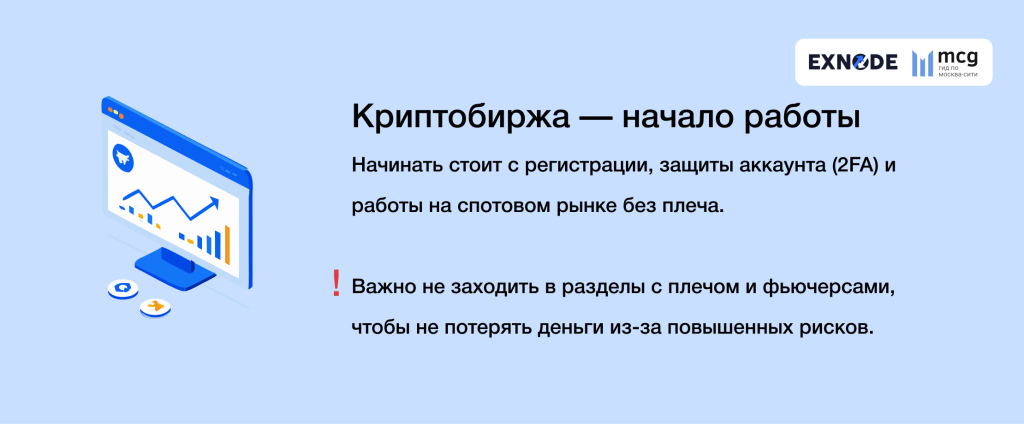
The right start looks different. First — basic registration, setting up two-factor authentication, checking withdrawal limits. Then — understanding the account structure: spot wallet, futures wallet, earn account. Many lose money already at this stage by accidentally moving funds between accounts or opening a margin position instead of making a regular purchase.
For example, this happens — a user deposits 2000 USDT and simply wants to buy ETH. Instead of the spot market, they go to the Perpetual section, open a 10x leveraged long, and do not notice it. The price falls by 8% — the deposit is liquidated. Formally, the market did not fall critically, but because of leverage the money disappeared.
The first stage of learning is to learn to distinguish between market types and understand where borrowed capital is used and where it is not.
Spot trading — the foundation of working on an exchange
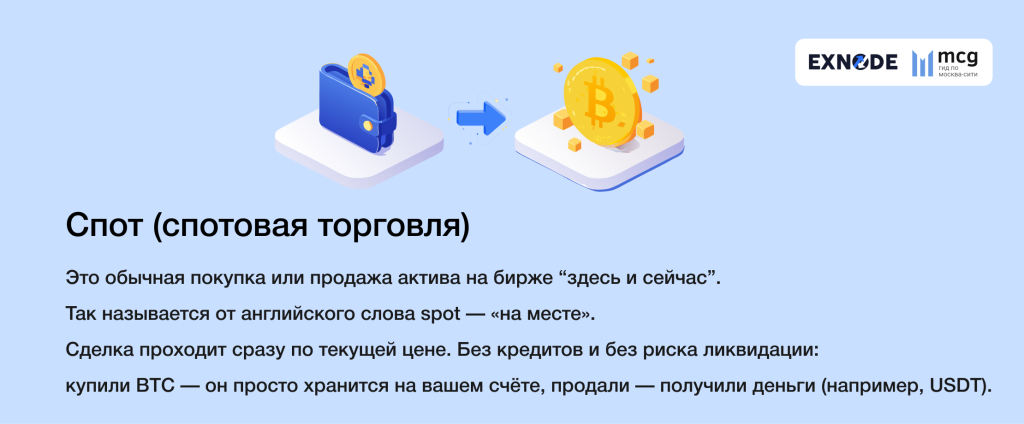
Spot is the regular purchase and sale of an asset. No leverage (borrowed funds), no forced liquidation. Bought BTC — it stays on your balance. Sold — received USDT.
Order types: what you need to master first
In spot trading there are several basic instruments:
- Market — buying or selling at the current market price.
- Limit — an order at a pre-set price.
- Stop-limit or Stop-market — a pending order that is triggered when a certain level is reached.
Beginners almost always use Market because “it’s faster.” In a calm market this is not critical, but during volatility you may get price slippage. With a large amount, a difference of 0.3–0.5% becomes noticeable.
A practical example — buying for 50,000 USDT at the moment of a sharp move. A market order is executed in parts at different prices. As a result, the average price is higher than expected. A limit order would have allowed a more precise entry.
Learning spot trading is, first of all, discipline: not chasing the candle, not buying on emotions, understanding the exit point in advance. In simple words, following a strategy and not acting impulsively.
Fees — hidden capital leakage
Most exchanges charge 0.1%–0.2% per trade. It seems like a small thing, but with active trading it turns into a constant outflow of funds.
If a trader makes 100 trades per month with a turnover of 10,000 USDT each, at a 0.1% fee they will pay about 1000 USDT. Over a year — already 12,000. And this is without taking losing positions into account, if we hypothetically imagine that trading is “at break-even.”
Some platforms reduce the fee when using their own token or when increasing trading volume. This needs to be taken into account already at the training stage — the strategy must include costs, otherwise even accurate entries will not save you.
Working with futures and other derivatives
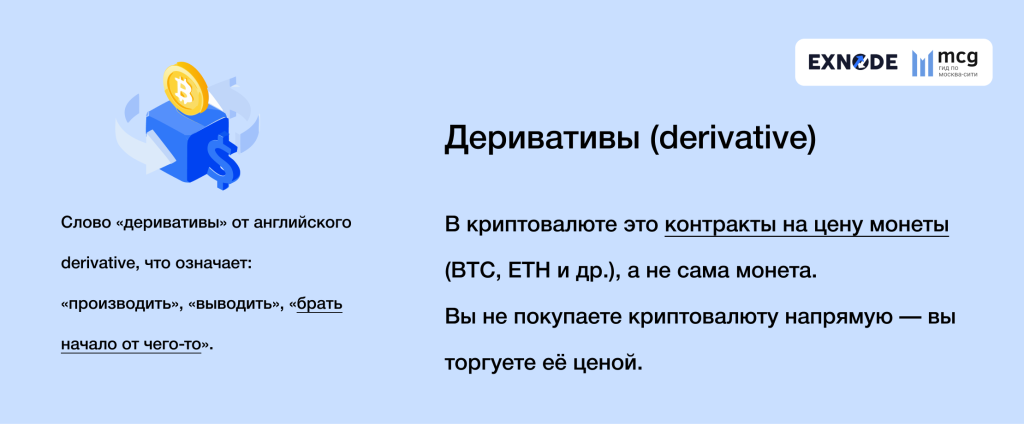
Futures are not “just spot with leverage.” This is a separate logic of profit calculation, risks, and margin. On exchanges like Binance, Bybit, and OKX, derivatives (financial instruments derived from an underlying asset) have long generated more turnover than the regular market. And most liquidations happen there.
Perpetuals — the main instrument
In crypto, perpetual futures (perpetual contracts) are most commonly used. They have no expiration date, but they do have a funding rate — a periodic payment between longs and shorts. If most positions are opened long, long positions pay shorts, and vice versa.
In practice, this means the following: in an overheated market, you can not only be wrong about the direction, but also lose additionally on funding. In a strong bullish impulse, the rate can reach 0.05–0.1% every 8 hours. For a position of 100,000 USDT, that is 50–100 USDT three times a day. Over a week, it adds up noticeably.
Training here comes down to three basic things:
- calculating the real risk before entering a trade;
- understanding the difference between cross and isolated margin;
- using stop-losses without manually “moving them away.”
A typical mistake is to open 20x leverage “on a level breakout,” not set a stop, and then watch the position melt within a few minutes on a false move.
Cross and Isolated — the difference that saves the deposit
Isolated margin limits the risk of a specific position. If it gets liquidated, only the allocated margin is lost. Cross margin uses the entire available balance as collateral.
A practical case: a deposit of 10,000 USDT. A position of 2000 USDT with 10x leverage is opened. In isolated mode, the maximum risk is those 2000 USDT. In cross mode, during a strong move against the trader, the exchange will begin taking the entire free balance to support the position. As a result, liquidation can affect the whole account.
For beginners, it makes sense to start with isolated and small leverage of 2x–3x. This is not about “earning less,” but about survival.
How liquidation works
When using leverage, the exchange calculates the liquidation price. If the market reaches it, the position is forcibly closed.
A practical scenario: deposit 3000 USDT, leverage 20x, position of 60,000 USDT. A 5% move against the trader — and the entire deposit disappears. The market may then reverse, but the position is already closed.
Futures training should include:
- position size calculation;
- risk control per trade;
- understanding the funding rate;
- working with stop-losses.
The main mistake beginners make is using maximum leverage. Exchanges allow 50x or 100x, but this is more a tool for short-term speculation with a minimal share of capital, not for a full-fledged strategy.
Options — an instrument not for impulse trading
Options are less common, but they are gradually gaining traction. On OKX, for example, there is a full-fledged options market for BTC and ETH.
An option is the right to buy or sell an asset at a fixed price before a certain date. This is a hedging instrument (insurance for other positions), not only speculation. For example, the holder of a large BTC portfolio can buy a put option as protection against a decline.
In practice, options are more complex than futures; you need to take volatility, time until expiration, and premium into account. An incorrect assessment can lead to a situation where even if the direction is correct, the option price does not provide the expected profit.
For learning derivatives, one rule is important — first understand how much you can lose, and only after that — how much you can earn.
Promotional campaigns on exchanges and how to earn there
Promo campaigns are a separate ecosystem inside crypto exchanges. Trading competitions, deposit bonuses, launchpads, quests, token distributions for activity. For many, this is an additional source of income, sometimes more stable than trading itself.
Trading competitions
Exchanges regularly launch tournaments with prize pools of 100,000–1,000,000 USDT. Participants compete by volume or by percentage return.
A real case — Bybit held a futures tournament with a prize pool of 500,000 USDT. One of the participants entered the top 100 by generating more than 20 million USDT in volume in a week. Fees consumed a significant part of the profit, but the prize covered the costs.
The conclusion is that volume competitions are beneficial for those who already have large capital and reduced fees. It makes no sense for a beginner to try to compete on turnover — fees will eat the deposit.
Launchpad — real numbers
Launchpad on Binance during the 2021 bull market provided returns of 20–100% within a few days after listing. Users locked BNB and received an allocation of new tokens.
One of the cases — locking 10,000 dollars in BNB for the subscription period. The received allocation of a new token tripled after listing. Net profit amounted to about 3000 dollars in a week. But in 2022, some projects launched at 10–20% below the offering price.
A грамотный approach is to participate with part of your capital and take the market phase into account. In a bear market, a launchpad rarely gives multiple growth.
Deposit bonuses and cashback
Some exchanges offer a bonus for topping up your account and reaching a minimum turnover. Formally, this is “free money,” but almost always with a condition on trading volume.
A real scenario — a 100 USDT bonus for a 1000 USDT deposit with a condition of 50,000 USDT turnover. If you trade without a strategy just to meet the volume requirement, fees may exceed the bonus.
Therefore, it is more profitable to use a bonus when you already have planned trading activity, rather than for the sake of the bonus itself.
Quests and micro-airdrops
Cryptocurrency exchanges periodically run quests — complete 3–5 actions (make a trade, pass a quiz, enable two-factor authentication) and receive 5–20 USDT.
For large capital, this is insignificant, but when working with several accounts and platforms, over a year it can add up to several thousand dollars. This is already part of a systematic approach to earning on exchanges, not a random bonus.
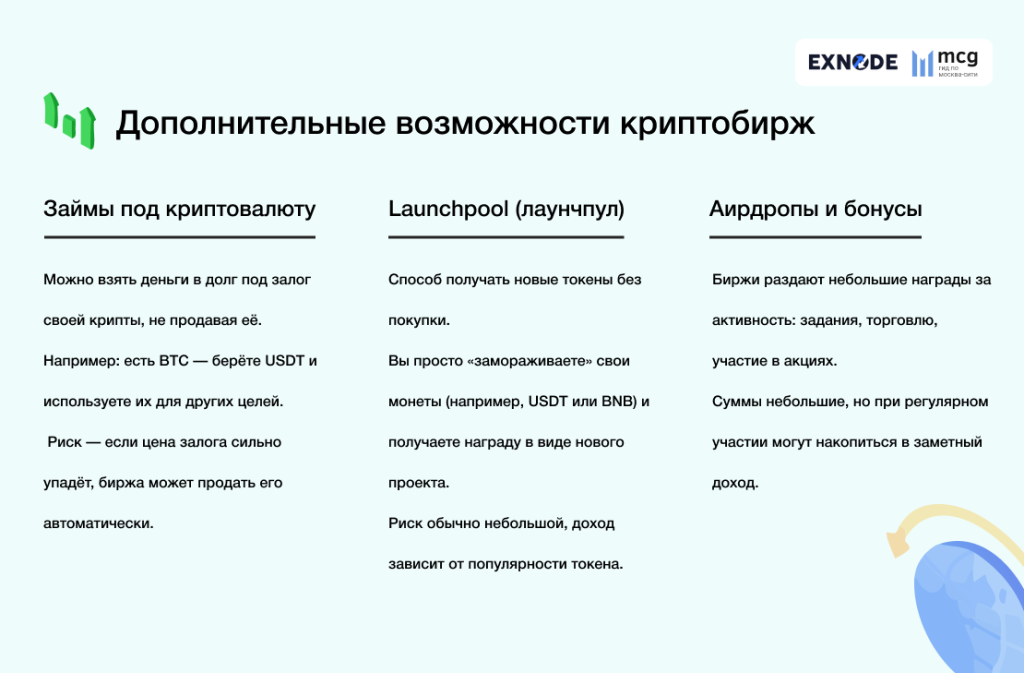
Additional options on crypto exchanges — loans, launchpools, micro-airdrops
An exchange has long ceased to be only a place for trading. It is a hybrid of a bank, a broker, and a token marketplace. Let us look at some examples of other functions, what they give, and whether it is possible to earn from them.
Loans and margin lending
A user can take a loan against cryptocurrency collateral. For example, they hold BTC worth 100,000 USDT and take a loan of 30,000 USDT in stablecoins.
A practical case: an investor does not want to sell BTC before a tax period or expects growth. Instead of selling, they take a loan at 6–10% annually and use the stablecoins for other investments. If BTC rises, the collateral increases in value and the loan is repaid without selling the main asset.
The risk is a sharp price drop and forced liquidation of the collateral when the LTV (loan-to-value ratio) is exceeded. In 2022, many positions were liquidated because of the cascading market decline.
Launchpool — farming without buying the token
Launchpool allows you to stake existing assets (for example, BNB or USDT) and receive a new token as a reward. Unlike a launchpad, there is no direct purchase here.
Here is an example — placing 20,000 USDT in a pool for 10 days. The received tokens after listing gave a profit of about 5–8% of the placed amount. In a bull market, the figures were higher.
This is a relatively low-risk instrument, but profitability depends on interest in the project and overall market dynamics.
Micro-airdrops and reward centers
Exchanges actively compete and stimulate user activity through reward centers. Completing tasks, participating in test products, trading new pairs — for this, users receive tokens or vouchers.
It may seem like a small thing — 10–30 dollars per promotion. But with systematic participation on 3–4 exchanges over a year, you can get the equivalent of 2000–5000 dollars. This is already comparable to passive staking of a small deposit.
Where people most often lose money on additional options
The first mistake is participating in all programs in a row without calculating liquidity. Money is locked for 30–90 days, while during that time the market may provide other opportunities.
The second is ignoring the volatility of the reward token. The received token may fall by 50% in a week.
The third is using borrowed funds to participate in launchpool or staking. A return of 8–12% per year does not cover the risk of collateral falling when leverage is used.
Working with derivatives, promo campaigns, and additional options is the next level after basic spot trading. Here it is no longer enough to understand how to open an order. You need to calculate fees, take fund lock-ups into account, analyze the market phase, and assess counterparty risk.
The exchange gives dozens of ways to earn. But almost every one of them, if approached incorrectly, turns into a way to lose money faster. Systematic thinking and calculation are more important here than the search for the highest yield.
Additional crypto exchange options: pros, cons, and features
| Additional crypto exchange option | Pros | Cons | Features |
|---|---|---|---|
| Launchpads (Launchpad / Launchpool) | The opportunity to receive new tokens before mass listing, often at a more favorable price; sometimes it is enough just to hold the exchange’s tokens | Limited allocations, high competition, and sometimes a requirement to lock funds or the exchange’s tokens | Participation usually requires holding the exchange’s native tokens or staking assets for a certain period |
| Trading competitions | The opportunity to earn bonuses, tokens, or USDT for active trading; they help develop trading skills | Require large trading volume; sometimes the winners are professional traders with large deposits | Rewards are distributed based on trading volume or portfolio profitability over a certain period |
| Micro-airdrops | Free small token rewards for completing simple actions — registration, trading, participation in campaigns | Small reward value; sometimes several conditions or KYC are required | Often used to promote new tokens and increase user activity |
| Staking and Earn programs | The opportunity to receive passive income from stored crypto assets without active trading | Sometimes funds are locked for a fixed term; the yield may change | Suitable for long-term holders of cryptocurrencies who do not plan to trade actively |
| Copy trading | Allows you to automatically copy the trades of experienced traders and learn in practice | The result depends on the chosen trader; losses are possible with a poor strategy | The user chooses a trader from the ranking and copies their trades proportionally to their own deposit |
| Quests and educational programs | Help beginners learn the exchange functionality and the crypto market, sometimes with monetary bonuses | Rewards are usually small; availability depends on the user’s region | Often include watching educational materials and completing small quizzes |
Storing funds on an exchange — convenient, but not without risks
A crypto exchange is a custodial service. The user does not own the private keys; the funds are stored in the company’s accounts. Unlike non-custodial crypto wallets such as Metamask and Trust Wallet, to which only the owner has access, in theory the exchange may freeze an account for a wide variety of reasons.
This is convenient for trading, but it creates counterparty risk simply when storing deposits on the platform’s accounts. History has already seen cases of bankruptcies and withdrawal freezes. Even large platforms can face liquidity problems.
How to reduce storage risks
Learning to work on an exchange should include basic rules:
- Do not store all capital on one platform.
- Separate your trading portfolio and long-term portfolio.
- Use cold wallets for large amounts.
A practical example — an investor keeps 200,000 USDT on an exchange “just in case.” A sudden withdrawal freeze for a week — and the funds become unavailable at the moment when the market gives an opportunity to buy an asset at a low price.
The balance between convenience and security is a key skill.
Staking and passive instruments
Modern exchanges offer earn programs: staking, fixed deposits, flexible savings accounts.
How staking works on an exchange
The user places tokens that participate in supporting the network. The exchange aggregates the funds and distributes the reward.
Yield varies: 2–5% annually on major assets, 10–20% on less liquid tokens. A high percentage almost always means increased risk or a withdrawal restriction.
Let us take an example: placing 50,000 USDT at 8% per year in a flexible product. The income is about 4000 USDT per year. But in the event of a sharp market drop, there may be a need to withdraw funds urgently — and the flexible product becomes less profitable because of temporary restrictions.
Learning staking on a crypto exchange is not about searching for the maximum percentage, but about analyzing liquidity and early withdrawal terms.
Copy trading and automated strategies
Copy trading allows you to repeat the trades of a selected trader. It sounds simple — choose a leader, connect, and receive profit.
In practice, much depends on the leader’s risk profile. Some use aggressive leverage, and a series of losing trades can wipe out the connected account. Training here consists of analyzing statistics: drawdown, average leverage, number of trades, position holding duration.
A typical mistake is focusing only on the monthly return percentage while ignoring maximum drawdown. It is important to understand that copy trading is a risky method, similar to a casino, not “money from the sky.”
Trading psychology — the invisible factor
Even with technical competence, most people lose because of emotions. Fear of missing growth, the desire to “win it back,” moving the stop-loss farther away.
A practical case — after two losing trades, a trader increases the position size to recover losses faster. The market continues moving against them — the loss doubles.
Learning to work on an exchange must include:
- keeping a trade journal;
- limiting risk per position (1–2% of capital);
- taking breaks after a series of losses.
These are not theoretical tips, but survival mechanisms for a competent trader.
How to build a learning system
Learning to work on cryptocurrency exchanges should be gradual and based on a comprehensive approach.
First — spot trading without leverage. Understanding orders and fees. Then — working with small amounts, analyzing trades. Only after stable results does it make sense to move on to futures.
In parallel — studying security: two-factor authentication, anti-phishing codes, verification of withdrawal addresses.
A practical 3-month plan:
- first month — spot trading, trades without leverage, no more than 10% of capital in one position;
- second month — testing stop-losses and risk management;
- third month — minimal leverage of 2x–3x on a small part of the deposit.
The main thing is not to rush. The market is not going anywhere, but the deposit can be wiped out because of stupid mistakes.
Common beginner mistakes
The first is entering one coin with all capital. Even if it is BTC, volatility of 20–30% over a short period is not rare.
The second is ignoring fees and the funding rate on futures.
The third is storing funds without a backup access plan. Losing access to email or phone can freeze the account for weeks.
The fourth is trying to trade based on rumors and social media without your own strategy.
FAQ
how to learn crypto exchange trading from scratch
It is best to start with the spot market and small amounts, having studied order types and basic risk management. Practice with real but limited funds gives more understanding than a demo account. It is important to immediately implement the rule of limiting risk per trade and to keep a record of operations.
what is spot trading in simple words
Spot trading is the regular purchase and sale of an asset without borrowed funds. The purchased token fully belongs to the user; there is no risk of liquidation because of leverage. If the price falls, the asset remains on the balance, and the owner decides when to sell.
how leverage works on an exchange
Leverage allows you to open a position larger than your own capital using the exchange’s borrowed funds. Profit and loss are calculated from the full size of the position. A small market move can lead to a complete loss of the deposit if the price reaches the liquidation level.
is it safe to store cryptocurrency on an exchange
Storage on an exchange is convenient for trading, but it is associated with the risk of blocking or technical issues. For large amounts, it is reasonable to use cold wallets and keep only working capital on the exchange. Distributing funds between several platforms reduces dependence on a single service.
what is staking and how much can you earn
Staking is placing tokens to support the network in exchange for rewards. Yield is usually from 2% to 10% annually on major assets, and higher on less stable projects. Income depends on lock-up conditions and the reliability of the network itself.
how much money is needed to start trading cryptocurrency
You can start with an amount you can afford to lose without harming your budget. Even 100–200 USDT is enough to understand the market mechanics. More important than the size of the capital is following risk management rules and gradually increasing volume after a confirmed result.
Learning to work on an exchange is a process, not a one-time study of the interface. Trading, storage, staking, and other instruments provide opportunities, but they require a systematic approach. Those who treat the exchange as a “quick money” button usually leave with losses. Those who study and build their own strategy gradually turn chaotic activity into a controlled strategy.