




Creating your own Bitcoin wallet in Russia is the first and most important step for anyone who wants to independently manage their assets in the world of cryptocurrencies. Today, having an account on a centralized exchange or in a mobile platform is not enough: the user gains full control only when the keys belong to him personally, and not to a third party.
A proper crypto wallet allows you not only to safely store cryptocurrency, but also to use it as a full-fledged means for transfers, investments, or exchange into rubles. At the same time, creating a wallet can be completely free, and the process itself does not require complex technical knowledge.
First, let us briefly consider which crypto wallets are best suited for use in Russia and how they differ from each other, so that you can quickly choose the optimal option for your tasks. Further in the article, a detailed analysis will be presented: what a Bitcoin wallet is, what types of storage exist, how to create a wallet step by step, how to ensure the security of funds, preserve the seed phrase, and, if necessary, withdraw cryptocurrency to a bank card without losing access to the assets.
Best Bitcoin wallets for Russia (Android / iOS) — 2026
Below are working, secure, and truly available apps in the Russian Federation without blocks.
1st place: Trust Wallet (Android / iOS)
Why it is the best:
- Works in Russia without restrictions
- Full control of keys (non-custodial)
- Supports BTC and other cryptocurrencies
- Very simple interface
- Free
Suitable for: beginners and most users
Trust Wallet is one of the most popular mobile wallets in the world and supports hundreds of blockchains and assets.
2nd place: Muun Wallet (Android / iOS)
Why it is top for BTC:
- Made specifically for Bitcoin
- Lightning support (very fast transfers)
- Simple access recovery
- Without KYC
- Works excellently in the Russian Federation
Optimal for those who need only BTC
Muun is a non-custodial wallet with Lightning support and convenient recovery.
3rd place: Ledger Live + Ledger Nano X (maximum security)
(Android / iOS app + device)
Why it is the safest option:
- Cold storage (keys are offline)
- Practically impossible to hack
- Used for large amounts
- Works in the Russian Federation
Worth considering for those who plan: investments, long-term storage.
Hardware wallets are considered the best for storing large amounts of BTC.
A couple more good options (work in Russia)
Exodus (Android / iOS)
- Beautiful interface
- Support for BTC and other coins
- Non-custodial
- Can be linked to a hardware wallet
Exodus is one of the best universal crypto wallets.
Guarda Wallet (Android / iOS)
- Works without restrictions
- Support for many networks
- Non-custodial
- Can be used without registration
Guarda supports dozens of blockchains and DApps.
Not the best option for BTC — MetaMask
This is primarily a wallet for Ethereum
Bitcoin is inconvenient there
Summary — what to choose
- For a beginner — Trust Wallet
- Only Bitcoin — Muun
- Large amounts — Ledger (cold)
- Beautiful universal one — Exodus
This list is provided for quick orientation and selection of a suitable option. Next, we will analyze in detail how a Bitcoin wallet is structured, what types of storage there are, how to create it correctly, and what security measures are necessary to preserve access to assets.
What is a Bitcoin wallet
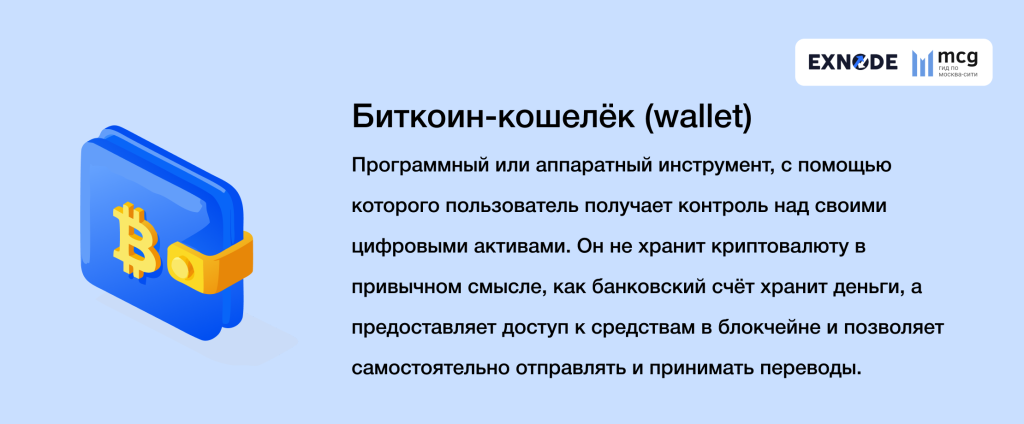
A Bitcoin wallet (Wallet) is a tool that allows a user to manage his digital funds. It does not “store” coins the way a bank stores money, but gives access to assets and the ability to independently send and receive cryptocurrency.
Each wallet operates on the basis of two keys: public and private. The public key is the address that can be given to other people so that they send you BTC. The private key is a secret code with which you confirm transfers and fully control your digital assets.
There is an important difference between “storage” and management. If the wallet is linked to a platform or exchange, part of the control over the money remains with the service: you see the balance, but do not always manage the funds directly. In a non-custodial wallet, the keys are stored by the user: only he is responsible for security and restoring access.
Types of Bitcoin wallets
When choosing a BTC wallet, it is important to understand exactly how it stores keys and who controls your assets. In general, solutions are divided into several types: hot and cold, as well as custodial and non-custodial.
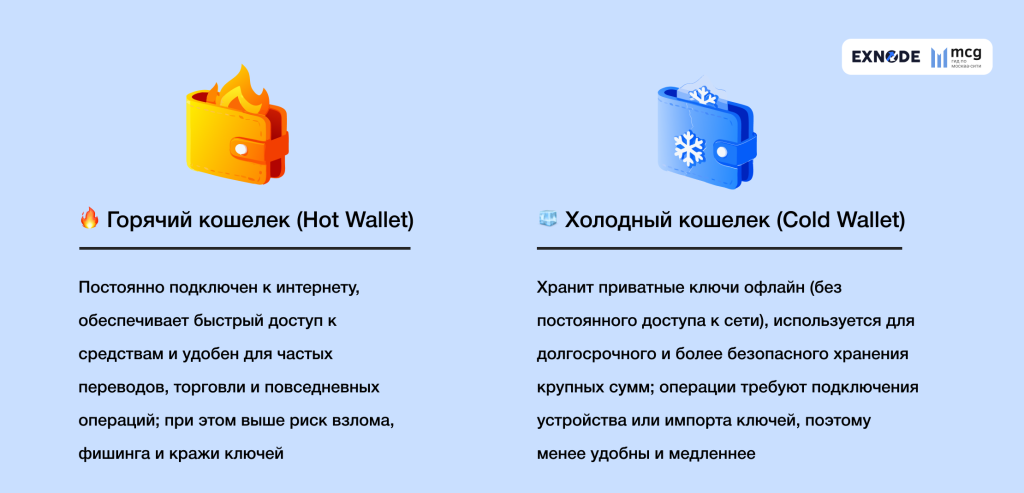
Hot wallets
Hot wallets are constantly connected to the internet or use online services. These include mobile applications, web versions, and browser extensions. Examples of such wallets are Trust Wallet and MetaMask, although the latter is more focused on the Ethereum ecosystem..
The advantage of hot wallets is speed and convenience: transfer Bitcoin, pay for a purchase, or exchange cryptocurrency can be done in a matter of minutes. But there is also a downside: constant connection to the network increases the risk of hacking or theft of funds through malware, phishing, and operating system vulnerabilities.
Cold wallets
Cold wallets are offline devices or programs that are not connected to the internet. For example, Ledger and SafePal. They are created in such a way that private keys never leave the device.
The main advantage of a cold wallet is security. Even if a computer or smartphone is infected with viruses, hackers will not be able to gain access to the keys. The main disadvantage is lower speed of operations and the need for physical interaction with the device to confirm transactions.
Hot and cold wallets: comparison
| Type | Key control | Speed | Security | Suitable for |
|---|---|---|---|---|
| Hot | User partially | High | Medium | Everyday transfers |
| Cold | Full | Medium | High | Long-term storage |
Custodial and non-custodial solutions
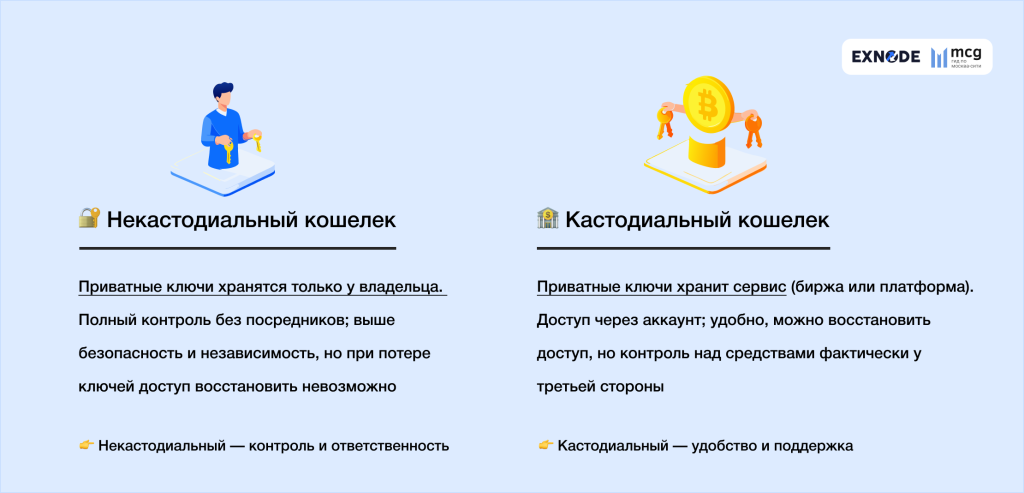
The difference here is who actually manages the keys and coins. In a custodial wallet, control partially remains with the platform or exchange: the service stores the private keys, and the user works with the balance. This is convenient for beginners, but increases the risk of losing funds in the event of a platform failure or its closure.
Non-custodial wallets give full control to the user: private keys are created and stored only on his device. This is safer, but increases responsibility — loss of the key or seed phrase means complete loss of access, without the possibility of recovery.
The choice between these options depends on what is more important: speed and convenience or complete security and independent management of assets.
Main functions of crypto wallets
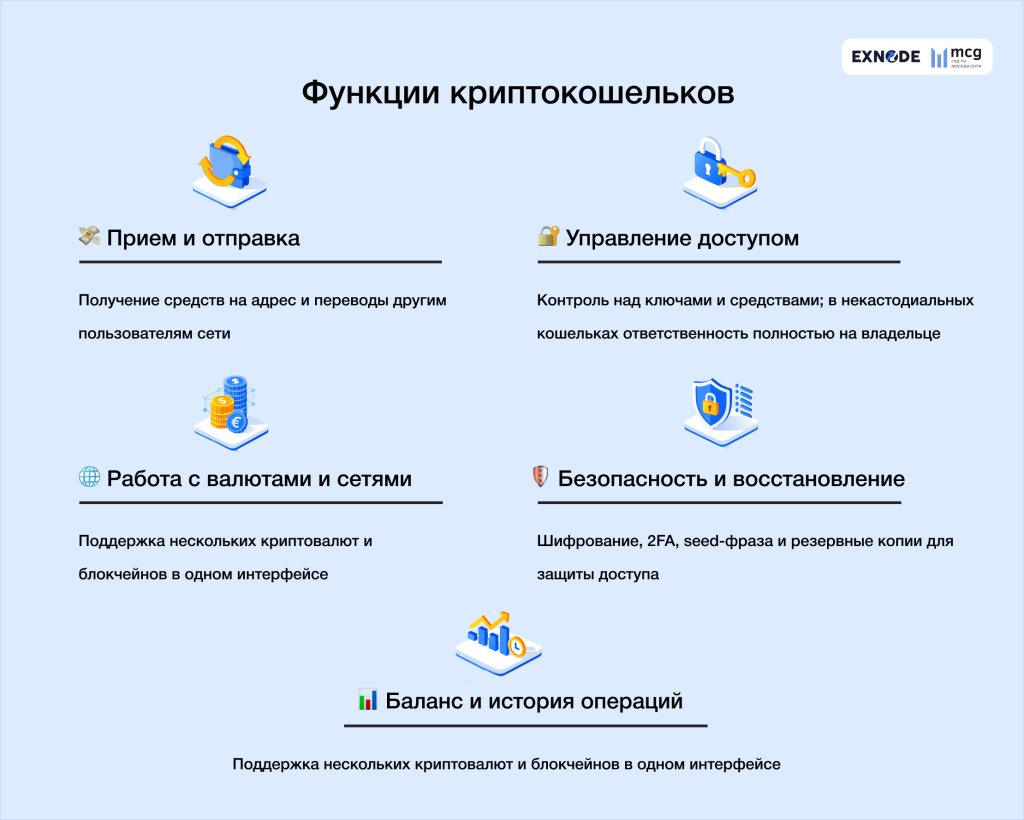
1. Receiving and sending cryptocurrency
The user can receive funds to an address and send them to other network participants. All transactions are confirmed in a secure way, which guarantees the safety of the balance.
2. Access management
The main function is control over access to financial assets. In non-custodial solutions, responsibility lies entirely with the owner: loss of recovery data means loss of access to the account.
3. Working with different currencies and networks
Modern solutions allow simultaneous management of several cryptocurrencies and interaction with various blockchain networks. This is convenient for users investing in Bitcoin, Ethereum, and other popular platforms.
4. Security and backup
Programs and devices offer protection methods: encryption, two-factor authentication, and recovery through a mnemonic phrase. Hardware and offline solutions reduce the risk of cyberattacks, and backups allow you to restore access to assets if the device is lost.
5. Balance and transaction control
Modern interfaces display the current balance, transfer history, and fees. This helps the user track the account status, plan transactions, and check the correctness of the network operation.
User security and responsibility
Working with Bitcoin is fundamentally different from service in a bank. There is no support service here that will restore access if a password is lost, and there is no insurance in case of a hack. Responsibility for the safety of funds lies entirely with the wallet owner. Understanding the basic principles of security and typical mistakes makes it possible to avoid losing assets even without technical experience.
Storage of the seed phrase and private key
A seed phrase (mnemonic phrase) is a sequence of 12 or 24 words that is generated when creating a non-custodial wallet. It is a master key from which all the private keys of the wallet addresses are derived. Possessing the seed phrase, you can restore access to all funds on any device at any time.
A private key is a unique code that gives the right to распоряжаться BTC from a specific address. In most modern wallets, private keys are stored inside the application, and the user interacts only with the seed phrase.
Storage rules:
- The seed phrase must be written down on a physical medium — paper, a metal plate, or a special fireproof form. Storage in digital form (a photo on the phone, a screenshot, a note in the cloud, a file on a computer) is категорически not recommended: the device may be hacked, lost, or passed to third parties.
- The written phrase is stored in a reliable place inaccessible to outsiders. For large amounts, it makes sense to use a safe or a bank deposit box.
- You must not tell the seed phrase to anyone, including representatives of the wallet support service, friends, or relatives. Legitimate services never request the mnemonic phrase.
- When using an exchange (custodial) wallet, there is no seed phrase — access is restored through standard procedures (email, phone). However, in this case control over the keys belongs to the exchange.
Setting up two-factor authentication
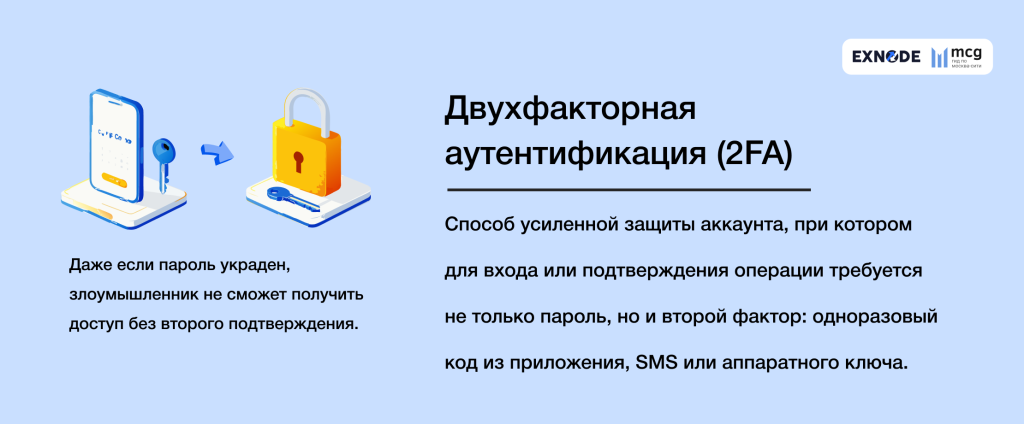
Two-factor authentication (2FA) is an additional level of protection requiring confirmation of login or execution of an operation by a second method in addition to the password. Even if an attacker learns the account password, without the second factor he will not be able to gain access.
Setup recommendations:
- On exchanges and in online services where crypto assets are stored, 2FA must be enabled obligatorily. The exception is non-custodial wallets, where access to funds is protected by the seed phrase itself, but a PIN code or biometrics on the device may be used there.
- The preferred method is authenticator applications (Google Authenticator, Authy, Microsoft Authenticator). They work offline and are not tied to a phone number, which may be intercepted or lost.
- Using 2FA via SMS is not recommended because of the risks of SIM swapping (reissuing a SIM card by fraudsters).
- Backup recovery codes issued when setting up 2FA must be stored just as securely as the seed phrase — they allow access to be restored if the phone is lost.
- For significant volumes of assets, it makes sense to use hardware keys (YubiKey), providing physical protection.
Checking addresses before sending
An error when entering the recipient's address is one of the most frequent reasons for irreversible loss of funds. Transactions on the blockchain are irreversible, and mistakenly sent assets cannot be returned.
Practical measures:
- When copying an address, always check the first and last 4-6 characters. Fraudulent programs may substitute the address in the clipboard, replacing it with their own wallet.
- If the address is transmitted through a messenger or email, it is worth calling the sender back and verifying several characters verbally.
- When sending large amounts, it is recommended first to carry out a test transaction with a minimal amount of bitcoins in order to make sure the address is correct.
- It is important to choose the correct network: sending BTC to an address of another network (for example, in the Ethereum network) will lead to loss of funds.
Creating a Bitcoin wallet: step-by-step instructions
Creating your own account for working with bitcoins is a simple process if you follow a certain logic. Let us consider the standard path that will suit any user.
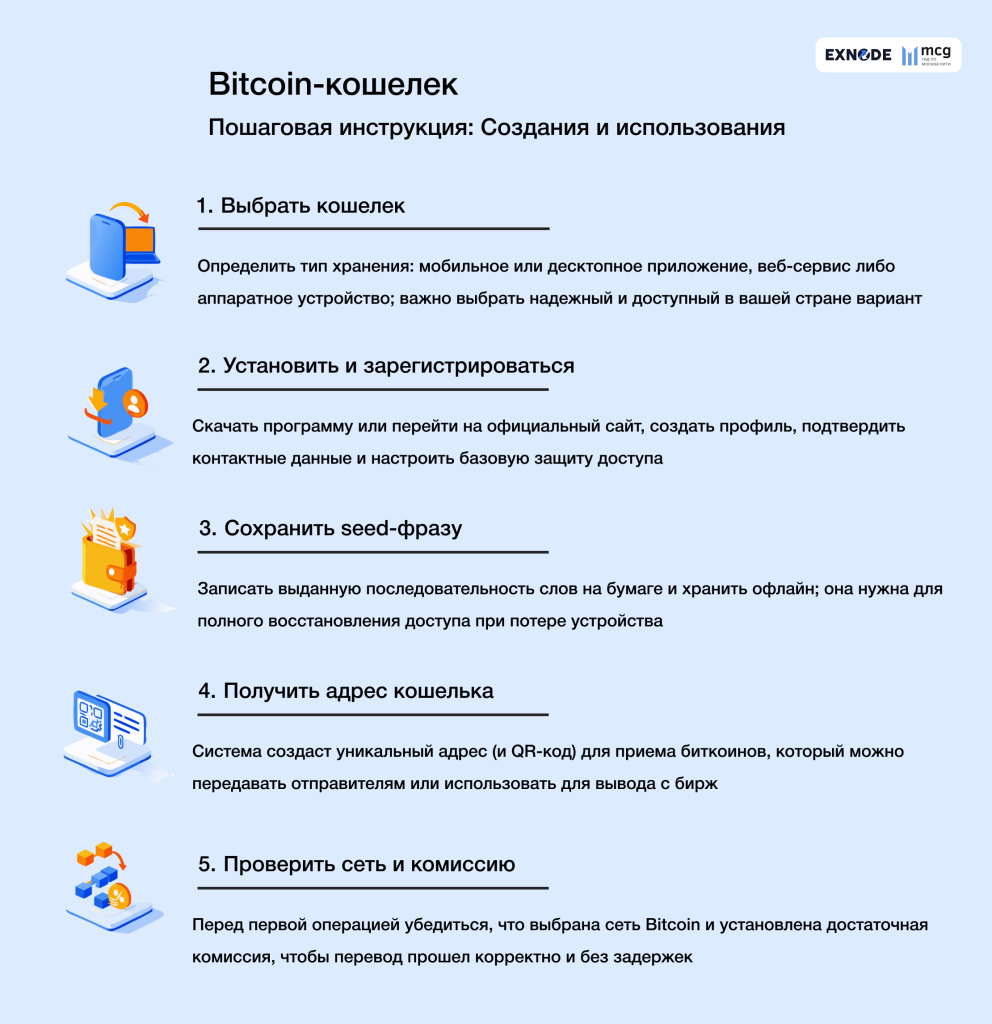
1. Choosing an application or platform
Creating a wallet begins with choosing the type of storage — an online application, web service, or offline device. It is important that the service be reliable, proven, and available for work in your country.
2. Installation and registration
After choosing, you need to download the program or go to the official website. The registration process is usually simple: a personal profile is created, the user confirms contact details and agrees with the rules of the platform. Some services may request additional information for security, but a basic account is opened quickly.
3. Generating a protective phrase and storing it
The next step is creating a mnemonic sequence of words that will allow you to restore access to the account in case of loss of the device or deletion of the application. The phrase must be written down on paper and stored in a safe place inaccessible to outsiders. This ensures the safety of all funds and protection against accidental loss.
4. Obtaining an address for receiving digital assets
After setting up the profile, the system creates a unique identifier that is used to receive digital coins. This address can be passed to other network participants or used for transfers from exchanges and exchange services.
5. Checking the network and calculating fees
Before the first transaction, it is important to make sure that the selected network is active and supports the operation. It is also recommended to clarify the minimum transfer fee so that the funds arrive correctly and without delays. Sometimes a small amount of the network's base currency is required to confirm the transaction.
Withdrawing funds from a Bitcoin wallet to a bank card
Storing Bitcoin in a wallet solves the task of preserving the asset, but to use cryptocurrency in everyday payments, its conversion into fiat rubles is required. Since BTC is not accepted by the banking system directly, the withdrawal process involves the participation of an intermediary — a platform where cryptocurrency is sold with the subsequent transfer of rubles to a card.
Conversion channels
Three main methods of withdrawing funds have developed on the Russian market, differing in mechanism, speed, and level of control on the part of the user.
- Cryptocurrency exchanges. The user transfers cryptocurrency from a personal wallet to an exchange account, sells it in a pair with the ruble, and withdraws fiat to a card. Exchanges provide high liquidity and automation; however, to work with rubles it is necessary to undergo identity verification (KYC).
- P2P platforms. A model of direct deals between users. The seller places an offer to sell Bitcoin, the buyer transfers rubles to his card, after which the platform transfers the cryptocurrency to the buyer, acting as the guarantor of the deal. P2P does not require verification for participation in trading and often offers a rate close to the exchange rate.
- Exchangers. Specialized websites offering a fixed exchange rate. The user sends Bitcoin to the specified address, and after receiving network confirmations the operator transfers rubles to the card. Exchange services do not require registration and are suitable for one-time operations; however, the rate in them is less favorable due to the built-in margin (usually 1–3%).
Methods of withdrawing BTC to a bank card
| Method | Fee | Speed | Verification | Suitable for |
|---|---|---|---|---|
| Exchange | 0.1–1% | 10–60 min | KYC is mandatory | Regular traders, large amounts |
| P2P | Minimal | 10–40 min | Often not required | Private deals, confidentiality |
| Exchanger | 1–3% | 5–20 min | Minimum requirements | One-time operations, beginners |
Service selection criteria
When choosing a withdrawal channel, users usually take several factors into account:
- Reputation. For exchangers, information about reliability can be obtained in monitoring services (for example, Exnode) and on профильных forums. For P2P deals, a significant indicator is the seller's rating and the number of successful transactions.
- Rate. On exchanges and P2P, the rate is as close as possible to the market rate. In exchangers it is higher due to the margin. Offers that significantly deviate from the market average (by 5–10%) are often associated with fraudulent schemes.
- Limits. Services set minimum and maximum withdrawal amounts. For large transactions, individual approval or verification may be required.
- Supported networks. Bitcoin exists only on the Bitcoin network. Sending funds to addresses of other networks (BEP-20, ERC-20) leads to irreversible loss of assets.
Withdrawing Bitcoin into rubles is a standard operation that does not require special skills provided that you pay careful attention to addresses, networks, and the reputation of counterparties.
Frequently asked questions about wallets for storing BTC
Can a Bitcoin wallet be created anonymously
Yes, a non-custodial wallet can be created without specifying personal data — neither a passport, nor a phone number, nor an email are usually required. The application simply generates a seed phrase and addresses that you will use. However, it is important to understand the difference between wallet anonymity and transaction anonymity. Any interaction with centralized services — exchanges, exchangers, bank cards — may reveal the identity of the user. In addition, transactions on the blockchain are public: if necessary, they can be tracked with analytical tools. Therefore, the wallet itself is not tied to a person, but the chain of operations may indirectly point to the owner.
Is it possible to open several Bitcoin wallets at the same time
Yes, there are no restrictions. Moreover, separating funds across different wallets is considered a good security practice. Separate addresses are often used for savings, everyday expenses, working with exchanges, and receiving payments. This approach reduces risks: compromise of one wallet does not affect the rest of the funds. It also simplifies financial accounting, allows you to control sources of incoming funds, and makes it more convenient to plan withdrawal into fiat. Many modern wallets support the creation of several accounts or addresses within one application.
What to do if the application was deleted or the device was lost
The main thing is the presence of the seed phrase. It allows you to restore access on any compatible wallet regardless of the manufacturer and platform. You need to install the application, select the recovery function, and enter the words in the correct order. After that, the balance and transaction history will be pulled up automatically from the blockchain. If the phrase is not saved, it is impossible to regain access to the funds — there is no password reset mechanism or support service in the Bitcoin network. Therefore, backup storage of the seed phrase is a key element of security, especially when working with large amounts.
Is it possible to receive payment in bitcoins for goods and services
Yes, the wallet allows you to receive payments directly from clients or partners from any country. For this, it is enough to provide the address or QR code. This method is convenient for international settlements, digital services, and remote work, since it does not require intermediary banks and works around the clock. But when regularly receiving payments, it is important to take into account legal and tax aspects, especially if the funds are then withdrawn into rubles. It is also worth considering the volatility of the rate: the amount in BTC may change significantly in value by the time of exchange. To reduce risks, stablecoins are sometimes used or incoming funds are quickly converted into fiat.
How safe is it to store large amounts in Bitcoin
Security depends not so much on the cryptocurrency itself as on the way the keys are stored. With proper organization, Bitcoin is considered one of the most protected assets: the network is resistant to hacking, and access to funds is possible only through private keys. For large amounts, cold hardware wallets or multisignature are usually used, in which several keys are required for a transfer. Additionally, separation of backups, storage of the seed phrase in different places, and refusal of constant connection to the internet are used. The main risks are associated with the human factor — loss of data, phishing, malware, or physical access to the device. If basic security rules are followed, the probability of loss of funds is extremely low, which makes Bitcoin a convenient tool for long-term storage of capital.
Conclusion
Creating a Bitcoin wallet in Russia is a process available to any user and does not require financial expenses. The choice of a suitable solution depends on the tasks: hot and exchange wallets are convenient for everyday operations, while cold hardware devices are convenient for long-term storage of large amounts. The determining factor remains control over private keys: in non-custodial wallets, it fully belongs to the owner, which requires a responsible approach to preserving the seed phrase.
Security when working with BTC is ensured by basic rules: physical storage of the mnemonic phrase, use of two-factor authentication on exchanges, careful checking of addresses and networks before sending transactions. These measures make it possible to minimize risks even in the absence of deep technical knowledge.
To withdraw cryptocurrency to a card, use crypto exchanges, P2P platforms, or crypto exchangers. The choice depends on the amount, speed, and need for verification. In any case, it is important to check the reputation of the platform, compare rates, and take fees into account.
If the listed recommendations are followed, a Bitcoin wallet becomes a reliable tool for storing digital assets and converting them into rubles, available for use in Russia on a par with traditional financial means.