


In the professional environment, the question of a crypto wallet is considered primarily through the lens of blockchain architecture. Unlike traditional money, which has a physical form, digital assets exist exclusively as records in a distributed database.
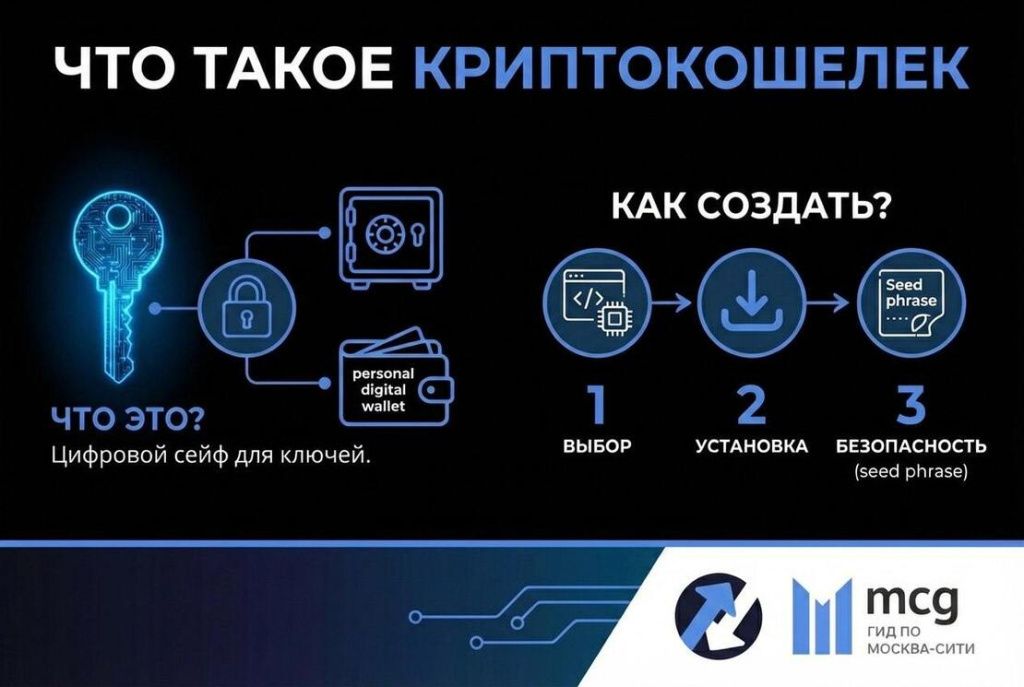
Answering the question of what a cryptocurrency wallet is, it is important to clarify: we are not talking about “storing coins” in the literal sense. The blockchain does not contain personalized files or accounts with the names of owners. In this system, the wallet acts as a key management tool that allows the user to confirm the right to dispose of funds assigned to a certain address.
From a technical point of view, a cryptocurrency wallet is a software tool for managing cryptographic keys. It is the keys that make it possible to form a digital signature and confirm the right to dispose of assets assigned to a specific address. Without a correct signature, initiating a transfer of funds is impossible.
In simple terms: a crypto wallet is a tool for accessing digital assets. It does not store cryptocurrency, but only allows you to manage funds using cryptographic keys.
How a crypto wallet uses asymmetric cryptography
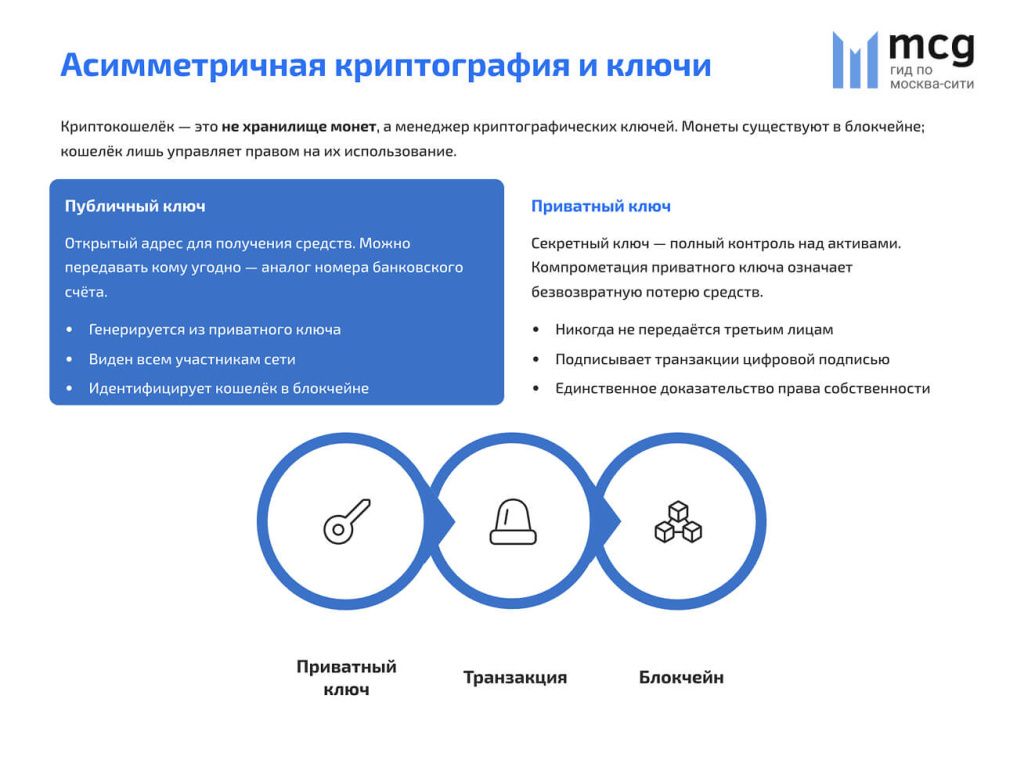
The operation of any cryptocurrency storage is based on the mechanism of asymmetric cryptography — an encryption method in which two interconnected keys are used: public and private. It is this mechanism that defines what a crypto wallet is from a technical point of view and how a user gets the ability to independently manage assets without the participation of banks or intermediaries.
Public key
The public key performs the function of an address identifier: it can be shared with third parties to receive funds. In fact, through it the logic of transferring assets in the blockchain is implemented.
Private key
The private key, on the contrary, provides control over funds. It is a unique sequence of characters mathematically linked to the public key. A public key can be derived from a private key, however the reverse operation is impossible. Such a one-way dependency provides cryptographic protection of the system.
Transactions
When sending a transaction, a digital signature is formed. The network verifies its correspondence to the public key and, if the verification is successful, confirms the transfer. That is why the owner of the private key has actual control over the assets. From a technical point of view, any crypto wallet is essentially a tool for managing cryptographic keys, not a means of “storing” coins.
This principle is applied in the same way in all types of solutions. For example, a cold wallet for cryptocurrency — what is it in a practical sense? It is a storage model in which the private key is isolated from the internet and used offline, which significantly reduces the risks of unauthorized access.
The problem is that the private key in its original form is inconvenient for writing down and storing. To solve this task, in 2013 the BIP39 standard was proposed, which introduced the mechanism of a mnemonic seed phrase — a more convenient form of backing up access to the wallet. It translates a complex cryptographic key into an understandable sequence of words that can be written down and used to restore access to assets.
What a seed phrase is and how it protects a crypto wallet
Answering the question of what a crypto wallet is and how to use it, it is necessary to separately consider the mechanism of backup access — the seed phrase. It is what ensures the restoration of control over assets in case of loss of a device or software access.
BIP39 Standard
The BIP39 standard transforms a complex cryptographic key into a human-friendly form. The algorithm generates a sequence of numeric values, each of which corresponds to a word from a fixed dictionary containing 2048 English terms. As a result, a mnemonic sequence of 12 or 24 words is formed — the so-called seed phrase.
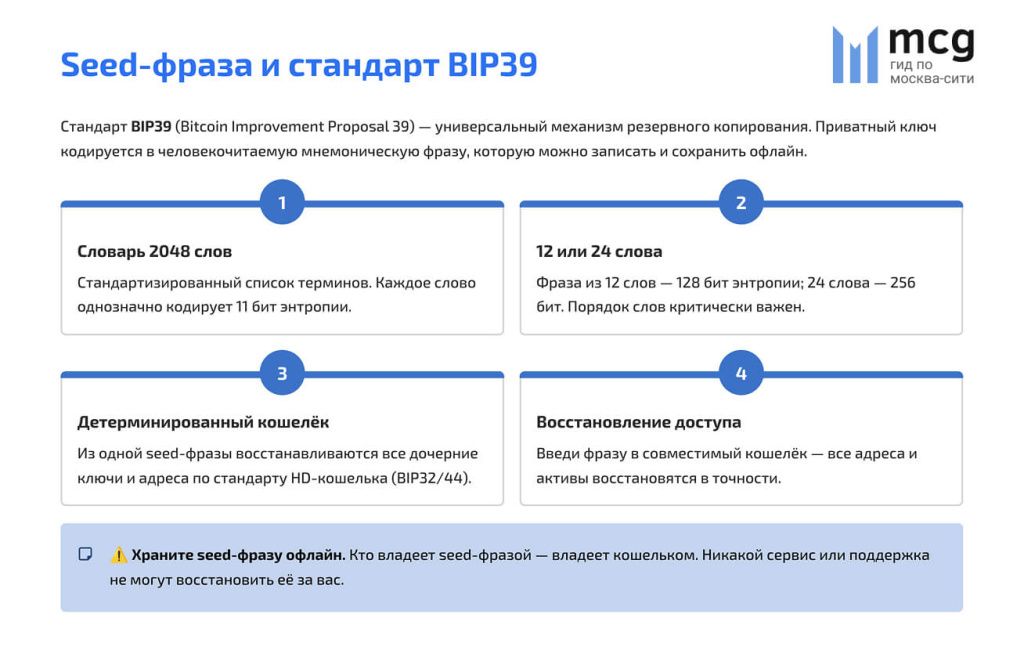
From a technical point of view, this is an alternative representation of the private key. The order of words is strictly defined: changing the sequence leads to the generation of a different set of keys and, accordingly, another address in the network.
seed phrase
In essence, it is the seed phrase that provides the ability to restore access to assets. Regardless of whether the device is lost or the app is deleted, the user can redeploy the crypto wallet — what it is and how to use it — on a new medium by entering the correct sequence of words.
At the same time, the level of responsibility lies entirely with the owner. Losing the seed phrase means the inability to restore access to funds, because in a decentralized system there is no mechanism for centralized reset or password recovery.
Access to funds: custodial and non-custodial solutions
The key storage model determines who actually controls digital assets. Depending on this, the market is divided into two main segments — custodial and non-custodial solutions.
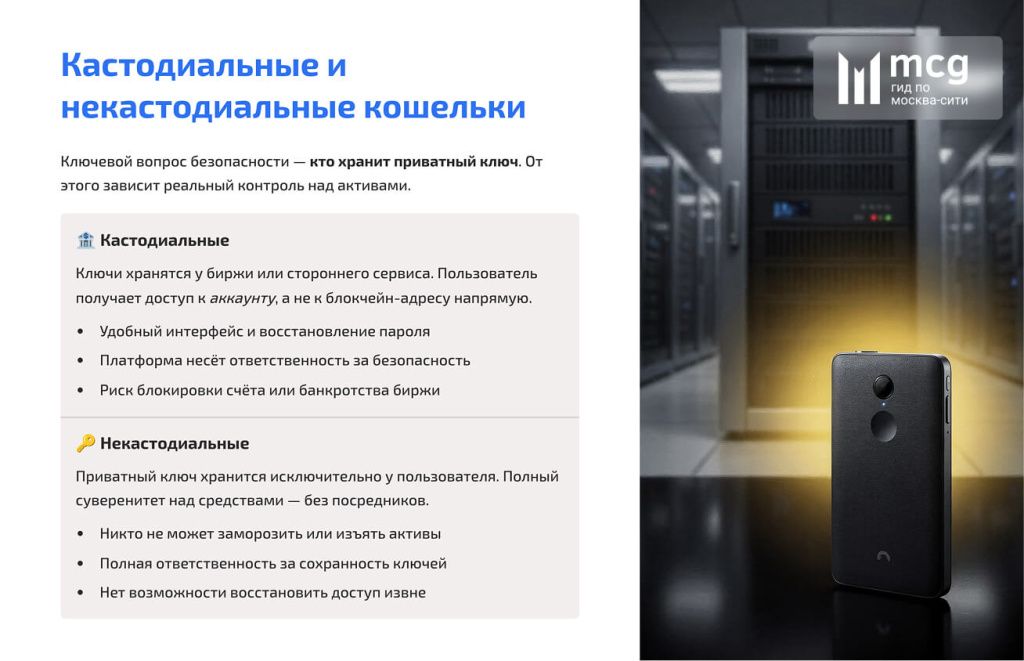
Custodial
The custodial format is most common on centralized crypto exchanges. The user registers in the system, passes basic identification, and gains access to an account. In this case, cryptographic keys are generated and stored on the platform side. Formally, the assets are displayed on the client's balance, but technical control over them is exercised by the service operator.
The history of the crypto market contains numerous examples of bankruptcies and closures of exchanges, accompanied by the loss of users' funds. Transferring keys to a third party means delegating control and accepting the counterparty’s infrastructure and operational risks.
In this context, the question is natural: what is a non-custodial wallet from a practical point of view?
Non-custodial wallet
A non-custodial wallet is a model in which the generation and storage of the private key take place on the user's side. The software creates a seed phrase locally, without transmitting data to the developer or an external operator.
This approach eliminates the possibility of centralized blocking of funds or restricting access by third parties. At the same time, the level of personal responsibility increases: loss of the seed phrase or compromise of the key leads to a complete loss of control over assets without the possibility of recovery via support service.
Thus, the choice between a custodial and non-custodial model is a choice between convenience and independent risk management.
Cold and hot wallets in cryptocurrency
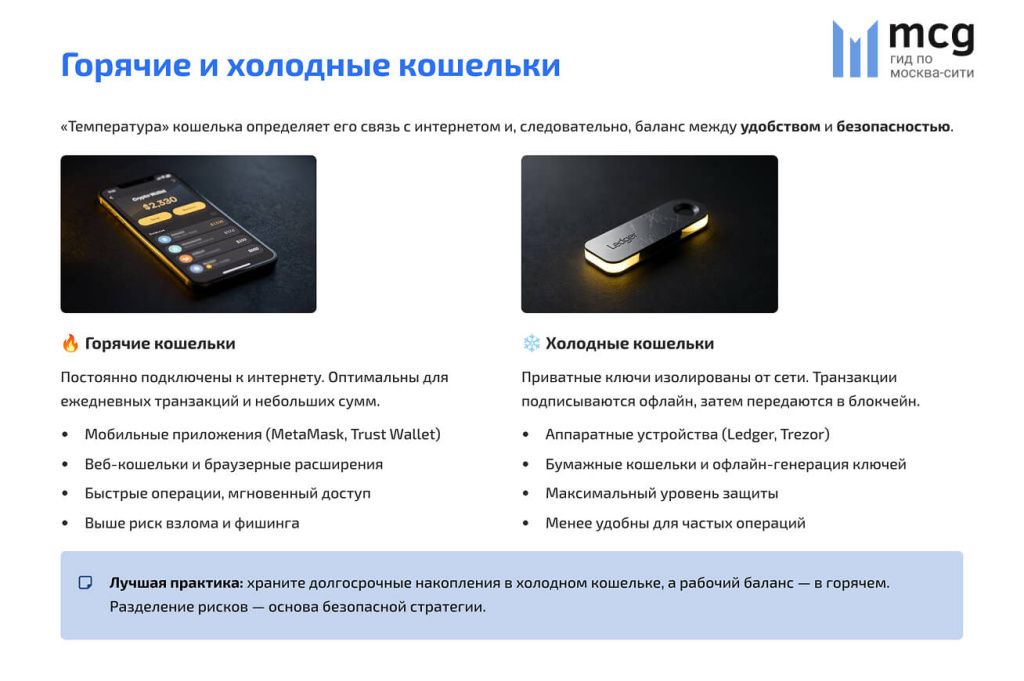
In the professional environment, the term “temperature” of storage is used to denote the level of isolation of private keys from the internet environment. When analyzing what a cold and hot wallet in cryptocurrency is, it is necessary to consider the main criterion — the presence or absence of a permanent connection to the network.
Hot wallet
Let’s start with the basic definition: a hot wallet. This category includes software solutions that function online or regularly connect to the internet. These are mobile apps, web interfaces, and browser extensions.
The advantage of such tools is the speed and convenience of operations: the user can quickly transfer funds, interact with services, or swap tokens. However, constant network connectivity increases potential cyber risks. Operating system vulnerabilities, malware, or phishing attacks can lead to compromised access.
An alternative approach involves isolating keys from the network. In this context, the question arises: what is a cold wallet for cryptocurrency from a technical point of view? We are talking about a storage model in which private keys are created and stored on a device without a direct internet connection.
Cold wallet
In practice, early cold storage solutions were implemented manually: separate computers with communication modules disabled were used. Transactions were signed offline, after which their data were transferred to a network-connected device to be sent to the blockchain.
This method provided a high level of protection due to the physical isolation of the keys, but required technical preparation and was difficult for the mass user.
Hardware solutions for key isolation
The development of cold storage technologies led to the emergence of hardware crypto wallets — special devices for securely storing private keys offline. Essentially, this is a small secured microcomputer with a built-in security chip (Secure Element) that isolates the key and does not allow it to be extracted even if the computer to which the device is connected is infected with viruses.
It works simply: a transaction is created on a computer or smartphone, then the data is transmitted to the device. The hardware wallet shows the address and amount on its screen and signs the operation only after the user confirms it. At the same time, the private key always remains inside the device, which significantly reduces the risk of theft of funds.
Crypto wallet for business and corporate tasks
To understand how crypto wallets are used in a corporate environment, we can consider a typical scenario — settlements with foreign partners in stablecoins, for example USDT. In such systems, the key role is played not by the application interface, but by the architecture of private key management: it is the distribution of access that determines the level of security.
In one of the models, a multisignature scheme (multisig) is used. A single address is created for the company, and the access keys are distributed among several participants — for example, executives and backup storage. Sending funds requires confirmation from several parties.
Such an architecture turns a crypto wallet into a system of distributed control, where security is ensured not by one person, but by access rules.
How to create a crypto wallet
Creating a crypto wallet begins with choosing a reliable application. Usually, non-custodial solutions are used, where private keys are generated and stored on the user’s device. Among popular wallets used in Russia and abroad, one can name Trust Wallet, MetaMask, Exodus, Ledger Live, and SafePal. To avoid installing fake programs, it is recommended to download the application via the developer’s official website.
After installation, the system will prompt you to create a new wallet and generate a seed phrase — a sequence of 12 or 24 words. This phrase is backup access to the funds, so it must be written down on paper and stored in a safe place.
After confirming the setup is completed. The user receives a public address — a string of characters used to receive and send cryptocurrency.
Comparison of popular crypto wallets:
| Crypto wallet | Wallet type | Key storage | KYC | Popular coins | Works with Russia | Rating |
|---|---|---|---|---|---|---|
| Trust Wallet | Non-custodial mobile | By the user | No | BTC, ETH, BNB, SOL | Yes | 4.9 |
| MetaMask | Web3 browser-based | By the user | No | ETH, USDT, LINK | Yes | 4.8 |
| Exodus | Desktop + mobile | By the user | No | BTC, ETH, SOL | Yes | 4.8 |
| Ledger | Hardware cold | On the device | No | BTC, ETH, XRP | Yes | 4.9 |
| SafePal | Hardware + mobile | On the device | No | BTC, ETH, BNB | Yes | 4.7 |
| Bybit Wallet | Exchange wallet | By the platform | Yes | BTC, ETH, LTC, XRP | Yes | 5.0 |
| MEXC Wallet | Exchange wallet | By the platform | Yes | BTC, ETH, XRP | Yes | 4.9 |
| OKX Wallet | Web3 + exchange | Partly by the user | Partly | BTC, ETH, SOL | Yes | 4.9 |
| Cropty | Mobile wallet | By the user | No | USDT, ETH, TON | Yes | 4.7 |
| Payeer | Payment crypto wallet | By the platform | Yes | BTC, ETH, BCH | Yes | 4.7 |
Interaction with networks and fees
When working with digital assets, it is important to consider the architecture of blockchains. Each cryptocurrency operates within its own network: for example, Bitcoin and Ethereum use independent blockchains with separate transaction processing rules.
Modern applications allow you to combine management of multiple networks in one interface. Therefore, what a crypto wallet is in practical terms — a universal tool for access to different blockchains that can display balances and assets from different networks simultaneously.
When sending funds, the user pays a network fee for processing the transaction. It is received by miners or validators who include the operation in a block. An important nuance is that the fee is always paid in the base cryptocurrency of the specific network.
For example, if USDT tokens are in the TRON network, sending them will require a small amount of TRX coins. Without them, the transaction cannot be processed, even if the token balance is displayed correctly.
For this reason, when working with any blockchains, it is recommended to keep a small reserve of the network’s base coin to pay fees.
It is also necessary to carefully check the transfer network. In decentralized systems, transactions are irreversible: sending funds to an unsupported or incorrect network may lead to their irreversible loss, since there is no mechanism to cancel operations in the blockchain.
Conclusion
Cryptocurrency infrastructure fundamentally differs from the traditional financial system. If in the banking model security and accounting of funds are ensured by centralized organizations, then in blockchain control over assets is determined by ownership of cryptographic keys. That is why a crypto wallet in a practical sense is not just an app, but a tool for managing access to digital assets.
Modern solutions offer several storage models: custodial services, where key management is carried out by the platform, and non-custodial wallets, where control is fully in the hands of the user. In addition, the market has formed different levels of protection — from online solutions to cold storage and hardware devices.
Understanding the basic principles of operation — from asymmetric cryptography to the mechanics of network fees — makes it possible to answer more precisely the question of what a crypto wallet is and how to use it. Ultimately, the security of digital assets depends not only on the chosen tool, but also on the user’s actions: proper storage of the seed phrase, checking transfer networks, and careful distribution of access to keys.
As blockchain technologies develop, interfaces become simpler and the infrastructure becomes more resilient. However, the fundamental principle remains unchanged: control over the private key means control over the funds. This mechanism is at the core of the entire decentralized finance system.