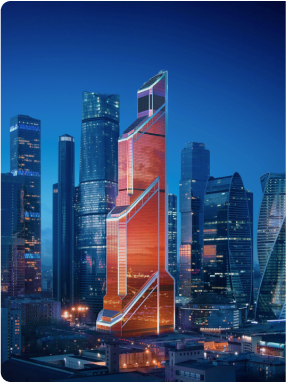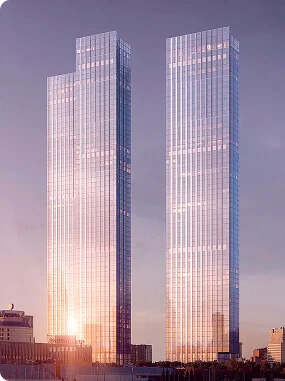


Moscow-City is entering a new stage of development: the business district is no longer limited to the towers of the Moscow International Business Center, but is becoming the core of the large-scale Big City macro-location, where offices, housing, headquarters, services, public spaces and new urban infrastructure will be concentrated. According to forecasts, by 2035 the office area in Greater City may grow from 2.8 to 6.8 million sq. m, and every fifth office in Moscow will be located in this zone. This is no longer just an expansion of a business quarter, but the formation of a new urban district of federal scale.
The historic Moscow International Business Center “Moscow-City” remains the main symbol of business Moscow, but its role is gradually changing. While it was previously perceived as an independent center of high-rise development, it is now becoming the assembly point for a larger system: new office clusters, business- and premium-class residential projects, service spaces, transport links and public areas are developing around it.
Moscow-City Has Outgrown Its Boundaries
In recent years, Moscow-City has effectively reached a state of high business density. There is almost no vacant high-quality office space left in the MIBC, while demand from major companies remains strong. By the end of 2025, the share of vacant offices in the business district had fallen to a historically low level of around 2.8%. At the same time, the weighted average rental rate for Class A offices increased by 32% and reached RUB 79,700 per sq. m per year, excluding operating expenses and VAT.
This is an important signal for the market: even with high rates, Moscow-City remains one of the most sought-after business locations in the country. Companies are willing to pay for status, transport accessibility, concentration of the business environment, infrastructure and the opportunity to be close to the largest players in the financial, industrial, technology and public sectors.
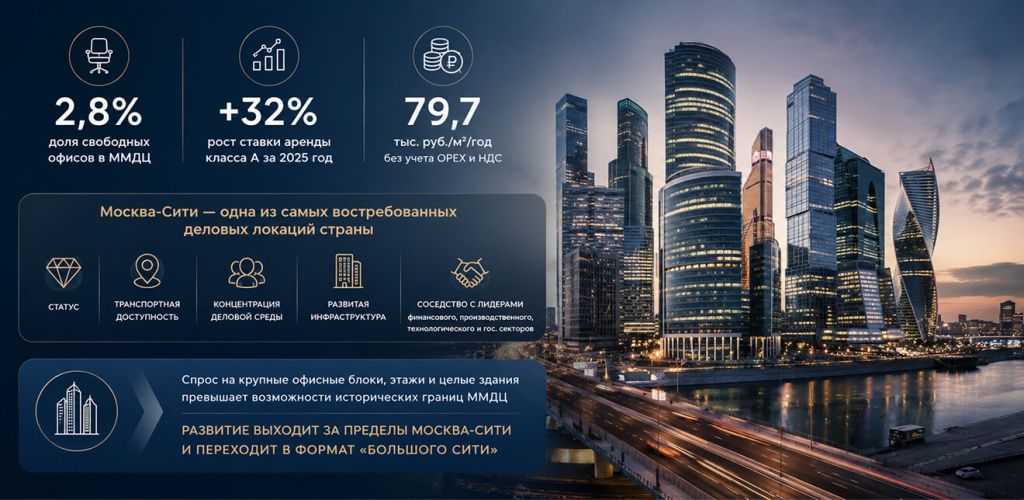
But this high demand has also created a new challenge. Within the historical boundaries of the MIBC, it is becoming increasingly difficult to meet the needs of large tenants and buyers. Headquarters, banks, corporations and fast-growing companies need not separate rooms, but large office blocks, floors, buildings and entire towers. Therefore, development is gradually moving beyond the familiar “City” and shifting into the Greater City format.
What Is Greater City
Greater City is not simply an area next to Moscow-City. It is a broader urban-planning concept that includes business, residential, public and infrastructure projects around the MIBC. It refers to a new business belt of Moscow, where offices, housing, social facilities, transport hubs, embankments, retail spaces and everyday services will develop.
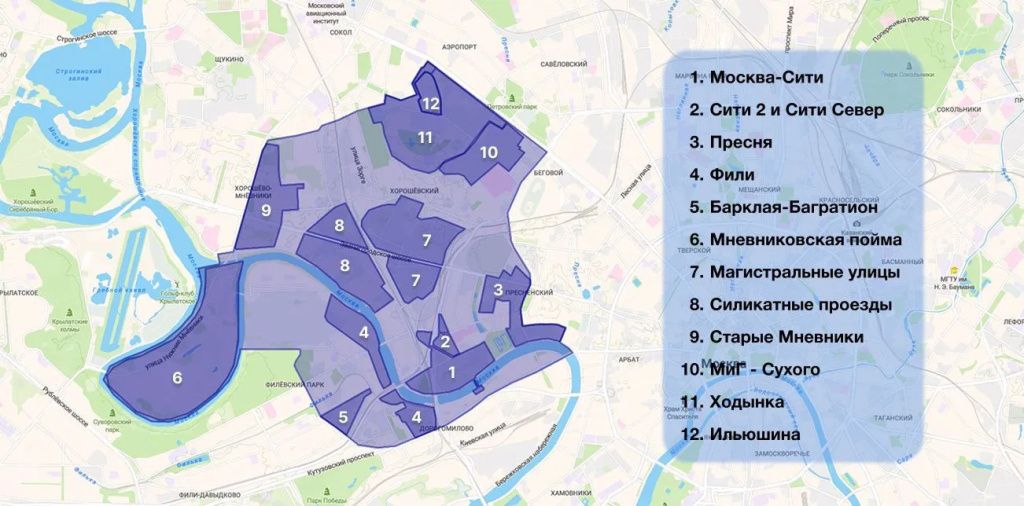
If the first-generation Moscow-City was primarily a place of work, the new-generation Greater City aims to become a full-fledged urban environment: a place to work, live, meet, hold business events, use restaurants, fitness facilities, educational institutions and city infrastructure.
This approach follows the global trend in the development of business districts. A modern business cluster can no longer be a territory that comes alive only in the morning and empties in the evening. It must function as an integrated urban system with different usage scenarios throughout the day.
Why Moscow’s Office Market Has Entered a New Phase
Moscow’s office market in 2025–2026 is at a complex but interesting point. On the one hand, demand for quality offices in strong locations remains high. On the other, macroeconomic conditions, the high cost of money and business caution are leading tenants and buyers to behave more conservatively.
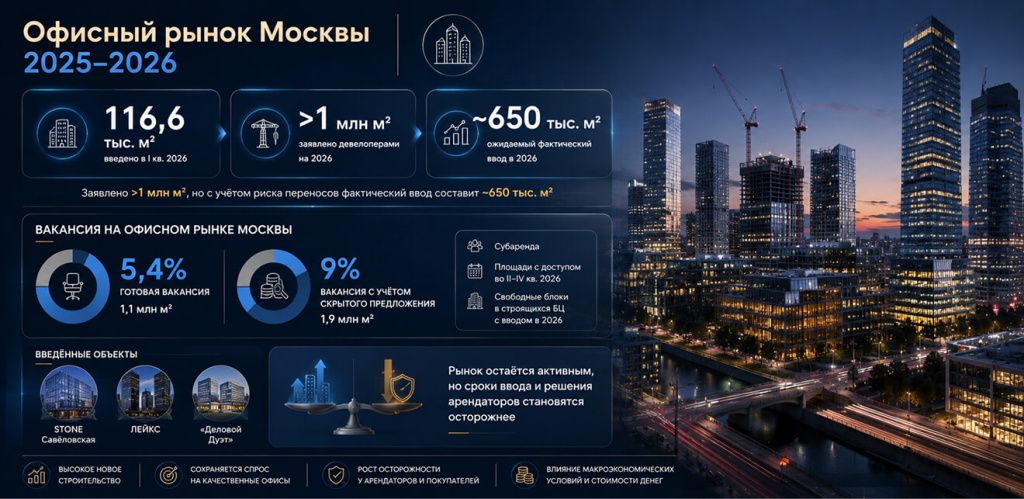
In Q1 2026, 116,600 sq. m of office space was delivered in Moscow. Among the completed projects were STONE Savyolovskaya, LAKES and Delovoy Duet. Developers have announced more than 1 million sq. m of new office deliveries for 2026, but taking into account the risk of delays, the actual figure may be around 650,000 sq. m. This means the market remains active, but actual project delivery timelines may be more cautious than initially planned.
By the end of Q1 2026, ready vacancy in Moscow’s office market stood at around 5.4%, or 1.1 million sq. m. However, if hidden vacancy is taken into account — sublease space, premises becoming available in Q2–Q4 2026 and vacant offices in business centers under construction with delivery in 2026 — the potential volume of available supply may reach 9%, or about 1.9 million sq. m.
| Indicator | Value | What It Means |
|---|---|---|
| New office deliveries in Q1 2026 | 116,600 sq. m | The market is being replenished with new space, but a significant share of future deliveries may be postponed |
| Ready vacancy | 5.4%, or 1.1 million sq. m | Formally, the amount of vacant space is limited |
| Vacancy including hidden supply | 9%, or 1.9 million sq. m | The real choice for tenants is wider than classic vacancy statistics suggest |
| Average rental rate | RUB 32,061/sq. m/year | The market is seeking balance after a period of rental growth |
| Average sale price for Class A and B+ offices | RUB 473,152/sq. m | Buyers remain interested, but are acting more cautiously |
| Demand volume in Q1 2026 | 145,900 sq. m | Demand fell by more than half year-on-year |
At first glance, falling demand may seem alarming. In reality, however, this is more a transition to a more balanced market than a collapse. After sharp rental growth, active deal-making and strong competition for quality space, tenants have begun to calculate costs more carefully, while buyers have adopted a wait-and-see position.
2026–2028: From Pause to Recovery
The next three years may become a period of transition for Moscow’s office market from stagnation to recovery. In 2026, the market is already in a pause phase: the total amount of purchased and leased space is expected to decline by around 13% compared with the previous year. New construction will remain at a high level, but the market will be under pressure from rising vacancy.
By the end of 2026, the share of vacant space is expected to grow by around 2.5 percentage points compared with 2025, while the weighted average rental rate may decline by year-end. This is logical: as supply grows, landlords will have to show more flexibility, especially in projects without a unique location, strong infrastructure or an established pool of major tenants.
In 2027, the market may move into early recovery. If macroeconomic conditions improve and business activity grows, the total amount of purchased and leased space is expected to increase. New construction will remain high, but the share of vacant space will start to decline, while rental rates may show moderate growth.
2028 may become the year of full recovery. If the key rate and inflation move closer to target levels, demand for offices will strengthen. Even with a high volume of new construction, the market will be able to absorb new space faster, while vacancy may decline to around 5.3%. Under this scenario, rates will continue to rise gradually.
| Year | Market Phase | What Is Happening | What It Means for Greater City |
|---|---|---|---|
| 2026 | Stagnation | Demand declines, vacancy rises, rates may correct downward | Strong locations retain their advantage, but the market becomes more demanding in terms of project quality |
| 2027 | Early recovery | Business and development activity grows, vacancy starts to decline | New projects may enter the market in a more favorable phase |
| 2028 | Full recovery | Demand accelerates, the market absorbs new space faster, rates rise gradually | Quality offices in strong business districts receive support from both demand and pricing |
This forecast is especially important for Greater City. In 2026, the overall market may look cautious, but long-term demand for quality business locations is not disappearing. A pause period often becomes a time of selection: projects with strong transport accessibility, a clear concept, good infrastructure, flexible layouts and the ability to offer companies not just square meters but a complete working environment will win.
Why Moscow-City and Greater City May Prove More Resilient Than the Market
The average Moscow office market and premium business districts are not the same thing. Vacancy may rise across the city as a whole, tenants may negotiate harder, and landlords may make concessions. But in the strongest locations, quality space remains a limited resource.
Moscow-City and Greater City have several advantages that help them withstand market cycles more steadily:
- established business status and location recognition;
- concentration of high-level companies;
- transport accessibility and proximity to key city arteries;
- developed restaurant, retail and service infrastructure;
- availability of large projects capable of accommodating headquarters and major corporate blocks;
- the prospect of comprehensive territorial development rather than point-by-point construction.
This is why interest in the City remains even against the backdrop of a general market pause. Companies may optimize space, review budgets and make decisions more cautiously, but a high-quality business environment remains in demand. This is especially true if it allows employees, clients and partners to move around conveniently, hold meetings, use services and remain at the center of business activity.
New Moscow-City Towers Through 2032
Within the MIBC Moscow-City itself, six new office towers with a total area of around 538,000 sq. m have been announced through 2032. This is a significant volume: it could increase the total office stock of the business cluster to around 2.2 million sq. m.
| Project | Developer | Office Area | Planned Delivery |
|---|---|---|---|
| City 4 | Sezar Group | 72,398 sq. m | 2027 |
| Top Tower | MR Group | 96,660 sq. m | 2029 |
| One | MR Group | 56,000 sq. m | 2030 |
| Sezar Tower | Sezar Group | 126,895 sq. m | 2030 |
| Tower near Bagration Bridge | Hals-Development | 164,100 sq. m | 2030 |
| AURUS Residences | Strana Development | 22,000 sq. m | 2031 |
| Total | 538,053 sq. m |
Importantly, this volume does not appear excessive. Some of the future space has already been sold in large lots or is in active sales. In recent years, there have been several examples of towers under construction being purchased by major corporate users in full or in substantial blocks. This confirms that demand in the City is being formed not only by traditional tenants, but also by companies that view offices as a strategic asset.
Who Is Building Greater City
The development of Greater City is being shaped by a whole group of major developers. This is an important difference from the classic model of a single district or one master developer. A polycentric system is emerging here, where different companies are developing offices, housing, mixed-use complexes, social facilities and retail infrastructure.
| Developer | Total Area | Key Projects | Main Function |
|---|---|---|---|
| Sezar Group | 554,700 sq. m | Sezar City, Sezar Tower, Sezar Silica, City 4, Sezar Future | housing, offices, social infrastructure |
| MR Group | 374,700 sq. m | One, Top Tower, Jois | housing, offices, retail infrastructure |
| Donstroy | 235,900 sq. m | Ostrov | housing |
| Strana Development | 231,800 sq. m | Strana.City | housing |
| Stone | 228,600 sq. m | Stone Khodynka, Stone Mnevniki | offices |
| FSK Group | 132,700 sq. m | Amber City, Sydney City, Magistralnaya 12 | housing, offices |
| Wildberries&Russ | 128,000 sq. m | headquarters in Moscow-City | offices |
| Prospekt | 120,400 sq. m | Light City | offices, retail |
| Tekta Group | 91,100 sq. m | Air | offices, retail, social infrastructure |
| Vesper | 90,800 sq. m | Vesper Kutuzovsky | housing |
Sezar Group and MR Group are betting on a hybrid format where offices are combined with housing, retail, services and social infrastructure. Stone, by contrast, is actively forming office clusters in promising business directions, including Khodynka and Mnevniki. Donstroy, Strana Development, Vesper and other players are strengthening the residential component of the territory.
As a result, Greater City is developing not as one project, but as a network of interconnected urban fragments. This makes it more complex, but also more resilient: it has several demand scenarios — office, residential, investment, service and infrastructure.
Housing Near Offices: Why It Is Becoming Important
The development of Greater City cannot be viewed only through the lens of offices. New workplaces create demand for housing near the business center. This is especially important for entrepreneurs, executives, finance and technology specialists, headquarters employees and companies for which proximity to the business environment matters.
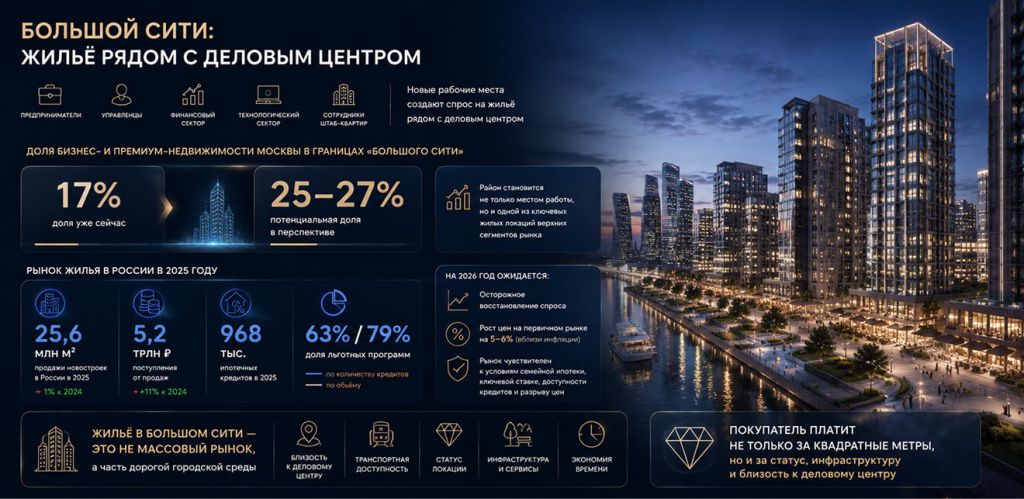
According to analysts, around 17% of all business- and premium-class real estate in Moscow is currently being sold within the boundaries of Greater City. In the future, this share may increase to 25–27%. This means the district is gradually becoming not only a place of work, but also one of the key residential locations in the upper market segments.
The overall housing market went through a difficult period in 2025. New-build sales in Russia amounted to 25.6 million sq. m, which was 1% higher than in 2024. Sales revenues reached RUB 5.2 trillion, up 11%. At the same time, mortgage issuance fell to 968,000 loans worth RUB 4.5 trillion, while the share of subsidized programs reached 63% by number of loans and 79% by volume.
For 2026, analysts expect a cautious recovery in demand. Prices in the primary market may grow by around 5–6%, roughly in line with inflation. At the same time, the market remains sensitive to family mortgage conditions, the key rate, credit availability and the gap between prices in the primary and secondary markets.
For Greater City, this means housing here will develop not as a mass-market product, but as part of an expensive urban environment. Buyers pay not only for square meters, but also for proximity to the business center, transport, the status of the location, views, infrastructure and time savings.
Moscow Remains the Most Resilient Real Estate Market
Against the backdrop of nationwide uncertainty, Moscow remains the most resilient market. It has a higher concentration of capital, jobs, investment demand, corporate clients and upper-class projects. This is especially important for territories such as Moscow-City and Greater City.
Yes, buyers have become more cautious. In early 2026, the number of shared-construction agreement transactions in Moscow declined, and part of demand shifted to completed real estate. Buyers increasingly compare projects under construction with already delivered properties, assessing mortgage terms, move-in timelines, the price gap between the primary and secondary markets, district quality and future liquidity.
But caution does not mean demand has disappeared. Rather, its quality is changing. Buyers have become more rational: they want to understand what they are paying for. In strong locations, this benefits projects with a clear concept, developed infrastructure and long-term urban-planning logic.
The New Office: No Longer Just a Workplace
One of the key shifts of recent years is the change in requirements for offices. After the period of remote and hybrid work, companies are bringing employees back to offices, but the old model no longer works. People have become used to more comfortable conditions, while businesses have started to view the office not only as a place to accommodate staff, but also as a tool for retaining teams, building corporate culture and supporting business communication.
A modern business center should not simply be a building with offices and open space. It should offer a complete service environment. According to market data, 65% of tenants consider underground parking mandatory, 49% reject buildings without food and beverage outlets, and 31% reject those without fitness facilities. Demand is also growing for meeting rooms, coworking spaces, conference halls and flexible spaces for internal events.
What Is Becoming Mandatory for a New-Generation Business Center
- underground parking and convenient access from parking to the lobby;
- charging stations for electric and hybrid vehicles;
- restaurants, cafes, coffee shops and various food formats;
- fitness and recreational spaces;
- meeting rooms, coworking spaces and halls for internal events;
- internal delivery and separation of flows for employees, guests and couriers;
- high-quality public areas, lobbies and resident services.
For developers, these are no longer optional extras, but part of the project economics. Developed infrastructure reduces tenant turnover and helps maintain higher rental rates. For tenants, it is a way to make the office more attractive to employees. For the district, it is a way to create a lively urban environment rather than just a collection of towers.
Serviced Offices: Flexibility Matters, but the Market Is Also Cooling
Serviced offices are a separate segment. In recent years, they have developed actively amid hybrid work and demand for ready-made solutions. However, in Q1 2026 this segment also faced more cautious tenant behavior.
The share of vacant workstations in Moscow serviced offices was around 12%. The average rental rate reached RUB 41,362 per workstation per month, while the average area per workstation, including common areas, meeting rooms and corridors, was around 7 sq. m. At the same time, serviced-office tenants have started considering more affordable options, including direct leases, while operators are adapting to client requests.
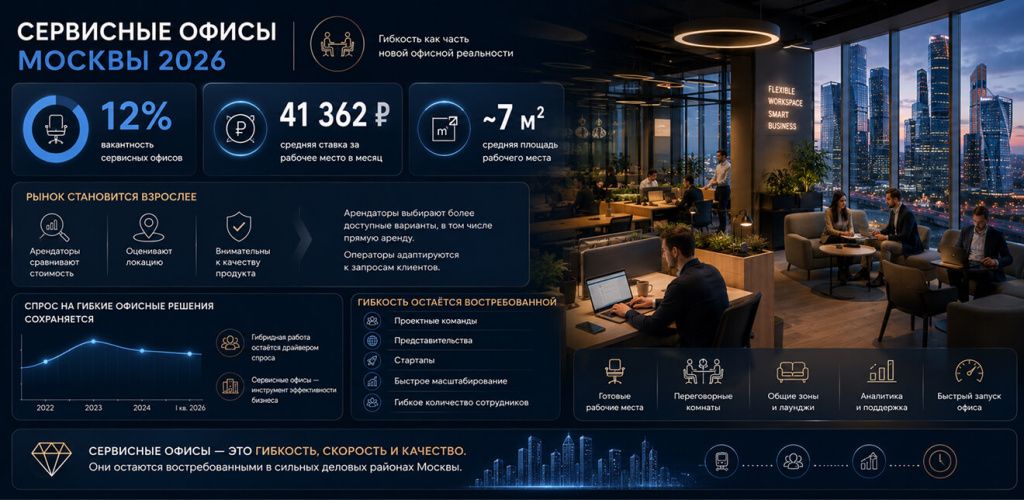
This is another sign of market maturity. Flexibility remains in demand, but clients are comparing cost, terms, location and product quality more carefully. In strong business districts, serviced offices may still be in demand, especially for project teams, representative offices, startups, companies with fluctuating headcount and businesses that need to launch an office quickly.
The Hidden Cost of the Office Boom: Fit-Out and Engineering
Construction of new office towers is only part of the future Greater City economy. After a building is delivered, another major market begins: design, fit-out, engineering, equipment, furniture, digital infrastructure, public areas and operational solutions.
According to market estimates, fit-out work for new, under-construction and announced business centers in the Moscow-City business cluster may require more than RUB 100 billion excluding VAT. This is a huge volume of work, showing that the real office boom is measured not only by the area of new towers, but also by the quality of the internal product.
For tenants and buyers, the readiness of premises, engineering capacity, energy efficiency, acoustics, quality of lobbies, restrooms, elevator areas, meeting rooms, security systems and digital services are becoming increasingly important. In a competitive environment, it is not just buildings that win, but projects where the entire user-experience chain is thought through — from entering the parking garage to the workplace and public spaces.
Why Greater City Is Not Only About Square Meters
Real estate markets are usually described in numbers: how much will be built, how much has been sold, how much remains vacant, and how rates have changed. But in the case of Greater City, something else is more important. The very model of the business district is changing here.
The old format was clear: an office tower, a retail podium, parking, restaurants and several services. The new format is more complex. Offices coexist with housing; large projects include schools and kindergartens; embankments, public spaces, transport hubs, fitness, restaurants, retail and everyday services are developing nearby.
Greater City is becoming a district where three scenarios come together:
- Work — offices, headquarters, business clusters, serviced offices, meeting rooms and event spaces.
- Live — business-, premium- and elite-class housing near the business center.
- Use the city — transport, restaurants, fitness, education, public spaces, embankments and services.
This is what distinguishes Greater City from ordinary office development. It is forming as a new urban environment where the business function remains the main one, but is no longer the only one.
What Could Restrain Development
Despite large-scale plans, the development of Greater City will depend on the overall state of the economy. The main risks for the real estate market in 2026–2027 are a slow reduction in the key rate, declining mortgage issuance, the high cost of project financing, buyer caution and the possible accumulation of imbalances between supply and demand.
Developers have already become more cautious in residential construction. In 2025, the launch of new projects declined, while the market still faces risks of insufficient demand in certain segments and regions. In the office sector, tenants are optimizing costs, buyers are taking a wait-and-see position, and landlords have to be more flexible in negotiations.
But for Moscow-City and Greater City, these risks look less critical than for weaker or peripheral locations. A strong business district with transport, infrastructure, status and limited quality supply usually passes through cooling periods more steadily. This is especially true when projects are backed by major developers and demand is supported not only by tenants, but also by corporate buyers.
Main Conclusion
Greater City is not simply a new wave of construction next to Moscow-City. It is a transition from point-by-point high-rise development to a full-fledged business urban system. The historic MIBC remains its main symbol and core, but a much larger territory is forming around it, where offices, housing, services, transport and public spaces work as a single organism.
In the coming years, the market will go through a difficult cycle. 2026 may become a period of stagnation and selection of strong projects. In 2027, a transition to early recovery is possible. In 2028, if the key rate and inflation decline, the market may return to more sustainable growth. But it is already clear that the strongest business locations retain their advantage even during a period of caution.
This is why Moscow-City and Greater City remain among the main points of the capital’s future development. What is forming here is not simply a new volume of real estate, but a new model of business Moscow — larger, more mixed-use, more service-oriented and focused not only on the office day, but on full urban life.
Related materials:
Moscow 2030: How Greater City and New Clusters Are Changing the Capital’s Business Map
Moscow-City and Greater City: Office Boom, Space Shortage and New Trends
Greater City: Moscow’s New Business Center