
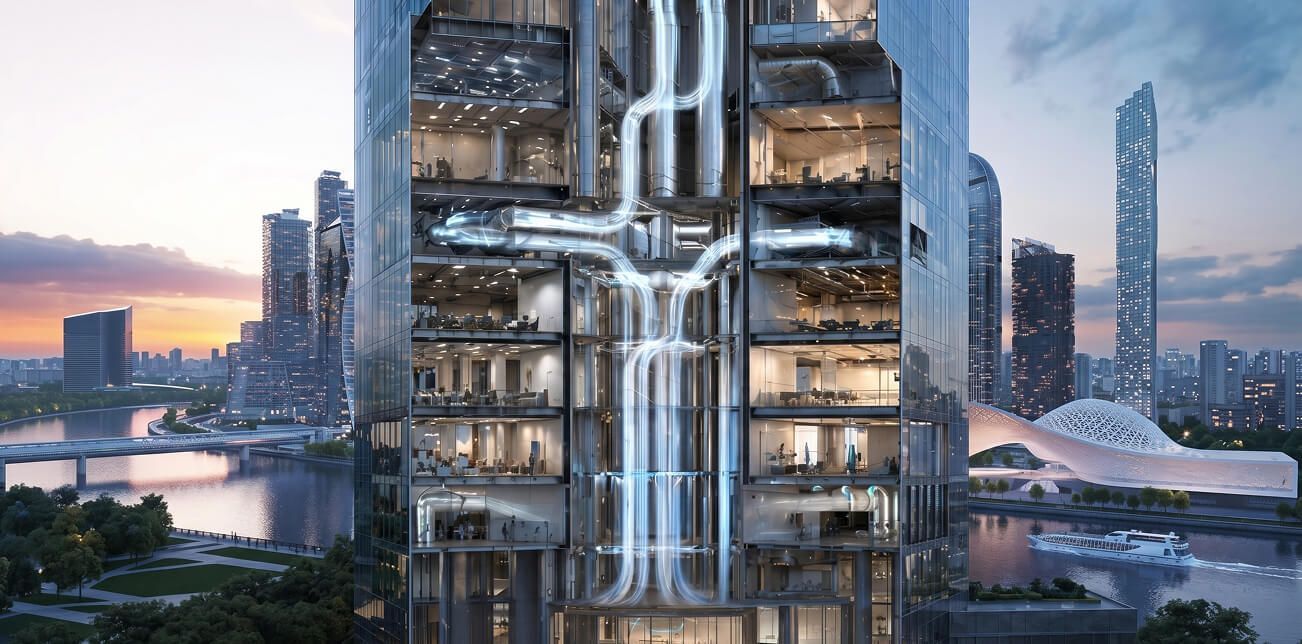
The skyscrapers in Moscow City are not ventilated like ordinary buildings. In these buildings, air passes through an entire mechanical system: it is drawn in from outside, filtered, heated or cooled, distributed throughout the floors, and then exhausted back outside. All of this happens almost imperceptibly to people, although behind this comfort lie technical floors, ventilation shafts, filters, fan coils, heat recovery units, and automated controls.
To put it simply, every tower has its own “lungs.” Only they are not on the facade, but inside the building—in places where the average visitor almost never goes.
Moscow City is most often perceived through its external image: glass facades, height, panoramic restaurants, and evening lighting. But the life of a skyscraper depends not only on architecture. Engineering is no less important, as it makes the towers suitable for work, life, and leisure every day.
Why ordinary ventilation isn’t enough for a skyscraper
In a regular apartment, it’s simple: if it gets stuffy, you open a window. In a skyscraper, that’s no longer the main solution.
At great heights, the wind behaves differently. Pressure changes. The facade becomes not just a beautiful shell, but part of an engineering challenge. Moreover, a single tower can contain completely different spaces: offices, apartments, restaurants, fitness areas, utility rooms, parking garages, lobbies, and public areas.
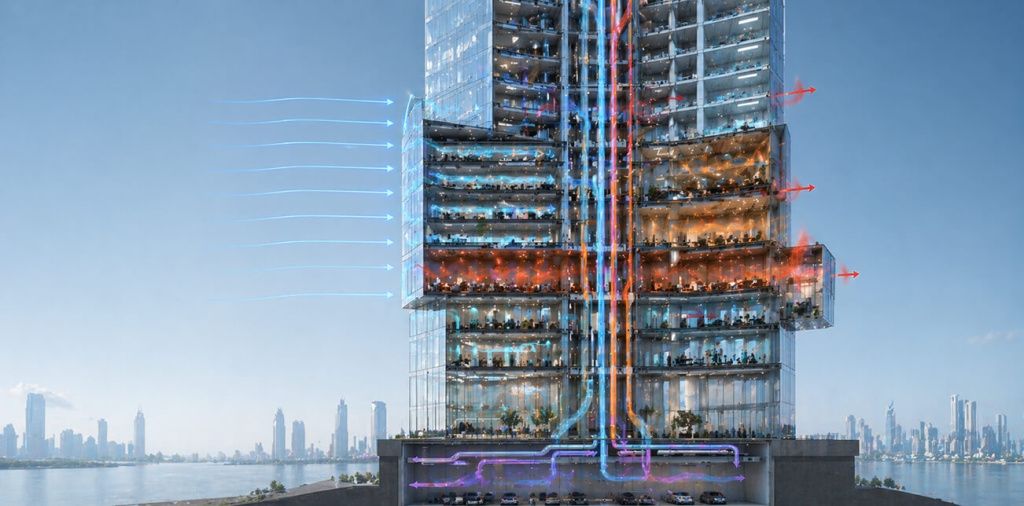
All these spaces have different requirements.
A restaurant needs a powerful exhaust fan. An office needs a steady supply of fresh air throughout the workday. Apartments need quiet, a consistent temperature, and no drafts. An underground parking garage needs a separate ventilation system.
That’s why ventilation in Moscow City isn’t just grilles in the ceiling. It’s a standalone building infrastructure that operates constantly. And the better it works, the less people notice it.
Bad air is noticeable right away. Good air—almost never.
Technical floors: the hidden part of the high-rise city
Skyscrapers have floors that aren’t shown in promotional brochures. There are no panoramic views, restaurants, lavishly decorated offices, or apartments there. Instead, that’s where the equipment is located—the equipment without which the tower couldn’t function properly.
These are the technical floors.
They house ventilation systems, heating units, pump stations, refrigeration equipment, automation systems, control centers, and part of the security systems. For the average visitor, this is a restricted area, but for the building, it is one of the most critical.
A high-rise cannot be serviced by a single, simple “all-in-one” system. The lower, middle, and upper levels are subject to different conditions. Therefore, the tower is divided into engineering zones. One set of equipment serves one group of floors, another serves another.
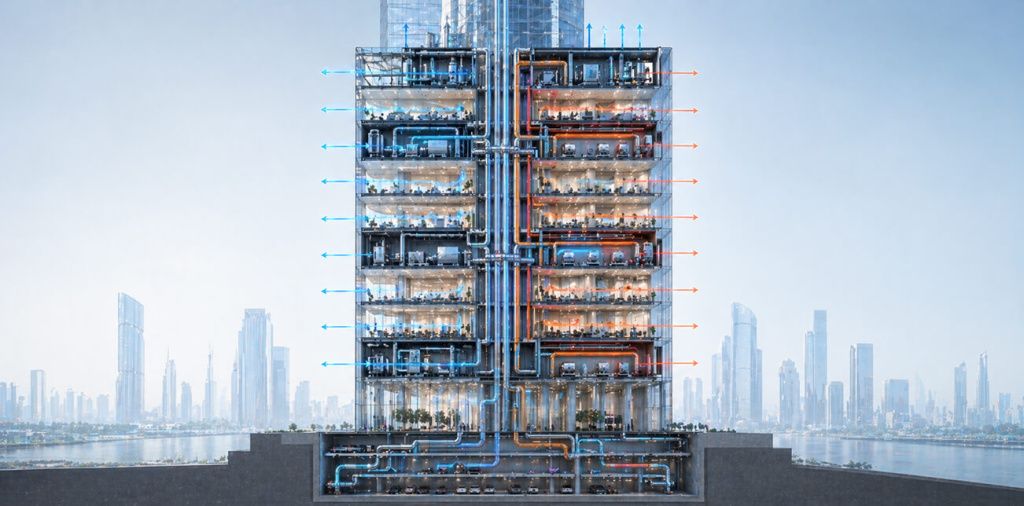
This makes it easier to maintain pressure, temperature, and a uniform air supply.
If you compare a skyscraper to a city, the technical floors are its utility infrastructure. Not the most noticeable, not the most impressive, but without it, the city would simply grind to a halt.
How air enters the tower
The path of air in a skyscraper is longer than it seems. It doesn’t go directly from the street into an office or apartment.
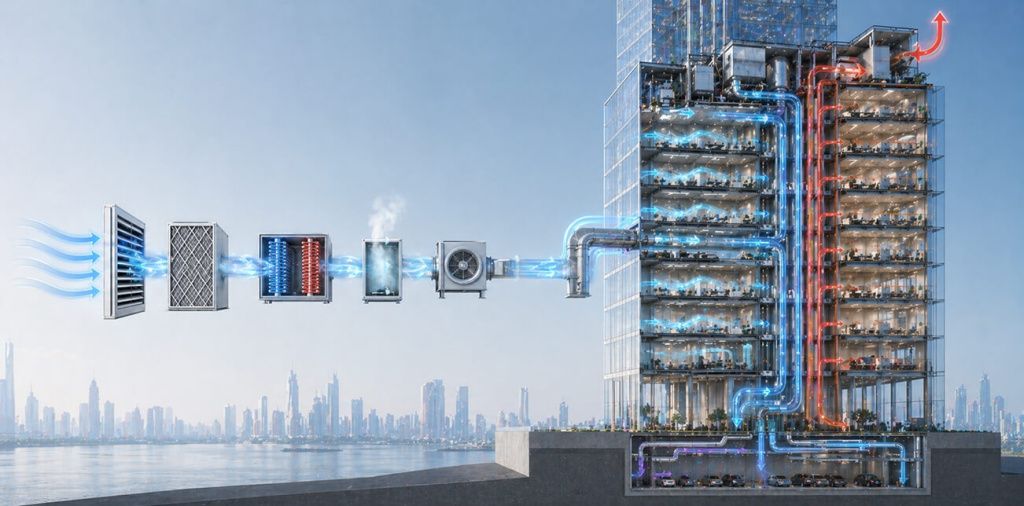
Typically, the process works like this:
-
air is drawn in from outside through special utility zones;
-
it is filtered;
-
it is heated in winter or cooled in summer;
-
it is humidified if necessary;
-
distributed throughout the floors via shafts and air ducts;
-
and then removed by the exhaust system.
In a well-designed tower, people shouldn’t directly feel all this work. The air shouldn’t blow sharply from the vents, make noise, or create drafts. It should simply be fresh and comfortable.
This is precisely the case where the quality of a building is determined not only by the view from the window, but also by how peaceful it is to be inside every day.
How this is addressed in different Moscow City towers
Each tower has its own engineering logic. Moscow City was not built in a single year, so buildings from different generations stand side by side, with different objectives and different usage scenarios.
"Federation": Air from High Technical Levels
The “Federation” tower is one of the most striking examples of high-rise engineering in the City. According to publicly available data, air intake for the apartments here is located on high technical levels—around the 61st–62nd and 87th–88th floors.
From there, the air undergoes two-stage filtration and is supplied to the rooms in a prepared state. Depending on the season, it can be heated, cooled, or humidified.
For a conventional building, this would seem excessive. For a skyscraper of this scale, it is a standard necessity. The taller the tower, the more difficult it is to maintain a uniformly comfortable microclimate across different levels.
OKO: Ventilation and Safety
The OKO complex uses central air conditioning, supply and exhaust ventilation, additional filtration, and air heating.
But in high-rise buildings, ventilation is not just about comfort. It is also linked to safety.
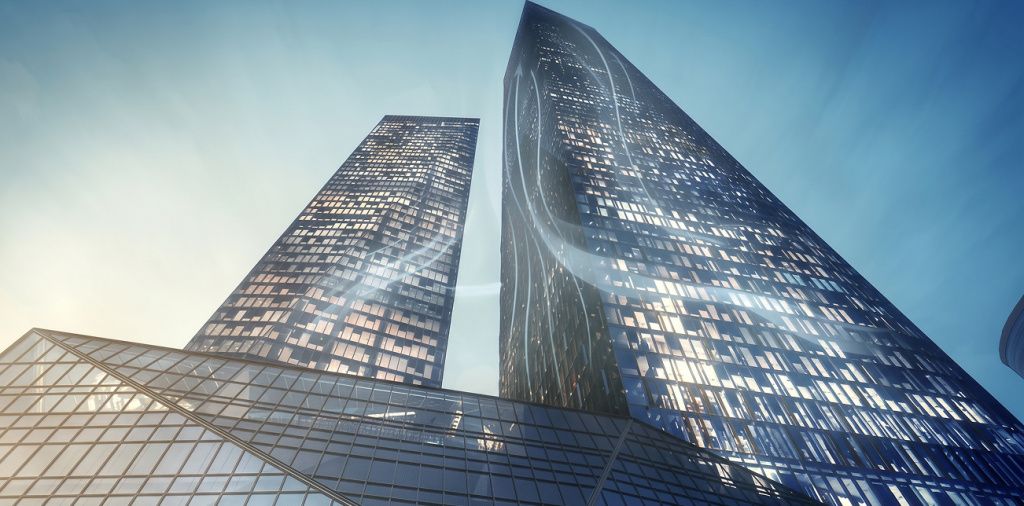
Under normal conditions, the system supplies fresh air and removes stale air. In an emergency, its role changes: it must remove smoke, protect evacuation routes, and prevent hazardous combustion products from spreading rapidly through the shafts.
This is precisely why, in skyscrapers, it is not only the air ducts themselves that are important, but also the materials, automation, smoke control protocols, and protection of internal utilities.
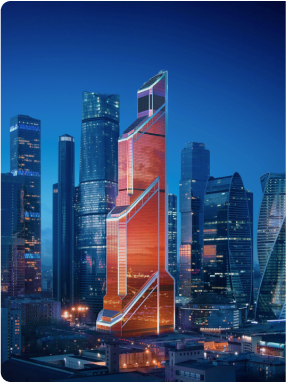
Mercury Tower: Climate Controlled by Automation
Mercury Tower is most often recognized by its golden facade. But inside, it is also a complex engineering structure.
The tower utilizes central ventilation and air conditioning systems, as well as air filtration and humidification. Control is integrated with the building’s overall automated system.
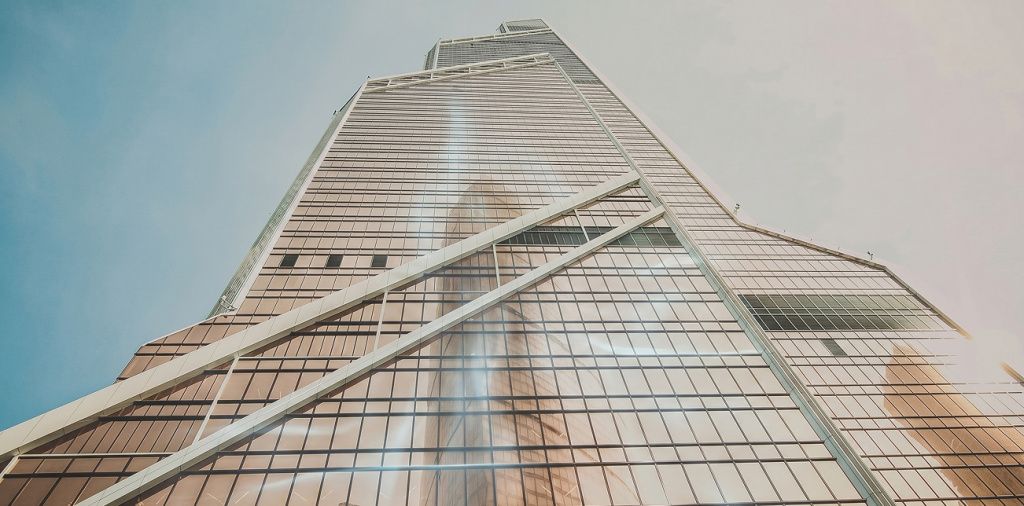
This is particularly important for a large business center. Employees arrive in the morning, offices and meeting rooms are actively used during the day, and in the evening, the load may shift to restaurants and public areas. The climate control system must respond to these changes.
A modern skyscraper can no longer be viewed as a collection of separate rooms. It is a single entity where climate, security, energy consumption, and control systems are interconnected.
IQ Quarter: Heat Recovery and Energy Savings
Heat recovery is mentioned among the engineering solutions in the IQ Quarter. The term is technical, but the concept is simple.
Air that has already been heated in winter or cooled in summer is removed from the rooms. Instead of completely losing this energy, the system can partially reuse it—to condition the fresh incoming air.
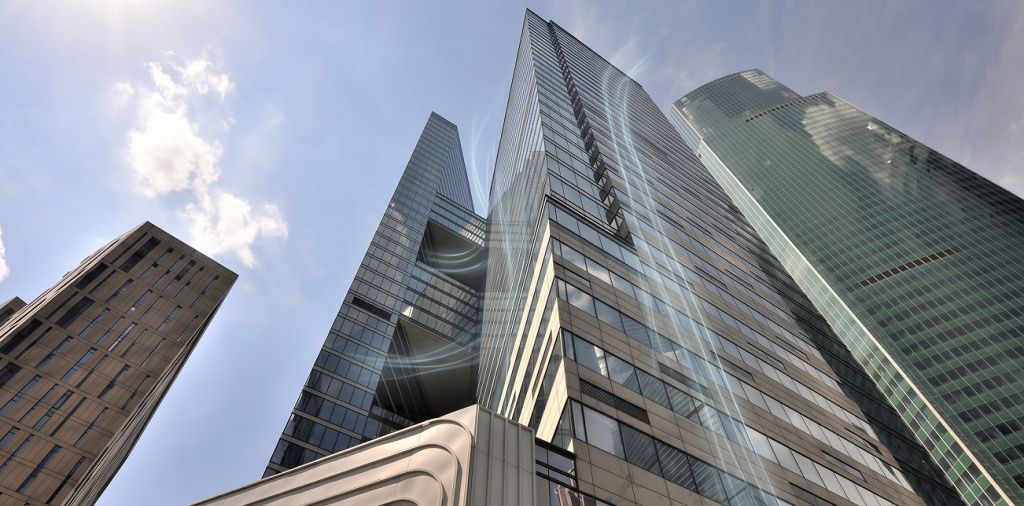
For a small apartment, this may seem like a minor detail. For a skyscraper, however, it is a significant factor. Huge volumes of air pass through the system, so even partial energy savings become noticeable.
Here, ventilation works not only for comfort but also for more efficient building operation.
Capital Towers: Residential Design and Openable Windows
In residential towers, air quality requirements differ from those in offices. You can leave an office in the evening. An apartment must remain comfortable at all times: in the morning, at night, in winter, in summer, on weekends, and on holidays.
Capital Towers features autonomous general-exchange supply and exhaust ventilation in the apartments. Separate exhaust ventilation is provided in kitchens, bathrooms, and walk-in closets.
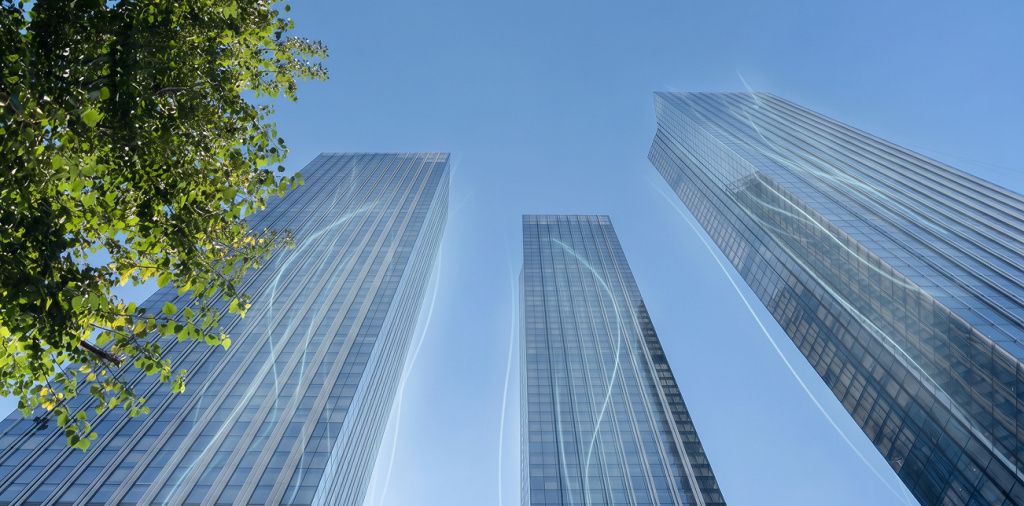
An interesting feature of the complex is the ability to bring in fresh air not only through the mechanical system but also through windows that open.
For high-rise buildings, this is not the most obvious solution. In many skyscrapers, windows do not open or open only with restrictions. Here, however, the developers sought to combine mechanical control with the more familiar human sensation of contact with the outdoors.
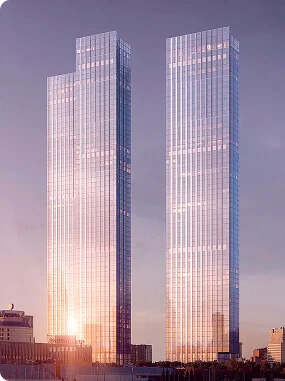
Neva Towers: Centralized System and Local Comfort
Neva Towers uses centralized ventilation and air conditioning. The residential section of the complex features a chiller-fan coil system.
To put it simply, the chiller is responsible for generating cooling, while the fan coils help distribute it throughout the interior. This allows the building to have a powerful central system while still maintaining the ability to adjust temperatures locally in specific zones.
For residents and tenants, this is an important compromise: the engineering systems operate centrally, while comfort is experienced individually.
“Empire” and “Tower on the Embankment”: Early City Engineering
Interestingly, complex climate control systems were incorporated into Moscow City as early as the initial stages of the district’s development.
In the “Empire” tower, engineering systems are controlled from a central control room. The building utilizes ventilation, air conditioning, heating, and cooling systems.
The “Tower on the Embankment” utilized individual heating, ventilation, and air conditioning systems, including fan coils with digital thermostats.
Today, such solutions may sound familiar. But for their time, they demonstrated an important point: Moscow City was originally built not as a typical office district, but as a district of complex high-rise structures.
Ventilation is not just about fresh air
Ventilation is often thought of solely in terms of comfort: to prevent stuffiness, heat, or cold. But in a skyscraper, it has a second role—safety.
In the event of a fire or smoke, normal operating conditions change. The system must help remove smoke, protect evacuation routes, and prevent the rapid spread of hazardous combustion products through shafts and ducts.
In the “Evolution” tower, for example, specific solutions were mentioned for protecting internal utilities and air ducts with non-combustible materials. This is a good example of how striking architecture is underpinned by very practical engineering logic.
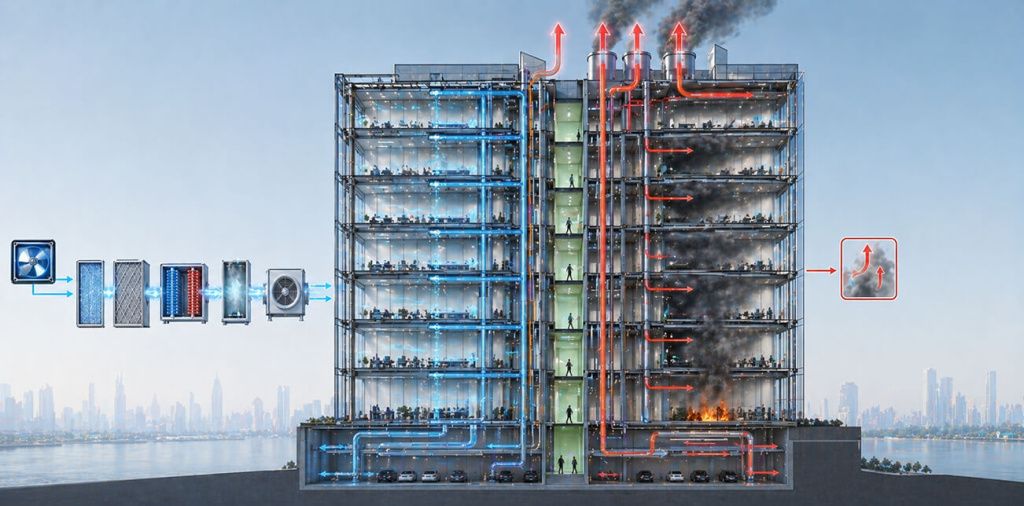
In high-rise buildings, many systems operate in two modes. On a normal day, they provide comfort. In an emergency, they become part of the protection for people and the building.
Why the view affects a tower’s class
The view from the window makes the first impression. Especially in Moscow City. But people quickly get used to the panorama.
But poor air quality is felt immediately. Stuffy air, dryness, noisy ventilation, sudden temperature swings, drafts, or weak exhaust can ruin the impression of even the most expensive interior.
For an office, this is a matter of employee productivity and the appeal of the space to tenants. For apartments, it’s about daily quality of life. For a restaurant, it’s part of the service that a guest may not even be able to put into words, but will certainly feel.
That is why building services have long been a key indicator of a building’s status.
It is not enough to build a tall tower and create a beautiful lobby. What matters is how the building performs day to day: whether it maintains the temperature, how quietly the HVAC system operates, whether the air is fresh, and whether there is a sense of being in a closed space.
The Bottom Line
Moscow City is not built solely on concrete, glass, and metal. It is also built on engineering that is almost invisible.
The facades make the district recognizable. Lighting and panoramic views create the image. But it is ventilation, air conditioning, filtration, heat recovery, technical floors, and automated control that make skyscrapers suitable for living and working.
If you look at the towers only from the outside, Moscow City seems like an architectural symbol. If you look deeper, it becomes clear: it is also a massive engineering organism.
And one of its main processes is breathing. Air must be properly drawn in, purified, prepared, and quietly delivered to the places where people spend their days. Without this, the high-rise city would be nothing more than a pretty picture.