


Recently, there has been a persistent trend of the state displacing private investors throughout the Russian economy. Moscow-City, which will celebrate its 30th anniversary in 2021, has not been spared this process.
Where it all began
Back in 1991, the distinguished architect B. Thor submitted an ambitious proposal to the city authorities to build a massive business district on the site of a former quarry near the Expocentre, with the aim of alleviating congestion in Moscow's historic center. It was thoroughly reviewed and accepted. As a result, construction began on the site, which covers over 100 hectares. However, the concept for the modern business district has evolved numerous times over the years, and today it bears virtually no resemblance to Thor's original vision.
Over the course of 30 years, Moscow City experienced periods of decline and growth, with construction repeatedly frozen, and the entire project was in jeopardy when it was put on hold for 10 years in 1993. Active work on the project only began in 2003, when major private developers, including Capital Group and Enka, began buying up the sites one by one. According to OAO City, the company managing and operating the business district's skyscrapers, total investment in the project amounted to approximately $12 billion. But who was so keen on the project's implementation?
Who owns Moscow City today?
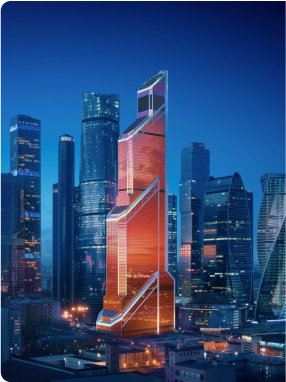
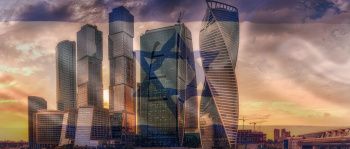
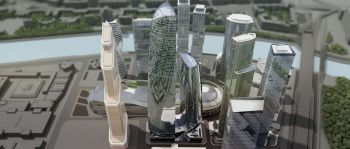
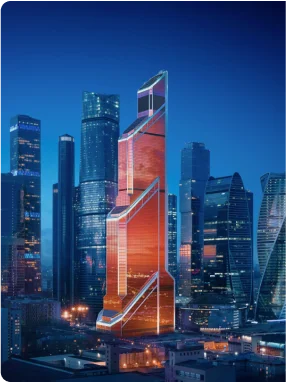
Today, 12 multifunctional complexes comprised of 17 skyscrapers have been commissioned. But that's not the limit, as 11 more projects are planned for the foreseeable future.
The market value of the completed towers is approximately 695.5 billion rubles, equivalent to $11.2 billion. Of this , City Point , owned by Samvel Karapetyan and his partner, Ara Abrahamyan, is valued at 11 billion rubles. Samvel Karapetyan ranks 29th in the Forbes rating and owns the Tashir Group of Companies. His brand-new business center, City Point, is considered the least expensive tower in Moscow City.
As for the most expensive tower in the Moscow International Business Center, that title rightfully belongs to the Federation Tower . It consists of two separate skyscrapers, named "East" and "West," whose combined cost is approximately 120 billion rubles. Construction of this grandiose structure was initiated by the controversial billionaire Sergei Polonsky. He became remembered by Moscow residents not only for his eccentricity but also for the two years he spent in the Matrosskaya Tishina Hotel. Today, Moscow's tallest tower, "East" (374 meters), belongs to billionaire Roman Trotsenko, who ranks 59th on the Forbes list. Its immediate neighbor, the "West" tower (243 meters), is rightfully owned by state-owned VTB Bank.
But VTB owns more than just the Federation Towers skyscraper. Its portfolio also includes the Eurasia Multifunctional Complex, valued at 42 billion rubles. The Eurasia complex was originally developed by Mukhtar Ablyazov, a native of Kazakhstan. However, he became embroiled in a conflict with his native authorities, losing most of his fortune and moving to France on his remaining, albeit modest, income. VTB employees currently work in both buildings, which are owned by VTB.
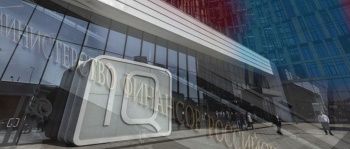
The state also owns the 173-meter IQ-Kvartal skyscraper, valued at 60 billion rubles. Its official owner is Dom.RF. The IQ-Kvartal mixed-use complex was initially built by Hals-Development, then owned by Vladimir Yevtushenko (ranked 63rd on Forbes).
Another state-owned company, Transneft, owns the original 255-meter-tall "Evolution" skyscraper. The market value of the spiral tower is 40 billion rubles. The project for the spiral building was initiated by Alexander Chigirinsky.
His older brother, Shalva Chigirinsky, also had his eye on Moscow City. He partnered with Viktor Rashnikov to build the tallest tower, "Rossiya," with a roof 612 meters above ground level. The project was designed by Norman Foster, but it was never realized. After a major scandal in 2009, all of the former billionaire's properties, both in Russia and abroad, were seized by VTB Bank.
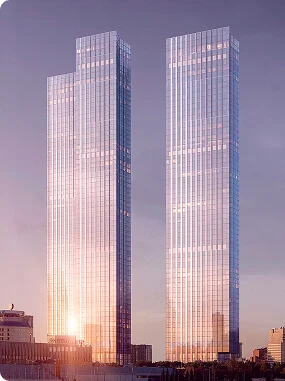
This prompted Viktor Rashnikov, currently ranked 14th in the Forbes rankings, to engage the Turkish developer Renaissance Construction, which eventually acquired all rights to the new multifunctional complex. However, the project was altered, and the grandiose "Rossiya" was replaced by the rather mundane Neva Towers mixed-use complex, consisting of two towers, 345 meters and 297 meters high.
Thus, Moscow City, like a mirror, reflects the major changes in the Russian economy that have occurred over the past 15 years. Gradually, private investors are going bankrupt and leaving the arena, or moving abroad. And the state is taking their place.



Any questions or comments?
This complex belongs entirely to private investors - the population of Russia. Today, the income that this Capital gives, as well as all the Capital of Russia, belongs to the Owners of this Capital, citizens of Russia - RENTIERS and works in global trade, every day gives an income of at least 50% of the market price of these towers.
Site administrators response:
Thank you for your comment! The Moscow-City complex is truly a unique object that attracts investors from both Russia and abroad. It is a complex ecosystem project that unites the interests of commercial and residential property owners, tenants and management companies. Regarding the claim about the yield of 50% of the market value of the towers, I would like to clarify that the real yield indicators depend on many factors, such as: -Type of real estate (offices, apartments or retail space); -Duration of rental; -Facilities occupancy level; -General state of the real estate market and the economy. In addition, a significant part of the capital in Moscow City actually belongs to private investors, both Russian and international. This complex is actively integrated into the economic life of Moscow and is an important element of its business infrastructure. We are pleased that Moscow City continues to attract attention as an example of a successful urban development project. If you have more specific questions or data, we would be happy to discuss them!