If you want to know how to buy Bitcoin in Russia in 2026, there are three main options available to users: P2P exchanges, online exchange platforms, and cash transactions. The limited nature of these options is due to sanctions imposed on international payment systems, as well as current Russian legislation, which is why online channels have become the primary means of dealing with cryptocurrency.
Three main ways to buy BTC:
- P2P exchanges — user-to-user transactions protected by an escrow service;
- Online cryptocurrency exchanges — fixed rates, fast transactions, and a simple interface;
- Offline crypto exchanges — cash purchases with personal transaction support.
What is Bitcoin
Bitcoin (BTC) is the first and largest cryptocurrency by market capitalization, operating on a decentralized blockchain network. In the context of purchasing, Bitcoin acts as a digital asset that a user acquires for rubles (or another currency) for the purpose of accumulation, investment, or subsequent transfers. Technically, a purchase involves receiving a certain amount of satoshis (millionths of a BTC) into your own wallet and recording the corresponding transaction on the blockchain. A cryptocurrency wallet is required to store the purchased asset.
Main ways to buy Bitcoin
1. P2P exchanges
P2P (peer-to-peer) exchanges are platforms that connect buyers and sellers directly. The platform does not act as a counterparty to the transaction but merely provides the infrastructure: a bulletin board, a chat for communication, and an escrow mechanism. When a transaction is created, the seller’s bitcoins are locked in a special account and released only after the buyer confirms the transfer of rubles.
Advantages:
- A wide range of payment methods—card number transfer, SBP, e-wallets (YuMoney, QIWI, WebMoney), and even cash.
- The exchange rate is close to market rates, as sellers compete with one another.
- Buyers are usually not required to undergo identity verification (KYC); registration on the platform is sufficient.
Risks:
- A bank transfer may be blocked under Federal Law No. 115-FZ if the recipient (seller) raises suspicion with the bank.
- There is a risk of encountering a scammer who, after receiving the money, attempts to dispute the transaction. Escrow reduces this risk but does not eliminate it entirely.
- Transaction speed depends on the seller’s response time.
Fees: A P2P platform typically charges a fee to the seller (0.1–0.5%). For the buyer, the platform is usually free, though sellers may factor their costs into the exchange rate.
Verification: Registration on a P2P exchange requires only an email address or phone number. Full verification (including document upload) may be required when withdrawing cryptocurrency from the exchange, unless it is a P2P section within a major exchange.
Popular P2P platforms available to Russian users:
- Bybit P2P — the most popular P2P platform among Russians as of 2026, ranking first in terms of ruble liquidity.
- OKX P2P — an exchange with mandatory KYC verification, distinguished by its advanced Earn ecosystem, copy trading, and sophisticated Web3 tools.
- MEXC P2P — a platform without mandatory KYC with some of the lowest fees on the market (0.05% for spot trading, 0.02% for derivatives).
When choosing a seller on a P2P exchange, it is recommended to pay attention to the number of completed transactions, the success rate (close to 100%), and text reviews. Sellers with no transaction history or those offering a rate significantly different from the market rate are potentially risky.
2. Online BTC Exchangers
Online exchanges are specialized services that automatically convert one currency into another. Unlike P2P exchanges, here the user interacts only with the service itself, which acts as the sole counterparty. Exchangers offer a simple interface without a order book or orders: just select the direction (e.g., BTC → RUB or RUB → BTC), enter the amount and payment details.
For many users, this is the easiest way to buy Bitcoin online, quickly and without the hassle of setting up a trading account.
How it works:
- The process usually begins with selecting the exchange direction and amount. The service locks in the exchange rate for a specific period (usually 15–30 minutes).
- The user transfers rubles to the specified details (card, bank account, wallet).
- After receiving the funds, the exchange sends the cryptocurrency to the specified address.
Advantages:
- High speed: the transaction takes 5 to 30 minutes.
- Fixed rate — no slippage.
- No registration or KYC required for amounts up to a certain limit (usually up to 100,000–200,000 rubles).
Disadvantages and risks:
- The rate includes a service margin—the spread can be 1–5% compared to the market rate.
- There are fraudulent exchange platforms that create phishing copies of well-known websites.
- For large amounts, the service may request verification or refuse the exchange.
How to choose a reliable exchange:
To check a service’s reputation, use exchange monitors—aggregators that collect current rates, reserves, and, more importantly, reviews from real users. For example, the reputable monitor Exnode is a Russian service focused on rubles and cryptocurrencies, including information on the legal status of services.
Recommended exchange platforms (based on the aggregator-monitoring service and a solid reputation):
- BukhtaObmena — a service with over 350,000 completed exchanges, an average request processing time of 14 minutes, and support for over 5,000 payment methods, including cards from any Russian bank and payment systems.
- ChangeExpert — a platform offering competitive exchange rates, request processing in up to 7 minutes, and a money-back guarantee in case of unforeseen circumstances, backed by numerous positive reviews.
- Finex24 is an exchange with reserves exceeding $1,000,000, over 400,000 completed transactions, and 24/7 customer support, operating with thousands of exchange pairs.
The main focus remains on buying and selling Bitcoin for rubles (BTC/RUB). Most exchanges also offer transactions with other assets—for example, buying Bitcoin for stablecoins (BTC/USDT) or exchanging Ethereum for Bitcoin (ETH/BTC).
3. Buying Bitcoin with cash rubles through offices
Buying BTC with cash rubles remains relevant as a separate market segment, especially when dealing with large sums or in situations where interaction with the banking infrastructure needs to be minimized. Transactions can take place either directly between users or through specialized offline exchange points (crypto exchange offices).
Formats:
- Face-to-face meeting between the parties. The transaction is arranged through P2P platforms or third-party channels (messengers, forums), where the parties agree on the exchange rate and terms. The transfer of cash and the sending of BTC occur simultaneously.
- Exchange through crypto exchange offices. Specialized services with a physical location act as intermediaries, accepting cash and subsequently sending cryptocurrency to the client’s wallet. In some cases, the exchange rate can be fixed in advance, and a staff member may assist with the transaction.
- Combined methods. Use of safe deposit boxes, courier services, or trusted representatives.
Advantages:
- Ability to handle large sums without the restrictions of bank transfers.
- Transaction speed depends on the arrangement of the meeting or office hours (on average, from 15 minutes to several hours).
- The exchange rate typically includes an additional margin for the offline format and service risks.
Risks:
- Increased security risks during in-person meetings: fraud, counterfeit bills, potential threats to physical safety.
- Limited transaction protection: even when using P2P platforms, cash transactions are not covered by the standard escrow mechanism.
- Variations in the reliability of offline services: lack of uniform standards for regulation and transparency.
- Legal factors: transactions involving large amounts of cash may attract additional attention from regulatory authorities.
Unlike direct P2P transactions, crypto exchange offices partially reduce operational risks by standardizing the process, but do not eliminate them entirely. The choice of this method is typically driven by requirements regarding transaction volume, speed, or payment format, rather than a universal advantage in terms of fees.
Minimum Bitcoin purchase amount
You don’t need to buy a whole BTC—the asset is divided into 100,000,000 satoshis, so any fraction can be purchased. The minimum threshold is determined not by the price of Bitcoin, but by the limits of the service through which the transaction is processed.
- Market entry starts at 500–1,000 rubles;
- the typical range for initial transactions is 0.0001–0.001 BTC;
- the network fee averages $1–5 and depends on blockchain congestion;
- transaction confirmation takes 10 to 60 minutes.
The process is always the same: a test purchase is made, the funds are verified in the wallet, and then the transaction volume is increased.
Frequently Asked Questions About Buying Bitcoin
Is it possible to buy Bitcoin without a fee?
In practice, transactions are never completely commission-free. Even if a service doesn’t charge a separate fee, the costs are already factored into the exchange rate. Therefore, it makes sense to focus not on formal commissions, but on the total amount you’ll pay.
Is buying Bitcoin legal in Russia?
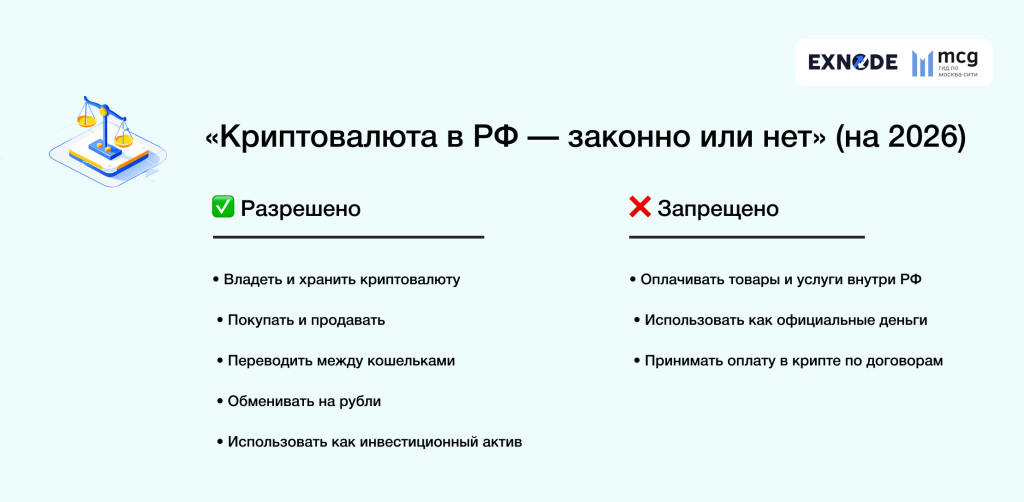
Yes, buying BTC is not prohibited. In accordance with Federal Law No. 259-FZ “On Digital Financial Assets,” cryptocurrency is recognized as property. Citizens have the right to acquire, hold, and transfer digital assets. The restriction applies to the use of cryptocurrency as a means of payment for goods and services within the Russian Federation—payments must be made in rubles.
Legal commentary:
The legal regulation of cryptocurrency transactions in the Russian Federation is established by several regulatory acts.
- The foundational document is Federal Law No. 259-FZ of July 31, 2020, “On Digital Financial Assets and Digital Currency,” which defines cryptocurrency as property rather than a means of payment. This means that the purchase, sale, and storage of BTC within the Russian Federation are permitted, but the use of cryptocurrency to pay for goods and services is prohibited.
- Additionally, law enforcement practice relies on the provisions of Federal Law No. 115-FZ “On Combating the Legalization (Laundering) of Proceeds from Crime,” under which banks are required to monitor customer transactions, including transfers related to cryptocurrency. It is precisely on the basis of Law No. 115-FZ that credit institutions may suspend transactions or request confirmation of the source of funds.
- The Central Bank of the Russian Federation (CBR) takes a cautious stance toward cryptocurrencies and views them as high-risk assets. In informational letters and public statements, the CBR has repeatedly pointed out the inadmissibility of using digital currency as a means of payment within the country, as well as the increased risks for users.
However, there is no direct ban on owning, buying, or selling Bitcoin in Russia. Cryptocurrency transactions are within the legal framework but are treated as property transactions, which entails tax obligations in accordance with the Tax Code of the Russian Federation (in particular, when receiving income from sales).
Can a bank block a card for purchasing cryptocurrency?
Banks are guided by Federal Law No. 115-FZ and may block a transfer if they deem it suspicious. Most often, blocks occur with transfers to cards held by individuals that are actively used for cashing out (so-called “drop” accounts). To reduce the risk, it is recommended to:
- Use a separate card for cryptocurrency transactions.
- On a P2P exchange, choose sellers with a long history and high ratings.
- Avoid transfers exceeding your card’s usual transaction volume without notifying the bank in advance.
Is it possible to get cash rubles for Bitcoin?
Yes, this is possible through P2P exchanges marked “cash” or through exchange services offering cash withdrawals in Moscow, St. Petersburg, and other major cities. However, such transactions carry increased security risks and often involve higher fees (3–7%). For most users, a safer and more cost-effective option is a non-cash withdrawal to a card followed by a withdrawal at an ATM.
How can you protect yourself when buying Bitcoin online?
Basic safety rules:
- Use only verified platforms (P2P exchanges with escrow, exchange services from monitoring sites).
- Before a large transaction, make a test payment with a small amount.
- Verify the wallet address by checking the first and last 4–6 characters.
- For long-term storage, transfer Bitcoin to your own non-custodial wallet (e.g., a hardware or mobile wallet with key control).
Conclusion
The choice of how to buy Bitcoin in Russia depends on individual priorities: speed, convenience, commission size, and the desired level of anonymity. P2P exchanges offer the most favorable exchange rate and payment flexibility; online exchanges offer simplicity and speed; cash transactions remain the domain of experienced participants willing to accept higher risks. Regardless of the channel chosen, adhering to basic security measures—verifying the counterparty, conducting test transactions, and verifying addresses—remains a prerequisite for the safety of your funds. For those just starting to work with cryptocurrency, we recommend first reviewing the series of articles dedicated to a detailed analysis of the asset’s fundamental nature and the proper creation of a Bitcoin wallet.