Ethereum is a public blockchain and a software platform for transferring digital assets and running applications based on smart contracts. The network's native cryptocurrency is called ether and uses the ticker ETH. In everyday speech, Ethereum may refer to the network, the ecosystem, or the coin, although these are different concepts.
The essential distinction is simple: Ethereum is the network and execution environment, while ETH is the asset used to pay for operations and help secure the network. This guide explains how the system works without price predictions or promises of returns.
What is Ethereum in simple terms?
Ethereum can be pictured as a shared computer whose state is stored and verified by many independent participants. A user sends a digitally signed instruction, called a transaction. Nodes check it, validators include the result in the blockchain, and no single server owner can rewrite the record at will.
The Ethereum blockchain stores more than ETH transfers. It runs smart contracts—programs with predefined rules. Developers use them to create tokens, decentralized exchanges, lending protocols, games, identity tools, and NFTs. An application may combine a conventional website with contracts on the network: the interface assists the user, while important actions are executed onchain.
Ethereum is therefore more than a cryptocurrency. It is an infrastructure for programmable digital ownership. ETH plays a central role inside that infrastructure, but the ecosystem also includes applications, token standards, wallets, development tools, and scaling networks.
What is ETH?
Ether, or ETH, is Ethereum's native asset. It can be transferred between addresses, is used to pay gas fees, and is deposited by validators in staking. Unlike an ERC-20 token, ETH is part of the protocol itself rather than a balance managed by a separate token contract.
Exchanges and wallets may label the asset “Ethereum,” while the technically precise name of the coin is ether. Before withdrawing, users should verify the network and destination. A token with a familiar ETH label on another blockchain may be a wrapped or bridged representation rather than native ether.
The abbreviation ETH can mean different things outside crypto. In a cryptocurrency trading terminal, it normally means ether. The market name, trading pair, and selected network provide the necessary context.
| Term | Meaning | Practical role |
|---|---|---|
| Ethereum | Blockchain and application ecosystem | Executes contracts and stores state |
| Ether | Native cryptocurrency | Fees, transfers, and staking |
| ETH | Ticker for ether | Balances and trading pairs |
Who created Ethereum?
Vitalik Buterin is the best-known co-founder of Ethereum. He described the idea of a programmable blockchain, while a wider group of co-founders and developers worked on the launch. The network went live in 2015.
It is therefore incomplete to attribute Ethereum to one person. Buterin proposed the key concept and remains a prominent member of the community, but Ethereum was built by a team and is now developed through an open international ecosystem. No founder can unilaterally change user balances or impose a network upgrade.
Protocol changes are discussed publicly, implemented in several software clients, tested, and adopted by network participants. Public estimates of any founder's personal wealth are not reliable facts: they move with asset prices, may cover only known addresses, and do not reveal all holdings or liabilities.
How smart contracts work
A smart contract is code deployed at an address on the blockchain. A user calls one of its functions through a transaction, and the Ethereum Virtual Machine executes the instructions. Every node can verify the same result. A contract may track a token balance, perform an exchange, issue a digital credential, or organize a vote.
- Published rules are inspectable. Contract code and operations can be examined with a block explorer.
- Execution is deterministic. Nodes must obtain the same result from the same valid input.
- Operations are normally irreversible. The network has no customer support desk that can cancel an accidental transfer.
- Code creates risk. A bug, unsafe permission, or malicious design may result in lost assets.
USDT and USDC on Ethereum are not extra native coins. They are tokens whose accounting is managed by separate smart contracts. The broader models are explained in our stablecoin guide.
What is gas?
Writing data and executing operations requires a gas fee paid in ETH. A simple ETH transfer uses less computation than a swap through several contracts. The final amount depends on the complexity of the operation and current demand for block space. A wallet normally estimates it before confirmation.
Gas is not a separate token. It is a unit used to measure computational work. Even when a user sends USDC, an NFT, or another token, the main network fee is paid in ETH. This is why an address may display a token balance but still be unable to move it without some ether.
A failed contract call may still consume gas because validators already performed work. Before signing, users should verify the network, the contract, the action being requested, and any spending allowance.
How Ethereum confirms transactions
Ethereum has used proof-of-stake since 2022. Validators lock ETH as collateral, verify blocks, and may be selected to propose new ones. Honest participation can earn rewards, while dangerous or conflicting behavior can lead to penalties and loss of part of the stake.
GPU mining is no longer used on Ethereum Mainnet. A person can run a validator when meeting the technical and collateral requirements, or use a third-party staking service. The second option adds counterparty, custody, and smart-contract risks.
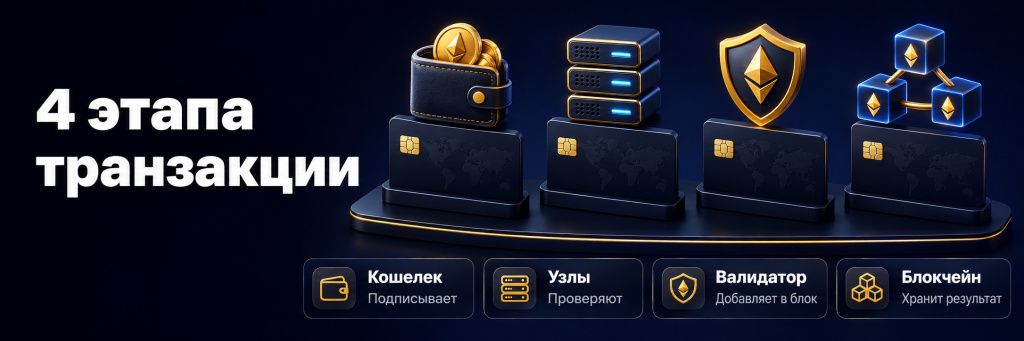
- A wallet signs a transaction with the user's private key.
- Nodes check the signature, balance, and protocol rules.
- A validator includes a valid transaction in a block.
- Other participants attest to the network state.
- Once finalized, the record cannot be reversed through a normal request.
Mainnet and Layer 2 networks
Ethereum Mainnet is the primary network where real assets and applications live. Layer 2 networks reduce the cost of high-volume activity by processing many actions outside the main chain and publishing data or proofs back to Ethereum.
A Layer 2 is not merely a cheaper setting in a wallet. Each network has its own contracts, bridges, withdrawal rules, and risks. Users should confirm that the recipient supports the same network and send a small test amount before moving a large balance.
What is Ethereum used for?
- Transfers. Users send ETH and supported tokens between addresses.
- DeFi. Contracts enable swaps, lending, collateral, and other financial functions.
- Stablecoins. Dollar-linked and other price-referenced tokens circulate on the network.
- NFTs. Unique tokens record ownership of digital objects and application rights.
- DAOs. Contracts help communities coordinate voting and treasury rules.
- Games and identity. Assets and credentials may work across compatible services.
Owning ETH is not the same as owning shares in a company. It does not create a claim on corporate profits. Its market price is volatile and the utility of the network does not guarantee an investment return.
How to store and transfer ETH
A cryptocurrency wallet manages the keys that control blockchain records; it does not keep coins inside a phone. Custodial and self-custody options have different responsibilities, which we explain in our cryptocurrency wallet guide.
- Confirm whether the operation uses Ethereum Mainnet or a particular Layer 2.
- Compare the complete destination address, not only the first characters.
- Keep enough ETH for a later transaction fee.
- Never provide a seed phrase to a website, support agent, or acquaintance.
- Use a small test transaction for a new destination.
Main risks
Price volatility
ETH may rise or fall sharply. The age and popularity of Ethereum do not guarantee the future price of the asset.
User errors
A wrong network, phishing signature, exposed seed phrase, or incorrect address can cause an irreversible loss.
Smart-contract risk
An application may contain a vulnerability or give an administrator excessive power. An audit reduces risk but does not prove that code is safe.
Intermediary risk
Exchanges, bridges, staking providers, and custodial wallets can impose limits, suspend withdrawals, or fail.
Fake tokens
Names and logos are easy to copy. Authenticity is checked through the network and contract address, not a familiar-looking card.
Checklist before a first transaction
- Determine whether you need native ETH or an ERC-20 token.
- Make sure the sender and recipient use the same network.
- Keep enough ETH to pay gas.
- Read the action and spending limit shown by the wallet.
- Verify the application domain and contract address.
- Start with a test transaction when possible.
Frequently asked questions
Is Ethereum a network or a coin?
Ethereum is the blockchain and application platform. Its native cryptocurrency is ether, identified by the ticker ETH.
Who created Ethereum?
Vitalik Buterin is the best-known co-founder, but a group of founders and developers launched the project and a broad community now maintains it.
Can ETH still be mined?
No. Ethereum Mainnet moved to proof-of-stake in 2022 and now uses validators rather than proof-of-work miners.
Why do token transfers require ETH?
Every state change on Ethereum requires gas. The fee on Mainnet is paid in ETH even when another token is being transferred.
Are ETH and ERC-20 the same?
No. ETH is the native asset of Ethereum. ERC-20 is a smart-contract standard used by fungible tokens.
Can an Ethereum transaction be cancelled?
Before confirmation, a pending transaction may sometimes be replaced. Once included and finalized, it cannot be reversed by contacting the network.