An NFT is an individually identifiable token on a blockchain. It records an owner and information about a particular digital object or a right inside an application. The abbreviation means non-fungible token. Unlike equal units of one cryptocurrency, two NFTs may have different properties and values.
In simple terms, an NFT resembles a digital certificate. It can help verify which address owns a specific token. It does not necessarily store the picture itself on the blockchain, and buying it does not automatically transfer copyright in the associated work.
What is an NFT in simple terms?
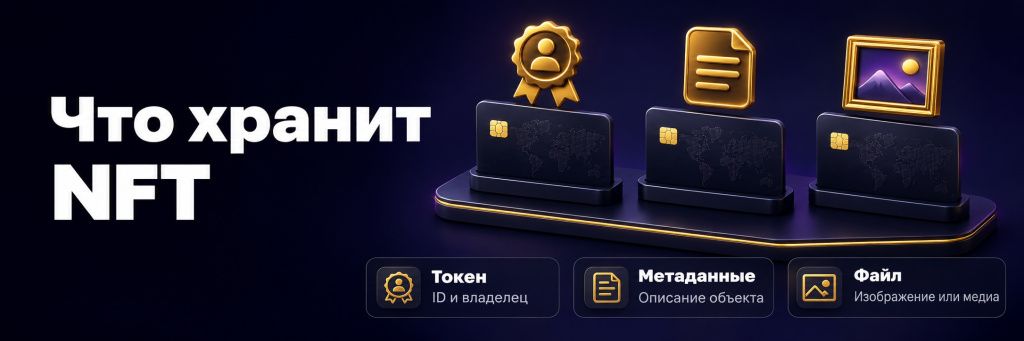
An NFT is a blockchain record that can be distinguished from every other record in its collection. It has a smart-contract address, a token ID, and a current owner. Metadata may describe an image, a game item, a ticket, a domain name, or another object.
The token is not simply a picture or a file type. It is an onchain record that may point to a file and define transfer rules. Its contract and ID are central identifiers; a copied image does not become the original token merely because it looks identical.
| Property | Fungible token | NFT |
|---|---|---|
| Interchangeability | One equal unit can replace another | Each token has a separate ID and properties |
| Typical use | Payments and accounting for equal units | Collectibles, tickets, game items, and access rights |
| Divisibility | Often divisible into smaller units | Usually tracked as one distinct object |
| What to verify | Balance and token contract | Contract, ID, metadata, and ownership history |
Why is an NFT non-fungible?
One ETH is equivalent to another ETH of the same amount. A ticket for the front row is not equivalent to a ticket for the last row because the seats and conditions differ. An NFT represents this individuality at token level.
Non-fungibility does not mean that an image can never be copied. A creator may issue a thousand similar tokens, and a file can be duplicated. What remains distinct is the token ID and ownership record. Market value depends on demand, creator reputation, utility, scarcity, and collection terms.
An NFT is therefore not necessarily an “expensive picture.” It may represent digital art, membership, a ticket, an in-game item, an attendance certificate, or a domain name. The actual rights depend on the contract, project terms, license, and applicable law.
How NFTs work
The process begins with a smart contract. A developer deploys the contract and defines who can create tokens, how many may exist, how they can be transferred, and where metadata is stored. During minting, the contract assigns a token ID and records an owner.
- The creator prepares the object and its metadata.
- A smart contract mints a token with a distinct identifier.
- The blockchain links that ID to the owner's address.
- A sale or transfer changes the owner address.
- A block explorer displays a verifiable history of operations.
Technically, NFTs use standards implemented by smart contracts. Ethereum commonly uses ERC-721 and ERC-1155. Other blockchains use their own standards, so one wallet, address format, or marketplace does not automatically support every network.
Where is the image stored?
The blockchain often stores the token ID, owner, and a link to metadata. The actual image may be kept in distributed storage or on an ordinary server. Some small assets are stored fully onchain, but this is more expensive.
A buyer should determine:
- where the file is stored and whether its link can stop working;
- whether the contract owner can change metadata;
- whether attributes have been permanently fixed after minting;
- which blockchain holds the ownership record;
- who controls the domain or server hosting the content.
A permanent token record does not guarantee that an externally hosted file will remain available. Storage design is a separate part of evaluating a collection.
NFTs and copyright
Buying an NFT normally transfers the token, not copyright in the associated image. The owner may display or resell the token and use it inside an application when the rules allow. Rights to print merchandise, create derivative works, or use content commercially must be granted through a license or separate agreement.
Minting a token does not prove that the minter created the original work. A fraudster can copy an image and issue a token linked to it. Users should verify the artist's official channels, contract address, collection history, and license.
Creator royalties are not a universal guarantee either. A contract or marketplace may implement a payment, but enforcement depends on its technical design and the rules of the venue handling the sale.
What are NFTs used for?
- Digital collectibles. Individually tracked cards, images, and commemorative objects.
- Games. Characters, equipment, land, and achievements.
- Tickets. A token may prove access to an event or identify a seat.
- Membership. Ownership may unlock a section, community, or feature.
- Certificates. An organization can record attendance or course completion.
- Domain names. A unique record connects a readable name with a blockchain address.
- Asset tokenization. A token may help account for an object, but legal title still needs the required documentation.
Utility does not remove risk. If an application shuts down, an in-game item may lose its function even when the ownership record remains on the blockchain.
Which networks support NFTs?
NFTs exist on Ethereum, TON, and many other blockchains. The selected network affects fees, wallet compatibility, marketplaces, and token standards. An NFT cannot simply be sent to an incompatible network; bridges add another layer of contracts and risk.
Ethereum is one of the major smart-contract ecosystems. The difference between the network and its native asset is covered in our Ethereum and ETH guide. Operations on Ethereum require ETH for gas even when an NFT is being transferred.
On TON, network fees are paid in Toncoin. The architecture and address rules differ from Ethereum, so instructions cannot be copied mechanically from one network to another.
How NFTs are purchased
A buyer needs a compatible wallet, the native network coin for payment and fees, and a venue listing the collection. Before connecting a wallet, verify the domain. Then find the official collection contract and review the token's properties and the total fee.
- Choose the network and install a compatible wallet.
- Fund it with the network's native coin.
- Open the marketplace through a verified link.
- Compare the collection's contract address.
- Review metadata, sales history, and owner rights.
- Before signing, read the price, fee, and requested permissions.
Our cryptocurrency wallet guide explains the basics of key storage. A marketplace does not need a seed phrase to connect; the wallet signs requests locally.
What determines NFT value?
There is no universal formula for fair value. Price may depend on attribute rarity, creator reputation, utility, trading activity, and community sentiment. The last sale records only one transaction and does not ensure that another buyer exists.
| Factor | What to examine | Main risk |
|---|---|---|
| Rarity | Generation rules and attribute counts | Metadata may be changeable |
| Liquidity | Actual sales and number of buyers | A resale may take a long time |
| Utility | Working product and access terms | The service may close |
| Provenance | Creator, contract, and owner history | Forgery or rights infringement |
Main NFT risks
A sharp price decline
The market for one collection may disappear. A high mint price and famous owners do not guarantee demand.
Phishing and malicious approvals
A fake site may request permission to transfer every token. Read the exact action and access limit displayed by the wallet.
Copy collections
Fraudsters reuse images and similar names. The principal identifier is the contract address, not a logo or visual badge.
Unavailable metadata
If a file sits on a server that goes offline, the token may remain while its associated image disappears.
Trading manipulation
Related addresses can trade with one another to create an illusion of demand. Review transaction history and owner distribution together.
Legal uncertainty
A token does not replace a contract or official registration when the law requires them. Read the license and consider the applicable jurisdiction.
Checklist before buying an NFT
- Verify the network and contract address through an official source.
- Check the token ID and ownership history.
- Find out where metadata is stored and whether it can be changed.
- Read the license and the owner's rights.
- Evaluate completed sales rather than only listing prices.
- Review administrator powers in the contract.
- Use a separate wallet for unfamiliar applications.
Frequently asked questions
Is an NFT just a picture?
No. It is a token record that may point to an image or represent another object or right.
Can an NFT be copied?
The associated file can be copied. The original token's contract, ID, and ownership record remain distinct.
Does the buyer receive copyright?
Not automatically. Only rights expressly granted by a license or separate agreement are transferred.
Is cryptocurrency required to buy one?
Usually the network's native coin is needed for price and fees. Some platforms offer other payment methods under their own terms.
Can an NFT disappear?
The token record may remain while an externally hosted file or application becomes unavailable.
How can a fake collection be identified?
Compare the contract address with an official creator source, then examine minting history and administrator permissions.