TON is a blockchain platform for transfers, smart contracts, and decentralized applications. Its native cryptocurrency is Toncoin, which is used to pay network fees and execute programs. Wallets and exchanges normally identify the asset with the ticker TON.
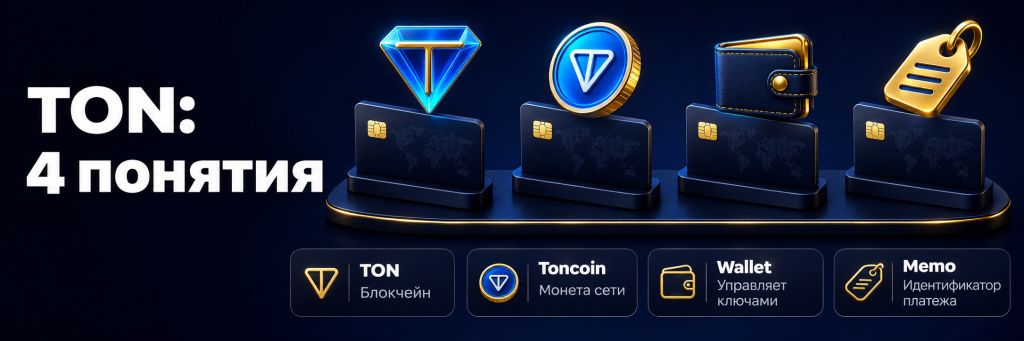
The terms TON, Toncoin, and TON coin are often used interchangeably, but the network and asset should be distinguished. TON is the infrastructure; Toncoin is the native coin inside it. The project's history and integrations connect it closely with Telegram, yet the messenger, blockchain, and wallet services are not one product.
What is TON in simple terms?
TON is a distributed network in which independent nodes agree on the state of accounts and smart contracts. A user signs an operation with a key, validators check it, and the result is added to the blockchain. Mainnet uses real assets, while testnet is intended for development and experiments.
The blockchain was designed for high throughput and for dividing work across chains. This architecture aims to support consumer-scale applications, but it does not remove basic safety requirements: users must check the address, fee, payment comment, and asset support at the destination.
The phrase “Telegram cryptocurrency” reflects a historical and product connection but can be misleading. The idea began within the Telegram team; development of the open network was later continued by the community. Telegram integrates some ecosystem services, while blockchain transactions are executed by TON rather than an ordinary chat.
| Concept | Meaning | Typical use |
|---|---|---|
| TON | Blockchain and ecosystem | Transfers, apps, and smart contracts |
| Toncoin | Native coin | Fees, transfers, and network participation |
| Jetton | Fungible token on TON | Project tokens and stablecoins |
| NFT | Individually identifiable token | Collectibles and functional digital items |
What is Toncoin?
Toncoin is TON's native coin. It pays for message processing, smart-contract execution, and storage when required by a particular operation. It also participates in the network's validator economics and consensus.
TON wallets can also display many other tokens. A familiar name or icon does not prove authenticity. For a jetton, users should verify the master contract, the source that added the asset, and data in a block explorer.
Toncoin is not a Telegram share or an ownership interest in the company. Holding the coin does not create a claim on the messenger's profits. Its market price changes freely with demand, liquidity, the broader crypto market, and participant expectations.
How the TON blockchain works
Nodes and validators maintain a common view of network state. Accounts and smart contracts communicate by sending messages. Once a message is processed, the resulting changes are recorded in a transaction. A user does not need to master the low-level design, but should understand that a transfer is not simply an entry in one application's database.
TON uses a multi-chain architecture and sharding. Work can be distributed between parts of the system while contracts exchange messages. The design targets scalable applications, payments, and consumer services.
- Mainnet. The production network with real Toncoin and live applications.
- Testnet. A testing environment with coins that do not carry normal market value.
- Smart contracts. Programs that keep data and process messages according to rules.
- Validators. Participants that help maintain consensus on blockchain state.
What is a TON wallet?
A TON wallet is an interface that manages keys and prepares signed network operations. Coins remain records on the blockchain; the application displays the balance and helps the owner interact with it.
Wallets may be self-custody or custodial. With self-custody, the user controls the seed phrase and bears responsibility for recovery. With custody, a service controls the keys and access depends on its account rules. The distinction is explained in our cryptocurrency wallet guide.
An app name does not guarantee that it is official or safe. Install wallets through a verified source, and never enter a seed phrase into a bot, a support form, or a website offering “synchronization.”
What is a TON memo?
A memo or comment is an identifier that some exchanges and custodial services require with a deposit. It tells the platform which customer should receive funds sent to a shared address. The exact requirement must be copied from the receiving platform's deposit page.
A separate memo is normally unnecessary for a personal self-custody address unless the recipient says otherwise. An exchange may use one address for many clients, making the individual memo essential.
- Open the TON deposit page at the receiving service.
- Copy the address and, if shown, the memo or comment.
- Confirm the network and supported asset.
- Paste the memo without changing it.
- Use a test transfer if the limits make it practical.
If a required memo is omitted, the blockchain may successfully deliver funds to the service address while automatic crediting fails. The sender must then contact the recipient's support team and provide the transaction hash. Recovery may be slow, carry a fee, or be impossible.
How TON is connected to Telegram
TON grew out of the Telegram Open Network project. After Telegram ended its original involvement, an independent community continued developing the open-source blockchain. Later wallet integrations and mini apps brought the ecosystems closer again.
- Telegram is a messenger and a platform for mini apps.
- TON is a separate public blockchain.
- Toncoin is the network's native cryptocurrency.
- A wallet or bot is an interface with its own operator and terms.
A message from a familiar account does not make a crypto transaction safe because the account may be compromised. Do not follow urgent links, reveal recovery words, or sign an action you do not understand.
What is TON used for?
- Toncoin transfers. Users send coins between compatible addresses.
- Network fees. Toncoin pays for operations and smart-contract execution.
- Applications. Games, financial services, marketplaces, and community tools run on the network.
- Jettons. Projects issue fungible tokens using TON standards.
- NFTs. The blockchain supports unique digital items and collections.
- Names and services. Contracts can connect human-readable identifiers with addresses and apps.
The value of a particular app depends on more than the blockchain. Its team, contracts, administrator powers, liquidity, and withdrawal rules still need to be assessed.
How to transfer Toncoin safely
- Confirm that the recipient accepts TON on the TON network.
- Copy the address with the interface button rather than typing it.
- Check whether a memo or comment is required.
- Read the final amount and fee before signing.
- Send a small test amount to a new destination.
- Use the transaction hash to check the result in a block explorer.
Blockchain addresses are irreversible: the network does not know whom the sender intended to pay. A person promising to recover an incorrect transfer in exchange for an advance fee is likely attempting fraud.
Risks of TON and Toncoin
Price volatility
Toncoin can move sharply in either direction. Previous growth does not promise a future return.
Phishing and fake bots
Fraudsters copy wallet, giveaway, and mini-app designs. A seed phrase is never required to receive an ordinary transfer.
Fake jettons
Anyone can create a token with a similar name. Verify the contract and an official project source.
Memo and network mistakes
A transfer to a shared address without its identifier may not be credited. An unsupported network may also result in lost access.
Application risk
A contract, bridge, or service may contain a bug, retain administrator keys, or restrict withdrawals. Read wallet requests before signing.
Frequently asked questions
Is TON a network or a coin?
TON is the blockchain platform. Its native coin is called Toncoin and normally uses the ticker TON.
Does Toncoin belong to Telegram?
No. Toncoin is not a share in Telegram. The blockchain has historical connections and current integrations, but operates as a separate public network.
What is Toncoin used for?
It pays network fees, supports transfers and smart-contract interaction, and participates in validator economics.
Is a memo always required?
No. It is required only when the recipient asks for it, most commonly an exchange using a shared address.
Can TON be stored inside Telegram?
Different wallets and mini apps are available through Telegram. Users should identify who controls the keys, how recovery works, and which restrictions apply.
How can a TON transaction be checked?
Use its hash or address in a block explorer. A successful technical status does not prove that the recipient is trustworthy.