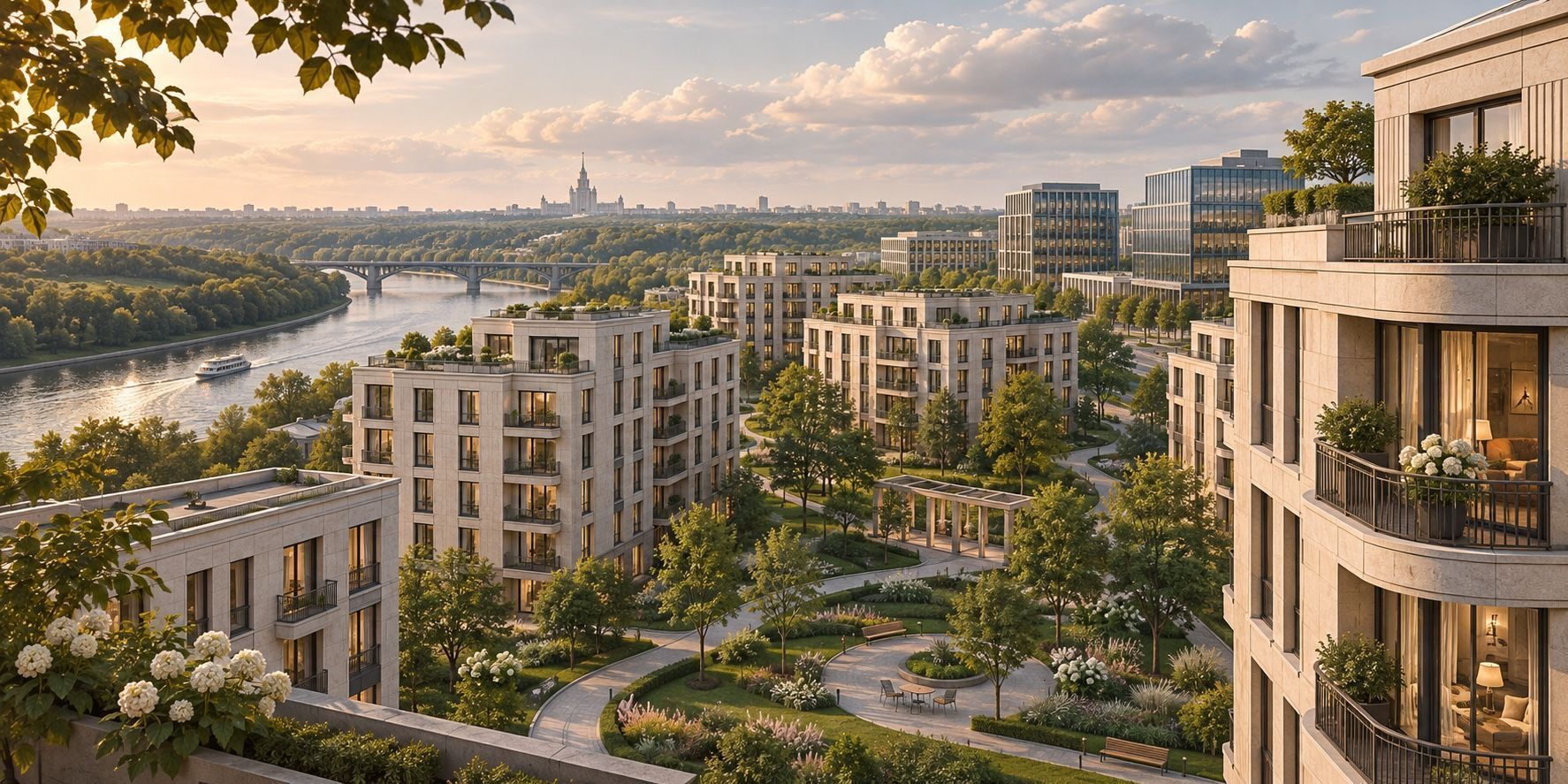
SberCity is a district under development in western Moscow. On 16 October 2026, the developer announced the commissioning of two buildings with 161 apartments at Quarter 120, Building 28. Some services are operating on the central square, while the SberCity metro station remains under construction. The first section of the Rublyovo-Arkhangelskaya line is open; the city plans an extension to Novorizhskaya in 2027.
The size and scope of SberCity
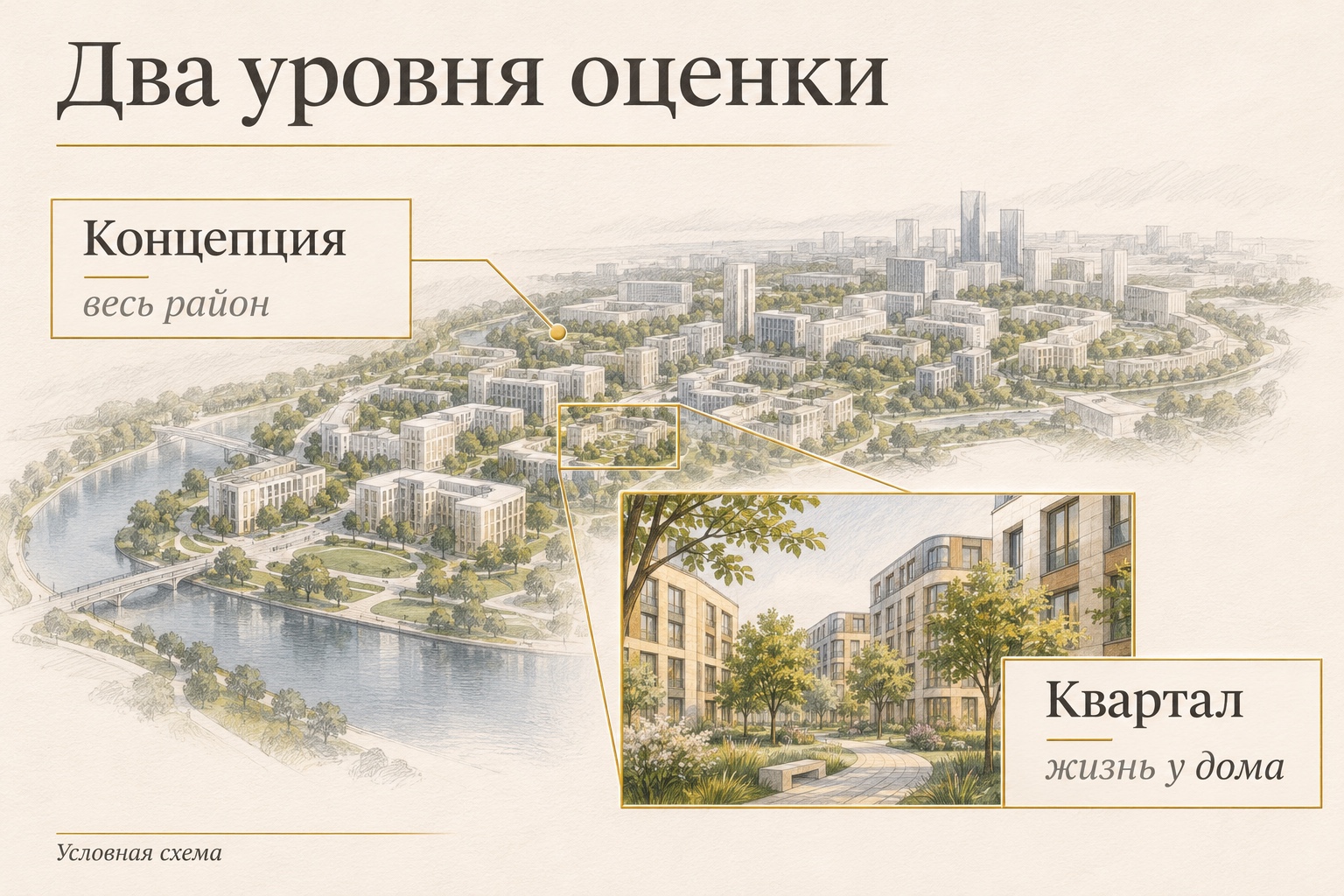
The official SberCity website lists a 461-hectare site, 2.5 million m² of housing and 833,000 m² of offices. The concept includes seven schools and thirteen nurseries, with 30% of the land allocated to green space. These describe the overall project, not a list of completed facilities.
| Information level | What it describes | How to use it |
|---|---|---|
| Master plan | The site, housing and office volumes, and future facilities | To understand the district's direction of development |
| Individual quarter | Buildings, courtyards and the schedule for a particular phase | To choose a building and plan relocation |
| Commissioned property | A building that has received a commissioning permit | To verify construction completion |
| Operating service | A shop, restaurant or service with current opening hours | To assess everyday life today |
For moving in, readiness around the chosen building matters. The master plan shows the district's scale; the building's address lets you check routes to stops and the nearest open shops.
Which SberCity buildings were commissioned in October 2026?
In its announcement of 16 October, the developer reported commissioning permits for two buildings at Quarter 120, Building 28. Together they have almost 33,000 m² of gross floor area and more than 16,000 m² of residential area, with 161 apartments and heights of up to 12 storeys. An underground car park connects them.
The same publication reports around 200,000 m² of housing, social facilities and offices commissioned since the start of 2026. This includes three residential quarters, a nursery for 350 children, two office buildings and a mixed-use complex. It is a combined figure covering different uses, not solely completed apartment space.
The project also reported around 800,000 m² at the design stage and 1.2 million m² under construction. These figures relate to the publication date. They show the scale of ongoing work; dividing unlike measures would not produce a meaningful single completion percentage for the district.
Why the district is organised around neighbourhoods
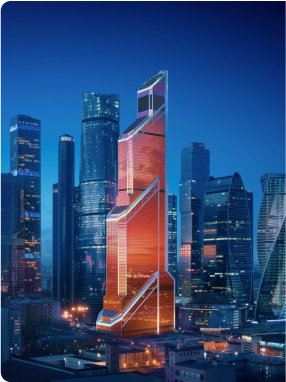
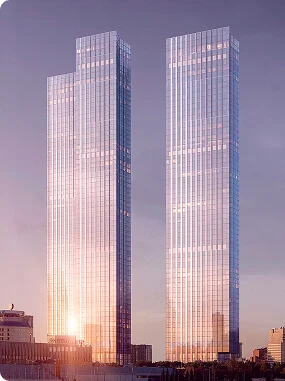
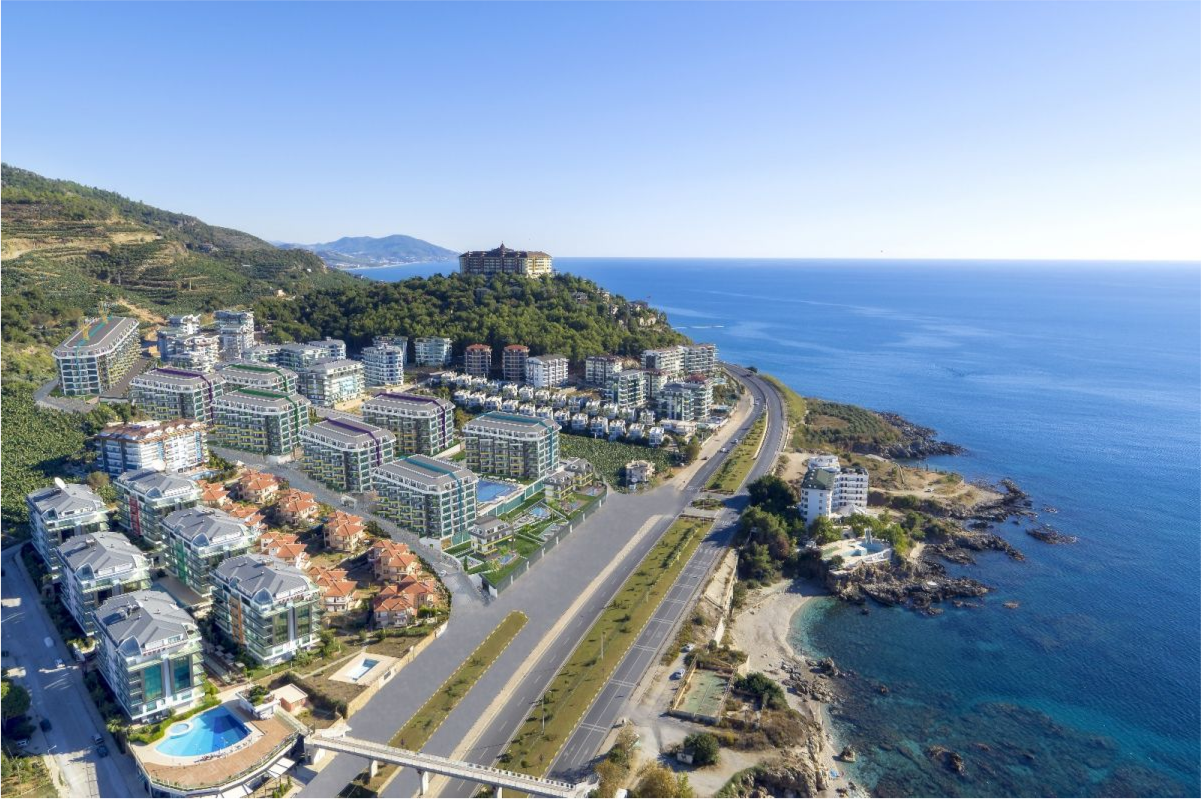
SberCity offers a different urban setting from Moscow-City's skyscrapers. Its concept places emphasis on mid-rise development, courtyards and connections with the natural surroundings. The buildings commissioned in October, reaching up to 12 storeys, provide a concrete example of that scale.
Residents experience the difference at ground level: the time from apartment to street, views of neighbouring buildings, and proximity to trees and walking routes. This does not mean a lower building is universally more convenient. Preferences for density, panoramas and closeness to city activity vary.
Apartments within the same large district can offer very different conditions. Windows facing a quiet courtyard differ from those facing a planned busy street. Start with the quarter's layout, the building's orientation and surroundings. An attractive facade photograph does not explain where a particular bedroom faces.
When will the metro reach SberCity?
The SberCity station under construction is planned in Kuntsevo District beneath Projected Passage No. 7107. Moscow Transport provides the station name and location.
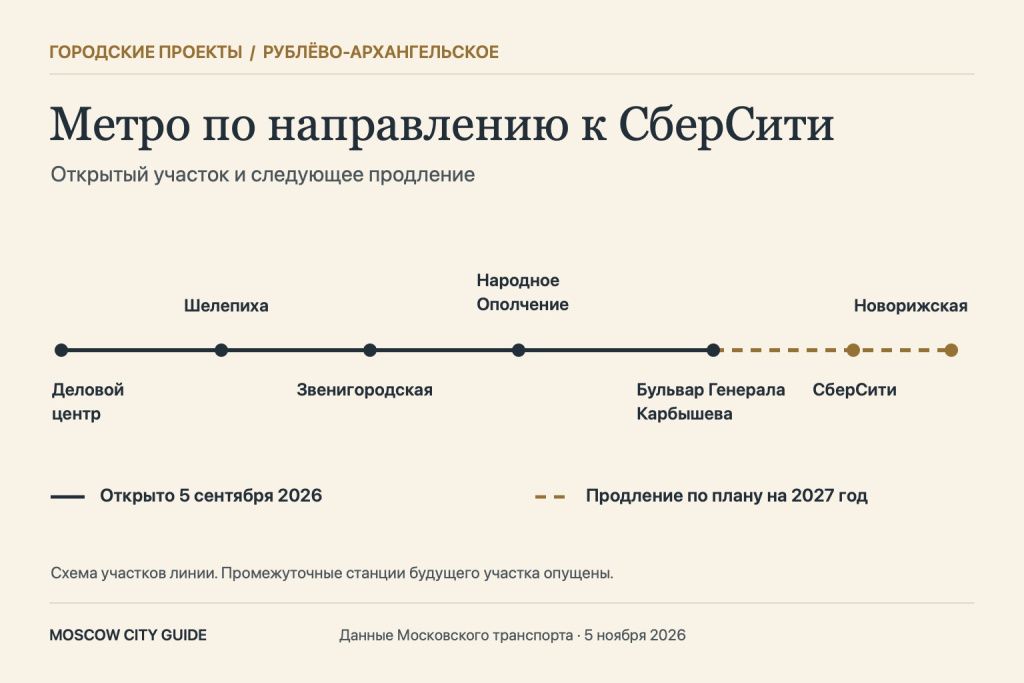
SberCity's transport prospects are tied to the Rublyovo-Arkhangelskaya line. Its first section, from Delovoy Tsentr to Bulvar Generala Karbysheva, opened on 5 September 2026. This was an important milestone for the line, but did not mean that a station in SberCity itself had opened.
- Open since 5 September 2026. The first section from Delovoy Tsentr to Bulvar Generala Karbysheva.
- Planned for 2027. The extension to Novorizhskaya, including the SberCity station under construction.
- For travel now. Plan from the exact building address to your destination, checking transfers and walking time.
A Moscow Transport announcement of 28 October lists the next section to Novorizhskaya as planned for 2027. The district website's promised 27-minute journey on the new line should therefore be treated as a future transport scenario. Moving today requires a calculation based on the existing route.
Until the next section opens, use operating stops and station entrances. Check the journey from your building to the interchange at the time you normally leave for work.
Even after the metro opens, the walk from home to the platform and from the destination station to work remains. Travel between stations is only part of the total. On a large site, building location, crossings and station entrances are particularly important.
Which SberCity services are already operating?
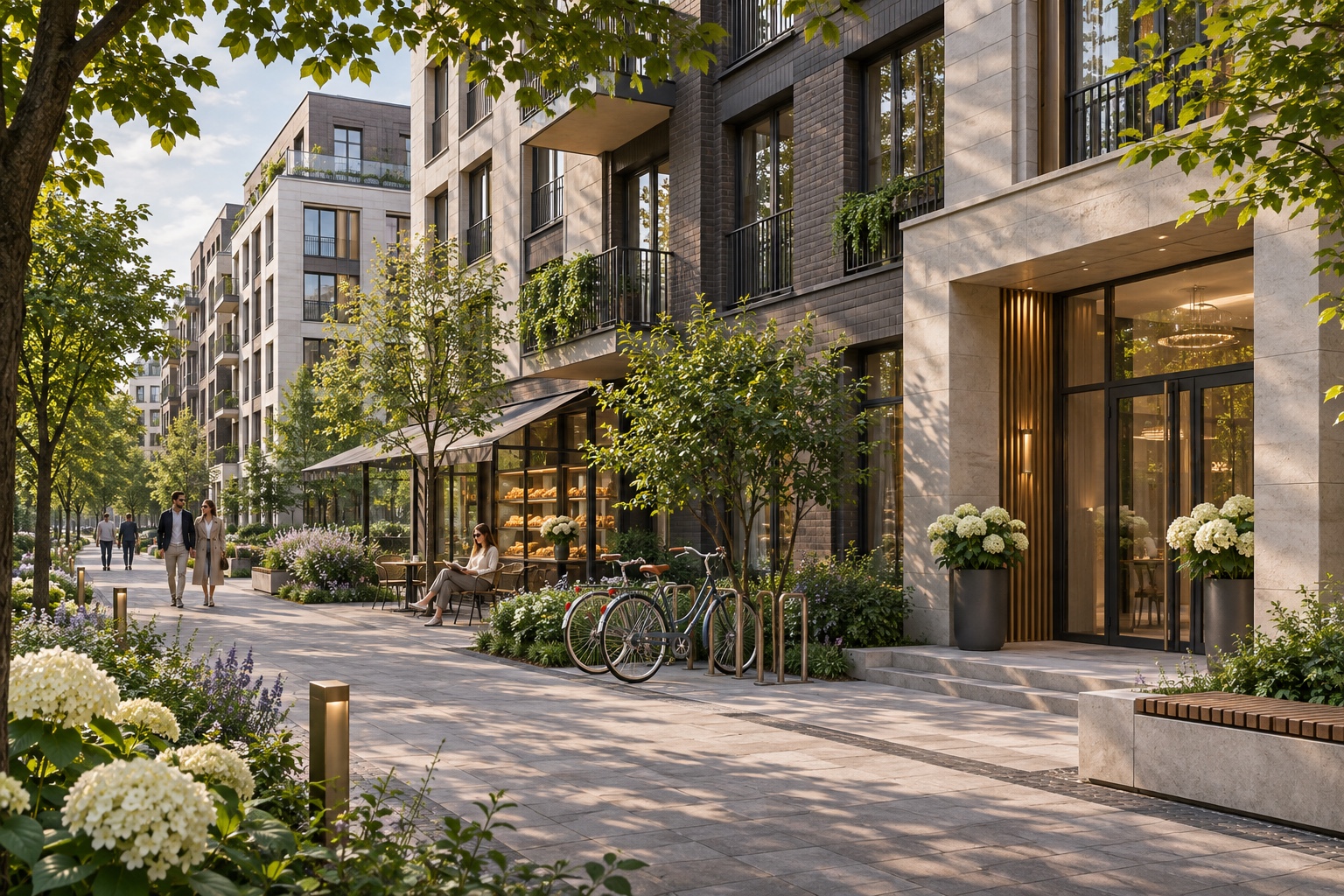
On 22 September 2026, the project announced the opening of Coffeemania on the central square. The same publication lists an operating grocery shop, barbershop and dry cleaner. These are tangible signs of an emerging everyday environment, unlike a general promise of future shops.
The nearly 120,000 m² allocated to retail and services in that announcement refers to the district's plans. An underground shopping gallery connected to the future metro is also described as forthcoming. These expand the outlook but should not be listed as services residents can use immediately.
Families should check a small set of essentials: groceries, a pharmacy, children's activities, healthcare and a convenient walking route. A well-known restaurant opening shows progress but does not answer all those needs. Walk through a typical weekday rather than only touring the most impressive places.
Which roads are being built?
A report on road construction in SberCity was published on 27 October. Separate reporting on the street network highlights a feature of new districts: homes and all the connections around them become ready at different times.
Before buying, establish which access road will be available by your move and how traffic is managed during neighbouring construction. Pedestrians need lighting, crossings and continuous pavements. Drivers need to reach the right entrance, drop off passengers and return home without unnecessary detours.
If choosing a home for older relatives or a family with young children, walk the route at their pace. Five hundred metres along a level, finished path feels different from the same distance with temporary diversions. A site visit avoids relying on assumptions about future convenience.
What mixed housing and offices mean for businesses
The office cluster brings another pattern of activity. Residents use services in the morning and evening, employees during the working day, and visitors come for meetings. In a mature mixed-use area, these groups can support different retail and service formats.
A business owner should not add projected residents to planned workplaces and treat the total as guaranteed customers. In a new district, actual occupancy, office attendance, entrance locations and existing businesses matter. The site's potential and an individual unit's economics require separate assessments.
For a shop or cafe, the particular stretch of street matters more than the project name alone. A unit on an operating route starts in different circumstances from an equivalent unit beside a future quarter. Opening date and the period the business can sustain while demand develops matter as much as floor area.
Choosing a home in a district built in phases
First decide when you need to move and whether nearby construction is acceptable. Then shortlist buildings and compare apartment plans. Only after that consider views, floor and finishes. Reversing this order can create an attachment to an attractive apartment that does not fit the family's timetable.
For the selected building, request current documents, the handover date and the work included inside the apartment. Commissioning does not mean that a home is fully ready to occupy. If refurbishment is needed, allow for design, work, deliveries and furnishings, and check renovation rules in advance.
For a completed building, actual charges and management rules are useful; for a future one, examine the servicing arrangements for that phase. Extensive parks and modern building systems need ongoing upkeep. Their value depends on maintenance quality and ease of use.
SberCity and Moscow-City: two different locations
The shared word “City” does not make the projects direct equivalents. Moscow-City is an established mixed-use business centre with diverse towers. SberCity is developing as a large residential and office district in the west of Moscow. Compare particular properties and actual daily journeys.
Compare locations by routes to work and school, apartment area and access to walking spaces.
Our Ostrov residential development profile offers another example of housing linked to water and landscaping. Our article on the Greater City project provides wider urban context: overall concepts and the readiness of a particular building should be assessed separately.
Our comparison of high-rise residential locations discusses other differences in urban settings.
SberCity already has commissioned buildings and operating services, while substantial construction continues. Assess it in two ways: the existing environment for a move now and the future district for longer-term living. Understanding the boundary helps buyers choose a specific apartment or commercial unit more carefully.
The images are artistic illustrations created for this article; the diagrams are not architectural drawings.