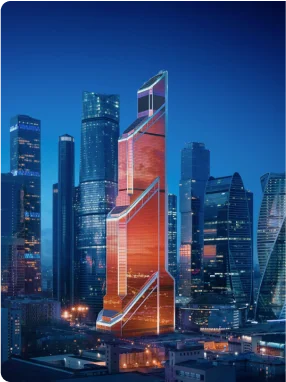


The first auction for the sale of the office portion of the Moscow Towers skyscraper in the Moscow City business district did not take place: Russian Railways received no bids. This is one of the capital’s largest and most expensive office properties—the starting price for the lot was 280.8 billion rubles.
What exactly was Russian Railways selling?
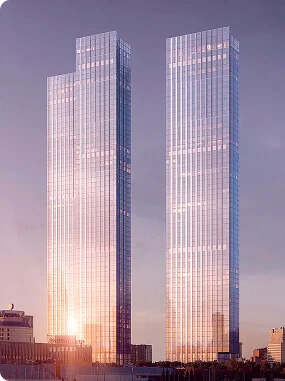
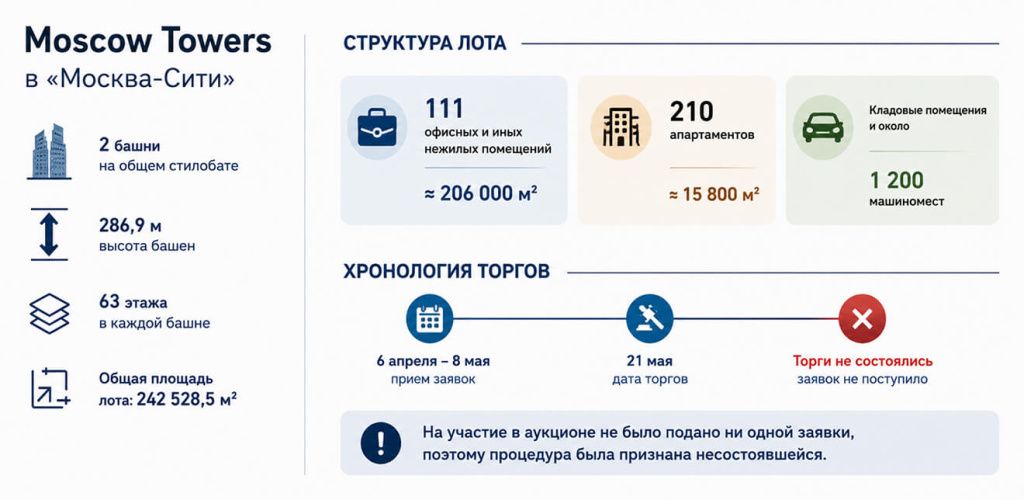
The lot included two Moscow Towers on a shared stylobate. The complex is located in Moscow City and is one of the most prominent new high-rise buildings in the business district. According to RZD, the property offered for sale had a total area of 242,528.5 square meters: two towers, each 286.9 meters tall and 63 stories high.
The lot included office and non-residential spaces, apartments, storage rooms, and parking spaces. According to published data, the asset’s composition included:
-
111 office and other non-residential spaces with a total area of approximately 206,000 square meters;
-
210 apartments with a total area of approximately 15,800 sq. m;
-
storage rooms and approximately 1,200 parking spaces.
Applications were accepted from April 6 to May 8, and the auction was scheduled for May 21. However, by the deadline, no participant had submitted an application, so the procedure was deemed invalid.
Why did this asset receive no bids?
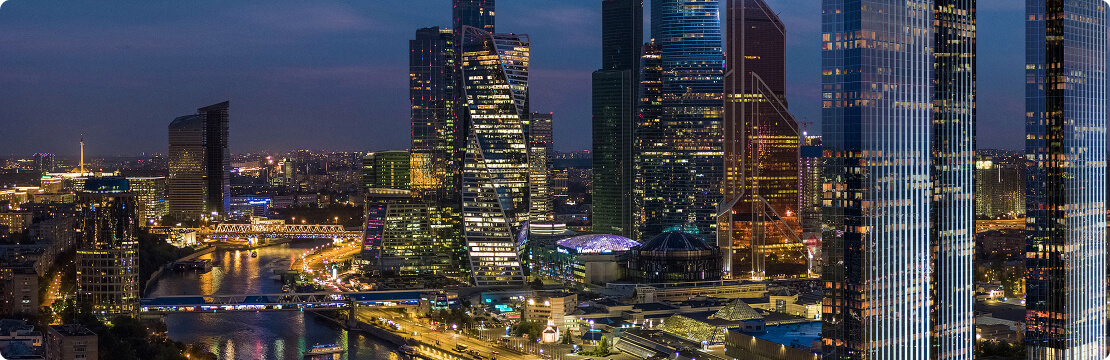
At first glance, the situation seems paradoxical: “Moscow City” remains one of Moscow’s most prestigious office locations, and high-quality space in the business center is still in demand. But in the case of Moscow Towers, we are not just talking about offices, but about a massive asset with a very high entry barrier.
Russian Railways acquired space in Moscow Towers in 2024. According to media reports, the deal was worth 193.1 billion rubles, and the complex itself was viewed as a future site for housing the company’s operations. Later, the issue of selling the asset became part of a broader financial agenda surrounding Russian Railways.
The main challenge is scale. The buyer must be prepared not only to pay hundreds of billions of rubles for the property itself, but also to account for further expenses related to finishing, operation, launching the space, and managing such a large volume of real estate. For a private investor, this is an extremely high-stakes bet, and for the end user, it’s a decision on the scale of a new headquarters.
What does this mean for the Moscow City market?
The failed auction does not mean there is no interest in “Moscow City.” Rather, it shows that the market is more cautious about mega-deals, especially when the property is sold as a single lot. This is an important signal for the business district: liquidity in “City” remains, but even a premium location does not eliminate questions regarding price, deal structure, and future strategy for the building’s use.
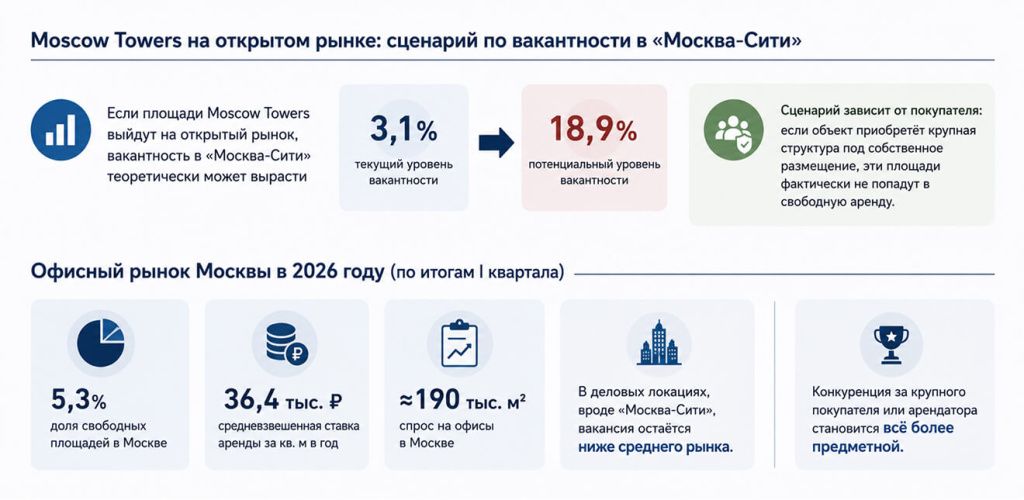
Previously, Nikoliers analysts estimated that if the Moscow Towers space were to enter the open market, vacancy rates in Moscow City could theoretically rise from 3.1% to 18.9%. However, this scenario depends on who the buyer is: if a large organization acquires the property for its own use, these spaces will effectively not enter the open rental market.
At the same time, Moscow’s overall office market in 2026 remains heterogeneous. As of the end of the first quarter, the vacancy rate in the capital stood at 5.3%, the weighted average rent was 36,400 rubles per square meter per year, and demand was approximately 190,000 square meters. In business districts such as Moscow City, vacancy rates remain below the market average, but competition for major buyers or tenants is becoming increasingly intense.
Is a new sales scenario possible?
After the failure of the first auction, the seller has several options: a repeat auction, changing the terms, dividing the asset into larger blocks, or directly seeking a strategic buyer. The most significant impact on the market would come from a fragmentation scenario: if a significant volume of office space begins to gradually come up for lease or sale, this could affect the supply-demand balance in Moscow City.
But for now, the key conclusion is different: Moscow Towers remains a rare asset in terms of scale, capable of altering the statistics of the entire business district. How Russian Railways relaunches the sale will determine not only the fate of this specific skyscraper but also the dynamics of the Moscow City office market for the coming years.
Previously, we reported:
Russian Railways has withdrawn the Moscow Towers skyscraper in Moscow City from sale
Russian Railways will sell the Moscow Towers office complex in Moscow City at auction