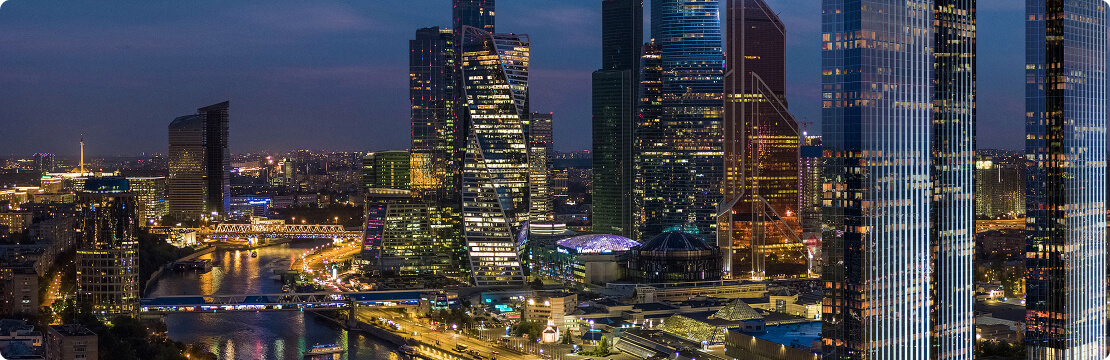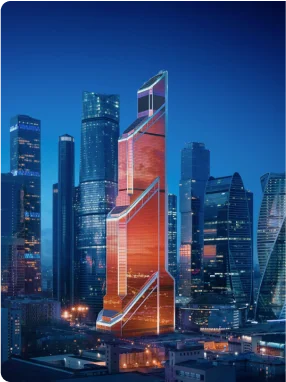


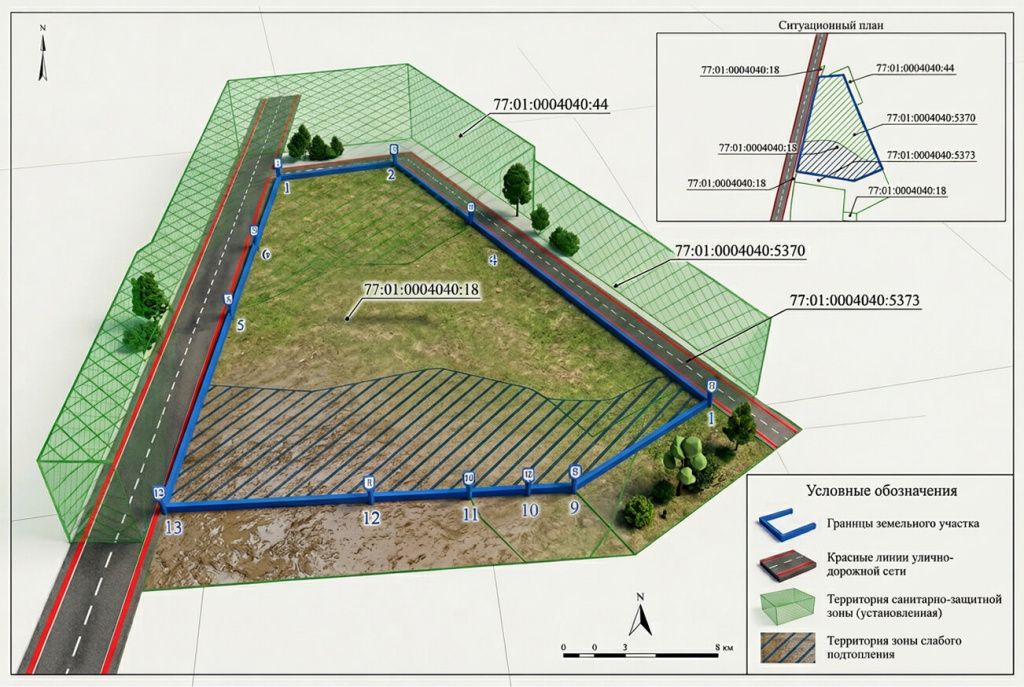
Another prominent development site is coming onto the market in the area of the future “City-2.” The site in question is located near Antonova-Ovseyenko Street, close to the Third Transport Ring and the established Moscow City business district. Formally, the plot does not appear large—about 0.91 hectares—but zoning regulations allow for up to 303,200 square meters of real estate to be built here.
This is an important signal for the area. Moscow City has long since ceased to develop solely within the familiar boundaries of the Moscow International Business Center (MIB). New development is gradually shifting to neighboring blocks, where there used to be warehouse, industrial, and technical areas. It is precisely these plots that will form the future “City-2” belt—a broader business and residential district surrounding the skyscrapers.
Based on current parameters, the project could include approximately 137,200 square meters of residential space and roughly 166,000 square meters of non-residential space. In other words, the site will most likely be viewed not as a purely residential project, but as a mixed-use development featuring offices, commercial spaces, and urban infrastructure on the ground floors.
There is also a contentious issue: parking. The documents specify 837 parking spaces. For a development of this scale, that seems rather modest. If the site does indeed include both residential and office space, the future developer will have to carefully plan the transportation layout: entrances, exits, internal roadways, connections to the Third Transport Ring, pedestrian routes, and access to public transportation.
Interestingly, previous plans for the Antonova-Ovseyenko 13–15 site were significantly more ambitious. Earlier comprehensive development plans included up to 580,000 square meters, comprising apartments, offices, and commercial space. Now the picture has become more modest. This makes sense: the market has changed, the density of development near City is already raising many questions, and following regulatory changes, the apartment format is no longer such a convenient tool for large-scale projects.
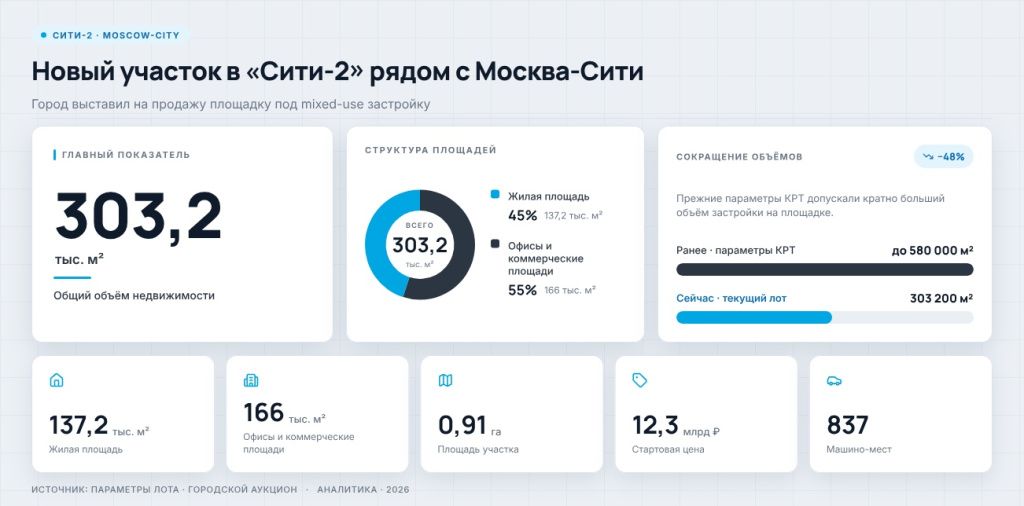
The starting price for the plot is approximately 12.3 billion rubles. For a developer, this is a significant entry point. It is one thing to buy land near Moscow City; it is quite another to structure the project’s economics so that it can withstand the cost of the plot, the construction budget, financing, competition, and future sales.
Following previous deals in “City-2,” market participants will likely proceed with particular caution. The location is strong, but there are also significant risks: high density, expensive land, a complex transportation environment, and the need to create a product that will stand out from existing projects around Moscow City.
Therefore, the main question now is not just who will submit a bid for the plot. What is far more important is exactly what kind of project will ultimately emerge in this area. If the developer manages to balance residential, office, retail, public spaces, and traffic flow, “City-2” will gain another important element of the future urban environment. If, however, the focus is solely on maximizing square footage, the project risks becoming yet another example of overly dense development on the outskirts of the business district.
Related materials:
A "Jenga"-style skyscraper may appear in "City-2" near "Moscow City"
The design for the bionic skyscraper “Strana.City” has been approvedin City-2
City-2: How an integrated engineering plan is transforming a vacant lot into a new business center
The “City-2” and “City-North” projects: new skyscrapers that will change the face of Moscow