


Bybit's commission depends on the product, the role of maker or taker and the terms of the account. You can see the exact rate in the “My Fee Rate” section, and the withheld amount in the execution history. Funding, loan interest, withdrawal, conversion and payment for services of a bank or payment provider can be added to the trading commission.
Before calculating, please visit “My Fee Rate” in your account: actual rates vary by region, product and user level. If an account has not yet been created, it is available Bybit affiliate link for MCG readers. Please check the registration conditions and personal fee rate before depositing funds.
Bybit Trading Fees by Product
When tested on November 4, 2026 at Russian and English versions of the official Help Center turned out to have different base rates VIP 0. The Russian page was marked with an update on October 7, the English page - on September 2, 2026. This discrepancy is shown below: it explains why you cannot take the first percentage you find and consider it a personal rate.
| Help / Product Version | Maker | Taker |
|---|---|---|
| Russian: regular spot | 0,1000% | 0,1800% |
| English: regular spot | 0,1000% | 0,1000% |
| Russian: perpetual and futures contracts | 0,0360% | 0,1000% |
| English: perpetual and futures contracts | 0,0200% | 0,0550% |
The language of the page does not determine the tariff by citizenship or place of residence. Both versions warn that rates may vary by region and suggest checking terms and conditions after verification on the My Fee Rate page. For the transaction, use the rate of your account and the desired product; For the calculations below, the percentages are given as example conditions.
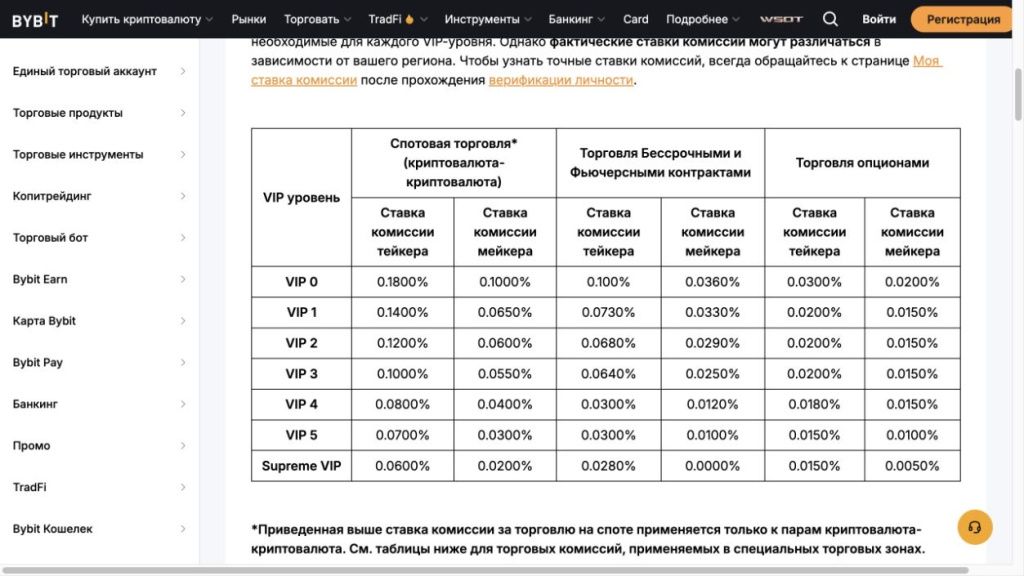
The regular spot rate cannot be automatically transferred to Adventure Zone, xStocks or fiat-cryptocurrency pairs: they have separate conditions. Promotions of a particular couple are also checked separately. The name Spot by itself does not mean a single fee for all tools.
Bybit indicates that VIP levels are recalculated daily at 07:00 UTC, that is, at 10:00 Moscow time. Subaccounts inherit the tariff structure of the main account. The order rate is determined by the level at the time of its placement. Therefore, today's rate screen and the execution of an old order may apply to different conditions.
Where to Check Your Personal Fee Rate
The personal rate is verified on the My Fee Rate page after passing the identity verification. Select the desired product and check both columns - maker and taker. The official general table helps you understand the order of expenses, and the account field shows the conditions of a specific user.
Before a major transaction, save the rate and verification time. After execution, open the transaction history and compare the withheld amount with the volume. If the rate is different from what you expected, check the trading zone, VIP level at the time of listing, region and availability of multiple executions. Withdrawal rates and payment methods are checked in their own forms.
Why a Limit Order Can Be Charged a Taker Fee
Maker adds liquidity: the order remains in the order book and awaits counter execution. Taker takes advantage of an already available offer. The name of the order type does not in itself determine the commission. A market order is usually executed as a taker; a limit order can also immediately take the counter volume if its price allows this.
Conditional example: there is a sale in the order book at 100 USDT, and the user places a limit buy at 101 USDT. The limit allows immediate purchase at 100 as a taker. The limit price does not promise a maker tariff.
One order can receive multiple executions. Part of it can immediately match the orders in the order book, and the rest can wait for a counter transaction. To check costs, use data from individual executions: volume, price, role and withheld commission. At different rates, multiplying the entire volume by one percent gives an error.
How Spot Trading Fees Are Calculated
V Bybit spot commission rules withholding is calculated from the executed volume in the purchased cryptocurrency. The percentage is converted into a share: 0.1% = 0.001. An error in translation changes the result a hundred times.
Spot purchase: commission in the underlying asset received = quantity executed × bid. Net receipt = quantity purchased − commission.
Spot sales: commission in the received settlement currency = quantity executed × execution price × rate. Net receipt = sales proceeds − commission.
Example for BTC/USDT with a notional BTC price of 100,000 USDT and a notional rate of 0.1%. If you buy 0.01 BTC, the execution cost will be 1,000 USDT. The commission is 0.01 × 0.001 = 0.00001 BTC. 0.00999 BTC will be added to the balance. The commission equivalent for the price of this execution is 1 USDT.
If you sell 0.01 BTC at the same notional price, the proceeds before commission will be 1,000 USDT. The commission will be 1,000 × 0.001 = 1 USDT, and the net receipt will be 999 USDT. In two directions the equivalent of the expense is the same, but the deduction currency is different. Therefore, in history you need to read the amount along with the designation of the coin.
For multiple executions, the calculation is made for each line, then the commissions in one currency are added up. The average price is useful for evaluating a trade, but it does not replace the original lines when the maker/taker role or bid changed. Rounding rules and quantity precision can also affect the last digits of the result.
The purchase procedure and types of applications are discussed in detail in Bybit spot instructions. To check expenses, it is enough to know what was executed, at what price and in what currency the commission was written off.
How Much Do a Purchase and Subsequent Sale Cost?
Let's continue with the tutorial example with the price unchanged and the rate of 0.1% on both sides. 0.01 BTC was purchased for 1,000 USDT, leaving 0.00999 BTC after the commission. Selling the entire balance gives 999 USDT before the second commission. Of these, 0.999 USDT is retained. Total - 998,001 USDT, total commission expense - 1,999 USDT.
To return to the original amount, both fees must be covered. Additionally, the result is affected by the spread and price changes between executions. An increase in the quote by 0.1% with two holds of 0.1% each does not in itself mean that buying and selling have already brought profit.
Futures Fees: Position Value, Leverage and Entry/Exit
In a linear contract, the commission is calculated from the value of the executed position. For a quantity denominated in an underlying asset, the formula is: quantity × execution price × bid . The margin deposited and the value of the entire position may vary significantly.
Training example: position value is 10,000 USDT, entry is made as a taker at a conditional rate of 0.055%. The opening fee is 10,000 × 0.00055 = 5.50 USDT. If the position is closed with the same denomination and taker role, another 5.50 USDT is retained at the exit. Total - 11 USDT before funding and other expenses.
With a margin of 1,000 USDT, that 11 USDT is 1.1% margin. The trading rate remains 0.055% for each side. Comparing commission to margin and comparing to par answer different questions; designate the denominator when estimating expenses as a percentage.
Leverage does not need to be re-substituted into the formula if the denomination has already been calculated. For example, a margin of 1,000 USDT and leverage of 10x in a simplified model gives a position of 10,000 USDT. After multiplying 10,000 by the bet, an additional multiplication by ten will increase the commission.
If you keep the same par value, changing the leverage itself does not change the trading commission basis. If you maintain margin and increase leverage along with the position, the expense increases with the nominal value. For this reason, a small percentage can significantly affect the result of frequent trading with a large turnover.
At the exit, the value of the position is determined by the closing price. In a conditional example with an entry of 10,000 USDT and an exit of 10,200 USDT, the taker closing commission at a rate of 0.055% will be 5.61 USDT. The sum of the two trading commissions is 11.11 USDT. For the final profit, the result of price changes and other charges are then taken into account.
For inverse contracts, the formula and commission currency are different. Before calculating, check the contract unit and rules of the selected product.
Funding Fees: When Additional Charges Apply
Funding refers to perpetual contracts and is transferred between market parties if the position is held at the time of settlement. If the bet is positive, the long side pays the short side, and if the bet is negative, vice versa. For USDT contract Bybit formula: quantity × Mark Price × funding rate.
Case Study: Mark Price position value is 10,000 USDT, conditional funding rate is 0.01%. The payment is 1 USDT. For three settlements of 0.01%, 0.02% and -0.01%, with the position value unchanged, the long side will pay 1 and 2 USDT, then receive 1 USDT. Net expense - 2 USDT.
All funding rates in this example are conditional. They cannot be transferred to the current pair or to the next billing period. To evaluate an open position, see the rate, time of the next calculation and actual accruals in the history. The interval may vary between contracts and may change.
Find accruals through Orders → Unified Trading Order → Futures → Trade History and the Filled Type: Funding filter. In history, a positive commission value means you paid, a negative commission value means you received it. The sign of this entry cannot be directly equated with the sign of the public bet: the result also depends on the side of the position.
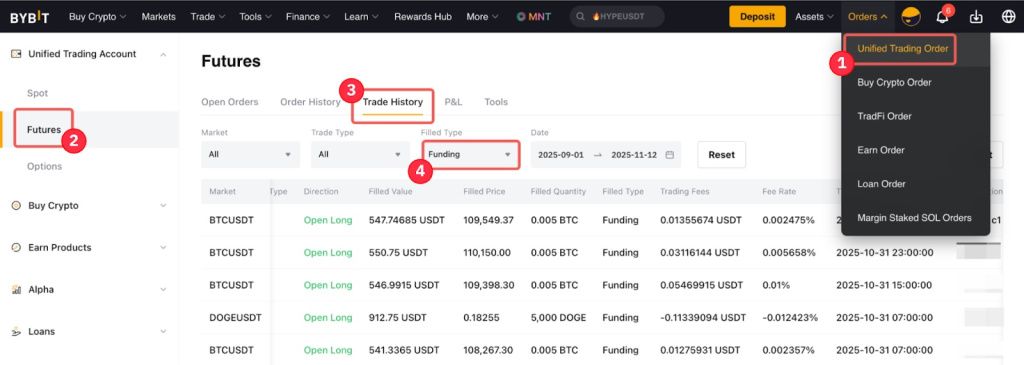
Funding is debited from the available balance. If there is a shortage, retention may affect initial margin; for an isolated position, this brings the liquidation price closer. Bybit also warns about accounting uncertainty within five seconds around the estimated moment. Closing at the last second does not provide a reliable guarantee of avoiding charges.
If a loan is used, the interest on it is taken into account separately. They relate to the value of the borrowed assets and their accrual periods. You should not replace all expenses on a position with leverage with the funding line: the composition of write-offs depends on the product and method of financing.
Bybit Withdrawal Fees and Minimum Amounts
By Bybit output rules the transaction is subject to a fixed fee specified for the selected coin and network. The user does not set it manually. The current minimum and tariff are visible in the withdrawal form after selecting the network, as well as on the Crypto Deposit/Withdrawal Status page.
In the form, check the debit amount, commission and quantity receivable. The minimum withdrawal amount is a separate condition. It does not show the cost of the service and does not mean that the transfer of this size will be received in full.
First, check if the wallet or other exchange supports the desired coin on the selected network. Then compare fares on available routes. The low fees of an unsupported network are of no use to the recipient. There may also be a minimum deposit and Memo/Tag requirements on the deposit side.
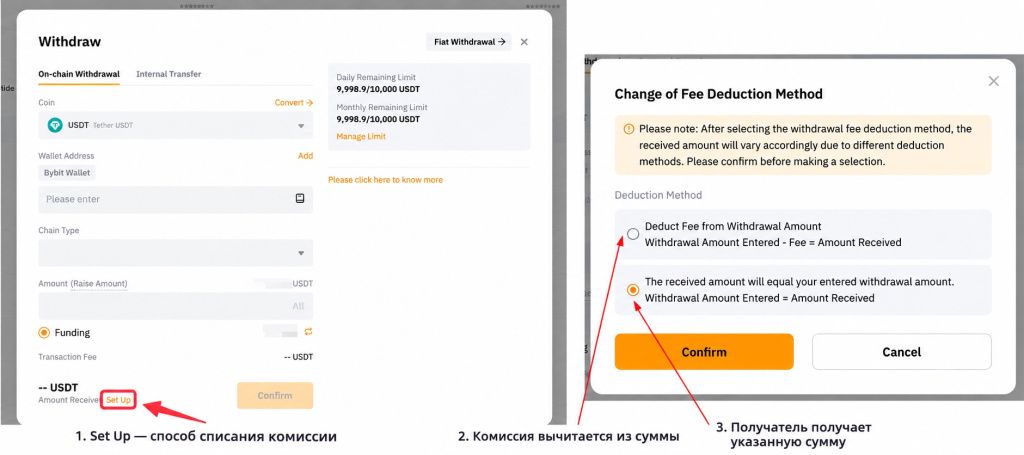
By default, the commission is deducted from the entered amount: Deduct Fee From Withdrawal Amount. Through Set Up you can select Withdrawal Amount Entered = Amount Received - then the entered value means the amount that the recipient should receive.
Conditional example with a withdrawal of 100 USDT and a commission of 1 USDT: in the first mode, 100 USDT will be debited, the recipient will receive 99. In the second, the recipient will receive 100 USDT, and the debit will require 101 USDT. The commission in the example is educational; it does not indicate the current network tariff.
In the second mode, there should be enough funds on the balance for the amount received plus the commission. Selecting All without this margin may cause an error of exceeding the available balance. Check the calculation mode before changing the amount or sending again.
For a fixed spend of 2 USDT, a transfer of 50 USDT loses 4% of the amount, and a transfer of 1,000 USDT loses 0.2%. This is educational arithmetic, not the current tariff of any network. It shows why the size of an individual operation affects the effective cost share.
Check what is already included in the final withholding before adding network costs to the calculation. Further sending from a personal wallet is a new transaction with its own commission.
Internal Transfer to another Bybit user occurs without withdrawal fees. It is available within the platform; an external wallet requires a suitable route through the blockchain. Movements between your own Funding and UTA are discussed in the article about Bybit accounts and wallet.
P2P and Fiat Purchase Costs
For P2P, the terms of the specific currency, transaction party, and payment method are checked. Even when the platform's individual commission for the selected transaction is zero, the seller sets the ad rate. The cost may be in exchange rates, bank transfer or conversion.
Compare amounts of USDT for the same amount. Conditional example: with a budget of 100,000 ₽, an offer of 100 ₽ for USDT gives 1,000 USDT, and for 101 ₽ - about 990.10 USDT. The difference of almost 9.90 USDT occurs in the rate. The inscription “no commission” by itself does not eliminate it.
Before paying, check the ad limits, the total of the application and the tariff of your bank. Consider the possible conversion of the account currency: the payment service rate and the bank rate may be applied at different stages. The criteria for selecting a counterparty are discussed in material about Bybit and P2P.
When paying by card or through a third party provider, compare the final screen before confirmation. It can separately display the service commission, the exchange amount and the expected receipt. An advertising percentage without the name of the method, currency and total amount is not sufficient for calculation.
The name of the payment method also needs to be read in context. Separately disassembled Mobile Top Up in P2P and Pay and banking operations Bank Transfer and Bank Transfer+: they differ in the recipient, the payment procedure and the composition of expenses.
How to Calculate the Full Cost from Transaction History
Select the boundaries of the calculation: from purchasing an asset to selling it back, or from writing off rubles to receiving coins in an external wallet. To compare the two methods, the boundaries must match. The balance on the exchange and coins after a paid withdrawal reflect a different number of completed stages.
- Record all original expenses in one currency: principal, bank, and provider.
- Collect order executions with quantity, price, maker/taker role and commission.
- Separately write down funding, interest and other charges relating to this period.
- Reconcile the output and the actual receipt to the recipient.
- Convert the expenses into a common currency and compare with the amount of the asset received.
Conditional example: 100,000 rubles were spent on a purchase, an additional 500 rubles were withheld by the bank. After all operations, 997 USDT was received in the external wallet. The effective cost of one delivered USDT is 100,500 ÷ 997 ≈ 100.80 ₽. This result already reflects all the stages that influenced the initial costs and final receipts.
A breakdown of the history is needed to highlight commissions. Changes in the market price between transactions are taken into account separately from the cost of services.
Fees charged in BTC, USDT and other coins first result in one currency. Use the selected conversion price along with the time and save it in the calculation. Otherwise, the change in the exchange rate of the coin with which the commission was paid will be imperceptibly mixed with the cost of the service.
Common Mistakes That Make Costs Look Too High
- Only the input is taken into account. Closing a position or selling an asset creates its own execution and commission.
- Interest applied to margin. The derivatives trading commission requires an executed denomination.
- The entire limit order is written as maker. Check the roles of individual performances.
- Compares different commission currencies. The amount of BTC and the amount of USDT require recalculation.
- Funding subtracted twice. Check whether it is included in the selected outcome measure.
- The price reduction is called a commission. Reconcile write-offs against historical lines separately from market movements.
For small discrepancies, check rounding; for large discrepancies, check repeat trades, partial executions, and period. An order can be displayed as a single line in one report and multiple executions in another. They cannot be added as independent expenses.
How to Compare Ways to Reduce Fees
It makes sense to evaluate the tariff reduction in absolute terms. With a nominal turnover of 10,000 USDT, the difference between rates of 0.1% and 0.08% is 2 USDT. Weigh these savings against additional terms, wait times, and possible changes in the exercise price.
Consider turnover: ten buys and sells generate more paid executions than one pair of transactions of the same size. A role change to maker requires a willingness to wait, and another output network requires compatibility in the recipient. Savings are assessed by the final result of the operation.
Frequently Asked Questions About Bybit Fees
Is There a Trading Fee for a Canceled Order?
The unexecuted balance does not have a trade volume from which the trading commission is calculated. If a part has already been fulfilled, the deduction for it remains. The cancellation status of the entire order must be read along with the execution history.
Do Trading Bots Have Separate Fees?
The cost of executions depends on the product and account rates. No startup fee doesn't make the trades free. The derivative strategy additionally takes into account funding and other applicable expenses. How expenses are reflected in the result of the grid is discussed in the article about Bybit trading bots.
What Should You Send Support About a Disputed Charge?
Prepare the order number, time, product, role in execution, commission amount and its currency. Please attach a calculation and a photo of the tariff. Remove passwords, verification codes, and other access data from the image. The application procedure is explained in instructions for contacting Bybit support.
This material is for informational purposes only and does not constitute individual financial advice. Prices, amounts and funding in educational examples are conditional; Please check your personal rates before your transaction.
Available to get started Bybit affiliate link from MCG. First, check My Fee Rate and the calculation of the desired operation, and after execution, save the actual deductions. This allows you to estimate costs based on your own data.