

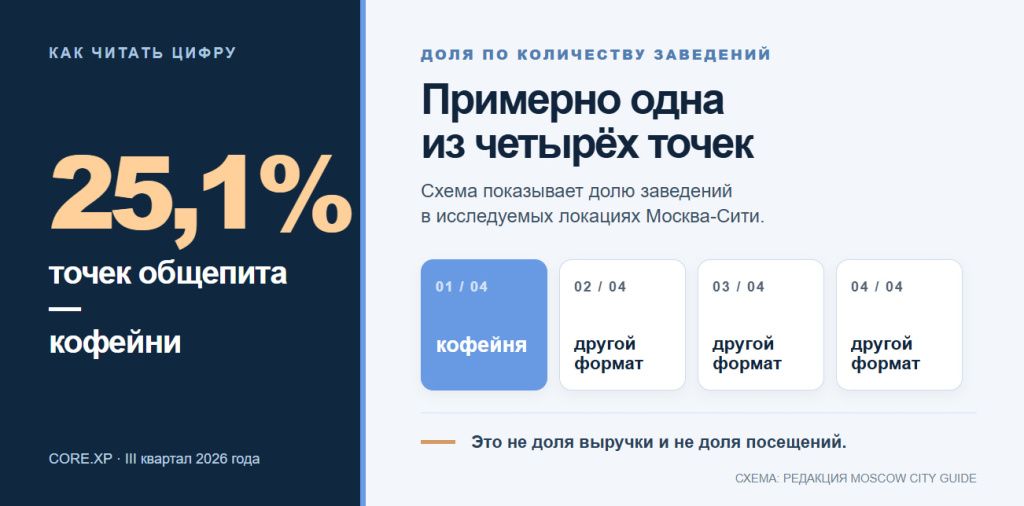
Coffee shops accounted for 25.1% of Moscow City’s food service establishments as of the end of the third quarter of 2026, compared with 22.1% a year earlier. These figures from CORE.XP were reported in industry publications on October 8. At the same time, the total number of locations in the surveyed areas grew by only about 2%. It is primarily the mix of offerings that is changing, rather than the scale of the restaurant market.
It is important to note what analysts are specifically measuring: the share of establishments based on the number of locations. This metric does not reflect revenue, the number of guests, or the share of coffee in orders. In other words, “one in four” refers to a cross-section of operating formats, not a measure of consumer spending.
You can scroll horizontally through the table →
Source: CORE.XP data published on October 8, 2026. The table shows selected categories, not the entire list of cuisines. Changes are expressed in percentage points.
The most notable shift is a 3 percentage point increase for coffee shops. They are already outpacing any single cuisine category on the published list. Among the cuisines listed in the report, European cuisine accounts for the largest share, while Pan-Asian and Russian cuisines grew by nearly the same amount. At the other end of the spectrum are restaurants with mixed menus: their share fell by 4.2 percentage points.
The “Asian” and “Pan-Asian” indices should be considered separately. The former lost 2.0 points, while the latter gained 1.7 points. The published report does not explain how researchers draw the line between these categories. Therefore, it would be inaccurate to combine them into a single “Asian segment” and declare its growth or decline.
Nadezhda Tsvetkova, head of retail leasing at CORE.XP, attributes these changes to a clearer specialization among establishments. For visitors, this means a more distinct choice between a quick coffee stop, a specific type of cuisine, and a full-service restaurant. However, the decline in the share of mixed-format establishments does not in itself indicate how many such establishments have closed: the report provides market shares, not statistics on openings and closings by category.
The distribution of dining options within the neighborhood is also uneven. According to CORE.XP’s estimates, the “Federation” Tower accounts for 19.6% of all establishments in the locations under review. That’s nearly one in five establishments in the sample. However, the publications available to the editorial team do not include a complete list of locations or the absolute number of establishments for the third quarter of 2026; it is not yet possible to convert the percentages into the actual number of coffee shops.
To help with practical selection, the portal features separate directories of Moscow City coffee shops, restaurants, and food courts. The listings help users find a specific address and type of establishment, but the number of listings cannot be directly compared to the CORE.XP sample: the directory also includes establishments that have since closed.
In the previous analysis of City’s retail sector, food service accounted for 35% of retail space tenants. The new 25.1% figure refers specifically to coffee shops located within the food service sector itself. These two metrics are calculated on different bases—they cannot be added together or directly compared.
Which formats gained market share and which lost it
Format or cuisine
Q3 2025
Q3 2026
Change
Coffee shops
22.1%
25.1%
+3.0 percentage points
European cuisine
18.6%
20.4%
+1.8 percentage points
Pan-Asian cuisine
4.3%
6.0%
+1.7 percentage points
Russian cuisine
2.6%
4.3%
+1.7 percentage points
Asian cuisine
12.6%
10.6%
−2.0 percentage points
Fusion cuisine
20.8%
16.6%
−4.2 percentage points
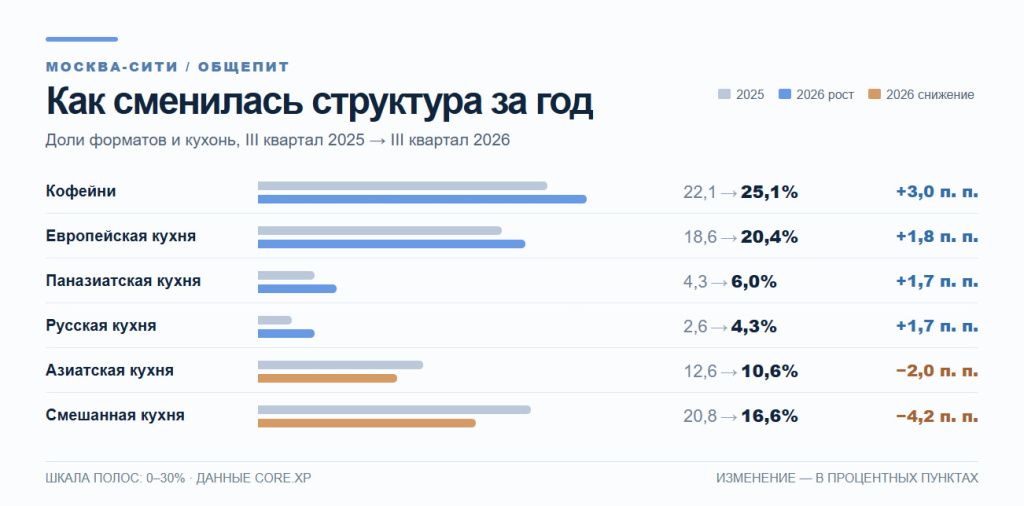
Coffee is growing the fastest, while mixed menus are losing ground
Where to Find a Coffee Shop in Moscow City