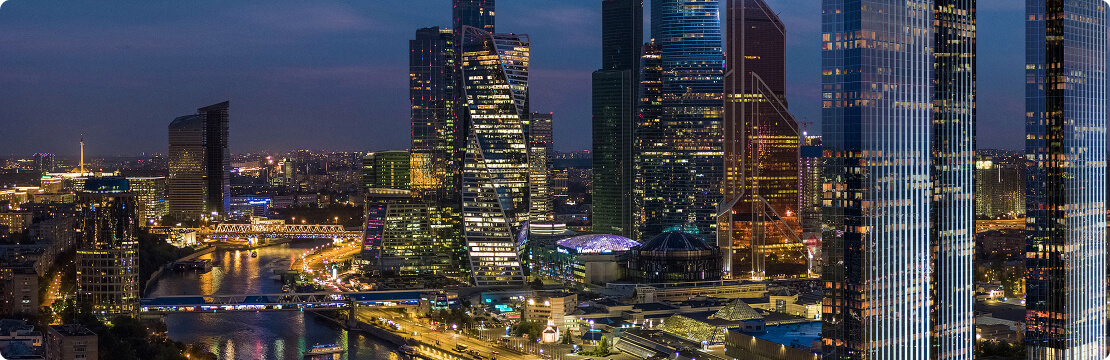


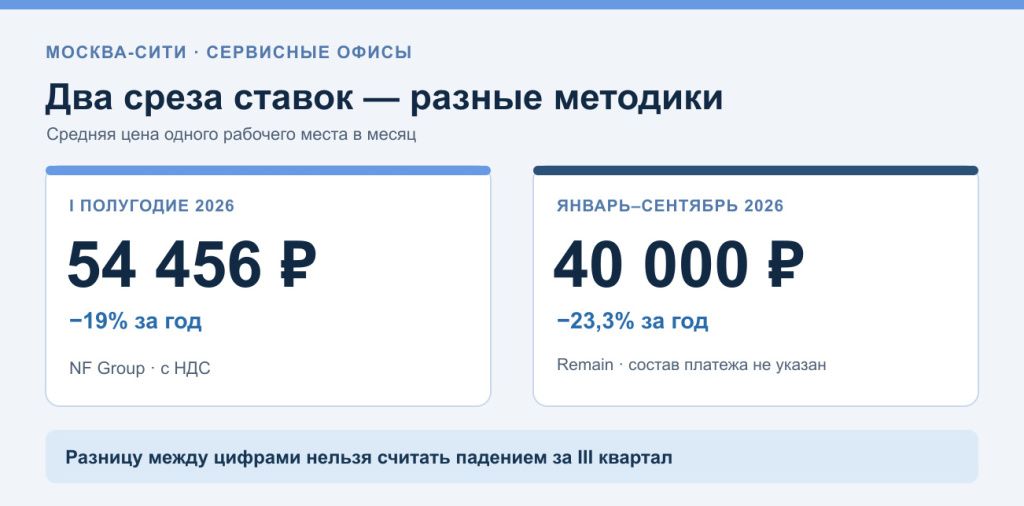
Based on figures for January–September 2026, a workstation at the “Moscow City” service office cost an average of 40,000 rubles per month—23.3% less than a year earlier. This estimate from Remain is cited by Kommersant. Across Moscow as a whole, the same company recorded a 5.9% increase, to 45,000 rubles. Moscow City is becoming cheaper amid a rise in the citywide average rate.
This is an analytical benchmark for the area, not the rate for each individual coworking space. The data published by Remain also does not specify whether the 40,000 rubles includes VAT and associated fees. For a specific team, the final cost must be confirmed with the operator.
You can scroll horizontally through the table →
How Rate Estimates Have Changed
Period
R rubles per seat per month
Year-over-year
Source of estimate
First half of 2026
54,456, including VAT
−19%
NF Group
January–September 2026
40,000, payment breakdown not specified
−23.3%
Remain
These are two independent studies with different sample sizes and calculation methods. The difference between 54,456 and 40,000 rubles cannot be considered a decrease in the rate for the third quarter.
There are now more available spots
The decline in rates in the City has a local context. According to Nikoliers’ July estimate, the vacancy rate for service offices in the Moscow International Business Center (MIBC) reached 49% following the vacating of large blocks. This figure reflects the flexible spaces surveyed by the company at that time, not the proportion of vacant space across all towers in the business center.
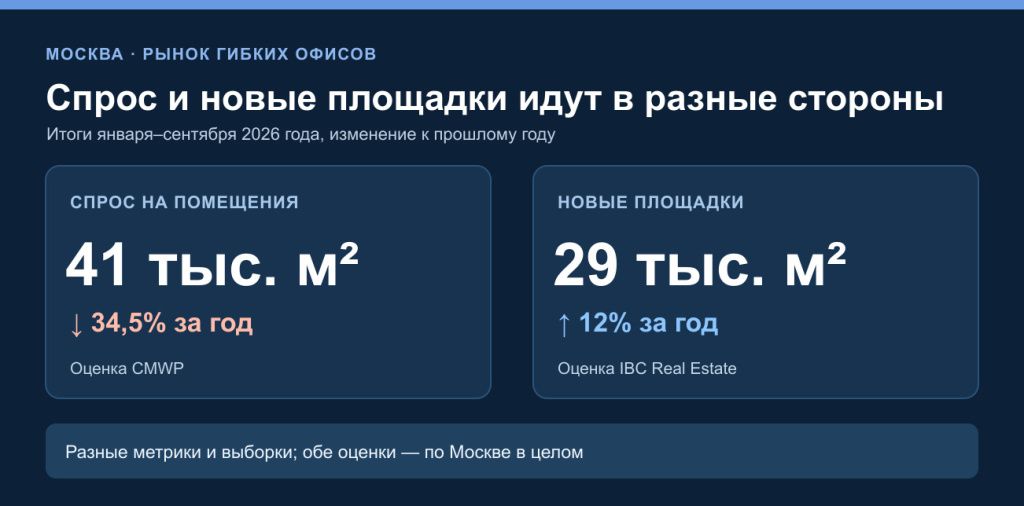
A cooling trend is also evident in the Moscow market as a whole. According to CMWP’s August snapshot, the vacancy rate in chain-operated flexible offices rose by 8.9 percentage points to 18.7%; demand for January–September, according to the company’s estimates, fell by 34.5% to 41,000 square meters. At the same time, according to IBC Real Estate, new spaces with a total area of 29,000 square meters opened over the first three quarters—12% more than a year ago. With this balance of supply and demand, it is becoming more difficult to fill the vacant units.
Mikhail Ioannessyants, a representative of the operator Business Club, attributes the decline in rates to landlords’ desire to find tenants more quickly. At the same time, Remain explains that the rise in average prices across Moscow is driven by expensive new developments: the citywide average may increase even as prices fall in certain neighborhoods.
What does this mean for tenants?
For companies choosing a ready-to-use office, it now makes sense to compare not only the price per workstation, but also the size of the unit, the lease term, VAT, and the list of included services. The portal lists coworking spaces and serviced offices in Moscow City. To compare with traditional leases, it’s helpful to look at office rates by tower: there, prices are calculated per square meter, not per workstation.
Evelina Kalisher, Commercial Director at Aspace, anticipates that rates for serviced offices in Moscow could drop by another 5–10% by the end of 2026. This is a forecast for the city as a whole, not a promise of the same discount in Moscow City. We examined how the broader office market in the business center is changing in our fall analysis of vacancy rates and transactions.