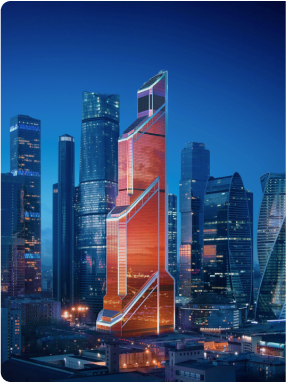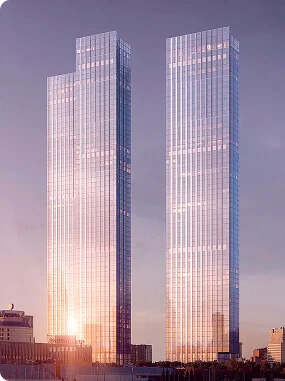


Skyscrapers in cities usually turn into giant screens displaying advertisements or simply dynamic images. The TOP TOWER business skyscraper will take a different approach. In the new 64-story office tower in Moscow-City, instead of a traditional media facade, will feature a smart system of flood and accent lighting that will interact with the building’s architecture with the same precision used to illuminate works of art in art galleries. The project is being implemented by MR Office—the office real estate division of developer MR.
Light on the structure, not on the glass
The new business skyscraper will be the first tower in Moscow where lighting accents will shift from the glass facade to the building’s structural elements. Thanks to sophisticated optics, the light will be directed exclusively onto the end walls and mullions, without illuminating the glazing. The glass will retain its transparency, depth, and ability to reflect the city at night, rather than turning into a solid light screen.
The concept is based on the idea of revealing the architecture rather than superimposing an additional visual layer upon it. The gables and mullions form the tower’s undulating silhouette, emphasize its sculptural quality, and visually elongate the structure upward. After dark, lighting will make these lines more prominent, transforming the 303-meter-tall skyscraper into a recognizable feature of the Moscow City skyline.
How the System Works
To create the effect of a living wave of light, engineers developed a combination of linear fixtures with full-color LEDs on the ends of the facade modules and spotlights on the imposts. The equipment will be integrated directly into the facade structure. This will allow for dynamic lighting scenarios while preserving the architectural integrity and avoiding visual clutter. INTILED served as a partner on the project; its lighting solutions have been used on the “Lakhta Center” tower in St. Petersburg, City Tower in Dubai, and other major architectural landmarks.
“Today, a building in Moscow cannot exist in isolation; it must blend organically into the urban environment and contribute to its development. The Moscow City business district was originally conceived as a venue where each tower sets a new technological standard. And our project continues this approach. We deliberately moved away from the classic animated media facade in favor of a more complex and sophisticated engineering solution. “It takes architectural lighting in Russia to a new level—there are virtually no such systems on the market where light becomes an integral part of the architectural concept, rather than a separate technological layer,” — notes Maria Litinetskaya, CEO and Managing Partner of MR.
The system’s technological complexity stems primarily from the precision of the lighting. In TOP TOWER, sophisticated optical systems will direct light exclusively onto specific elements of the facade. The most precise selection of LEDs based on brightness and power will ensure color uniformity, while a high color rendering index will preserve the accuracy of shades in various scenarios.
Louvre Abu Dhabi, Taipei 101, and the Bund
This approach is already being used in iconic international projects. Light helps reveal the geometry of the Louvre Abu Dhabi’s dome and the movable diaphragms of the Arab World Institute in Paris, highlights the minimalist architecture of the Langen Foundation in Germany, and subtly accentuates the historic buildings along the Bund in Shanghai. In high-rise architecture, accent lighting on structural elements creates the recognizable nighttime silhouettes of the Bank of China Tower in Hong Kong, Taipei 101 in Taiwan, and the Empire State Building in New York. In all these cases, light makes the architectural silhouettes legible.
Visual Ecology
“Drawing on cutting-edge global expertise in the sculptural highlighting of architectural forms, we are introducing a fundamentally new technological standard for high-rise real estate. Our goal is to use complex optics and intelligent systems not to broadcast media content, but to work with volumes and textures with the precision of a jeweler. Innovative engineering solutions function here just as high-precision lighting does in the world’s leading museums: the technology serves solely to reveal the skyscraper’s true form, emphasizing its timeless value. “The project sets a trend for ‘visual ecology’: the new 300-meter landmark does not compete with neighboring towers but establishes a serene identity that will remain relevant for decades,” — notes Elena Belova, Director of Development at INTILED.
An intelligent lighting control system will allow the brightness and color temperature of the lighting to be adjusted based on the time of day, season, and urban context. Transitions between lighting scenarios will be seamless, so the tower will not compete with neighboring buildings in terms of light intensity. Its image will be built on precision, depth, and the use of form. This approach reflects an emerging market trend toward visual ecology—as the number of light screens in the city increases, high-end architecture is increasingly opting for restraint.