Crypto staking lets you help a Proof of Stake network operate and earn rewards in its native coins. Validators check blocks and vote on the state of the blockchain, while staked funds support this process. For a coin holder, the outcome depends on the network's rules, the operator's performance, fees and the price of the coin itself.
There are several ways to take part: run a validator, delegate coins, join a pool or choose a staking product on an exchange. Below, we explain who retains control in each case, where payouts come from and which steps are needed before your coins become available to spend again.
The rules and public interfaces were checked in November 2026. The rates used in the calculations are illustrative: they help compare results before and after costs. The validator profile is included to explain its fields, without recommending a particular operator.
- Look for the source of rewards in the protocol rules or product terms. A label such as Staking or Earn is not enough.
- APR and APY express an annual figure under particular assumptions. Actual rewards for a month may differ.
- Exiting can involve a queue, deactivation and a separate transfer to your wallet.
- Measure the outcome in two ways: how many coins you hold and what they are worth in your chosen currency.
Types of staking: control, rewards and withdrawals
| Method | Who manages it | Source of rewards | How to exit |
|---|---|---|---|
| Your own validator | The owner of the node and keys | Participation in the protocol | The network's exit procedure |
| Delegation | An operator runs the node; account permissions depend on the protocol | Network rewards minus commission | Deactivation and withdrawal |
| Pool | The pool's contracts and operators | Staking; payout components are set out in the terms | Redeem your share; a liquid token may also be sold |
| Exchange product | The platform holds and manages the assets | Check the terms of the specific offer | Submit a request and follow the service's timetable |
What staking means and why a network needs it
A blockchain needs a way for many participants to agree on new records. In Proof of Stake networks, validators do this work. They run dedicated software, check incoming blocks and carry out other duties under the protocol rules. Staking ties participation in validation to the coin holder's economic interest.
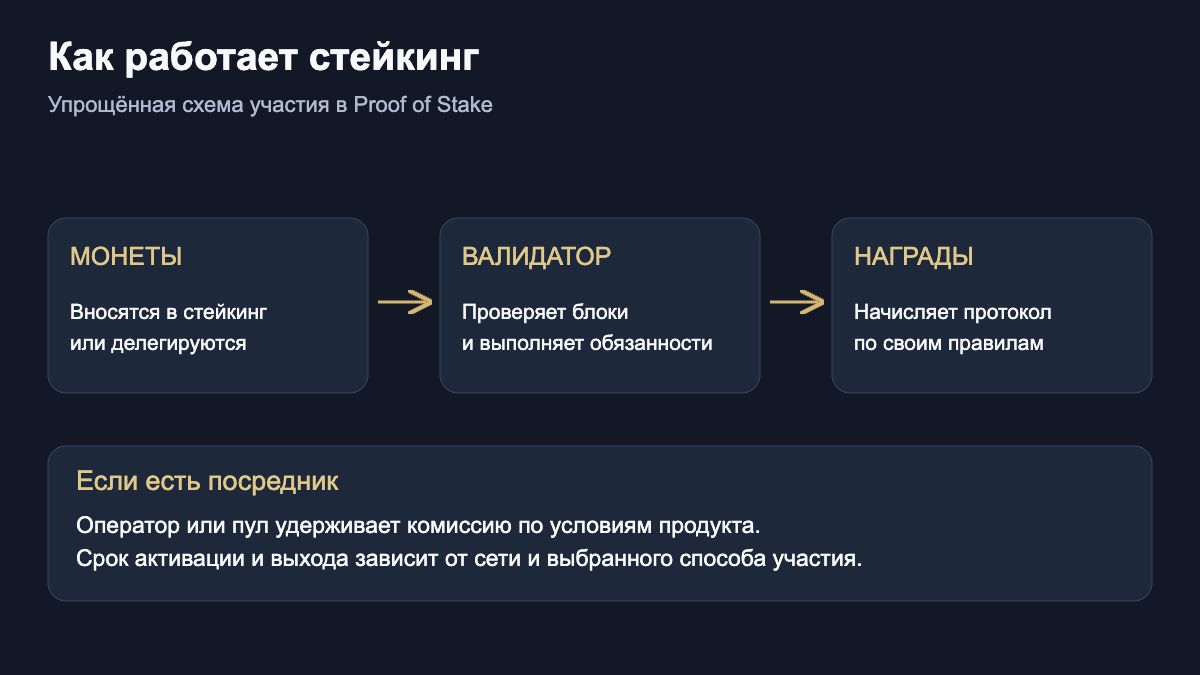
Rewards can include newly issued coins and a share of fees specified by the protocol. Their composition varies between networks. A service's advertised figure may also include extra payments from its operator. Two similar rates on a screen can therefore represent different sources of return.
Simply holding coins does not necessarily start earning rewards. In Solana, you need to create or use a stake account and delegate SOL to a validator. Direct participation in Ethereum requires setting up a validator and depositing ETH. With an intermediary, its infrastructure handles these tasks, while the holder receives rights and payouts under the chosen product's terms.
How the four ways to participate work
Running your own validator
The owner maintains the node, installs updates and keeps the keys secure. Activating an individual Ethereum validator requires at least 32 ETH. This threshold applies to running a validator directly; pools set their own minimums. Other networks may have very different requirements.
- Before starting: check node requirements, key permissions and the withdrawal address.
- While it is running: monitor availability, updates, missed duties and rewards.
- When exiting: check the validator's status, the queue and the address that will receive the funds.
Delegating coins to a validator
Where a protocol supports delegation, the holder chooses an operator and assigns their stake to it. There is no need to maintain a server yourself. In Solana, for example, coins are recorded in a separate stake account, with staking and withdrawal authorities defined for that account. With ordinary delegation, you retain withdrawal authority; you do not need to send SOL to the operator's personal address.
Validator commission usually means the operator's share of rewards, but you should read the exact definition of the field. Additional reward sources may carry a separate fee. Comparing only the largest yield figure overlooks both costs and node performance.
The cryptocurrency wallet directory can help you find a suitable interface. Supporting a coin and supporting its native staking are separate features. Also check whether the app displays the stake account address and reward history.
Pools and liquid staking
A pool combines participants' funds to run validators. Users can join with a smaller amount, while operators handle the technical work. They still need to consider how the contracts work, what powers the administrators have and how returns are shared among participants.
Liquid staking usually issues a token in exchange for the deposited asset. That token represents a share in, or a claim on, the product. Depending on the model, either the token balance grows or its accounting value relative to the underlying asset increases. Read how rewards are recorded before buying: an unchanged token count in a wallet does not by itself mean that no rewards have accrued.
A holder may have two routes out: redeem the token under the pool's rules or sell it on the market. A sale depends on available orders and liquidity. The market price can diverge from the value of the assets backing the claim, so a quick sale may involve a discount. Redemption follows the product's own waiting stages.
Staking and Earn on an exchange
On an exchange, the user sees the terms of a product and an account balance, while the platform handles on-chain transactions. Find out whether the funds actually participate in staking, who holds the assets, how fees are charged and what happens if you request early redemption.
An Earn section may bring together several mechanisms, including staking, lending and other products. A return on USDT, for instance, needs a separate explanation of its source: USDT is not the native coin used to secure Ethereum or Solana consensus. The word “yield” alone says nothing about how the product works.
For a guide to a particular platform's screens and terms, see our Bybit Earn review. When comparing products more generally, start with access to assets, reward rules and exit conditions, then compare rates.
How to read a validator profile and check your stake
A public profile helps you check a node's identifier, commission and active stake. The Block Logic example from Validators.app highlights the Commission and Active Stake fields. In the November snapshot, the commission shown in this field was 2%. This describes that operator at the time of checking; it is neither an average Solana rate nor a promised return.
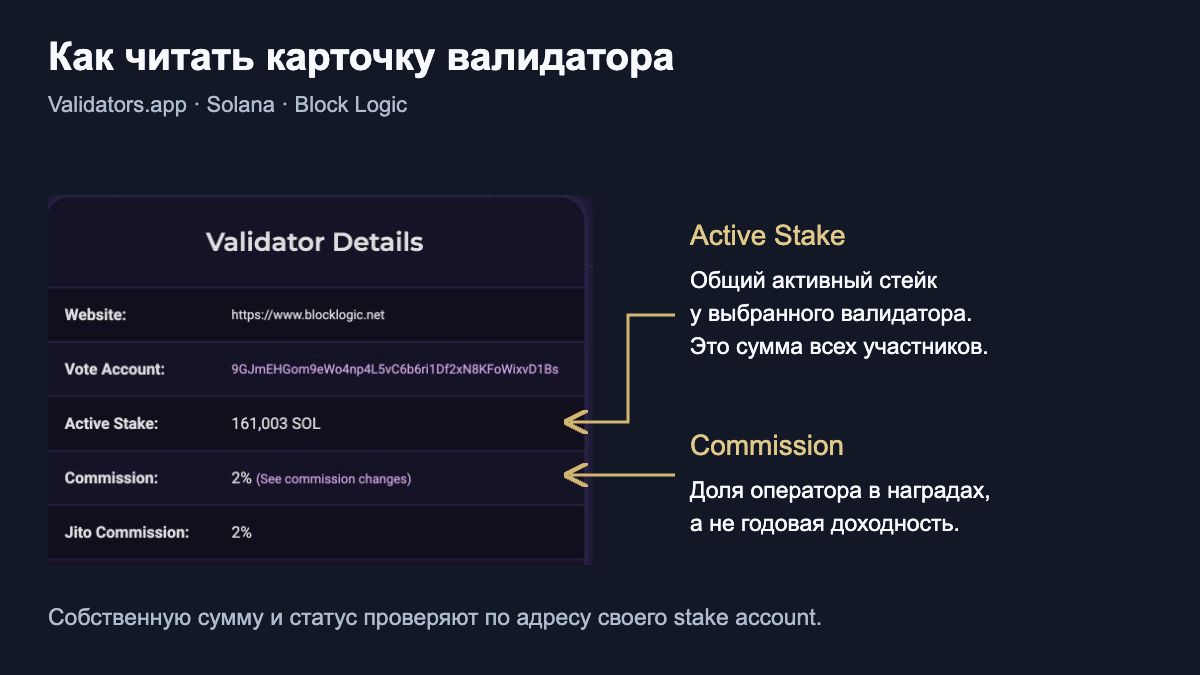
Active Stake on this kind of profile shows the total active stake assigned to the validator. It is not an individual reader's balance. Check your own deposit in an explorer using your stake account address: confirm the validator, the amount that is active and whether deactivation has started.
- Activating: the stake is becoming active. A confirmed delegation transaction does not mean the entire amount is already earning rewards.
- Active: the funds are participating in staking. Rewards depend on the network's rules and the validator's performance.
- Deactivating: an exit has begun, but some or all of the funds may still be active.
- Inactive: delegation has ended. Withdrawal also depends on the account's own permissions and restrictions.
Check the operator's identifier, not just its name and logo. Names can match, and a wallet may display a shortened address. Commission history is more useful than a single current figure when assessing longer-term terms. A third-party explorer's rating reflects its methodology and does not guarantee that funds are safe.
APR and APY in staking: what the annual rate means
APR usually shows an annual rate without reinvesting rewards. APY includes compound growth at a specified reinvestment frequency. Check which method the service uses, whether fees are included and which observation period the figure is based on.
For example, a constant 5% APR with monthly reinvestment and no costs gives approximately 5.12% APY: (1 + 0.05 / 12)12 − 1. This assumes the rate stays unchanged for a full year, rewards are reinvested immediately and there is no additional waiting time. A real product may not meet these conditions.
An “up to 12%” label needs careful reading. It may apply only to a limited amount, include a temporary bonus or describe a particular period. If the higher rate applies only to the first 100 coins, it cannot be used for the entire balance. Historical APY likewise does not lock in future results.
Calculating rewards after commission
Take an illustrative 100 coins, 5% gross APR and an operator commission of 10% of rewards. The full amount participates for exactly one year. The rate stays constant, rewards are not reinvested, and network costs, taxes, penalties and waiting periods are excluded for now.
| Step in the illustrative calculation | Coins |
|---|---|
| Starting amount | 100 |
| Reward before commission: 100 × 5% | 5 |
| Commission: 5 × 10% | 0.5 |
| Reward after commission | 4.5 |
| Balance after one year | 104.5 |
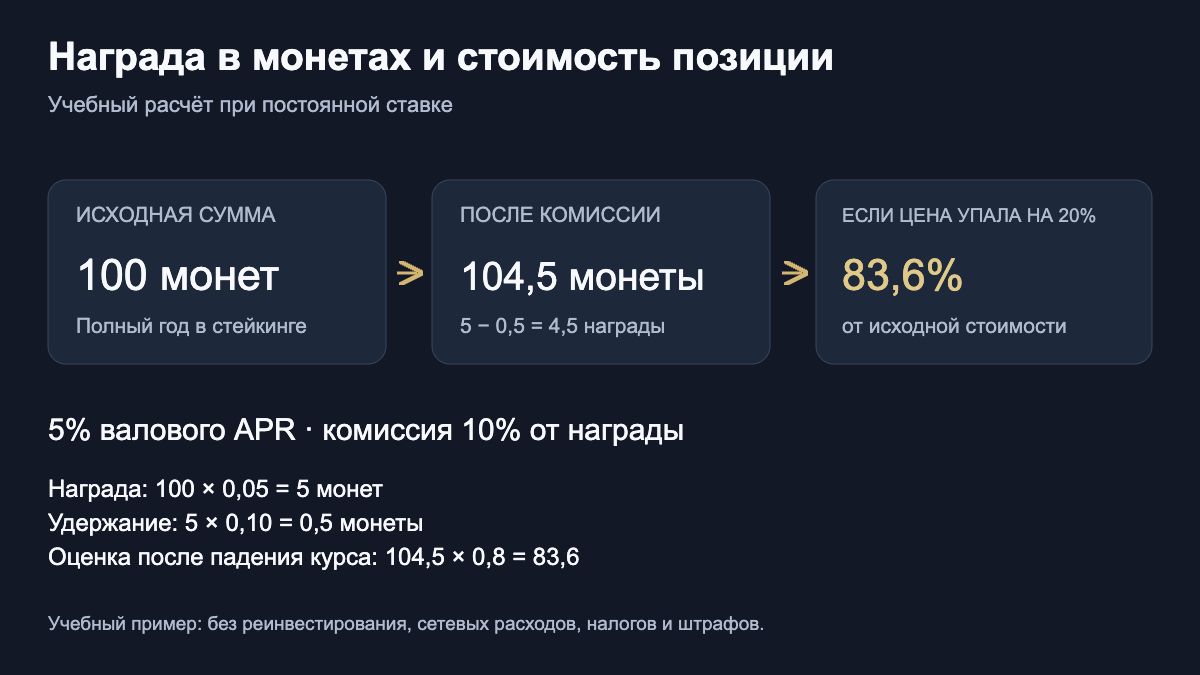
In this example, the 10% commission is deducted from the five coins earned. The fee is not ten coins and does not reduce the rate by ten percentage points. If the service already shows a rate after deductions, do not subtract the same commission again.
Why you can have more coins but less money
Now suppose the coin's price falls by 20% by the end of the year. The final 104.5 coins are worth 104.5 × 0.8 = 83.6% of the initial value of the original 100 coins. The coin count rose by 4.5%, while the position's value in the chosen currency fell by 16.4%. Positive rewards did not offset the price decline.
How to exit staking on Ethereum and Solana
Exiting begins with a request. Funds may then remain committed to the protocol, wait until withdrawal is allowed or go through the product's internal processing. “Request accepted” therefore needs to be distinguished from an available wallet balance.
Ethereum: the queue and receiving funds
During a full exit, a validator follows the network procedure for ending participation, after which its balance is transferred to the designated withdrawal address. Timing depends on queues and protocol rules. A blanket promise of “withdrawal within a day” is inappropriate without checking the current queue.
The rules for different validator types and the exit stages are covered in the Ethereum documentation.
A pool or exchange customer also faces the intermediary's rules: a redemption queue, request processing and crediting the account. Network timing alone does not tell them when the funds will appear in their particular app.
Solana: deactivation across epochs
An epoch is a period of network operation. In Solana, stake activation and deactivation follow epoch boundaries and network limits. Timing also depends on other participants' actions. The same number of hours cannot be promised for every amount and request time.
After deactivation, check the inactive balance and whether it can be withdrawn. A stake account may have additional date-based or epoch-based restrictions. The differences between staking authority, withdrawal authority and lockups are explained in the Solana stake account documentation.
Staking risks: where losses can occur
The risks depend on the arrangement you choose. With your own validator, much depends on the node and keys; a pool adds contract and governance risks; an exchange brings custody and its ability to meet obligations into the picture. Identical rates do not mean identical terms.
- Price changes. A coin's price can fall more than its quantity grows.
- Downtime and violations. Missed duties reduce rewards. On Ethereum, certain signing violations can lead to slashing, loss of part of the stake and the validator's exit. The grounds and amounts of penalties cannot be assumed to apply to other networks.
- Contract or governance failures. For a pool, check published audits, upgrade permissions and incident procedures. An audit does not eliminate vulnerabilities.
- Difficulty selling quickly. A liquid staking token can trade at a discount, and redemption queues can grow.
- Intermediary problems. A platform's withdrawal suspension is not necessarily caused by the blockchain.
- Loss of access. Losing a withdrawal key or signing an unrelated transaction can mean losing control of funds.
What to read before committing coins
Keep a copy of the terms for the specific product. A service's main page may show several offers with different timelines and rules. To compare them, gather answers to a few concrete questions.
- Where are the coins? In your stake account, in a pool contract or under a company's control?
- What earns the reward? Participation in consensus, lending funds or an additional programme?
- How is the rate displayed? APR or APY, before or after commission, and for which amount and period?
- When does participation begin? Immediately after the transaction, after activation or from the service's next accounting period?
- How do you end participation? Where do you submit a request, which stages follow and can the request be cancelled?
- What does the whole process cost? Entry, servicing, claiming rewards, exiting and any sale of the token received.
Staking questions and answers
Do I need to keep my phone switched on?
With ordinary delegation through a non-custodial wallet, the phone is used to sign transactions and view data. The validator's node checks blocks. Running your own validator has very different requirements for continuous hardware operation.
Do I have to claim every reward manually?
That depends on the protocol and product. A payout may automatically increase the stake, go to a separate address or need to be claimed through an interface. A Claim button in one app does not mean another app requires the same action.
Can I earn rewards after submitting an exit request?
Rewards may continue while the funds still participate in staking under the network's rules. An intermediary may set a separate cutoff for payouts. Check the on-chain participation status and the product's accounting-period terms.
What happens if the pool's website goes down?
An unavailable website does not by itself reveal the condition of contracts or assets. Whether another way to access them exists depends on the pool's design. Use only verified official instructions; giving a recovery phrase to a “recovery service” creates a separate threat.
Can I change validators without losing my history?
Previous transactions remain on the blockchain, but a new service's interface may display only part of that history. The switching process, waiting periods and retention of separate accounts depend on the network. Save the old stake account address and reward records before switching.