An electronic wallet lets you keep a small spending balance, pay for services and transfer money once you have completed the required identity checks. In Russia, banks and non-bank credit institutions issue these wallets. What you can do depends on the operator, your verification tier and the transaction.
We compare YooMoney and My Wallet in MTS Money using their published opening instructions and operator documents. We look at balances, transfers, top-ups and fees, then follow the process from registration to withdrawal. We also explain how e-money differs from bank accounts, virtual cards and cryptocurrency.
We checked public documents in November 2026 and did not open accounts or make transfers. The insurance rules due in February 2027 are covered separately. Before adding money, check which protections are in force and which have yet to take effect.
What are electronic wallets and e-money?
Law No. 161-FZ defines electronic money through the way it is recorded. A person supplies funds to an operator in advance. The operator records the balance without opening a bank account in the person's name and carries out transfer instructions. The app usually calls this balance a wallet.
An electronic means of payment lets you send an instruction to the operator. It may be a card or another instrument specified in the agreement. A virtual card identifies the payment instrument. The contract explains where the underlying balance is held.
| Product | Where the funds are recorded | What to check |
|---|---|---|
| E-money wallet | With the e-money operator, without a customer bank account | Operator, verification tier, restrictions and fees |
| Bank account | In an account the bank opens for the customer | Account agreement, servicing and transfer terms |
| Virtual card | Depends on the product. It can draw on a bank account or e-money. | Issuer, agreement and source of funds |
| Digital rouble account | On the Bank of Russia platform | Access through a participating bank and platform rules |
| Crypto wallet | Works with cryptoassets and the relevant network | Who controls the keys and which network and assets the product supports |
An ordinary e-money balance is distinct from a bank deposit. Operators do not accrue interest on it under the law. Any rewards or cashback follow the programme's own terms and do not make the wallet a savings account.
Which electronic wallets are available in Russia in 2026?
We chose two products with published terms. YooMoney is issued by YooMoney LLC, a non-bank credit institution. My Wallet in MTS Money is linked to MTS Bank PJSC. Both legal entities are on the Bank of Russia list of e-money operators as of 1 November 2026. Bank of Russia lists of operators.
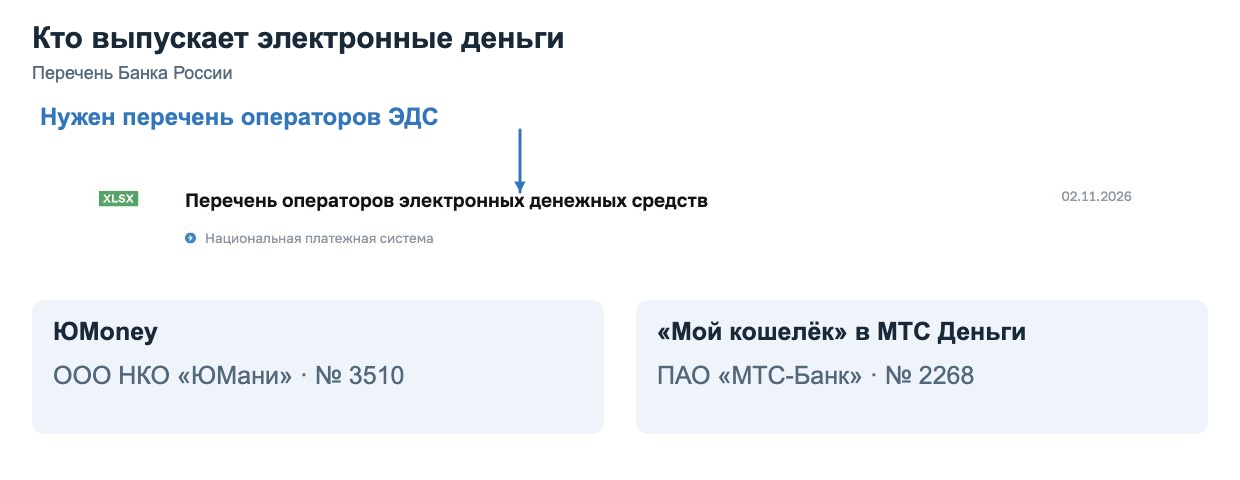
Look up the legal entity itself. A logo or app store listing is insufficient. The wallet issuance terms, licence information and operator name should match.
| Feature | YooMoney | My Wallet in MTS Money |
|---|---|---|
| Operator | YooMoney LLC, non-bank credit institution, registration No. 3510 | MTS Bank PJSC, registration No. 2268 |
| Opening a new wallet | Published registration instructions. Verification methods depend on citizenship and documents. | Provided for in the terms. Numbers from other mobile carriers are accepted. |
| Verification tiers | Anonymous, named, fully verified | Unverified, simplified verification and full verification |
| Maximum balance in published terms | RUB 15,000 / 100,000 / 500,000 across the three tiers | RUB 15,000 / 60,000 / 600,000 across the three tiers |
| Top-ups | Faster Payments System (SBP), bank card, cash or bank details, depending on the tier and method | Supported transfers and top-ups in the service. The wallet is separate from mobile credit and cards. |
| Transfers and withdrawals | SBP, another wallet, a card or an account within the permitted operations. Anonymous wallets have restrictions. | Routes available in the app for the user's verification tier |
| Fees | Vary by route. A standard card transfer is 3% plus RUB 45, and the operator charges no fee for an outbound SBP transfer to an individual. | Depend on the funding source and route. Check the tariff and payment screen before confirming. |
The table reflects published terms in November 2026. A service limit can differ from the statutory ceiling. Before topping up, check your tier and remaining limit in the account, which may be below the headline figure in the help centre.
YooMoney: a balance for payments and transfers
YooMoney publishes detailed help on registration, tiers, fees and withdrawals. Choose a route and then check its fee and limits before proceeding. The operator is a non-bank credit institution even though the app offers some bank-like functions.
- Small purchases. The basic wallet supports a limited set of transactions and a balance of up to RUB 15,000.
- Transfers to individuals. An eligible tier is required. Anonymous users cannot make wallet-to-wallet or person-to-person SBP transfers.
- Larger payments. Full verification expands access, and limits for each route still apply.
- Withdrawals. The cost can vary substantially between SBP, a card and bank details.
The YooMoney card follows the relevant product terms and verification tier. If you need a card, compare the issuer, network and acceptance. Our Virtual Cards section explains these differences.
MTS Money: wallet, mobile balance and card
MTS describes My Wallet as a separate payment instrument. Mobile credit, the wallet balance and a bank account can appear in the same app. Moving funds between them counts as a separate transaction. Check the selected funding source before confirming a payment.
- Phone number. The wallet is linked to a number and is available to subscribers of other carriers.
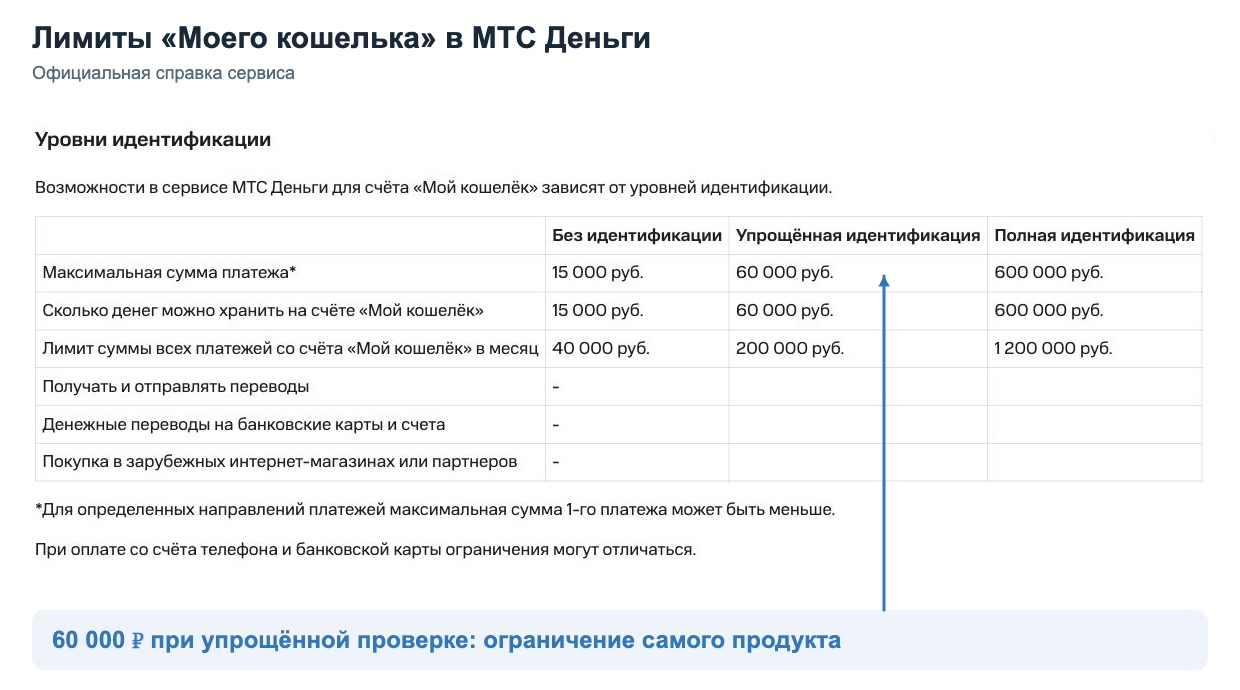
- Initial tier. The help centre lists a balance of up to RUB 15,000 and payments of up to RUB 40,000 a month.
- Simplified verification. The published product cap is RUB 60,000, while the law permits a higher ceiling.
- Full verification. Higher amounts are available. Check the applicable tariff for each transfer.
Why the former Russian QIWI wallet is outside the comparison
QIWI Bank lost its licence on 21 February 2024. Guides listing it alongside operating products without qualification need updating. An old app, familiar brand or top-up page does not establish that the former Russian wallet can still be opened.
How to open a wallet and verify your identity
Registration gives you access to the service. Verification establishes who owns the funds and affects which transactions are available. A basic tier may suffice for a small purchase, while a transfer to another person requires additional information.
Opening a YooMoney wallet
- Open the official site or app and choose wallet registration.
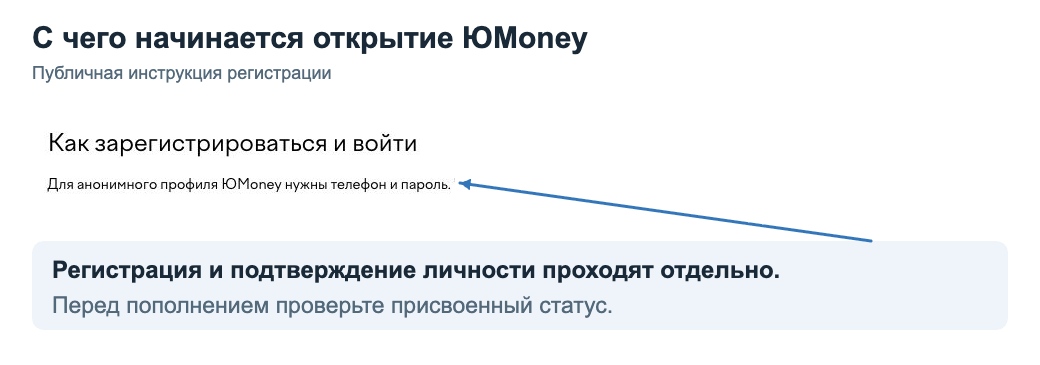
- Enter a phone number you control and complete the confirmation.
- Create a password. An email address is needed for certain actions, including identity verification.
- Check the tier assigned and the list of permitted transactions.
- If a transfer is unavailable, choose a suitable verification method and read the document requirements.
- Confirm that the tier changed after verification, then add the amount you need.
YooMoney's named tier is available to Russian citizens, including through confirmation with Gosuslugi, the government services portal. Foreign citizens can also use full verification, with methods and documents depending on their circumstances.
For MTS Money, check the service's own help for ways to upgrade. The operator may use subscriber information, identity documents or one of its full verification methods. A verified account with another service does not automatically give a new wallet the highest tier.
What to prepare before topping up
Submit documents only through a channel designated by the operator. Someone in a messenger offering to raise a limit for a card payment cannot perform the official identity check. Keep login and transaction codes to yourself, including when someone claims to be from support.
E-wallet limits under the law and service terms
Five different figures can appear in the limits: the balance, one top-up, one payment, the daily total and the calendar-month total. A figure of “100,000” is of little use without context. It may tell you what you can hold while leaving the amount you can withdraw to a card in one transaction unspecified.
| Statutory tier | Main limits for an individual | Practical implications |
|---|---|---|
| No verification | Balance up to RUB 15,000. E-money transfers within the applicable monthly limit of RUB 40,000. | Eligible recipients and methods are restricted. Check whether the specific recipient is allowed. |
| Simplified verification | Up to RUB 100,000 in balance and per transaction, and up to RUB 200,000 in monthly transfers | This is the legal ceiling. Operators can set lower amounts. |
| Full verification | Individual balance up to RUB 600,000 | The product terms still set per-transaction, daily and monthly limits for specific operations |
The Bank of Russia explains that the statutory ceiling for simplified verification rose from RUB 60,000 to RUB 100,000. MTS still publishes a RUB 60,000 limit for its specific wallet. Each figure makes sense when you know whether it refers to the law or the product. Bank of Russia guidance on wallet limits.
YooMoney has another difference between the two limits. The law allows fully verified individuals to hold up to RUB 600,000, while the operator's published standard cap is RUB 500,000. Its help centre lists per-purchase limits of RUB 15,000, 100,000 and 250,000 across the three tiers. These are separate from the balance limit.
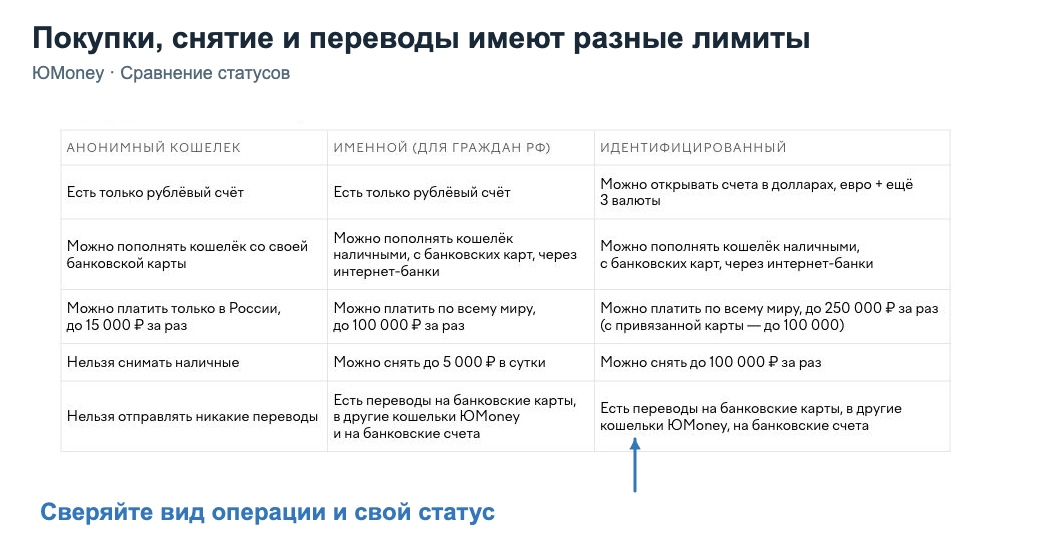
For a standard YooMoney transfer to a card on a Russian payment network, the help centre lists up to RUB 15,000 for a named wallet and RUB 75,000 for a fully verified wallet, including the fee. The overall tier, daily and monthly limits also apply. Use the lowest applicable limit.
A RUB 20,000 balance does not let a named wallet send the full amount in a single card transfer. Splitting the amount still leaves the monthly limit in place. Before a large top-up, check the entire route to the final recipient.
How much does it cost to top up or withdraw?
Fees depend on the transaction and the parties involved. The wallet may offer a free transfer while the sending bank or top-up partner charges a fee. Check the final confirmation screen and the terms of both parties.
YooMoney's published tariffs show no operator fee for outbound SBP transfers to individuals. A standard card transfer costs 3% plus RUB 45. A transfer to an individual's bank account in Russia costs 3% plus RUB 15. Special routes or recipients can have different terms.
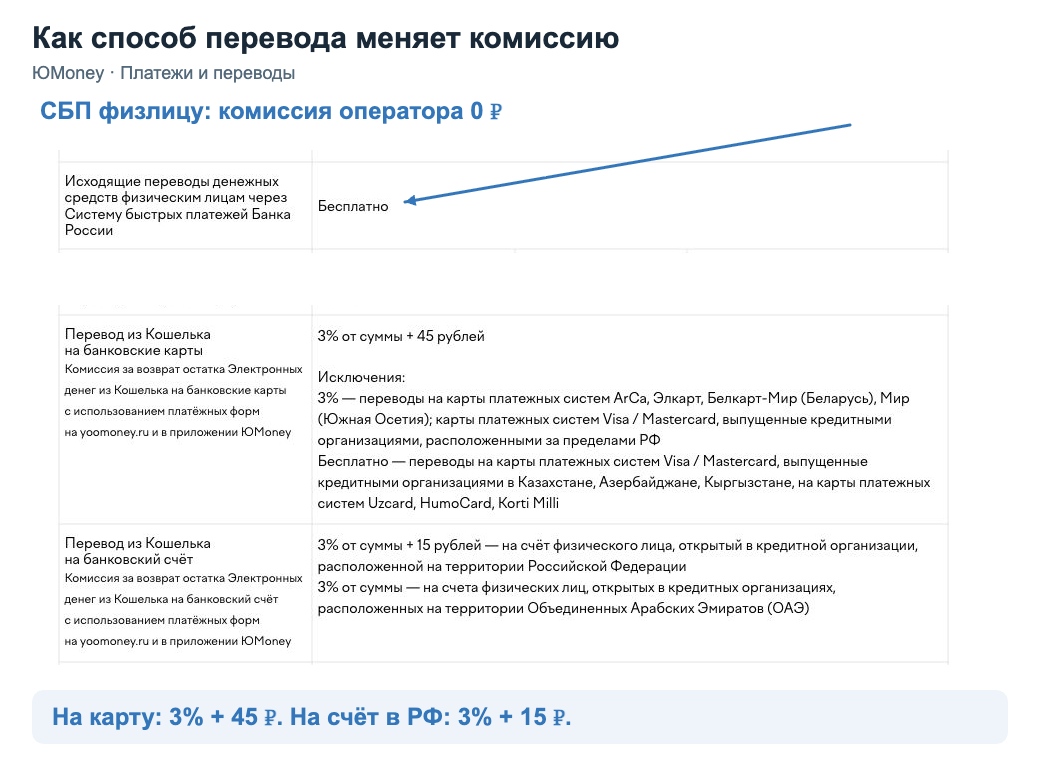
| Amount to recipient | SBP to an individual | Standard card transfer | Transfer to an individual bank account in Russia |
|---|---|---|---|
| RUB 1,000 | No YooMoney fee | RUB 75 = 1,000 × 3% + 45 | RUB 45 = 1,000 × 3% + 15 |
| RUB 10,000 | No YooMoney fee | RUB 345 = 10,000 × 3% + 45 | RUB 315 = 10,000 × 3% + 15 |
This example uses tariffs published when checked in November 2026. It assumes the operation is available at the customer's tier and falls within all limits. If the fee is added to the amount sent, a RUB 1,000 card transfer requires RUB 1,075. The recipient bank's possible charges are excluded.
The fixed charge matters most on smaller amounts. RUB 75 on a RUB 1,000 transfer is 7.5%, so include the additional RUB 45 when you see the 3% rate. Use the same approach for MTS Money. Select the funding source and recipient, then compare the final debit with what is credited.
How to top up and pay for a purchase
YooMoney supports top-ups via SBP, bank card, cash partners and bank transfer details. Check which route the help centre offers for your tier. An anonymous wallet is restricted, and some methods in the general list may be unavailable to you.
- SBP. Check the receiving operator, the name and whether inbound transfers are supported. Anonymous YooMoney wallets cannot send or receive SBP transfers to or from individuals.
- Bank card. Check issuer restrictions and the final fee. Do not save another person's card without their consent.
- Cash. Check the partner's fee and crediting time. Keep the receipt until the funds appear.
- Bank details. Use the current instructions and enter the correct wallet number in the payment reference.
Top-up instructions may list the operator's account. The wallet holder still has no personal bank account for that balance. A mistaken payment reference may require manual tracing, so check the details before reusing an old receipt.
Merchant payments, transfers to friends and loan repayments have different recipients and fees. When repaying a loan, check when the money will reach the lender. See our guide to MCCs and MFCs for the payment breakdown and documents.
For a foreign merchant, confirm the country, recipient, payment method and wallet tier for that route. A general statement about international payments does not guarantee that a specific subscription will work. Crypto transfers and exchanges are not standard features of a rouble wallet.
What to look for in wallet reviews
For an example of customer support, we used a public Banki.ru review of YooMoney dated 5 November 2026. The reviewer asked how to pay in a physical store using the wallet and praised the reply with QR code instructions. The company's 6 November response thanked them and asked for more details.
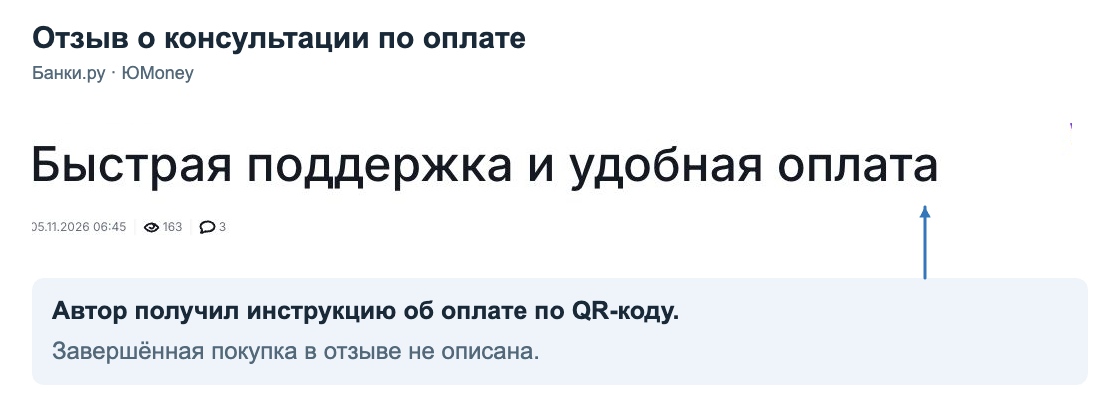
This example concerns one support interaction. The review does not describe a completed purchase, so it cannot establish acceptance at a given store or general support response times. Check the feature you need separately from the company's overall rating.
- Read reviews about the exact product and transfer method you plan to use.
- Distinguish the reviewer's opinion, the confirmed outcome and the company's response.
- Check the tariff even if a user says a transaction was free.
- Keep passport details, full card numbers, codes and wallet credentials private.
What to do if a wallet is restricted or a transfer fails
First identify what is restricted: sign-in, a transaction or access to the balance. The reason could be a used-up limit, a data mismatch, a review under Law No. 115-FZ or anti-fraud measures under Law No. 161-FZ. Each case has its own basis and procedure.
Under Law No. 115-FZ, the operator may request evidence about the source of funds and purpose of the transactions. Submit it through an official channel and keep a copy. For a fraud hold, ask what was suspended and how to confirm the action. Release within one day is not guaranteed.
- Record the restriction message, date, amount and transaction number.
- Check the wallet tier, remaining limit and recipient details.
- Contact the operator and ask for the reason, required documents and review process.
- Keep the response. If you disagree, use the applicable appeal process. You can raise questions about compliance with financial law with the Bank of Russia.
If you discover an unauthorised transaction, report it to the operator immediately and restrict access through the designated channel. Refunds depend on the facts and compliance with notification rules. Submit an official report even if you discuss the issue on a forum.
How e-money insurance changes in February 2027
As of November 2026, electronic wallet holders cannot assume they have the same insurance protection as bank depositors. If an operator loses its licence, recovery depends on the legal treatment of claims and the proceedings involving that entity. Verify the legal entity even when the brand is familiar or part of a major group.
Law No. 317-FZ of 4 August 2026 provides for changes from 1 February 2027. The new scheme covers eligible wallets with full or simplified verification at banks participating in deposit insurance. Anonymous wallets are excluded. Bank of Russia announcement on e-money insurance.
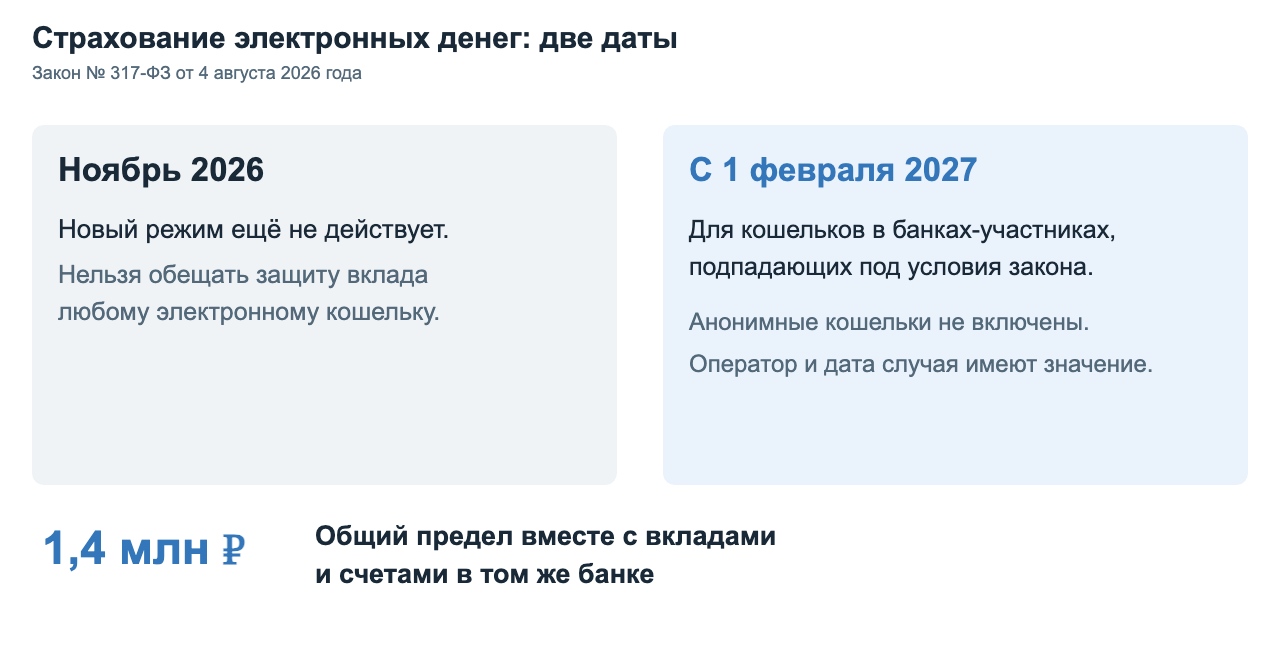
The total RUB 1.4 million limit includes insured deposits and accounts at the same bank. It applies across them and the eligible wallet balance. To assess coverage, check the operator, the payment instrument and the date of the insured event.
The distinction between a bank and a non-bank credit institution matters. YooMoney is operated by YooMoney LLC, a non-bank credit institution. Membership in a banking group alone does not make the wallet an insured bank product. A bank wallet must also satisfy the statutory conditions.
How to choose a wallet for your needs
Start with the operation you expect to use most. For bill payments, check the recipient and cost. For transfers, focus on the supported route, verification tier and monthly limit. If you will use it rarely, check inactivity fees and how to close it.
Questions and answers about electronic wallets
How do I close a wallet and withdraw the balance?
Check the procedure for ending the agreement and recovering e-money. YooMoney's tariff lists free closure through an office or by post, and RUB 20 for closure in the wallet, up to the remaining balance. Check the fee for sending the residual funds separately. Deleting the app does not terminate the agreement.
Can I be charged if I leave a wallet unused?
Yes, if the tariff provides for it. YooMoney publishes a RUB 270 monthly fee after more than two years of inactivity, capped by the available balance. No fee is charged with a zero balance. Check current terms before taking a long break.
What should I do when I change phone numbers?
Update the linked number through the operator, preferably while you still control the old one. If the old number is inaccessible, recovery and identity verification are required. Make sure the new SIM holder cannot reach your funds, and review any recovery methods tied to the old number.
Can a transfer to the wrong person be refunded?
Contact the operator immediately with the transaction number and a description of the error. A completed transfer is not automatically reversible. The procedure depends on the recipient, the transaction stage and the legal basis for a refund. Avoid paying a so-called verification fee to anyone promising to return the money.
Can I accept customer payments into my wallet?
A personal wallet does not give blanket permission to receive business payments. Regular sales require suitable operator terms, proper business registration and tax compliance. Check which product is available for your status and the way you sell.