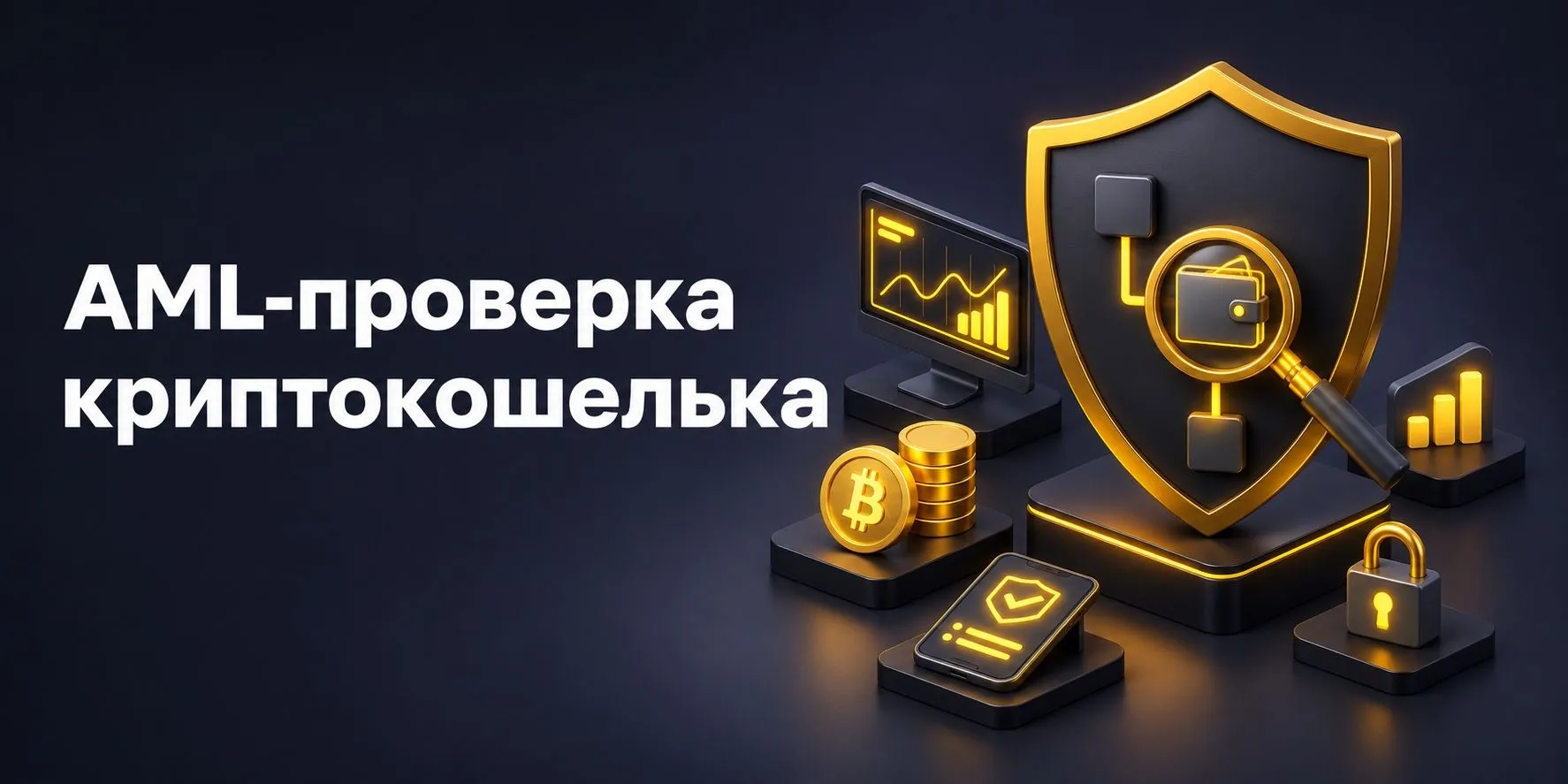
An AML check of a crypto wallet helps assess links between a public address or transfer and sources that an analytics service has flagged for risk. A report may contain counterparty categories, the history of fund movements and an overall rating. Its usefulness depends on what was checked, the data the service used and how clearly it explains its findings.
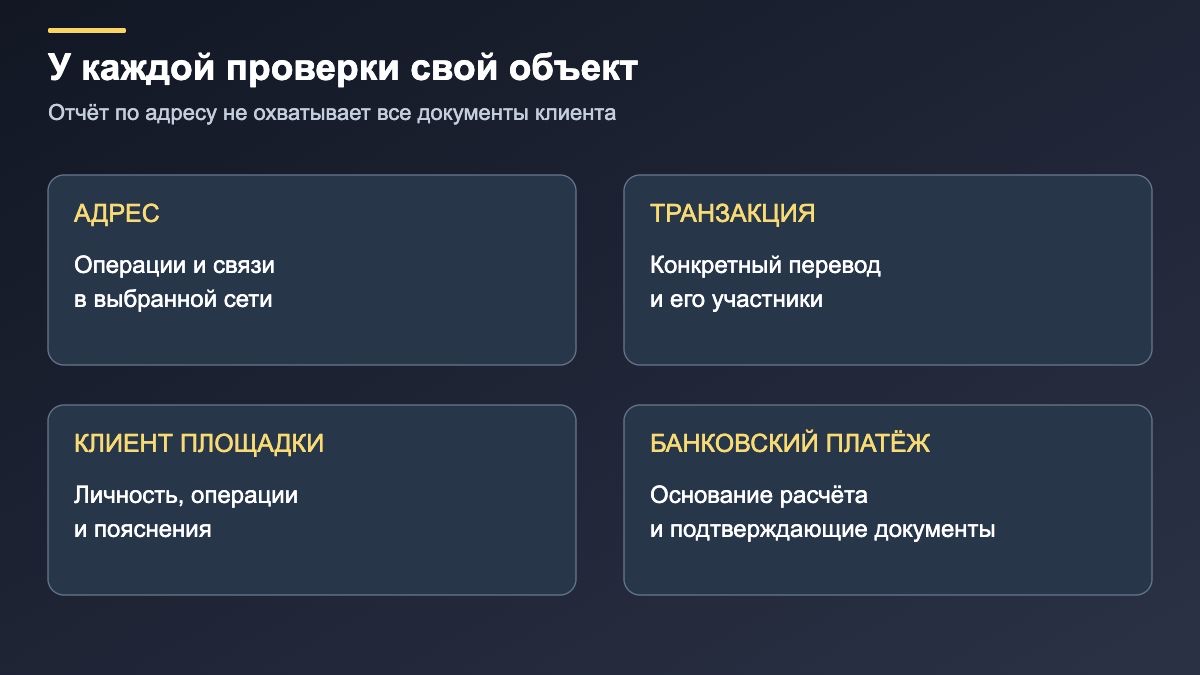
A check can cover an address, a particular USDT transaction or a customer's activity on a platform. A bank, meanwhile, examines movements through an account and documents explaining the source of funds. These checks answer different questions, so one colour-coded indicator cannot replace all the other information.
This guide explains how to read report fields, compare two systems' findings and prepare an enquiry if a transfer is held. The illustrations use a hypothetical example with no real addresses or personal data. The legal section concerns Russian banks; the terms of an individual crypto platform must be checked separately.
- Subject: the network and full address or TXID must match your transaction.
- Basis: a risk label needs a clear category and an explanation of the link detected.
- Timing: the findings reflect the data available when the check was performed.
- Documents: keep records of purchases and payments separately from the blockchain report.
What is being checked: an address, a transaction, a customer or a bank payment?
| Subject | What is examined | What else is needed |
|---|---|---|
| Public address | Transactions and known links on the selected network | Documents identifying the owner and the source of funds |
| Transaction | A specific transfer, its participants and their links | The full history of the parties' dealings |
| Platform customer | Identity, transactions and explanations | More than a colour in a blockchain report |
| Bank transaction | The payment, its purpose and supporting documents | More than a screenshot of a token transfer |
Consider an ordinary USDT purchase. A bank statement records a money transfer, the exchange service's account contains an order, and the blockchain records the token transfer. These are three parts of the same story. A screenshot of a successful transaction confirms an on-chain event, but does not, by itself, explain the parties' agreement or the source of the roubles.
What is a crypto wallet AML check? A plain-language explanation
AML stands for Anti-Money Laundering. In blockchain analytics, address checks are often called wallet screening, while the ongoing observation of activity is part of transaction monitoring. A service compares blockchain records with its own database of known addresses and organisations, then applies assessment rules.
The Chainalysis explanation of wallet screening covers address attribution, exposure assessment and rule configuration separately. This is why a report deserves a closer look beyond its first screen. An overall score may represent different categories and different grounds for further checks.
A public explorer displays the transfer, addresses, token, status and other blockchain data. An analytics platform adds interpretation: for example, it may associate an address with a particular organisation or flag an interaction with an address in its database. Some of this information comes from outside the blockchain. Its completeness and accuracy depend on the sources and methodology.
The search phrase “check whether a wallet is clean” is convenient, but too absolute. Every report has a defined scope and limitations. It can show risk indicators known to the system, but it is not a permanent certificate of origin for all funds and does not replace verification of the owner's identity.
What information is needed to check an address or USDT transfer?
Start by defining the question. To assess a prospective recipient, you need their address on the relevant network. To investigate a transfer already sent, keep its TXID and token details. An address report and a transaction report may return different findings because they analyse different sets of activity.
- Network. Record the full name, such as TRON or Ethereum. The word USDT alone does not identify the network.
- Address. Copy it in full from a verified source. An abbreviated address in a screenshot is useful for recognition, but cannot be used to run the analysis.
- TXID. Use the identifier of the specific transfer concerned. A service's order number may differ from the transaction hash.
- Asset and amount. Check the token, its contract, the direction of the transfer and the quantity.
- Date. Keep both the transaction time and the report generation time, especially when comparing two results.
This information allows the subject to be checked without access to wallet secrets. Analysing a public address does not require your seed phrase, private key or password. If a website offers a “check” that requires you to submit all your recovery words, stop filling out the form.
Our guide to checking a USDT wallet explains how to read balances and transaction status. First establish that the transfer exists on the correct network and relates to your address. Otherwise, even a detailed AML report will be answering the wrong question.
How to read an AML report: fields, labels and links
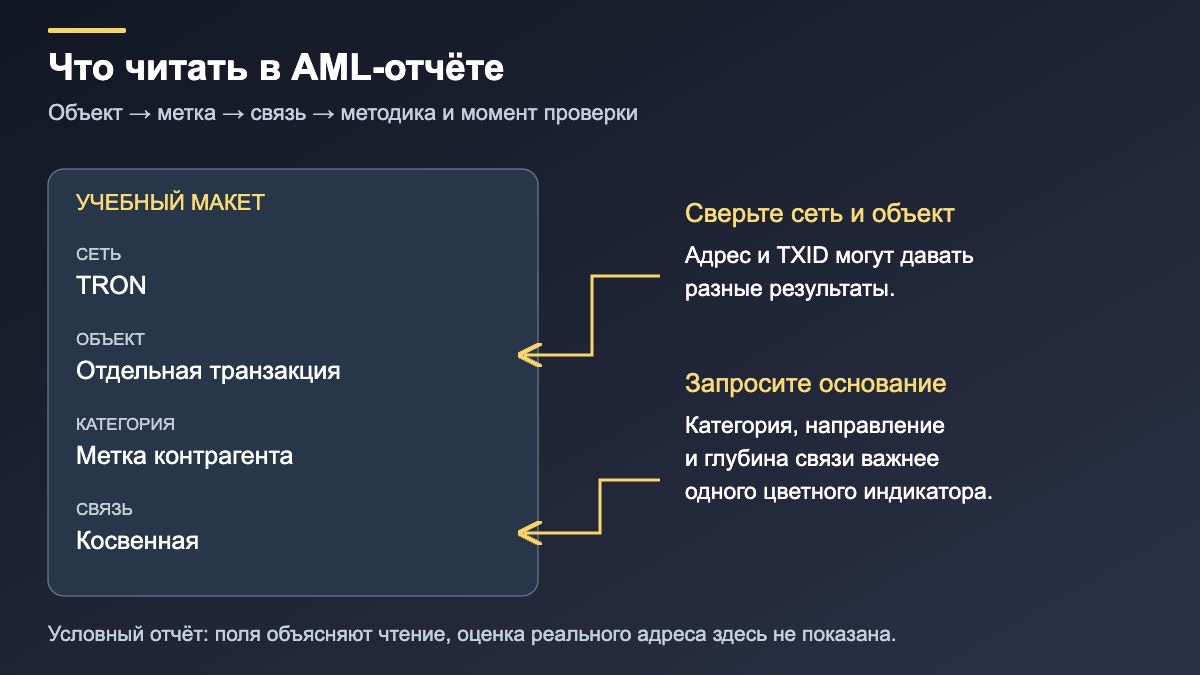
Begin at the top of the document. Find the check type, network, complete subject identifier, date and service name. Then see which transactions were included in the analysis. Without this information, an attractive chart is of limited use when comparing reports or contacting support.
The category and source of a label
The category name indicates how the provider classified an address or associated organisation. Services use different wording and category sets. One system may identify a counterparty's business activity separately, while another places it in a broader group. Translated labels can also obscure differences between two classifications.
Establish what the label applies to: the address being checked, its direct counterparty or an earlier point in the chain. If the interface displays a confidence level, read its definition. Confirmed address ownership and an algorithm's inference need different treatment, even when they appear in similar colours.
Direct and indirect exposure
A direct link means that the data under review shows an immediate interaction with a flagged address. An indirect link passes through intermediate addresses or transactions. To understand the finding, you need the direction, the number of steps along the chain and the method used to attribute funds to it.
Suppose a report indicates indirect exposure through several transfers. That line alone cannot establish that the owner of the checked address personally dealt with the original participant. To discuss the finding, ask which transactions form the chain and how much value has been attributed to it. Do not fill in missing parts of the story yourself.
Risk scores and percentages
The number beside “Risk” may be a score on the provider's own scale. Without a description of the methodology, it should not be interpreted as the probability of a crime. A score of 20 out of 100, for instance, does not automatically mean “a 20% probability of an offence”. That interpretation would require an explicitly stated and substantiated model.
A percentage in a source-of-funds chart also has a particular calculation base: a selected volume, period, or set of incoming or outgoing transactions. It may differ from the overall risk score. Before comparing results, clarify the denominator: what is the percentage a share of, does it cover the whole address, and does it include indirect links?
Why can two AML checks produce different results?
Differences can arise from updates to label databases, supported networks, analysis depth, address clustering rules and client-specific settings. Enterprise services may allow thresholds to be configured to an organisation's internal policy. The same category name therefore does not guarantee the same decision.
| What to compare | Why findings may differ |
|---|---|
| Subject and network | An address and a TXID involve different datasets |
| Time of the check | Databases and information about participants are updated |
| Categories | Similar names may have different meanings |
| Depth of exposure | One system may follow more intermediate steps |
| Scoring model | Category thresholds and weights may differ |
A practical way to compare two reports is to list their input parameters side by side, then compare the facts they found. If the first service examined an address's entire available history and the second checked just one transaction, it is too early to argue about which rating is “correct”. First make sure you are comparing like with like.
New information can also change the assessment of an old transaction. The transfer itself remains in the blockchain history, but the analytics database may acquire a new address attribution or a revised category. A saved report is therefore useful as a record of a particular check, while a later check reflects a different snapshot of the data.
What does low risk mean, and what does it not guarantee?
A low rating describes the selected tool's findings within its data and settings. The receiving platform may use a different source, its own thresholds and additional customer information. It also considers documents, service terms and the circumstances of the transaction.
Conversely, a single label in a commercial report does not establish that an address owner committed an offence. A colour, an abbreviated category name or a screenshot without its underlying data is not enough for that conclusion. In an enquiry, focus on the specific transaction and its origin, and ask for any disputed label to be explained and reviewed.
Be wary of a promise that funds from any address are guaranteed to be accepted in advance. The recipient or service provider makes that decision under its own rules and obligations. A third-party report helps you prepare for questions, but does not entitle you to automatic crediting.
A transfer is on hold: what information should you collect?
Record exactly where the delay occurred. A transaction may be awaiting network confirmation, an exchange may not have credited a confirmed deposit, or a bank may have restricted a particular payment. In your enquiry, describe the status you can observe and the channel through which you received the notice.
- Order: its number, date, exchange direction and agreed terms.
- Payment: the receipt or statement for the relevant transaction, the amount and the parties' payment details.
- Asset purchase: trading history or another document explaining where the funds came from.
- Blockchain: the network, TXID, addresses and transfer amount.
- Correspondence: the review notice, case number and replies from official support.
- Report: a saved file or link identifying the subject, date and provider.
Build a coherent account that can be reconciled by amounts and dates. If some information is missing, say so explicitly and ask what substitute is acceptable. Do not invent a receipt, change a payment's purpose or describe a transaction that never happened. Inconsistencies will only make the review harder.
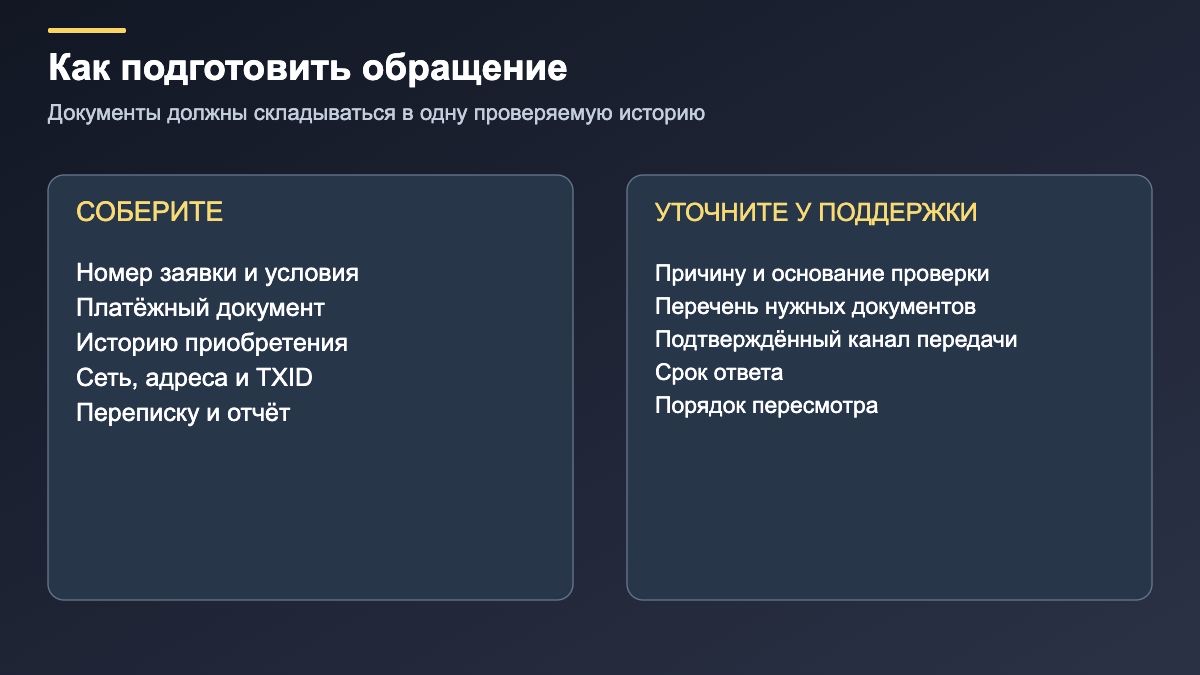
Ask the organisation to specify the reason for the check, the transaction concerned, the missing documents, how to submit them and the response deadline. Also ask about the review procedure if you disagree with the outcome. Send documents through a verified organisational channel and keep the case number.
If the problem arose at an exchange service, also check its website and terms using our guide to checking a crypto exchange service. Monitoring-service listings and complaints are covered in our BestChange review. Contacting a monitoring service does not replace the procedure of the exchange service, bank or competent authority.
AML, Law No. 115-FZ and banking restrictions in Russia
A commercial service's blockchain address check and a Russian bank's decision are separate procedures. The Bank of Russia explains that restrictions can relate both to anti-money-laundering measures under Law No. 115-FZ and to measures against fraudulent transfers under Law No. 161-FZ. The vague phrase “AML block” does not explain the legal basis or the next steps.
The Bank of Russia's guidance on customer enquiries says that banks should clearly explain the restrictions imposed, their legal basis, the transactions still available and ways to resolve the issue. Request these details from your bank first. Do not assume that the appeal procedure for one type of restriction applies to another.
For a refusal to execute a transaction under paragraph 11 of Article 7 of Law No. 115-FZ, the regulator describes an application to the bank for reconsideration, supported by relevant information. Under that procedure, the bank communicates its review outcome no later than seven working days after receiving the application. Further steps depend on the decision received; this guidance was checked in November 2026.
These time limits and procedures cannot automatically be applied to a foreign exchange or any currency-exchange website. Establish the platform's legal entity, applicable terms and official enquiry procedure. For a complex dispute involving a substantial amount, a lawyer can assess the documents and circumstances of the specific case.
AML check FAQ
What should I provide if an internal exchange transfer has no public TXID?
Keep the internal transaction identifier and the details shown in your account. Such a transfer may be recorded in the platform's system without a separate public blockchain entry. Address analytics cannot stand in for a non-existent on-chain transaction; ask the service for details of the internal movement.
Does one report cover every address in my wallet?
Only if the selected check explicitly provides for that. An app may contain multiple addresses and networks, while a report often covers a single submitted subject. Check the list of included addresses and the scope of the analysis.
Do I need to send cryptocurrency to check a public address?
Reading public data does not require a transfer of funds. If the service charges a fee, check its payment terms separately. A demand to send your entire balance to “prove it is clean” is not a normal step in address analysis.
What can I hide in a screenshot before sending it to support?
Ask about the recipient's requirements. A review usually needs the transaction identifier, network, amount and date. Avoid including other customers' data or information unrelated to the enquiry. Never include secret keys, login codes or a recovery phrase in your support materials.
Can an unexpected incoming transfer worsen the overall rating?
Different models treat these events differently. Keep the incoming transaction identifier and explain that you did not initiate it and do not know the sender. An incoming transfer alone does not explain your relationship with its sender; a review needs context.