A cryptocurrency airdrop distributes tokens to users under a project’s rules. Eligibility may depend on an address’s past activity, ownership of a particular asset, participation in an ecosystem or completion of previously announced requirements. In this context, “airdrop” refers specifically to tokens.
Some projects send assets directly to eligible addresses; others ask users to check the conditions and claim their allocation themselves. Participation can require time and network fees. Completed actions do not always establish eligibility, and the number of tokens received does not determine their market value.
This guide explains airdrop formats, the key terms in their rules and how to check a distribution before connecting a wallet. The historical UNI example illustrates the difference between an activity snapshot, eligibility and receiving tokens. We also examine costs, suspicious requests and reasons why an allocation may not appear.
What is an airdrop, and why do projects distribute tokens?
A distribution may help a project attract early users, transfer some voting power to ecosystem participants or reward previous use of a product. The organiser defines its purpose and rules. There is no single set of mandatory conditions shared by every airdrop.
| Format | Basis for distribution | What to establish |
|---|---|---|
| Past use | Transactions or other actions before a specified point | The period, eligible functions and address restrictions |
| Asset holders | Holding a token or NFT at the time of the check | Which asset counts, where it must be held and whether a minimum applies |
| Ecosystem participants | Development, community contributions, liquidity provision or other criteria | What evidence is required and how contributions are assessed |
| Announced tasks | Actions performed under a described programme | Whether they guarantee eligibility, how they are assessed and when the programme ends |
“Retrodrop” is often used for a distribution based on past actions taken before the final conditions were announced. Someone may have used an application without knowing whether a separate reward would follow. It is a common name for this mechanism, not a universal standard.
Some distributions are associated with DeFi applications. That does not mean every operation in such an application will be rewarded. Swaps, transfers and fees incur costs during participation, while the decision to distribute tokens may still be unknown.
Snapshot, eligibility and claim: reading airdrop terms
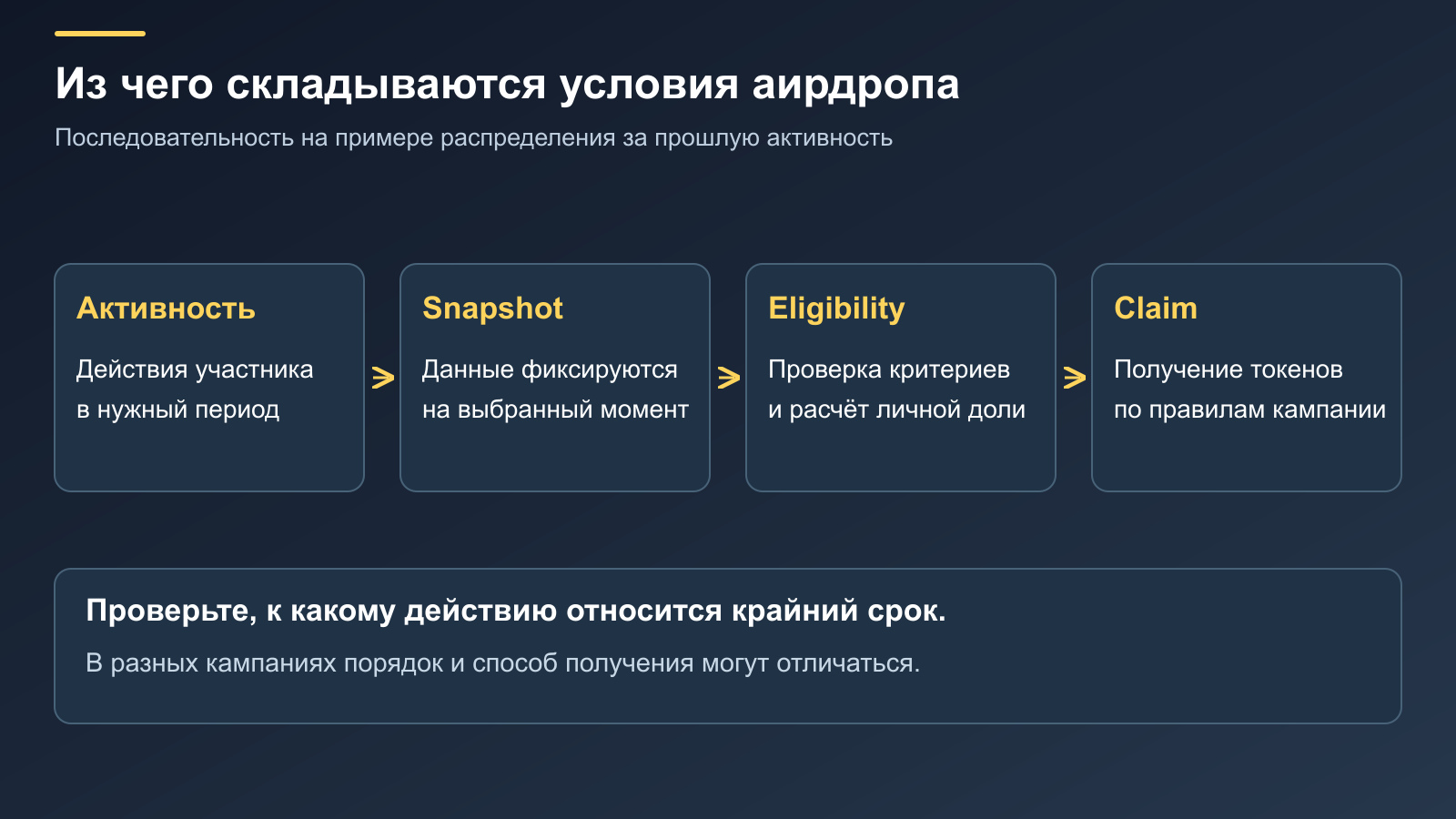
Snapshot: when the data was recorded
A snapshot records the data against which conditions are checked. Documentation may specify a date, time, block number or activity period. Buying the required asset after a past snapshot normally does not change the address’s state at that earlier point. A particular programme may, however, have several periods and additional rules.
The snapshot date, announcement date and start of token claiming can differ. If someone promises eligibility for a historical distribution in exchange for actions today, find an official rule confirming a new period. Simply mentioning a famous old airdrop is not evidence of one.
Eligibility: does an address meet the criteria?
Eligibility means satisfying the requirements. A project may consider transaction types, the period of use, activity levels, deposited assets and other attributes. Meeting one criterion may not be enough: several conditions can apply together.
The check often applies to an address. Accounts within the same wallet application can have different histories and different outcomes. Connecting a different address does not transfer the first address’s activity to it. For an exchange balance, also establish who controls the underlying address and how the platform handles distributions.
Allocation: how many tokens are assigned?
Once eligibility is established, the quantity is determined. It may be the same for a user group or calculated from several parameters. Approval of an address does not explain why it received a particular number of units. That requires the allocation rules and any thresholds.
Claim and deadline: how and when to receive tokens
Claim usually means taking the action needed to receive an allocation. Depending on the mechanism, users may need to submit a transaction, complete a specified procedure or wait for an automatic transfer. Sometimes a portion becomes available later according to a schedule.
A deadline is a specified time limit. Check the date, time, time zone and action to which it applies: checking an address, submitting an application or claiming the tokens themselves. Inclusion on an eligibility list does not guarantee unlimited time to claim. Conversely, a random guide’s failure to mention a date does not mean the official rules have no deadline.
Anti-Sybil checks
Projects may restrict artificial multiplication of participation through numerous linked addresses. These measures are often called anti-Sybil checks. Their criteria, grounds for exclusion and review procedures vary. Creating more wallets does not automatically create a separate entitlement for each one.
The UNI example: finding historical distribution terms
Uniswap’s documentation describes UNI’s initial distribution in September 2020. Historical users and liquidity providers were allocated 15% of the initial issuance, or 150 million UNI. The terms referred to a snapshot taken on 1 September 2020; SOCKS holders were also among the categories mentioned.
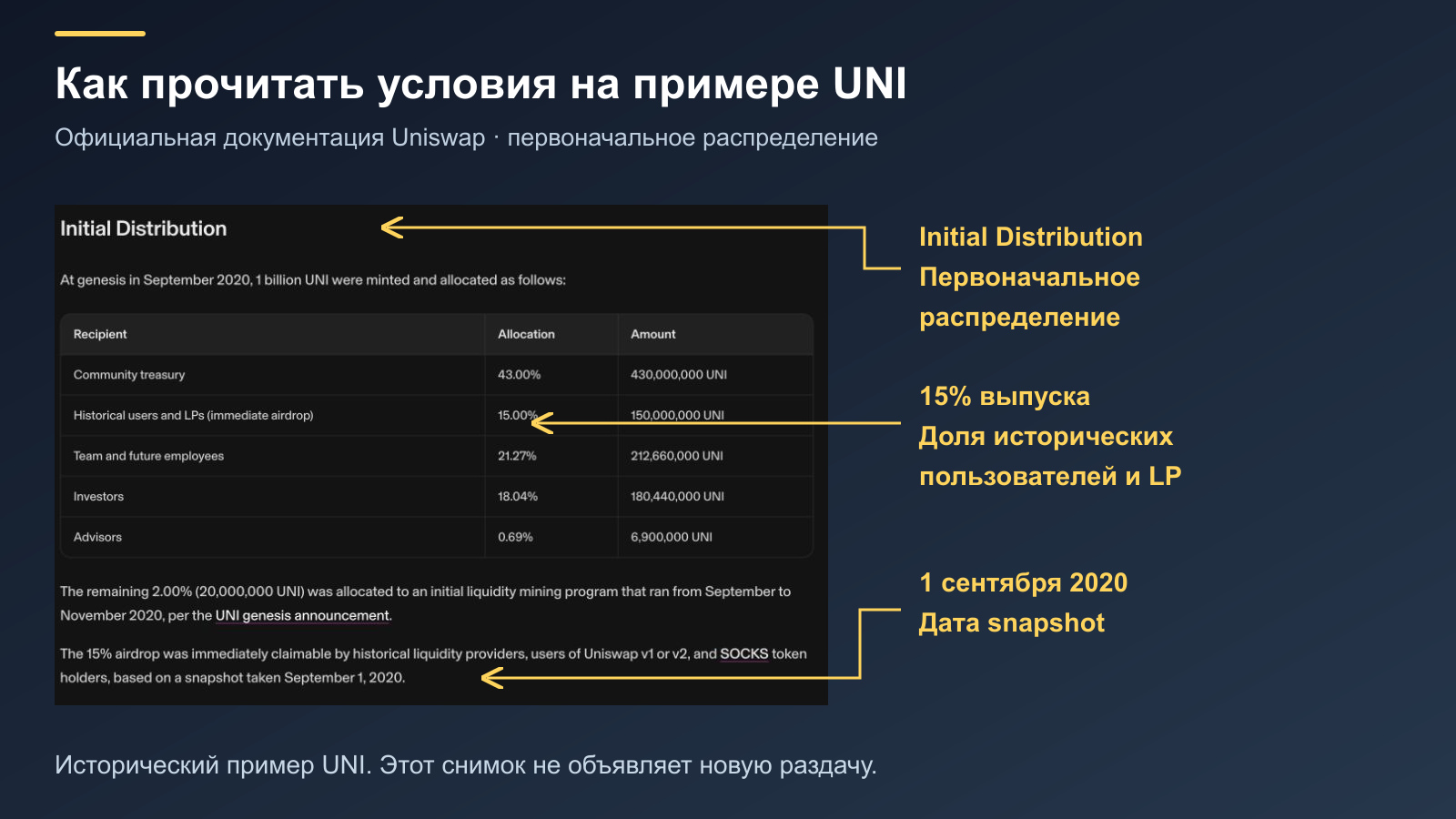
The screenshot highlights three useful details: Initial Distribution refers to the original allocation, Historical users and LPs identifies a recipient category, and the paragraph below names the snapshot date. These details help connect a promise to specific rules and a period. They appear in the official UNI documentation.
This distribution dates to 2020. Transactions made today do not change an address’s history before the snapshot. A new distribution promise requires a separate official announcement.
At the time of writing, Uniswap’s help centre still contains instructions for checking historical claim eligibility through the official interface. The existence of that guidance does not confirm any particular reader’s entitlement or announce a new airdrop. The result depends on the address and applicable conditions; we did not connect user wallets or submit a claim.
Questions to ask when reading any announcement
- Which campaign is this? Establish its name, organiser and connection to the official project.
- Which data counts? Identify the period, network, address and qualifying actions.
- What does the stated number mean? The total distribution, a category’s share and an individual allocation describe different things.
- How are tokens received? Check whether delivery is automatic or requires a claim, which interface is available and whether there is a deadline.
- Which conditions apply now? Compare historical documentation with the current official checking procedure.
How to check an airdrop before participating
Much of the checking can be done before connecting a wallet. Start with the documentation, then proceed to the claim screen. A website’s appearance, follower count and promised token value do not, by themselves, establish that a campaign is genuine.
- Find the original announcement. Open the project’s website and documentation. Confirm that they actually announce a distribution and direct you to the relevant interface.
- Check the domain. Compare the entire address. An extra word, substituted character or different domain suffix may lead to an unrelated page. A secure-connection icon only describes the connection to that domain.
- Identify the network and token. Find the official contract for the stated network. Do not rely solely on the asset’s ticker, name or image.
- Read the eligibility criteria. Note the period, minimum conditions and exclusions. Do not replace the complete rules with a brief social-media summary.
- Check the receipt method. Establish whether a claim is needed, which actions it requires, and whether an availability schedule or final deadline applies.
- Calculate costs. Estimate network fees, possible transfers and other expenses. Do not treat the assumed value of an unknown token as guaranteed income.
- Check participant restrictions. If the programme has country, age, account-type or verification requirements, read them before sharing data or taking paid actions.
Confirming ownership of a public address generally does not require giving a project the ability to restore the entire wallet. Stop if you are asked to enter recovery words. Our seed phrase guide explains what these secrets do and why they should not be shared with an application.
If participation requires a new address, use our crypto wallet setup guide. A new account does not inherit an old address’s history or establish eligibility for a historical distribution.
What a wallet request means when claiming an airdrop
After connection, an application may propose different actions. Their meanings differ even if every website button says “Confirm”. Read the wallet window for each request.
- Connecting an account. The site can see the selected public address and propose requests. Check that the correct account is selected.
- Signing a message. This confirms data on behalf of the address owner. It can be used for login, but may also grant other powers.
- Token approval. This allows a particular address to spend an asset within specified limits. Such a request needs a separate explanation if the stated purpose is merely checking eligibility.
- Claim transaction. This calls the campaign’s contract and may require a fee. Check the network, request destination and expected changes.
A fee-free signature is not necessarily safe. Signed data can sometimes be used later, so the absence of an immediate debit proves little. If an application promised only an eligibility check but the wallet asks for broad powers over existing tokens, stop and investigate the request’s purpose.
Our smart contract guide explains approvals, the account and spender fields, and the difference between reading and changing state. Claiming an airdrop does not require automatically accepting every request a website can generate.
Airdrop costs and restrictions
Assess participation by the actions actually required. Even when tokens are distributed without a sale, users may spend money on network operations or preparing an address. Costs arise before the final outcome is known.
| Cost or condition | When it arises | What to check in advance |
|---|---|---|
| Claim fee | When submitting the claim transaction | The network, fee payer and current wallet estimate |
| Funding network fees | When the eligible address lacks the asset needed to pay fees | Network compatibility, minimums and the sending service’s fee |
| Prior activity | When using the product before distribution | Which actions count and whether any payout has actually been promised |
| Allocation threshold | When calculating an individual share | Minimum criteria and exclusion rules |
| Vesting | When tokens become available gradually | The schedule, the currently available portion and conditions for later claims |
| Organiser restrictions | During participant checks or before claiming | Applicable requirements and the data requested |
Consider an illustrative example: participation required three operations costing $0.80 each and one claim costing $1.60. Total network costs were $4. If a platform also charged a withdrawal fee, add it separately. These figures demonstrate the calculation and are not the tariff of any network.
An allocation of 200 tokens does not yet establish a monetary outcome. Assessing it requires knowing whether the tokens can be claimed and transferred, the available liquidity and an actual execution price.
How to recognise a fake airdrop
A fraudulent page often borrows a familiar name, similar colours and an urgent promise of rewards. Examine its specific demands and whether they correspond to an official campaign.
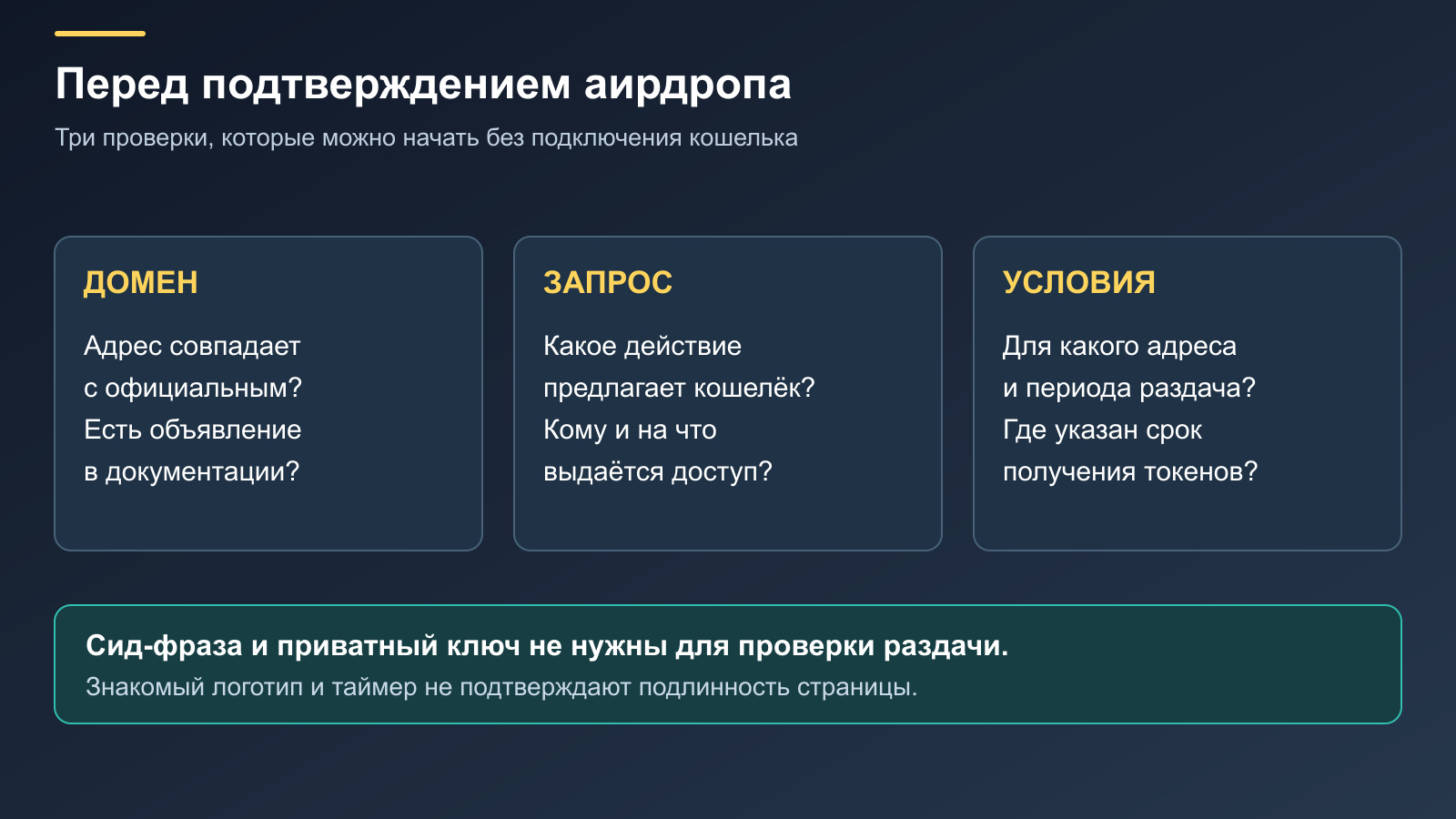
- It asks for a seed phrase or private key. These secrets allow control over assets and are unnecessary for ordinary inspection of public history. Never enter them in an airdrop form.
- It demands coins in exchange for a bigger prize. A promise to return twice as much after a transfer to someone else’s address is a clear reason to stop interacting.
- The domain differs from the official one. Check every character and how you reached the page. Advertising and a familiar icon do not replace verification.
- “Support” contacts you first and pressures you. Find the help channel yourself on the genuine website. Do not continue through a link in a suspicious message.
- The wallet request exceeds the promised action. Permission to spend existing assets needs a clear reason. A label saying “wallet check” does not provide one.
- The terms exist only on the claim page. If documentation and official announcements do not corroborate it, the campaign has not been verified.
- A timer prevents careful reading. Urgency does not remove the need to check. A genuine deadline should be described in the rules, not only in a pop-up.
Uniswap specifically warns about fake giveaways in which criminals impersonate the project and request a transfer or dangerous approval. The mechanism is described in its official giveaway scam guidance.
A network fee alone does not prove fraud. The distinction lies in the action’s purpose: paying the network to process your transaction and sending an arbitrary “prize deposit” to another address need entirely different explanations. Use the wallet’s actual data and the published claim procedure.
If you have already confirmed a suspicious request
Stop signing further requests and establish what was confirmed: a connection, message, approval or transfer. Save the operation’s public details and inspect permissions through established tools for the relevant network. Disconnecting the website alone may not revoke an approval already granted.
If recovery words were disclosed, the keys have been compromised; this is more than a problem with one website. The appropriate steps depend on the available assets and the environment in which the wallet was created. Do not share secrets with anyone promising to “cancel the airdrop”, or pay a recovery fee to details sent in a private message.
What to do if airdrop tokens have not arrived
First identify the stage where the discrepancy arose. A negative eligibility check, an unavailable claim, a failed transaction and an invisible token after a successful claim are different situations.
The address does not qualify
Compare the full address and network with its activity history. Then work through the criteria: period, required functions, minimums and exclusions. If the documentation provides a review procedure, use it. A screenshot of someone else’s allocation does not prove yours was calculated incorrectly.
Eligibility is shown, but claiming is unavailable
Check the start and end of the claim period, the availability schedule and any additional conditions. Make sure you selected the account for which the allocation was calculated. Do not send funds to an outside “activation operator” to enable the button.
The transaction was sent, but no result appeared
Find the transaction hash in the correct network’s explorer. Pending status, execution failure and success require different next steps. Do not repeat a claim blindly when the interface is slow. First establish whether the original request was included in a block and what it did.
The transaction succeeded, but the wallet does not show the token
Compare the recipient address, network and contract with the campaign rules. The application may not have displayed the asset yet, or a different account may be selected. Add a token only using a verified contract. Adding it manually changes the display; it does not create a balance or correct a mistaken transfer.
For a support enquiry, prepare the campaign name, public address, network, problem description and transaction hash, if available. Recovery words, keys and passwords are not necessary attachments. Seek replies through official channels and treat promises to recover any payout critically.
Airdrop FAQ
What does an unknown token that arrived without my involvement mean?
An asset can be sent to a public address without your consent. This does not confirm participation in an official campaign or oblige you to visit a website mentioned in the token’s name. Establish its origin first. An unwanted asset can usually be hidden in the wallet interface without interacting with its contract.
Can I participate with a watch-only wallet?
Watching allows you to view public data and sometimes check an address’s criteria. If claiming requires a signature, you need legitimate access to the corresponding keys or another supported authorisation method. Viewing someone else’s address gives you no right to its allocation.
Why distribute tokens if the application already works?
A distribution can serve separate goals, such as user involvement, transferring voting power or developing an ecosystem. Issuing a token does not, by itself, explain its holder’s rights. Read those in the project’s documents, especially if advertising mentions income, governance or access to features.
Can I decline my token allocation?
If claiming is voluntary, you can choose not to do it. The campaign’s rules determine what happens when a deadline is missed. With automatic transfers, the asset may already be at the address; hiding it in the wallet changes the display, not the network’s record.
Do I need to pay an intermediary to find suitable airdrops?
Official announcements are generally accessible without an intermediary. A third-party list may save time, but it does not authenticate every campaign or guarantee an allocation. Before paying, understand what the service charges for, which commitments are actually stated and whether checking the terms remains your responsibility.