TRC20, also written TRC-20, is a token standard on the TRON blockchain. It is used to issue and transfer fungible digital assets, including USDT. When an exchange offers a “USDT TRC20” withdrawal, it usually means a transfer of Tether tokens over the TRON network.
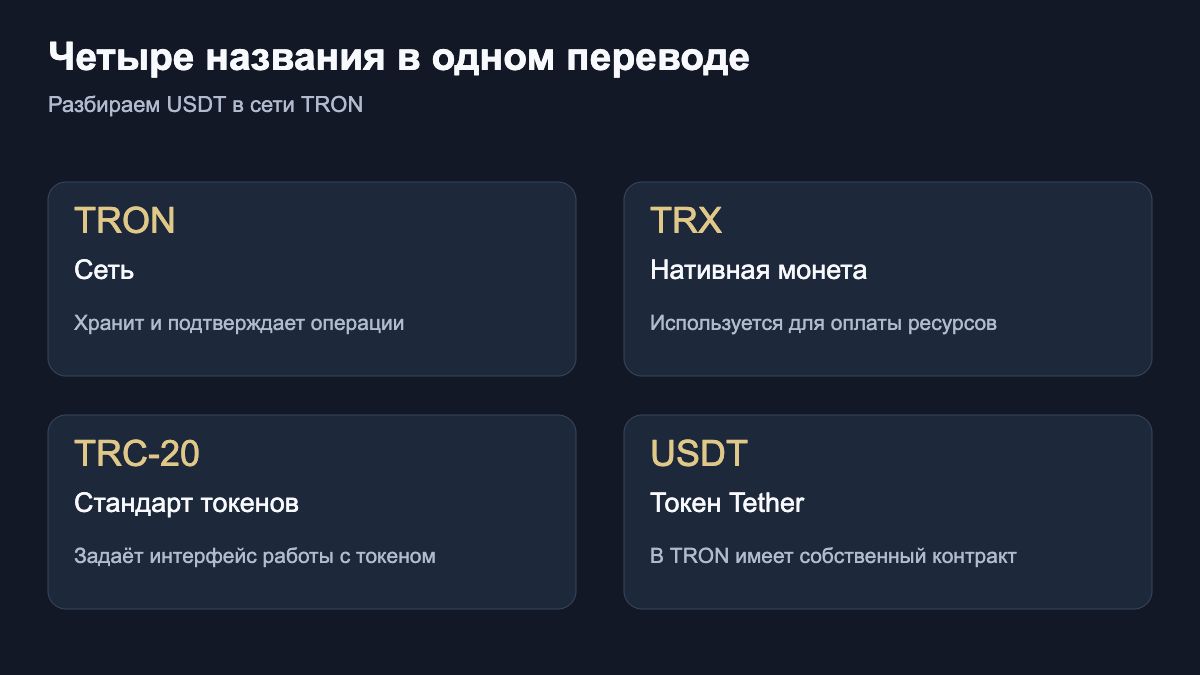
Four names often appear alongside one another in an interface: TRON, TRX, TRC20 and USDT. Each describes a different part of the transaction. We explain which one is the network, how its work is paid for, how to check a token contract and why matching USDT icons on two platforms are not enough to make a transfer.
The documentation and public screens were checked in November 2026. The screenshots show the USDT profile and a completed public transaction. Its resource usage belongs to that particular transaction and does not establish a universal fee for all transfers.
- TRON records transactions and executes smart contracts.
- TRX is the network's native coin and is used, among other things, to pay for resource shortfalls.
- TRC-20 defines the rules for interacting with a token.
- USDT on TRON is issued through a separate Tether contract. To credit a deposit, the recipient must support this particular asset on this network.
TRON, TRX, TRC20 and USDT: what is the difference?
| Name | Meaning | Where to check |
|---|---|---|
| TRON | Blockchain | The network selected for sending and depositing |
| TRX | Native coin | A separate balance and resource calculation |
| TRC-20 | Token standard | The token type in an explorer |
| USDT on TRON | Tether's token on this network | The contract listed by the issuer and in TRONSCAN |
Wallets and exchange services commonly use “TRC20 network” as a short label for a transfer option. Technically, the network is TRON and TRC-20 is a standard. This distinction helps when contacting support: the coin name, network name and transaction identifier describe different things.
What the TRC-20 standard is and how it works
The standard defines functions that let applications read token balances, transfer units and handle spending allowances. A shared interface means a wallet does not need a separate method for every new token. The relevant smart contract maintains the balance records.
When you transfer USDT on TRON, the sender signs a call to the USDT contract. The network executes it, checks the conditions and records the outcome. Transferring TRX and transferring USDT therefore work differently: the latter executes token code, which requires Energy.
How to verify USDT TRC20 by its contract
Open Tether's official list of supported protocols and find the TRON section. At the time of checking, it listed the USDT contract TR7NHqjeKQxGTCi8q8ZY4pL8otSzgjLj6t. Compare the complete address, including letter case, rather than a few recognisable characters.
The link in the official list opens the token profile in TRONSCAN. It includes the name, standard and Contract field. These details connect an asset in an app to a specific contract. Price, holder count and total supply serve other purposes and do not replace this check.
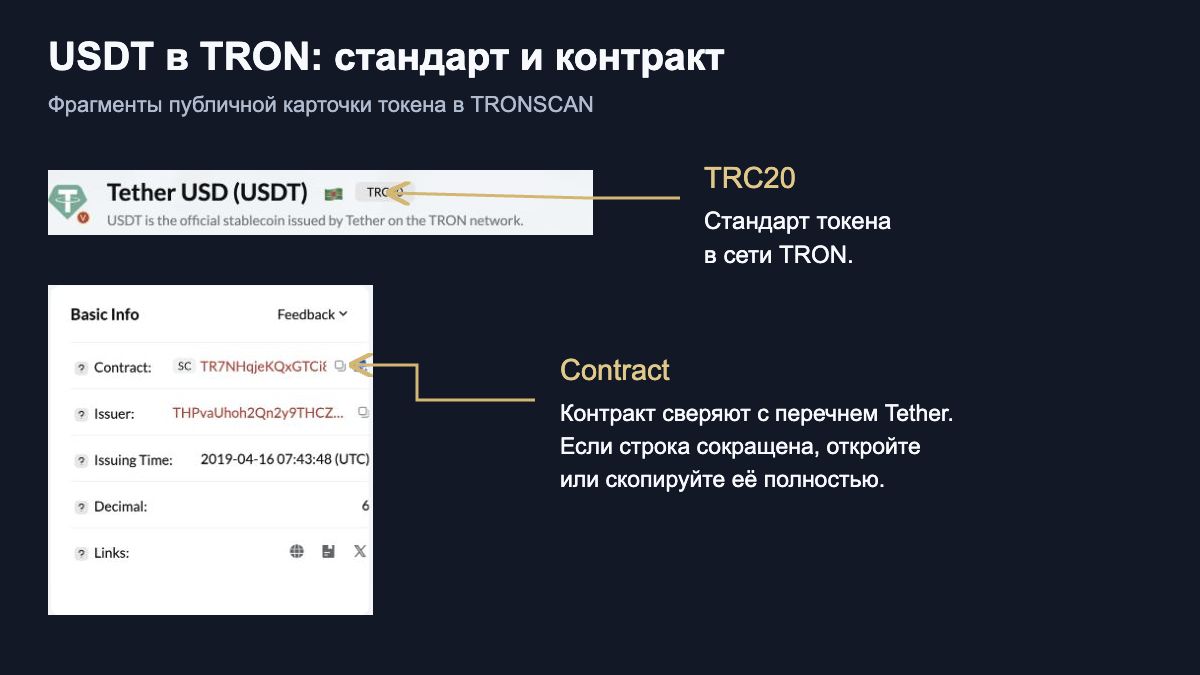
The screenshot marks the standard and the contract's location. If the interface shortens the address, open it in full or copy it with the built-in button and compare it with the original source. Matching only the name Tether USD and the ticker USDT does not rule out a fake token.
The token contract and the recipient address
The contract identifies the token and its rules. The recipient address comes from the deposit section of the intended wallet or service. Do not send funds to the contract shown in this article instead of the deposit address: they are different details.
Ordinary TRON addresses in the familiar user-facing format begin with T. That first letter does not confirm who owns the address, whether the receiving platform supports USDT or whether the deposit method is correct. An address of the correct length can likewise belong to someone entirely different.
Before sending, compare the network at both ends, the selected asset, the complete address and the platform's deposit requirements. Copy the details from the current deposit screen. An old message or an address from an unsolicited incoming transaction does not verify the recipient.
The stablecoin's structure, its issuer and its relationship with the dollar are explained in our article about Tether USDT. Here, the focus is its issuance and use on TRON.
USDT TRC20 fees: why Energy, Bandwidth and TRX matter
TRON has two resources for accounting for data transmission and contract execution. Bandwidth relates to transaction size, while Energy relates to the computation needed to execute a smart contract. A USDT transfer uses both. Available resources and actual consumption are checked separately from the USDT balance.
Resources can be obtained by staking TRX, and they can also be delegated. Bandwidth has a free allowance under the network's rules. Energy has no equivalent general free allowance. When resources are insufficient, payment may require burning TRX from the payer's balance.
Bandwidth and Energy follow different consumption rules. Available Energy can cover part of the computation, with the remainder paid in TRX. For an ordinary transaction, a Bandwidth source must cover its full size; partial balances from different allowances do not always combine. The mechanism is described in the official TRON resource model.
Why there is no single fee for every transfer
Consumption depends on the code executed, the contract's state and network parameters. The sender's available resources and payment rules also determine how much TRX they need. A fixed amount quoted in an old guide may therefore differ from the wallet's estimate.
Before confirming, check the app's current calculation: which asset is being sent, how much the recipient will receive, how the transaction is paid for and whether the available balance is sufficient. Renting Energy adds a separate service with its own price, duration and terms. Include that cost in the total even if the transaction itself burns very little TRX.
An exchange's withdrawal fee versus blockchain costs
An exchange can set its own withdrawal charge, for example deducting it in USDT. This is the service's tariff and does not have to equal the resources consumed by one on-chain transaction. A service may use Energy obtained in advance, manage operations together and change its withdrawal terms.
How to read resource usage in TRONSCAN
In the transaction details, first check Result and Status, then open Resources Consumed & Fee. The expanded section shows Bandwidth and Energy usage and explains how they were covered. Energy Fee Limit may appear nearby: this is the transaction's Energy fee budget limit.
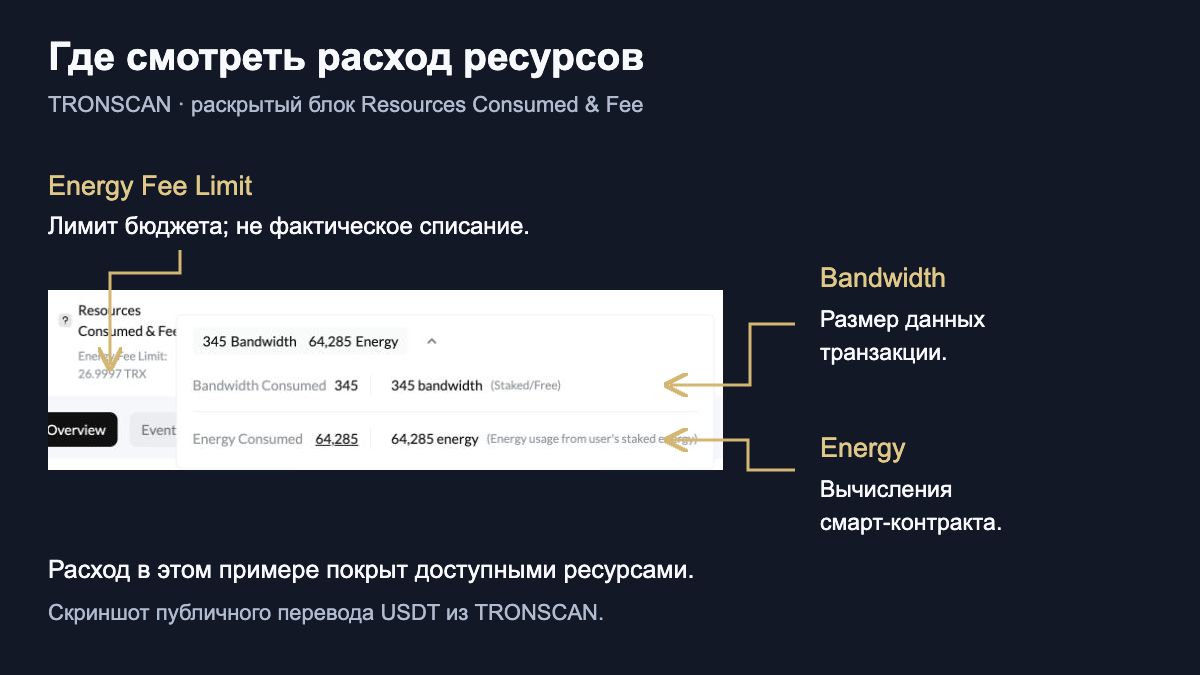
The public 15 USDT transfer shown here used 345 Bandwidth and 64,285 Energy. The expanded lines show consumption of available resources. The figure 26.9997 TRX is the Energy Fee Limit. It must not be recorded as the actual fee charged: a limit and the final payment mean different things.
If a contract execution fails, resources may still have been spent even though the token transfer did not take place. Check the first transaction's result before sending again. Repeating an action merely because a balance update is delayed can create a second successful transfer.
How TRC20 differs from ERC20
Both standards help applications work with fungible tokens. Similar functions simplify development, but they do not merge blockchains. Below, ERC-20 is illustrated using USDT on Ethereum Mainnet. Similar standards and address formats also exist on other networks, so the full network name still matters.
| Feature | USDT TRC20 | USDT ERC20 on Ethereum |
|---|---|---|
| Network | TRON | Ethereum Mainnet |
| Native coin | TRX | ETH |
| Transfer costs | Bandwidth and Energy; TRX may be needed if resources are insufficient | Gas paid in ETH |
| Explorer | TRONSCAN | Etherscan |
| Usual address format | Begins with T | Begins with 0x |
| Exchange deposits | Requires support for USDT on TRON | Requires support for USDT on Ethereum |
A low fee in the network list is of no use if the receiving platform does not accept that option. Check compatibility first, then cost. A successful blockchain record does not by itself require an exchange to credit an asset sent through an unsupported deposit method.
USDT appears in the wallet but cannot be sent: what to check
Start with the wallet's error message. A resource error, an unsupported-network warning and an account restriction call for different actions. Buying more TRX will not fix an incorrect address or a service's withdrawal ban.
- The token. Does its contract match official USDT, and is the balance on the main network?
- Wallet features. Does the wallet support sending USDT on TRON? Can you sign transactions, or is the address open in watch-only mode?
- Resources. Is there enough available Energy, Bandwidth or spendable TRX according to the transaction estimate?
- The address. Is the recipient correct, and is the required account activated where the network and transaction method require it?
- Platform terms. Is there a withdrawal minimum, account review, temporary network suspension or limit?
You can compare apps in the USDT wallet directory. Before depositing, also verify TRON support and sending conditions in the wallet you choose.
Some apps offer fee payment in USDT or transfers through a separate GasFree mechanism. This is a service-specific feature: the address, supported token and payment rules may differ. These terms cannot be assumed to apply to every ordinary TRON wallet. Follow the documentation for the exact feature being used.
For the sending process, see the step-by-step USDT transfer guide. If a transaction has already been submitted, save its TXID, network, address and amount; the checking procedure is covered in our article on verifying a USDT wallet and transaction. Recovery after using the wrong network depends on who controls the address and whether the service supports such a procedure.
TRC20 questions and answers
Why does 15 USDT appear as 15000000 in contract data?
The USDT contract on TRON uses six decimal places. Its technical amount is stored in the smallest units: 15 × 106 = 15,000,000. The user interface usually converts this into the familiar USDT amount automatically.
Is a Memo required for a USDT TRC20 transfer?
A standard USDT transfer on TRON uses the recipient address. If a platform imposes additional deposit requirements, follow its instructions. Do not automatically carry over a Memo requirement from another network.
Does the recipient need TRX to receive an ordinary USDT transfer?
The recipient generally does not need to hold TRX simply to receive an ordinary transfer. Paying to send those funds later is a separate matter. For a new address or special app features, also check the activation and service rules.
Does hiding a token in a wallet remove it from the blockchain?
No. This setting usually changes only the list of displayed assets. The address balance can be checked by network and contract. To see the token again, you may need to enable its display or add the official contract.
Can test USDT be mistaken for a real deposit?
Test tokens are intended for testing. Their name and appearance in an app may resemble real assets, but they do not confirm receipt of USDT on the main network. Always check which network is selected in the explorer.